A Builder’s Guide to ENERGY STAR Certification
For Florida builders and developers, the path to ENERGY STAR certification can often feel like navigating a maze of complex paperwork, rigorous inspections, and unique climate-specific requirements. The fear of a failed inspection causing project delays is real, especially when you may not have the dedicated internal bandwidth to manage the intricate verification process. But achieving this valuable certification doesn't have to be a source of stress.
Successfully completing the ENERGY STAR multifamily verification Florida process is more than just a compliance checkbox; it’s a powerful step toward unlocking significant tax credits, maximizing your property's marketability, and building a legacy of healthier, more resilient homes. This guide was created to demystify the entire journey. We will provide a clear, step-by-step roadmap-from initial design and pre-drywall checks to final testing and certification-so you can proceed with confidence, avoid costly setbacks, and ensure your project earns the trusted blue label it deserves.
Key Takeaways
Understand how ENERGY STAR certification elevates your project beyond code to create high-performance properties that attract modern tenants and enhance asset value.
The verification process begins long before construction; learn the essential checkpoints from design to final certification to avoid costly mistakes.
Master the ENERGY STAR multifamily verification Florida process by learning how to overcome the unique building science challenges posed by our state's hot and humid climate.
See your ENERGY STAR Rater as an essential partner in success, whose role is to guide your project team through program requirements from the very beginning.
Table of Contents
The Business Case: Why Pursue ENERGY STAR for Your Florida Multifamily Project?
Understanding the ENERGY STAR Multifamily New Construction (MFNC) Program
The Business Case: Why Pursue ENERGY STAR for Your Florida Multifamily Project?
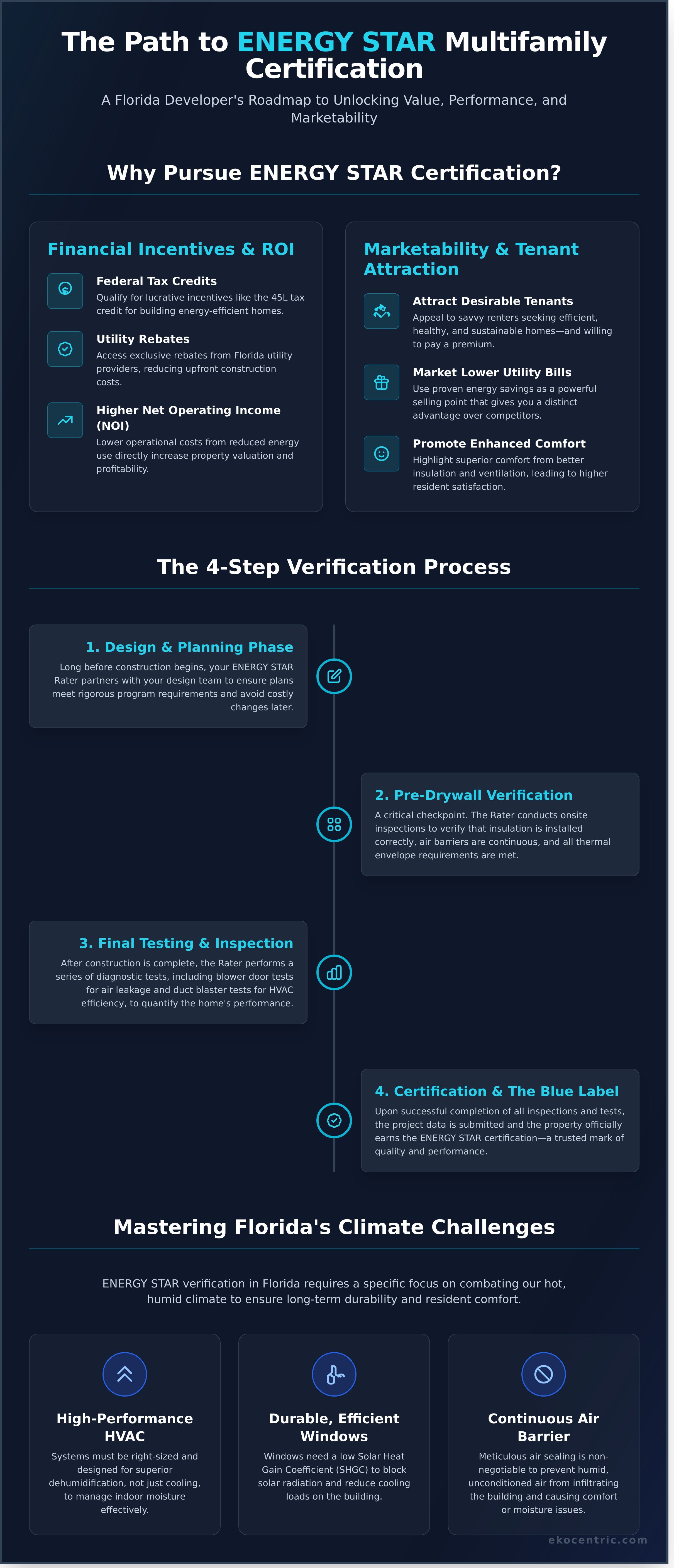
In Florida's competitive real estate market, building to code is simply the baseline. True market leaders understand that pursuing certifications like ENERGY STAR is a strategic business decision that delivers tangible returns. By voluntarily exceeding standard building practices, you create high-performance, resilient properties that are better equipped to handle Florida's climate challenges. This commitment to quality not only future-proofs your asset but also meets the growing tenant demand for healthier, more sustainable, and cost-effective living spaces. The process of ENERGY STAR multifamily verification Florida is an investment in long-term value and market differentiation.
For a clear overview of the program's benefits for multifamily projects, watch this informative video:
Change video
Financial Incentives and ROI
Achieving ENERGY STAR certification unlocks a powerful suite of financial benefits that directly impact your bottom line. It's a pragmatic approach to boosting profitability while building a superior product. Key advantages include:
Federal Tax Credits: Qualify for lucrative incentives like the 45L tax credit, which rewards developers for constructing energy-efficient homes and apartment units.
Utility Rebates: Access exclusive rebates and incentive programs offered by Florida utility providers for verified energy performance, reducing upfront construction costs.
Higher Net Operating Income (NOI): Significantly lower operational costs through reduced energy consumption translate directly to a healthier NOI and increased property valuation.
Green Financing: Certified projects often qualify for preferential loan terms, green bonds, and other financing vehicles from lenders prioritizing sustainable investments.
Marketability and Tenant Attraction
In a crowded rental market, differentiation is key. ENERGY STAR provides a trusted, third-party endorsement of your property's quality and performance. You can leverage the widely recognized ENERGY STAR program logo in all your marketing to build immediate trust and attract a higher caliber of tenant. This certification allows you to:
Attract Desirable Tenants: Appeal to environmentally conscious and financially savvy renters who actively seek out efficient, healthy homes and are often willing to pay a premium.
Offer a Tangible Benefit: Market proven lower utility bills as a powerful and unique selling point, giving you a distinct advantage over competing properties.
Promote Enhanced Comfort: Highlight the superior comfort that comes from better insulation, high-performance windows, and controlled ventilation, leading to higher resident satisfaction and retention.
Understanding the ENERGY STAR Multifamily New Construction (MFNC) Program
The ENERGY STAR Multifamily New Construction (MFNC) program is a national, voluntary initiative by the U.S. Environmental Protection Agency (EPA) that sets a rigorous standard for energy efficiency. Far exceeding minimum building codes, this program provides a clear blueprint for developers and architects committed to building healthier, more resilient, and cost-effective properties. It applies to a range of building types, including apartments, condominiums, and townhouses.
Achieving this certification is not a self-declared process. It requires a partnership with a licensed third-party verifier, known as a HERS Rater. This expert performs inspections, testing, and analysis throughout the construction process to ensure every requirement is met. This rigorous process is the foundation of ENERGY STAR multifamily verification Florida, guaranteeing that the final building delivers on its promise of superior performance.
Key Components of the Florida Program Requirements
In Florida, projects adhere to the national program, currently the ENERGY STAR Multifamily New Construction, Version 1.2. This framework includes specific considerations vital for our state's unique climate. Key requirements focus on high-performance HVAC systems designed for superior dehumidification, durable windows engineered for hurricane resilience, and advanced insulation and air sealing techniques. The Thermal Enclosure System Rater Checklist is a critical tool used to ensure the building envelope is robust, airtight, and ready to withstand Florida's heat, humidity, and storms.
The Three Compliance Paths
The MFNC program offers flexibility through three distinct compliance pathways, allowing project teams to select the approach that best fits their design and goals. While each path leads to the same high standard of efficiency, their methodologies differ.
Prescriptive Path: A straightforward, checklist-based approach where projects must install a pre-defined set of energy-efficient features and equipment.
Performance Path (using HERS Index): This is the most common path for ENERGY STAR multifamily verification Florida projects. It offers significant design flexibility by allowing trade-offs, as long as the building achieves a target HERS Index score.
ERI Path (per IECC): An alternative path based on the Energy Rating Index (ERI) as defined by the International Energy Conservation Code (IECC).
DownloadFeedback & RecreateDelete
The Verification Process: A Step-by-Step Project Timeline
Achieving ENERGY STAR certification is not a final inspection; it's an integrated quality assurance process that begins long before construction. The most common mistake we see is waiting until a project is underway to consider certification requirements. A proactive approach, starting in the design phase, is essential. This collaborative timeline between the architect, builder, and your ENERGY STAR Rater is the blueprint for success, preventing costly rework and ensuring your project stays on schedule. This integrated method is the foundation of a successful ENERGY STAR multifamily verification Florida project.
Phase 1: Design and Pre-Construction
This foundational phase ensures your project is designed for success from the start. Your ENERGY STAR Rater acts as a key sustainability partner, reviewing architectural plans to identify potential issues and opportunities. Through detailed energy modeling, we help your team select the most cost-effective path to compliance. The goal is to create a design that meets all program requirements on paper before a single shovel breaks ground.
Early Engagement: Your Rater joins the team to review plans and specifications.
Energy Modeling: We analyze design choices to determine the optimal compliance strategy.
Finalized Design: The building plans are locked in to meet or exceed ENERGY STAR standards.
Pre-Construction Report: Your build team receives a comprehensive report outlining all requirements and critical details.
Phase 2: Construction and On-Site Inspections
During construction, your Rater provides crucial third-party verification to ensure the high-performance design is executed correctly. We conduct on-site inspections at critical milestones, most notably before the drywall is installed. This allows us to visually verify insulation quality and air sealing details that will soon be concealed. This is also when we perform essential diagnostic tests.
Pre-Drywall Inspection: We verify thermal enclosure details, insulation installation, and air barrier integrity.
Performance Testing: A blower door test measures building envelope airtightness, while a duct blaster test checks for HVAC duct leakage.
Immediate Feedback: Our Rater communicates directly with site supervisors to address any issues in real-time, preventing them from becoming larger problems.
Phase 3: Final Verification and Certification
Once construction is complete, we perform the final verification. This stage confirms that all energy-related systems and features meet the rigorous standards of the ENERGY STAR program. We meticulously collect and review all required documentation from the project team to build a comprehensive certification package. After our final sign-off, the package is submitted, and your building officially earns its mark of superior energy efficiency.
Final Inspection: We verify the proper installation and function of HVAC systems, lighting, and appliances.
Documentation Review: All checklists and required submittals are collected and organized.
EPA Submission: The complete certification package is submitted to the EPA for approval.
Certification Awarded: You receive the official ENERGY STAR certificate-a trusted symbol of quality and performance.
The Role of Your ENERGY STAR Rater: Your Partner in Success
An ENERGY STAR Rater is much more than a final inspector; they are an accredited, third-party verifier and an indispensable member of your project team from day one. Engaging a certified Rater isn't an optional step-it's a foundational requirement for achieving certification. They serve as your expert guide and quality assurance partner, ensuring your project navigates the rigorous program requirements with precision and efficiency. Think of them not as an auditor, but as a dedicated consultant whose primary goal is to help you succeed.
What a Rater Does for Your Project
A Rater’s involvement goes far beyond a simple checklist. From pre-construction planning to final submission, their role is to streamline the process, provide technical expertise, and guarantee compliance. Their hands-on support includes:
Expert Guidance: Providing strategic advice on the most cost-effective ways to meet or exceed ENERGY STAR targets for insulation, HVAC design, and air sealing.
Diagnostic Testing & Inspections: Conducting all mandatory performance tests, including blower door tests for air leakage and duct blaster tests for duct leakage, along with critical pre-drywall inspections.
Proactive Troubleshooting: Identifying potential issues during construction-when they are easiest and cheapest to fix-and working with your trade partners to implement effective solutions.
Certification Management: Handling all the complex paperwork, data entry, and official submissions to the EPA, removing the administrative burden from your team.
Why a Proactive Rater is Crucial in Florida
In Florida's unique climate, a proactive Rater is a non-negotiable asset. Our state presents distinct challenges, from intense humidity and solar heat gain to stringent building codes. An experienced local Rater understands these nuances and knows how to address common failure points in Florida construction before they derail your project timeline and budget.
Successfully navigating the path to ENERGY STAR multifamily verification Florida requires a partner who is both a technical expert and a practical problem-solver. Ekocentric understands that builders don't always have the bandwidth to manage the sustainability side of a project. We provide comprehensive ENERGY STAR Rater services across Florida, acting as that essential layer of management to ensure your project’s success and deliver a significant return on investment.
Common Florida Challenges and How to Overcome Them
Florida's hot and humid climate presents unique building science challenges that can derail a project's performance goals. Successfully achieving ENERGY STAR multifamily verification Florida certification requires a deep understanding of these issues and a commitment to addressing them proactively. The key is adopting a 'house as a system' approach, where every component-from the foundation to the roof-is designed and built to work in harmony. Proper planning and expert execution are not just beneficial; they are critical for success.
Navigating these complexities requires a dedicated strategy focused on the three pillars of high-performance building in our climate.
Achieving Air Tightness Targets
Uncontrolled air leakage is a primary driver of high energy bills and poor indoor air quality in Florida. To pass the mandatory blower door test, teams must focus on sealing the building envelope meticulously. This means addressing all penetrations for plumbing, electrical, and mechanical systems early in the construction phase using durable materials like liquid-applied flashing and high-performance tapes. Paying close attention to the transitions between different materials-such as the wall-to-foundation and wall-to-roof connections-is essential for creating a continuous air barrier.
High-Performance HVAC Design and Duct Sealing
In a humid environment, an HVAC system must do more than just cool the air; it must effectively remove moisture. This begins with right-sizing units based on precise load calculations (Manual J), as oversized systems will short-cycle and fail to dehumidify. Furthermore, all ductwork must be rigorously sealed with mastic-not just tape, which can degrade over time. Any ducts located in unconditioned spaces like attics must be thoroughly insulated to prevent energy loss and condensation. The duct blaster test is a non-negotiable verification step that confirms the integrity of the entire system.
Continuous Insulation and Window Specifications
Radiant heat is a constant battle. Continuous exterior insulation is a powerful strategy to minimize thermal bridging, creating an unbroken thermal barrier that keeps conditioned air in and heat out. Window selection is equally critical. For Florida, specifying windows with a low Solar Heat Gain Coefficient (SHGC) is paramount to reducing the cooling load. Proper installation with integrated flashing is vital to prevent both air and water intrusion. These elements are foundational to a successful energy model and directly impact resident comfort and utility costs.
Successfully navigating these challenges is at the core of the ENERGY STAR multifamily verification Florida process. Partnering with an experienced HERS Rater ensures these critical details are managed effectively, turning potential obstacles into proven performance. For expert guidance on your next project, visit us at ekocentric.com.
From Blueprint to Blue Label: Your Path to ENERGY STAR Success in Florida
Achieving the ENERGY STAR certification for your multifamily project is more than an environmental goal-it's a powerful business strategy that enhances property value, lowers operating costs, and attracts discerning tenants. Success hinges on a proactive approach to the MFNC program and expert navigation of Florida’s unique climate challenges. A smooth and successful ENERGY STAR multifamily verification Florida process, therefore, depends on having a dedicated partner integrated into your team from day one.
At Ekocentric, we provide the specialized expertise and bandwidth your project needs to excel. As certified RESNET HERS Raters with deep experience in Florida's building codes, we act as passionate, pragmatic partners in your success. We help you avoid costly missteps and streamline the path to certification, ensuring your building performs as well as it looks. Let's work together to build healthier, more resilient communities. Partner with Ekocentric to streamline your ENERGY STAR verification. Contact us today.
Frequently Asked Questions
How much does ENERGY STAR multifamily verification cost in Florida?
The cost for ENERGY STAR multifamily verification in Florida is not a one-size-fits-all number; it's a strategic investment tailored to your project's unique scope. Factors like the total number of units, building complexity, and the chosen certification pathway directly influence the final price. At Ekocentric, we provide a transparent, detailed proposal after reviewing your project plans. This ensures you understand the full value and return on investment for achieving this high-performance standard.
How long does the ENERGY STAR certification process take?
The certification timeline aligns with your project's construction schedule, spanning from initial design review to final post-construction testing. Engaging an ENERGY STAR partner like Ekocentric early in the design phase is crucial for a smooth and efficient process. This proactive approach prevents costly revisions and ensures all requirements are integrated seamlessly. The final certification is typically awarded shortly after the final inspections are successfully completed and all documentation is submitted to the EPA.
Can a building be certified for both ENERGY STAR and LEED or other green building programs?
Absolutely. In fact, we highly recommend it. ENERGY STAR certification is a powerful, focused program for energy efficiency that complements broader green building standards like LEED and other regional or national sustainability programs. Achieving ENERGY STAR certification can directly contribute points toward these other programs, making it a strategic and efficient first step. This layered approach demonstrates an unwavering commitment to both energy performance and comprehensive sustainability, maximizing your building's marketability and resilience.
What are the current federal tax credits for ENERGY STAR certified multifamily buildings?
Developers can leverage the 45L Tax Credit for energy-efficient homes. For units certified under the ENERGY STAR Multifamily New Construction program, the credit can be substantial-often starting at $500 per unit. Higher credits, potentially reaching $2,500 per unit, are available for buildings meeting Department of Energy Zero Energy Ready Home (ZERH) program requirements. We guide you through the verification process required to claim these valuable incentives, though we always recommend consulting a tax professional.
What happens if a building fails an inspection during the verification process?
A failed inspection is simply a step in the quality assurance process, not a final verdict. If an issue is identified, our team provides a detailed, actionable report pinpointing the exact deficiency. We then work collaboratively with your construction team to outline the necessary corrective measures. Once the remediation is complete, we perform a re-inspection to verify compliance. Our role is to be your pragmatic partner, ensuring every requirement is met for successful certification.
Do we need an ENERGY STAR Rater if our architect is experienced with green building?
Yes, an accredited ENERGY STAR Rater is mandatory. While an architect's expertise in green design is invaluable, the EPA requires independent, third-party verification to ensure unbiased compliance with program standards. The Rater's role involves specific diagnostic testing, on-site inspections, and energy modeling that fall outside a typical architectural scope. Our certified Raters work alongside your design and build teams to provide this essential, required service for a successful certification.