Florida Live Local Act & HB 1389: Builder Guide

Could a Florida housing project qualify for a Live Local Act pathway and still face feasibility challenges? This guide to Florida's Live Local Act and HB 1389 explains how builders and developers can take advantage of these in Florida by assessing the project’s facts before relying on a potential development pathway. With HB 1389’s amendments effective July 1, 2026, review the current requirements and any transition options before making project decisions.
Before committing time and resources, assess the site, proposed use, development capacity, local processes, and statutory provisions that may apply. Broad summaries can’t replace a project-specific review. Start by identifying which pathways merit consideration, then compare their requirements with authoritative legal sources and the project’s documented facts.
This guide outlines early feasibility steps, the project information that can help clarify potential eligibility, and ways to coordinate legal review with housing objectives, certification, and building-performance goals. LEED BD+C, FGBC, NGBS, and RESNET Home Energy Rating verification can support broader project planning, but they don’t determine legal eligibility. Early coordination helps align objectives, documentation, and verification responsibilities.
Key Takeaways
Understand how Florida's Live Local Act and HB 1389 affect project review, and how builders and developers can take advantage of these in Florida.
Begin feasibility work with the site, proposed use, affordability goals, and project configuration to identify provisions that may warrant closer review.
Verify current statutory language, bill status, effective dates, and applicable local procedures before relying on a potential development pathway.
Separate legal eligibility review from certification planning so each project objective has clear responsibilities and documentation.
Coordinate LEED, FGBC, NGBS, or RESNET Home Energy Rating verification goals early to align certification and building-performance planning.
Table of Contents
What are Florida’s Live Local Act and HB 1389, and what is their current status?
Which Live Local Act provisions may create a development pathway?
How should builders assess HB 1389 alongside the Live Local Act?
What steps should developers take before relying on either law?
How can certification planning strengthen a Florida development strategy?
What are Florida’s Live Local Act and HB 1389, and what is their current status?
Which current provisions could matter to your project? Start by reviewing the site, proposed use, and applicable statutory language. Do not assume that every multifamily or mixed-use development qualifies. Florida’s Live Local Act began as 2023 legislation, Senate Bill 102, intended to address housing affordability and expand opportunities for affordable and workforce housing. The Act’s development pathways have conditions, so project details and current law matter.
HB 1389 is enacted legislation, not merely a proposal. Its amendments to the Live Local Act took effect July 1, 2026, according to current legislative information. Compare the enacted bill with the current Florida Statutes: the bill text, effective date, and codified language each help answer different questions. For broader context on affordability and the Act’s origins, see Housing in Florida. Use primary legal sources when assessing a specific project.
Watch this overview for additional context on the Live Local Act:
What the Live Local Act is intended to address
The Act’s workforce-housing purpose does not create a blanket entitlement for residential development. Eligibility and available pathways depend on the statute’s specific conditions and the project’s characteristics. Relevant details may include use, affordability commitments, site context, and configuration. Check those details against current law before including a potential pathway in project feasibility assumptions.
What HB 1389 changes, and what remains to verify
HB 1389 amended the Live Local Act, and its amendments took effect July 1, 2026. Distinguish enacted provisions from proposals or policy discussions that did not become law. Before relying on a provision, review the final bill text and legislative history alongside the current Florida Statutes and applicable local procedures.
Act: Florida’s affordable and workforce housing legislation, originally enacted through SB 102 in 2023.
Bill: HB 1389 is enacted legislation amending the Act; its amendments took effect July 1, 2026.
Later amendments: Verify subsequent changes separately in the current statute and legislative record.
Assess the Act and HB 1389 separately before considering how their provisions may apply together. Certification and building-performance planning can complement that review, but they don’t establish legal eligibility.
Which Live Local Act provisions may create a development pathway?
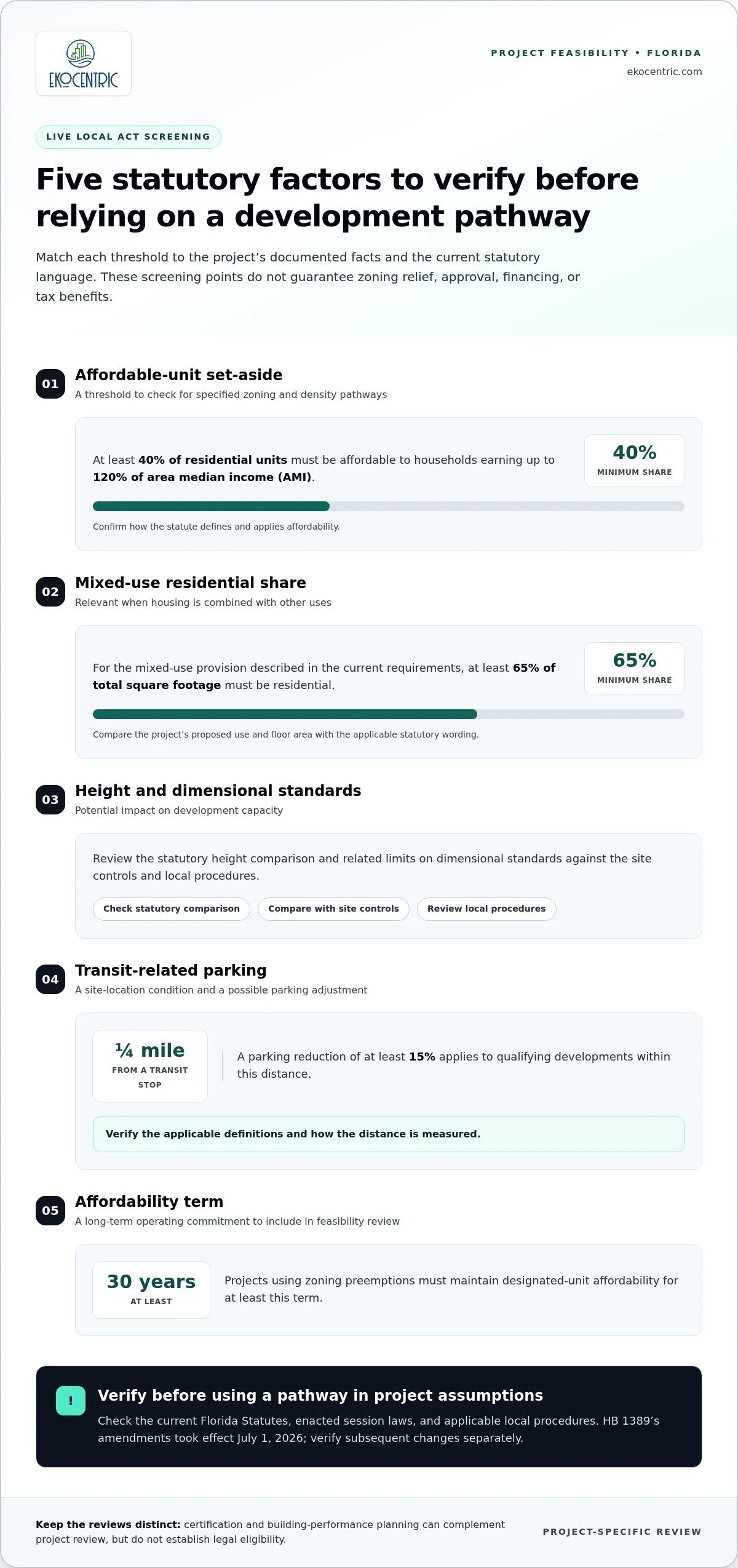
Potential relevance depends on the project’s use, affordability commitments, site context, and configuration. The provisions below are screening points, not a promise of zoning relief, approval, financing, or tax benefits. Match each provision to the current statutory text and project facts before relying on it in underwriting.
Provision to screenPotential relevanceKey condition to verifyPrimary-source referenceAffordable-unit set-asideMay support access to specified zoning and density pathways.At least 40% of residential units must be affordable to households earning up to 120% of area median income (AMI). Confirm how the statute defines and applies affordability.Current Florida Statutes, Live Local Act land-use provisions.Mixed-use residential shareMay matter when a proposal combines housing with other uses.At least 65% of total square footage must be residential for the mixed-use provision described in the current requirements.Current Florida Statutes, applicable Live Local Act provisions.Height and dimensional standardsMay affect development capacity on a qualifying site.Review the statutory height comparison and related limits on dimensional standards against site controls and local procedures.Current Florida Statutes and applicable enacted amendments.Transit-related parkingMay change parking assumptions for a site near transit.A reduction of at least 15% applies to qualifying developments within a quarter-mile of a transit stop. Verify the applicable definitions and measurement.Current Florida Statutes, Live Local Act parking provisions.Affordability termShapes long-term operations and feasibility.Projects using zoning preemptions must maintain designated-unit affordability for at least 30 years.Current Florida Statutes, applicable affordability provisions.
For exact wording, consult the current Florida Statutes and enacted session laws. The Florida Senate’s HB 1389 Full Text is a 2024 bill record. Match the year and bill number carefully, and do not rely on that record alone as authority for later amendments.
Screen the site and project concept
Start with a concise project fact set: proposed use, unit mix, affordability goals, parcel configuration, site controls, transit context, and application stage. Match each item to the precise statutory language. Flag unclear definitions, measurements, or transition questions for legal and local-government review before using them in underwriting assumptions.
Test affordability and feasibility separately
A statutory affordability threshold is only one part of the analysis. Model the unit mix and long-term affordability commitment alongside market feasibility, site constraints, and design decisions. A project may appear to meet one threshold yet still require ordinary approvals or additional local process. Statutory eligibility is not the same as a feasible design or an approved project.
Once project objectives are defined, early certification and performance planning can help organize documentation and verification. Treat green building certification as a complementary workstream, separate from legal eligibility review.
How should builders assess HB 1389 alongside the Live Local Act?
Start with the enacted text, then distinguish what the Live Local Act provides from what HB 1389 amended. HB 1389’s Live Local amendments took effect July 1, 2026, according to current legislative information. That does not mean every amended provision applies to every project or that separate pathways automatically stack. Check the current statutes, applicable session law, and relevant local procedures before adjusting project assumptions.
The Florida Housing Finance Corporation’s Live Local Act Programs page provides a useful state-program reference. It complements, but does not replace, the enacted language and project-specific legal review.
A project-team comparison matrix
LawVerified provisionProject relevanceEvidenceFollow-upLive Local ActProvides statutory pathways related to affordable housing and land use, subject to applicable criteria.May be relevant to a proposed residential or mixed-use project evaluating a qualifying pathway.Current Florida Statutes and applicable session laws.Match use, affordability plan, site facts, and project configuration to the specific provision.HB 1389 amendmentsRevised definitions related to commercial, industrial, and mixed uses apply retroactively to January 1, 2024.Could affect how a site or proposal is classified under an applicable provision.Enacted HB 1389 text and current codified law.Confirm the relevant definition, its application to the project, and any interpretive questions with Florida counsel.HB 1389 transition ruleApplicants with proposals submitted before July 1, 2026, may proceed under the prior law or amend the application under the new provisions.May matter if the project already has a pending proposal.Enacted HB 1389 text and current codified law.Confirm the application’s submission status and document the chosen approach.HB 1389 parcel provisionAllows certain parcels separated by a public pedestrian access of no more than 15 feet to be combined, with the provision extended through July 1, 2030.May matter when parcel configuration affects a project concept.Enacted HB 1389 text and current codified law.Verify the parcel facts, statutory conditions, and local review process.
Avoid assumptions that distort underwriting
Use the matrix as a review tool, not an entitlement forecast. A qualifying provision may help frame the review, but it does not guarantee approval, financing, or a particular development outcome. Flag conflicts, exceptions, and local implementation issues for qualified Florida counsel. Update assumptions when enacted language or authoritative guidance changes.
For Florida's Live Local Act and HB 1389, builders and developers can take advantage of applicable provisions by separating legal eligibility from project delivery goals. Once the legal pathway is defined, green building certification support can help coordinate performance objectives and verification documentation as a complementary workstream.
Live Local and HB 1389
What steps should developers take before relying on either law?
A disciplined review turns broad statutory language into project decisions the team can document and revisit. Before relying on a potential pathway, assemble the project facts, check current legal sources, and distinguish confirmed criteria from assumptions. Answering how builders and developers can take advantage of Florida's Live Local Act and HB 1389 starts with a reliable due-diligence sequence.
A practical due-diligence sequence
Document the project. Record site controls, parcel configuration, proposed use, unit mix, affordability objectives, application status, and anticipated timeline. Note which details are preliminary and who supplied them.
Identify the potential pathway. List the specific Live Local Act provision or HB 1389 amendment the team believes may apply. Do not assume separate provisions automatically combine.
Verify the law. Review the current Florida Statutes, enacted bill text and history, effective dates, and any relevant transition provisions. Record the citation and exact criterion being evaluated.
Check local procedures. Identify the applicable application process, ordinary approvals, and unresolved interpretation or implementation questions. A statutory pathway does not remove the need to understand local review.
Assign decision points. Florida counsel can assess legal eligibility and statutory questions. Planners and architects can evaluate site constraints and the project concept. Lenders can assess underwriting assumptions, while certification consultants can map performance targets, verification steps, and documentation responsibilities.
Document and revisit assumptions. Maintain a decision log with sources, open questions, responsible team members, and review dates. Revisit it before site commitments, financing milestones, and significant design decisions, or when enacted language or authoritative guidance changes.
For example, if a team is relying on a particular affordability mix or site configuration, connect that project fact to the exact statutory language and record any unresolved interpretation. If the connection is uncertain, keep it as an open issue rather than treating it as a settled feasibility assumption.
Coordinate compliance with building performance
Legal review and sustainability planning serve different project objectives. Set performance goals early, then identify the desired certification pathway, verification milestones, and documentation owners. LEED BD+C consulting, FGBC certification consulting, National Green Building Standard Green verification, ENERGY STAR rating, RESNET Home Energy Rating verification, and building-performance testing can be coordinated with project documentation. None substitutes for legal eligibility review.
Florida's Live Local Act and HB 1389 require a coordinated approach: define the legal pathway, then align it with project performance goals. Use green building certification services to plan documentation and verification responsibilities alongside the project’s other workstreams.
How can certification planning strengthen a Florida development strategy?
Certification is a separate project objective, not proof of eligibility under the Live Local Act or HB 1389. Once the legal pathway has been assessed, sustainability and building-performance goals can be incorporated into project delivery. Early coordination helps connect those goals to design decisions, verification scope, documentation, and key milestones rather than leaving certification until the final stages.
Align certification goals with project delivery
The right pathway depends on the project type and its goals. A multifamily team may evaluate LEED BD+C, FGBC certification, or National Green Building Standard (NGBS) Green verification. ENERGY STAR rating or RESNET Home Energy Rating verification may also support a project’s performance objectives. Each option has distinct program requirements, so define the goal before assigning documentation and verification work.
Set up a simple responsibility plan early. Identify who will track program documentation, coordinate verification, and communicate performance requirements across the project team. Tie those tasks to the project schedule and design decisions. For example, a performance target may affect what information needs to be captured during design and construction, so assign responsibility before documentation becomes difficult to recover.
This planning supports consistent delivery, but it does not replace statutory review or guarantee that a project qualifies for a housing pathway. Answering how builders and developers can take advantage of Florida's Live Local Act and HB 1389 means coordinating two distinct workstreams: verify legal criteria, then align certification and performance goals with the project that remains feasible.
Plan the next step with an integrated project team
Carry forward a concise project record: proposed use, site and parcel facts, unit mix, affordability objectives, application stage, relevant statutory provisions, and unresolved legal or local-process questions. Florida counsel can address legal interpretation. The project team can use the resulting direction to set certification objectives, assign documentation owners, and schedule verification milestones.
Ekocentric supports developers with LEED BD+C consulting, LEED Green Rater services, FGBC certification consulting, NGBS Green verification, ENERGY STAR rating, RESNET Home Energy Rating verification, blower door testing, and duct testing. This certification and performance support complements legal review; it does not determine statutory eligibility.
Once statutory review has clarified the project pathway, plan certification and building-performance support to align project objectives, documentation, and verification with the work ahead.
Move from statutory review to stronger project planning
A sound development strategy starts by matching project facts to current statutory language, then documenting eligibility questions and local review steps before relying on a potential pathway. To take advantage of Florida's Live Local Act and HB 1389, treat legal review, project feasibility, and certification planning as connected but distinct workstreams.
Once project objectives are defined, early certification planning can align performance goals, documentation, and verification responsibilities. Ekocentric supports projects through consulting across LEED, FGBC, and NGBS, along with ENERGY STAR rating and RESNET Home Energy Rating verification. Building-performance testing can also inform project goals. Ekocentric is a Licensed Florida Certified Building Contractor, bringing practical building knowledge to this work without substituting for legal eligibility review.
Clear planning can help teams pursue housing objectives while supporting efficient, high-performing buildings. Discuss certification planning for your development with Ekocentric and take the next step toward a well-coordinated project.
Frequently Asked Questions
What is Florida’s Live Local Act, and who may qualify?
Florida’s Live Local Act is legislation intended to support affordable and workforce housing through specified development pathways. A project may qualify only if it meets the criteria for the provision being considered. For example, the zoning and density benefits described in this guide require at least 40% of residential units to be affordable to households earning up to 120% of area median income. Site conditions, use, affordability commitments, and current statutory language all matter.
What does HB 1389 do in Florida, and is it currently in effect?
HB 1389 amended the Live Local Act, and its amendments took effect July 1, 2026. The changes include revised definitions related to commercial, industrial, and mixed uses, which apply retroactively to January 1, 2024. The amendments also address certain pending applications. Because bill summaries can omit important qualifications, review the enacted text, current Florida Statutes, and any relevant transition provision before applying a change to a project.
Can a Florida development use both the Live Local Act and HB 1389?
HB 1389 amends the Live Local Act, so assess the Act together with the changes that apply to the project rather than treating them as two independent benefit programs. The applicable version may depend on project facts and application timing. For example, proposals submitted before July 1, 2026, may have a transition option under the amendments. Confirm whether that rule applies before assuming a project can combine provisions or choose a particular approach.
Does every multifamily project qualify for Live Local Act provisions?
No. A multifamily project does not qualify simply because it includes residential units. Each pathway has specific statutory conditions, which may relate to affordability, use, site context, and project configuration. For certain zoning and density benefits, the development must reserve at least 40% of its residential units as affordable to households earning up to 120% of area median income. Confirm all applicable criteria before incorporating a potential pathway into project assumptions.
How can a builder verify whether a Live Local provision applies to a site?
Begin with documented project facts, including site controls, proposed use, unit mix, affordability objectives, parcel configuration, and application stage. Match each fact to the relevant language in the current Florida Statutes and enacted bill history, including effective dates and transition rules. Record citations and open questions. Then review applicable local procedures and seek qualified Florida legal counsel for unresolved statutory or implementation issues before relying on a projected outcome.
Do Live Local Act provisions guarantee zoning approval or project financing?
No. A statutory pathway does not guarantee zoning approval, other project approvals, or financing. The project must meet the relevant legal criteria, and applicable review processes still matter. Lenders also make their own underwriting decisions. Keep potential development effects separate from confirmed approvals and financing assumptions, and update the project record as legal interpretations, authoritative guidance, or project facts change.
Can green-building certification support a Live Local Act development?
Yes. Certification and building-performance planning can complement housing and compliance work, but neither establishes legal eligibility under the Act. Depending on project type and objectives, teams may consider LEED BD+C, FGBC certification, National Green Building Standard Green verification, ENERGY STAR rating, or RESNET Home Energy Rating verification. Early planning helps assign documentation and verification responsibilities, align performance goals with project milestones, and coordinate certification work with the broader development process.