HERS Index Explained for Builders: A 2026 Guide to Performance and Profit
The HERS Index isn't just another compliance metric; it's the single most important number for your profitability and market position heading into 2026. We get it. Juggling complex energy modeling, rising material costs, and the fast-approaching 2026 Florida building codes can feel overwhelming. Many builders see the HERS Index as just one more hurdle in an already complicated process, another line item that squeezes margins.
This guide changes that perspective by providing a clear, actionable breakdown of the HERS index explained for builders, designed to turn compliance into a competitive advantage. You'll learn exactly how to leverage lower scores to unlock the 45L federal tax credit, streamline green certifications like ENERGY STAR, and build higher-performing homes that command a premium in the market. We'll walk through the rating process, highlight key strategies for improving your scores without breaking the budget, and show you how to market these energy-efficient homes as superior assets to today's savvy buyers.
Key Takeaways
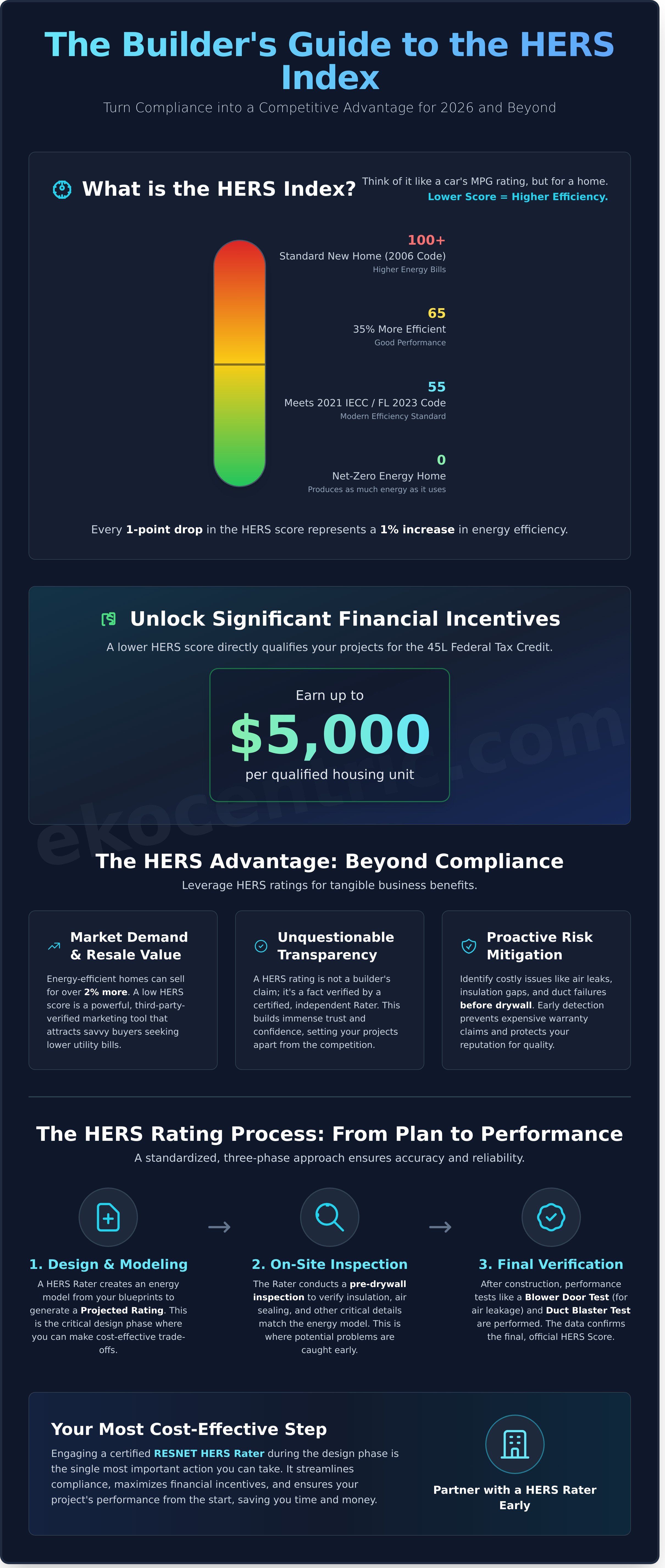
Unlock significant financial incentives by learning how a target HERS score can qualify your projects for the 45L Federal Tax Credit, worth up to $5,000 per unit.
This guide offers a complete HERS index explained for builders, translating the technical scoring system into clear performance benchmarks and marketing advantages.
Discover practical, high-impact strategies for envelope optimization and HVAC selection that go beyond code to dramatically improve your project's energy efficiency.
Understand why engaging a RESNET HERS Rater in the design phase is the most cost-effective step to streamline compliance and maximize your return on investment.
Table of Contents
What is the HERS Index? The 2026 Builder’s Perspective
For forward-thinking builders, the HERS Index is more than just a number; it’s the definitive scorecard for a home's energy performance. The Home Energy Rating System (HERS) provides a nationally recognized, performance-based metric that clearly communicates a home's efficiency. Think of it like a car's MPG rating, but for a house. It provides a clear, apples-to-apples comparison of energy consumption that both builders and buyers can instantly understand. This simple score is revolutionizing how we design, build, and market high-performance homes.
To see how this rating works in practice, this brief video provides an excellent overview.
The HERS scale is designed for clarity. A score of 100 represents a standard home built to the 2006 International Energy Conservation Code (IECC) baseline. From there, every single point drop signifies a 1% improvement in energy efficiency. A home with a HERS score of 65 is 35% more efficient than the reference home. As codes advance, so do the expectations. The 2021 IECC already mandates ERI scores as low as 55 in some climate zones, and Florida's 8th Edition (2023) Building Code embraces the ERI path. The ultimate target for sustainable development is a HERS score of 0. This indicates a Net Zero Energy Home, a building that produces as much renewable energy as it consumes annually. This is the new benchmark.
The Difference Between Code Compliance and HERS
Building codes traditionally offer two paths: prescriptive and performance. The prescriptive path is a simple checklist; you must use R-19 insulation, specific window U-factors, etc. The performance path, where the HERS Index lives via the Energy Rating Index (ERI), sets a target score. This gives you immense design flexibility. You can invest in superior windows or an ultra-efficient HVAC system to offset other building components, achieving compliance through intelligent, cost-effective trade-offs rather than rigid requirements.
Why Builders are Moving Toward HERS-Rated Homes
Many builders and developers simply don't have the bandwidth to navigate this shift alone, which is why a trusted partner is essential. The move toward HERS ratings is driven by clear business advantages that address market demand, transparency, and risk. Getting the HERS index explained for builders is the first step to leveraging these benefits:
Market Demand & Resale Value: Today’s homebuyers are savvy. They seek lower utility bills and healthier living spaces. A 2021 Zillow report confirmed that homes with energy-efficient features can sell for over 2% more. A low HERS score is a powerful marketing tool that proves a home’s superior quality.
Unquestionable Transparency: A HERS rating isn't a builder's claim; it’s a fact. The rating is conducted by a certified, third-party HERS Rater who verifies the home’s performance. This independent verification builds immense trust and confidence with potential buyers, setting your projects apart from the competition.
Proactive Risk Mitigation: A HERS Rater identifies potential problems before they become permanent. Inspections at the pre-drywall stage, including blower door tests, can catch costly air leaks, insulation gaps, and duct failures. Finding these issues early prevents expensive warranty claims and protects your reputation for quality construction.
How the HERS Score is Calculated: Technical Mechanics
The HERS Index isn't an abstract concept; it's the result of a rigorous, standardized process that bridges the gap between design theory and real-world construction. This process is managed from start to finish by a certified RESNET Home Energy Rater (HERS Rater), an independent third-party professional who serves as your project's energy performance accountant. Their role is to verify that the home you build performs as well in reality as it does on paper.
It all begins with a "projected rating" or "as-designed" score. Using your architectural blueprints, the HERS Rater inputs hundreds of data points into accredited software like REM/Rate or Ekotrope. This creates a sophisticated energy model that simulates the home's annual energy consumption. This initial score is a critical benchmark, but it's only a prediction. The final, official score depends entirely on what happens on site.
The transition from a projected rating to a confirmed "as-built" rating is where your team's execution truly matters. The HERS Rater conducts meticulous on-site inspections and performance tests to confirm that the components specified in the plans were installed correctly. A perfect design means nothing if the execution is flawed. This verification process provides a complete HERS index explained for builders: it's a measure of both design intelligence and construction quality.
The Critical Field Tests
During construction, the HERS Rater performs a series of diagnostic tests. A blower door test depressurizes the home to measure air leakage, ensuring the building envelope's integrity. To meet the 2021 IECC, for example, a home must achieve an air tightness of 3.0 air changes per hour (ACH50) or less. A duct blaster test quantifies air leakage in the HVAC system, a common source of significant energy loss. Visual inspections using thermal bypass checklists and insulation grading (Grade I, II, or III) confirm that the thermal barrier is continuous and effective.
Key Variables Influencing the Score
While every component contributes, several key variables carry significant weight in the energy model. Optimizing these interconnected variables is complex, which is why partnering with an experienced HERS Rater from the design phase is a strategic advantage. The most impactful factors include:
Windows and Doors: The U-factor (rate of heat loss) and Solar Heat Gain Coefficient (SHGC) of your windows are critical. Upgrading from a standard U-factor of 0.35 to a high-performance 0.25 can lower a HERS score by 3 to 5 points, depending on the home's window-to-wall ratio.
HVAC Efficiency: The system's SEER2 (Seasonal Energy Efficiency Ratio 2) rating has a direct and powerful impact. Choosing a 16 SEER2 unit over a baseline 14.3 SEER2 system can easily shave another 4 to 6 points off the final score.
Water Heating and Appliances: Often overlooked, these "hidden" points add up. A high-efficiency tankless water heater with a Uniform Energy Factor (UEF) of 0.95 or higher will perform significantly better in the model than a standard tank with a 0.65 UEF. Specifying ENERGY STAR certified appliances also contributes to a lower, more competitive score.
Once all inspections and tests are complete, the HERS Rater finalizes the model with the as-built data. The resulting HERS Certificate is the official document submitted to the building department. It doesn't just show a single number; it provides a detailed breakdown of the home's energy features, proving compliance with energy codes and unlocking access to green building certifications and utility rebates.
DownloadFeedback & RecreateDelete
Financial Incentives: 45L Tax Credits and Certification ROI
A HERS Index score is far more than a simple number on a certificate; it's a strategic asset that unlocks significant financial returns. For builders, understanding the direct line between a low HERS score and profitability is essential. This isn't just about building better homes. It's about building a better bottom line through direct tax credits, streamlined green building certifications, and powerful marketing advantages that resonate with today's buyers.
Maximizing the 45L Tax Credit
The Inflation Reduction Act of 2022 supercharged the 45L Federal Tax Credit, creating a powerful incentive for energy-efficient construction. A certified HERS rating is your key to accessing these funds. For projects completed from 2023 through 2032, builders can claim:
$2,500 per unit for single-family homes that meet the requirements of the ENERGY STAR Single-Family New Homes Program. A HERS Rater's verification is the primary pathway to prove compliance.
$5,000 per unit for single-family homes certified under the DOE Zero Energy Ready Home (ZERH) program. Achieving the low HERS score target is a non-negotiable prerequisite for ZERH certification.
This is a direct, dollar-for-dollar reduction of your federal tax liability, making it one of the most impactful financial tools available. The HERS Index provides the verified, third-party data required to confidently claim these substantial credits, turning your commitment to quality construction into tangible cash flow.
HERS as a Gateway to LEED and NGBS
Many builders see multiple green certifications as a complex administrative burden. The reality is that a HERS rating streamlines the entire process. The comprehensive energy modeling performed to generate a HERS score provides the foundational data required for the most respected green building certifications, including LEED for Homes and the National Green Building Standard (NGBS). This data directly feeds into essential verification processes, like our LEED Green Rater services, eliminating redundant modeling and saving you both time and money. By partnering with a single, certified professional who is both a HERS Rater and a LEED Green Rater, you can drastically reduce administrative overhead and ensure data consistency across your projects.
In Florida, the benefits are even more localized. A low HERS score directly contributes points toward certification with the Florida Green Building Coalition (FGBC). Within the FGBC Homes Standard, the "Energy" category awards a significant number of points for achieving HERS scores that are progressively better than the reference home, accelerating your path to certification and local recognition.
Beyond your own balance sheet, a strong HERS score delivers a direct financial advantage to your homebuyers. Lenders are increasingly offering Energy Efficient Mortgages (EEMs), or "Green Mortgages," for homes with verified energy performance. Because a low HERS score proves lower monthly utility costs, lenders like Fannie Mae recognize that the homeowner has more disposable income and a lower risk of default. This can enable buyers to qualify for a larger loan or secure a more favorable interest rate, making your properties more attractive and easier to sell. When the HERS index explained for builders includes these market advantages, its value becomes undeniable.
Practical Strategies to Lower Your Project’s HERS Index
Achieving a low HERS Index score isn't about checking boxes; it's about a holistic design and construction philosophy. A low score translates directly into a more marketable, resilient, and valuable property. For builders committed to leading the market, mastering these strategies is essential. It begins by shifting focus from isolated components to integrated, high-performance systems where every decision impacts the final energy model.
The building envelope is your first and most critical line of defense. Moving beyond simply meeting code-minimum R-values is the first step. True performance comes from creating a continuous, uninterrupted thermal and air barrier. This means meticulous air sealing at every penetration, joint, and transition. According to the U.S. Department of Energy, air leakage can account for 25% to 40% of the energy used for heating and cooling a typical home. Eliminating that waste provides a massive return in HERS score reduction.
High-Impact Envelope Upgrades
In Florida’s hot, humid climate, your insulation strategy is paramount. While open-cell spray foam offers excellent air sealing, exterior rigid foam provides a continuous thermal break, effectively mitigating thermal bridging through wood or steel studs. For maximum impact, insist on a RESNET Grade 1 insulation installation. This meticulous standard, free of gaps and compression, can improve thermal performance by up to 30% over a typical Grade 3 installation using the exact same materials.
Smart Mechanical and Lighting Choices
High-efficiency heat pump water heaters (HPWHs) are a game-changer, using 60% less energy on average than standard electric models. While tankless gas offers on-demand hot water, the all-electric HPWH pairs perfectly with solar PV for ultimate efficiency. Don’t overlook the simple wins: a complete ENERGY STAR appliance package and 100% LED lighting are low-cost, high-impact choices that HERS raters reward. Smart thermostats add another layer of verifiable efficiency.
Advanced HVAC systems are central to a low HERS score. High-efficiency heat pumps with a SEER2 rating of 16 or higher are the new standard for energy-conscious builds. In an airtight home, you must also mechanically manage air quality. An Energy Recovery Ventilator (ERV) is the solution. It exhausts stale indoor air while transferring thermal energy to the fresh, incoming air, preserving your heating and cooling efforts and ensuring a healthier living environment without an energy penalty.
Finally, integrating renewable energy is the most direct path to a single-digit HERS score. A properly sized solar PV array can offset a home’s entire energy consumption, pushing its score toward Net-Zero. This not only dramatically improves the HERS Index but also positively impacts the HERSH2O score by providing clean energy for electric water heating. A comprehensive HERS index explained for builders must include these actionable steps. The key is ensuring your subcontractors understand their role. From the framer to the electrician, every trade must be trained on how their work contributes to the home’s performance. One poorly sealed window can compromise the entire envelope. Let our certified HERS Raters guide your next project to a lower score and higher value. Partner with Ekocentric today.
Partnering with a RESNET HERS Rater for Project Success
Understanding the HERS Index is the first step. Translating that knowledge into a successful, profitable, and sustainable project requires a strategic partnership. A certified RESNET HERS Rater isn’t just a third-party inspector who shows up at the end of a project; they are a crucial consultant who can unlock significant value when engaged correctly. The most common mistake builders make is waiting until construction is underway. The single most cost-effective time to involve a HERS Rater is during the initial design phase, before a single shovel hits the ground.
Engaging a rater early transforms the HERS process from a simple compliance check into a powerful design tool. It allows you to model the energy performance of your project and make informed decisions that optimize costs, performance, and marketability from day one. This proactive approach is fundamental to building high-performance homes efficiently.
The Rater as a Design Partner
In pre-construction, HERS modeling software becomes a sandbox for optimization. Your rater can run "what-if" scenarios, providing hard data on how specific changes affect the final score. For example, you can precisely compare the impact of upgrading from R-38 to R-49 attic insulation versus investing in windows with a lower Solar Heat Gain Coefficient (SHGC). This analysis uncovers cost-neutral trade-offs, allowing you to hit target scores without inflating budgets. Many builders don't have the bandwidth to oversee these details, which is where we provide that additional layer of management to keep your sustainability goals on track.
Florida Expertise Matters
In a unique climate like Florida, local expertise is non-negotiable. A rater from another region won't fully grasp the immense impact of humidity and solar heat gain on a home's cooling load. A Florida-based rater understands how to model for our specific challenges and provides solutions that work. They are also deeply familiar with the Florida Building Code, Energy Conservation (8th Edition) and the nuances of local green building standards, especially those from the Florida Green Building Coalition (FGBC). This expertise ensures a smoother path to both compliance and certification.
Ultimately, a successful partnership with a rater closes the loop on your project. It moves from initial modeling and inspections to final certification. This tangible proof of performance-the certified HERS Index Score-becomes a powerful marketing asset, clearly communicating the quality, comfort, and long-term value you’ve built into the home. Once the HERS index explained for builders is put into practice, the focus shifts from just achieving a score to building a comprehensive green building strategy.
At Ekocentric, we integrate HERS ratings seamlessly into broader sustainability goals, including certifications like:
LEED for Homes
National Green Building Standard (NGBS)
ENERGY STAR
FGBC Green Home Certification
This "one-stop" approach ensures that your project not only meets energy code but also stands out as a leader in resilience and sustainable design, creating healthier spaces and a healthier planet.
Turn Your HERS Score into a High-Performance Asset
As 2026 approaches, the HERS Index is no longer just a compliance metric; it's a powerful tool for profit and performance. This guide to the HERS index explained for builders has shown two critical facts: a low HERS score directly translates to higher market value, and it unlocks significant financial returns through programs like the 45L tax credit, offering up to $5,000 per qualified unit. Achieving these scores requires a strategic, data-driven approach from the very start of your project.
You don’t have to navigate these technical requirements alone. Our team of Certified RESNET HERS Raters brings deep expertise in LEED, FGBC, and NGBS standards, along with specialized knowledge of the Florida market, to every project. We understand you don't always have the bandwidth to manage the sustainability side of a project. Partner with Ekocentric for your HERS Rating and Green Certification needs and let us handle the complexities for you.
Building a more resilient, energy-efficient future is a powerful business strategy. Let's build that future together.
Frequently Asked Questions
What is a good HERS Index score for a new home in 2026?
A good HERS Index score for a new home in 2026 will likely be in the low 50s or even the 40s. As building codes like the 2024 IECC push for greater efficiency, the baseline for high performance is dropping. For reference, a home built to the 2021 IECC standard scores around 60. Achieving a score between 45 and 55 demonstrates a significant commitment to energy efficiency that exceeds current code and appeals to savvy homebuyers.
How much does a HERS rating cost for a typical residential project?
A HERS rating for a single-family home typically costs between $800 and $1,500. This price depends on factors like the home's size, design complexity, and your location. For builders working on multi-home developments with repetitive floor plans, rating providers often offer volume-based pricing that can lower the per-unit cost. This investment covers the initial plan review, two mandatory site inspections, and all diagnostic testing required for the final certified report.
Can a HERS rating help me qualify for the 45L tax credit?
Yes, a HERS rating is an essential step to qualify for the 45L tax credit. To claim the $2,500 credit, your home must meet the requirements of an ENERGY STAR Residential New Construction program, which mandates a HERS rating. For the higher $5,000 credit, the home must be certified under the DOE Zero Energy Ready Home program. A certified RESNET HERS Rater must perform the verification for both tiers of this valuable federal incentive.
How long does the HERS rating process take from start to finish?
The entire HERS rating process spans the full duration of your construction project. It begins before you break ground with a pre-construction plan review to model the home’s projected performance. This is followed by a mid-construction inspection before drywall is installed and a final inspection after completion. This final visit includes critical diagnostic tests, and you'll typically receive your certified report within 5 to 10 business days after this last inspection.
What is the difference between a HERS Index and an Energy Star rating?
The HERS Index is a numerical score, while ENERGY STAR is a government-backed certification that uses the HERS Index as its core energy metric. Think of the HERS Index as the specific "miles per gallon" rating for a home's efficiency. To earn the ENERGY STAR label, a home must first achieve a target HERS score, which varies by climate zone, and then pass a series of comprehensive checklists for features like water management and HVAC quality.
Does a HERS score include the impact of solar panels?
Yes, the HERS Index accounts for the impact of solar panels by providing two distinct scores. The primary HERS Index rates the home's inherent energy efficiency without renewables. A second rating, the Net HERS Index, is then calculated to show the home's performance with on-site power generation. When the HERS index explained for builders includes this detail, it shows how you can market both the home's efficiency and its potential to be a net-zero energy building.
Is a HERS rating mandatory for all new construction in Florida?
No, a HERS rating isn't strictly mandatory for every new home in Florida, but it's the most common path for energy code compliance. The Florida Building Code's 8th Edition (2023) allows builders to use the Energy Rating Index (ERI) compliance path, which requires a HERS rating. To comply using this method, a new home must achieve a HERS Index score of 58 or lower. It's a practical and streamlined way to meet state requirements.
How do I find a certified RESNET HERS Rater for my development?
You can find a certified RESNET HERS Rater for your project by using the official directory on the RESNET website. This national database allows you to search for qualified rating companies and individual professionals in your specific area. Using a certified rater from this directory is crucial, as it ensures your project's rating is valid for code compliance, utility rebates, and federal programs like the 45L tax credit.