Florida Green Building Incentives: A Complete Guide for 2026
For many Florida builders, architects, and developers, the path to sustainable construction is paved with questions. You're committed to creating energy-efficient, resilient buildings, but the complex landscape of certifications, slow permitting, and uncertainty about financial returns can be a significant roadblock. The good news is that a robust framework of green building incentives Florida offers can transform these challenges into a powerful competitive advantage. The key is knowing where to look and how to connect certifications like LEED and FGBC to the rewards they unlock-from substantial tax credits to invaluable permit fast-tracking.
This complete guide for 2026 is your solution. We cut through the complexity to provide a clear, comprehensive roadmap. Inside, you will discover a categorized list of all available incentives, understand precisely how to qualify, and learn a step-by-step process to successfully apply and maximize your return on investment. It's time to build a greener future for Florida and ensure your projects are as profitable as they are sustainable.
Key Takeaways
Explore the full spectrum of green building incentives Florida provides, moving beyond simple rebates to include tax credits and permit fast-tracking that reduce project costs.
Learn why third-party certification is the essential key that unlocks access to the most significant and financially rewarding state and local programs.
Compare the two dominant standards, FGBC and LEED, to strategically select the certification that best aligns with your project's budget and sustainability goals.
Follow a clear roadmap to navigate the application process, simplifying the steps required to successfully secure your project’s financial rewards.
Table of Contents
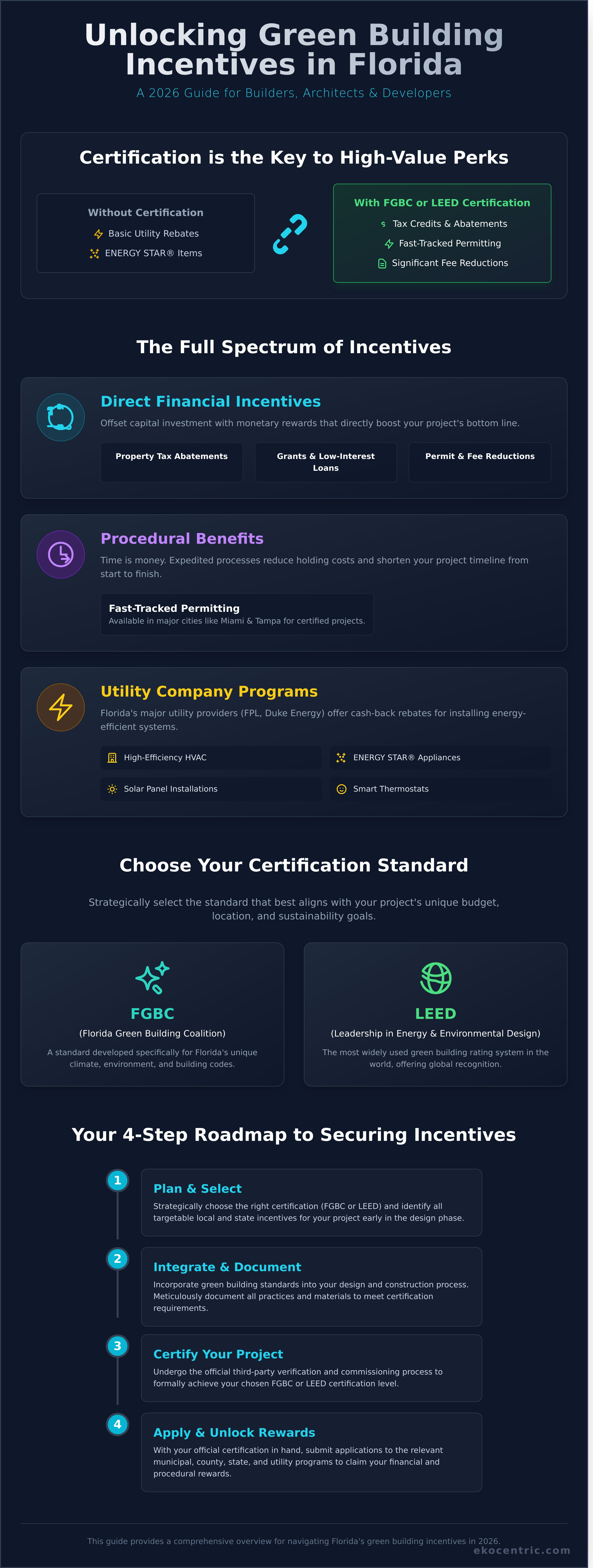
Why Certification Is the Key to Unlocking Florida's Top Incentives
Choosing the Right Certification for Florida Projects: FGBC vs. LEED
Your Roadmap: How to Secure Green Building Incentives Step-by-Step
The Full Spectrum of Green Building Incentives in Florida
For builders, developers, and architects in the Sunshine State, understanding the full scope of green building incentives Florida offers is crucial for maximizing project profitability and environmental impact. These programs go far beyond simple rebates, creating a powerful financial and logistical framework that supports sustainable construction. They are strategically designed to reduce both significant upfront costs and long-term operational expenses, making high-performance building a more attainable and rewarding investment.
It's vital to recognize that many of the most valuable incentives are unlocked through formal green building certification. Programs like the Florida Green Building Coalition (FGBC) standard or the globally recognized Leadership in Energy and Environmental Design (LEED) often serve as the gateway to these benefits. Availability can also vary significantly by county and municipality, so local due diligence is key.
Direct Financial Incentives: Rebates & Tax Credits
Direct monetary rewards provide an immediate boost to your project’s bottom line. These incentives directly offset the capital investment required for sustainable development and can include:
Property Tax Abatements: Certain counties and cities offer reductions on property taxes for buildings that achieve specific green certifications.
Grants & Low-Interest Loans: State and local programs may provide funding or favorable financing terms for projects incorporating green technologies and resilient design.
Fee Reductions: Many municipalities will reduce or completely waive expensive permit, application, and inspection fees for certified green projects.
Procedural Benefits: Fast-Tracked Permitting
Time is money in development, and procedural incentives recognize this reality. Major cities like Miami and Tampa offer expedited or "fast-track" permitting processes for projects pursuing certifications like LEED or FGBC. This benefit significantly reduces holding costs, shortens the project timeline, and allows for a quicker entry into the market. It also signals a cooperative and supportive relationship with local building departments, smoothing the entire development cycle.
Utility Company Programs & Rebates
Florida's major utility providers are key partners in promoting energy efficiency. Companies like Florida Power & Light (FPL) and Duke Energy offer a robust menu of rebates that directly lower the cost of building high-performance homes and commercial properties. These programs often provide cash back for installing:
High-efficiency HVAC systems
ENERGY STAR® certified appliances
Solar panel (PV) installations
Smart thermostats and energy management systems
Why Certification Is the Key to Unlocking Florida's Top Incentives
While many projects claim to be "green," municipalities and utility companies need a reliable, consistent standard to measure genuine environmental performance. How can they be sure a building truly reduces energy consumption, conserves water, and promotes a healthier indoor environment? This is where third-party green building certification becomes indispensable. Programs like LEED (Leadership in Energy and Environmental Design) and the Florida Green Building Coalition (FGBC) provide the trusted, objective verification needed to qualify for the most substantial green building incentives Florida has to offer. Certification moves a project beyond simple claims, providing a documented, rigorous assessment that separates verifiably sustainable buildings from "green-washed" marketing.
Moving Beyond Basic Rebates to High-Value Perks
Think of it this way: anyone can get a small rebate for buying an ENERGY STAR appliance. These are valuable but accessible to the general public. However, the most significant financial and procedural benefits-like expedited permitting, density bonuses, or significant impact fee reductions-are reserved for projects that demonstrate a deep commitment to sustainability. Certification is your project's ticket to this upper tier of incentives. It proves you have met comprehensive performance benchmarks, unlocking perks designed to reward developers who invest in a more resilient and efficient future for their communities.
Proving Performance and Building Trust
For local governments and lenders, a certified green building is a de-risked asset. The certification process provides a clear, documented case that your project is built to a higher standard, ensuring long-term performance and lower operational costs. This documented excellence builds immense trust. Municipalities are more confident offering incentives because they know the project aligns with their sustainability goals and is based on proven frameworks that guide effective sustainable building practices. This trust often translates into smoother, more predictable plan reviews and inspections, saving your team invaluable time and resources throughout the development lifecycle.
Choosing the Right Certification for Florida Projects: FGBC vs. LEED
When pursuing green building incentives Florida, developers and architects primarily navigate two certification systems: the Florida Green Building Coalition (FGBC) and Leadership in Energy and Environmental Design (LEED). While both are highly respected standards that validate a project's commitment to sustainability, they serve different strategic purposes. The optimal choice depends entirely on your project's type, long-term goals, and budget, but either path can unlock significant financial and regulatory benefits.
Florida Green Building Coalition (FGBC)
Developed by Floridians for Florida, the FGBC standard is tailored specifically to our state's unique climate, ecology, and regulatory landscape. This local focus often makes it a more practical and cost-effective solution for residential projects, from single-family homes to multifamily developments. Because it aligns so closely with local priorities, FGBC certification is widely recognized and valued by Florida municipalities when awarding local incentive programs and streamlining permits.
Leadership in Energy and Environmental Design (LEED)
LEED is the globally recognized benchmark for green building excellence. Its international prestige makes it the premier choice for high-profile commercial projects, corporate headquarters, and institutional buildings. This certification carries significant brand recognition that can increase property value and attract Class A tenants. Furthermore, LEED certification is frequently a requirement for projects seeking to qualify for certain Federal Green Building Incentives or large-scale grants.
Which Is Best for Your Project?
Making the right decision requires a clear understanding of the trade-offs. This table provides a high-level comparison to guide your initial assessment of these two powerful platforms for sustainable design.
Factor FGBC LEED Cost Generally lower certification fees and documentation costs. Higher fees and more intensive, data-driven documentation requirements. Complexity More straightforward, designed for practical application in Florida.Rigorous and prescriptive, often requiring specialized expertise.Ideal Project Type Residential (single & multi-family), local commercial, and public buildings.Class A commercial offices, corporate HQs, and high-profile projects.
The takeaway is clear: if your focus is a resilient Florida home or a community-centric commercial space, FGBC provides a direct and efficient path. For a landmark office tower or a project with a national scope, the prestige of LEED is a powerful asset. The path to certification is complex, but you don't have to navigate it alone. Explore our certification consulting services to partner with an expert who can determine the best path for your unique project.
For a summary of some Tax options, check out this video
Your Roadmap: How to Secure Green Building Incentives Step-by-Step
Many developers and project managers perceive the process of securing rebates and tax credits as overwhelmingly complex. However, with a strategic and proactive approach, it becomes a manageable and highly valuable part of your project's financial plan. The single most critical factor for success is early planning. This roadmap demystifies the process, transforming it from a perceived obstacle into a clear path toward maximizing your return on investment in sustainability.
Step 1: Pre-Design Research and Goal Setting
Success begins long before the first shovel hits the ground. Proactively identifying and integrating incentive requirements into your initial project scope is essential. Your team must align on which specific green building incentives Florida programs you will target, as their requirements will directly influence design, materials, and systems.
Identify Targets: Research and select the most advantageous incentives offered by your city, county, and local utility providers.
Integrate Requirements: Weave the specific criteria for your chosen incentives and green building certification (e.g., LEED, FGBC) into the core project plan.
Assemble Your Team: Engage a dedicated green building consultant early. Their expertise is crucial for navigating requirements and ensuring no opportunity is missed.
Step 2: The Design and Certification Process
This phase is about execution and meticulous documentation. Your green building consultant will work alongside your architects and engineers to seamlessly integrate sustainable strategies into the design. Every decision that contributes to your certification and incentive goals must be carefully documented. This includes undergoing necessary third-party verifications, such as inspections by a HERS Rater or LEED Green Rater, to validate performance. Once construction is complete, your project is submitted for its official certification review.
Step 3: Compiling and Submitting Incentive Applications
With your official green building certificate in hand, the final step is to prepare and submit your applications. This stage demands precision and organization. Each incentive program has its own unique application and documentation requirements. You will need to prepare separate, complete packages for each entity-from the local municipality to the utility company-and follow up diligently to confirm receipt and track progress. This persistent management ensures your applications are processed correctly and without unnecessary delays.
While this roadmap provides a clear framework, managing the intricate details requires dedicated oversight. Many teams simply do not have the bandwidth to handle this process effectively. At Ekocentric, we provide that essential layer of management, guiding your project from initial research to final rebate. Learn how our expert consulting can secure your project's success.
Partnering with an Expert to Maximize Your Incentive ROI
Securing financial benefits for sustainable construction is a strategic move that can significantly boost your project's profitability. However, the landscape of green building incentives Florida offers is dynamic and intricate. Navigating this web of local utility rebates, state tax credits, and federal programs requires specialized knowledge. Attempting it alone often leads to missed opportunities and costly errors. Partnering with a dedicated green building consultant transforms the certification process from a perceived cost center into a powerful profit driver, ensuring you capitalize on every available dollar.
Navigating Complex Paperwork and Deadlines
Each incentive program comes with its own set of specific documentation, stringent eligibility requirements, and unforgiving deadlines. A single misstep can result in application rejection and lost revenue. A specialized consultant acts as your project's administrative expert, managing the entire application lifecycle with precision. This dedicated oversight prevents common errors, eliminates delays, and frees your team to focus on what they do best-designing and building exceptional properties. It's the difference between struggling with bureaucracy and seamlessly securing your funds.
Staying Ahead of Evolving Florida Policies
Florida's commitment to resilience and sustainability means that building codes, energy standards, and incentive programs are constantly evolving. What was best practice last year might not qualify for the top-tier rebate this year. An expert partner’s job is to stay on the cutting edge of these policy shifts. This proactive expertise ensures your project is not only compliant with the latest regulations but is also strategically positioned to leverage new and emerging opportunities. This forward-looking approach protects your investment and maximizes your financial returns.
Ekocentric's Florida-Focused Expertise
At Ekocentric, we understand that developers and builders often lack the internal bandwidth to manage the complex sustainability side of a project. Our unwavering dedication is to bridge that gap. With deep, Florida-specific experience in both Florida Green Building Coalition (FGBC) and LEED certifications, we guide you to the most profitable path for your unique project. We don't just consult; we partner with you to manage the entire process, from initial design review to final incentive application. Our ultimate goal is to make sustainable, resilient building a profitable and streamlined reality for you. Let us show you how to turn your green initiatives into financial success. Learn more about our approach at ekocentric.com.
Unlock Your Project's Full Potential with Green Building Incentives
As this guide demonstrates, the landscape of green building incentives Florida offers is robust and financially rewarding. The path to success is clear: achieving a recognized certification like FGBC or LEED is the key to unlocking the most valuable benefits, and a strategic approach is essential for maximizing your return. Building sustainably is not just an environmental choice-it's a smart business decision that creates more resilient, high-value properties.
Navigating the requirements doesn't have to be a challenge. At Ekocentric, our team of certified FGBC and LEED experts has a proven track record of maximizing client ROI on sustainable projects. With deep experience across Florida's municipalities and building codes, we provide the dedicated partnership you need to succeed. Don't leave money on the table. Schedule a consultation to discuss your project's incentive potential.
Together, we can build a greener and more profitable future for Florida.
Frequently Asked Questions About Green Building Incentives
What is the most common green building incentive for residential homes in Florida?
The most prevalent incentives for residential projects are utility rebates and expedited permitting. Major providers like Florida Power & Light (FPL) offer significant rebates for high-efficiency HVAC systems and ENERGY STAR appliances. Additionally, many municipalities, such as Miami-Dade and Sarasota County, offer a faster permitting process for projects that achieve a recognized green building certification. These directly reduce upfront costs and project timelines, making sustainable construction a more attainable and profitable goal.
Are there Florida state-level tax credits for green building in 2026?
Currently, Florida does not offer a broad, state-level tax credit for general green building, and it's vital to monitor legislative updates as this can change. However, builders and developers can still leverage powerful federal tax credits, such as the 45L tax credit for energy-efficient homes. Focusing on these federal programs is a key strategy for maximizing the financial benefits of sustainable construction projects across the state.
How much faster can I get a permit with a green building certification in Miami-Dade County?
In Miami-Dade County, projects that qualify for the Green Buildings Expedited Plan Review Program see a significant reduction in permitting time. While exact timelines vary, certified projects are prioritized, which can often shave several weeks or even months off the standard review process. This acceleration is a major financial advantage for developers, as it reduces holding costs and allows projects to break ground and reach completion much faster than their conventional counterparts.
Does using sustainable materials automatically qualify me for an incentive?
While using sustainable materials is a cornerstone of green building, it does not automatically qualify a project for most incentives. These programs typically require a comprehensive, third-party certification like LEED or FGBC, where material selection contributes points toward the final rating. It is the holistic, verified performance of the entire building-encompassing energy, water, air quality, and materials-that ultimately unlocks access to the most valuable financial benefits.
Is LEED or FGBC certification more expensive to achieve in Florida?
The cost comparison between LEED and Florida Green Building Coalition (FGBC) certification depends heavily on project scope. Generally, FGBC is often more cost-effective for residential and smaller commercial projects in Florida, as its standards are tailored to the state's unique climate and construction practices. LEED, with its global recognition, can involve higher documentation and administration costs but may be essential for certain classes of large commercial or institutional buildings seeking national prestige.
Can I apply for incentives after my construction project is already finished?
In nearly all cases, you cannot apply for green building incentives retroactively. Programs like utility rebates, tax credits, and expedited permitting require applications and design integration from the very beginning. Key inspections and verifications must occur during construction to qualify. Engaging a green building consultant during the pre-construction phase is essential to ensure your project is properly designed and documented to capitalize on all available green building incentives Florida has to offer.
What is the difference between an ENERGY STAR rating and a full green building certification?
An ENERGY STAR rating focuses specifically on a building's energy performance, verifying that it is significantly more efficient than a standard code-built home. In contrast, a full green building certification like LEED or FGBC takes a more holistic approach. These programs evaluate a much broader set of criteria, including water conservation, indoor air quality, site selection, and sustainable materials, in addition to energy efficiency. ENERGY STAR is a component of, but not a replacement for, a full certification.
How do I find a qualified green building consultant in Florida?
The most reliable method is to search the official directories of the certifying bodies themselves, such as the U.S. Green Building Council (for LEED APs) and the Florida Green Building Coalition (for FGBC Certifying Agents). Prioritize professionals with a proven track record in Florida, as they will be most familiar with local codes and incentive programs. Always verify credentials and ask for case studies of similar projects to ensure they have the expertise to guide your project to success. Ekocentric has the experience and is here to assist you!