The 2025 National Green Building Standard: A Guide to the ICC 700 Updates
NGBS 2026
A residential building that meets 2024 standards will be considered outdated by the time your 2026 tenants move in. High-performance construction is no longer a niche market; it's the baseline for resilience and long-term asset value. We know that many developers and builders don't have the bandwidth to manage the complex technical paperwork required for the National Green Building 2025 update. It's common to feel uncertain about whether the ICC 700 or LEED provides a better return on investment for your specific multi-family project.
You deserve a clear path through the technical fog that doesn't sacrifice your project's timeline. This guide will help you master the new requirements of the 2025 NGBS update to streamline your certification process and build high-performance residential projects in 2026. We'll break down the specific technical shifts, provide a roadmap for the verification process, and help you determine which certification path aligns with your financial goals. By the end of this article, you'll have the tools to turn these regulatory changes into a competitive advantage for your next development.
Key Takeaways
Learn how the National Green Building 2025 (ICC 700-2025) update redefines residential construction standards to help you stay ahead of 2026 project requirements.
Discover the refined scoring system—from Bronze to Emerald—and how prioritizing lot design can minimize environmental impact right from the start.
Understand why climate resilience and carbon reduction are now central to the standard, providing a roadmap to mitigate risks like wildfires and hurricanes.
Master the multi-step verification process to streamline project registration and design reviews, ensuring your high-performance builds meet every certification milestone.
Find out how to bridge the bandwidth gap by partnering with experts who balance ambitious sustainability goals with the pragmatic realities of your business.
Understanding the National Green Building 2025 Standard (ICC 700-2025)
The ICC 700-2025 represents the fifth and most sophisticated evolution of the National Green Building Standard (NGBS). This update serves as a rigorous framework for sustainable residential construction, designed to meet the rising expectations of the 2026 housing market. Since its inception in 2008, the standard has provided a roadmap for builders who want to create healthier, more resilient homes that stand the test of time. The 2025 edition is particularly vital because it bridges the gap between current building practices and the high-performance requirements of the near future.
One of the most critical aspects of this standard is the ANSI-approved consensus process used for its development. A diverse committee of architects, developers, government officials, and environmental experts collaborates to ensure the criteria are both ambitious and achievable. This transparent process gives the National Green Building 2025 standard immense credibility with local jurisdictions and financial institutions. The standard applies to a broad range of residential work, including single-family homes, multifamily buildings, and even large-scale land development projects. This versatility allows developers to maintain a consistent sustainability strategy across their entire portfolio.
What Makes the 2025 Edition Different?
The 2025 update shifts the focus toward low-carbon construction and total operational efficiency. Unlike previous versions that focused primarily on energy use, this edition introduces more robust pathways for building renovation and existing structure certification. It aligns perfectly with 2026 market demands by emphasizing indoor air quality and materials that reduce a building's carbon footprint. Builders can now choose from more flexible compliance paths that reward innovation in moisture management and disaster resilience, ensuring the structure remains viable for decades.
The Role of NGBS in the 2026 Housing Market
Certified homes are proving to be superior assets in a competitive market. Data from industry reports suggests that certified green homes can see a resale premium of 2% to 5% compared to non-certified builds. Today's eco-conscious buyers aren't just looking for lower utility bills; they want a home that supports their well-being. Many developers recognize the value of these certifications but don't have the internal bandwidth to manage the technical documentation. Our professional services provide that necessary layer of management. By choosing the National Green Building 2025 pathway, builders gain a pragmatic partner in sustainability that is often more accessible and residential-focused than other certification systems.
Six Key Performance Areas of the 2025 NGBS
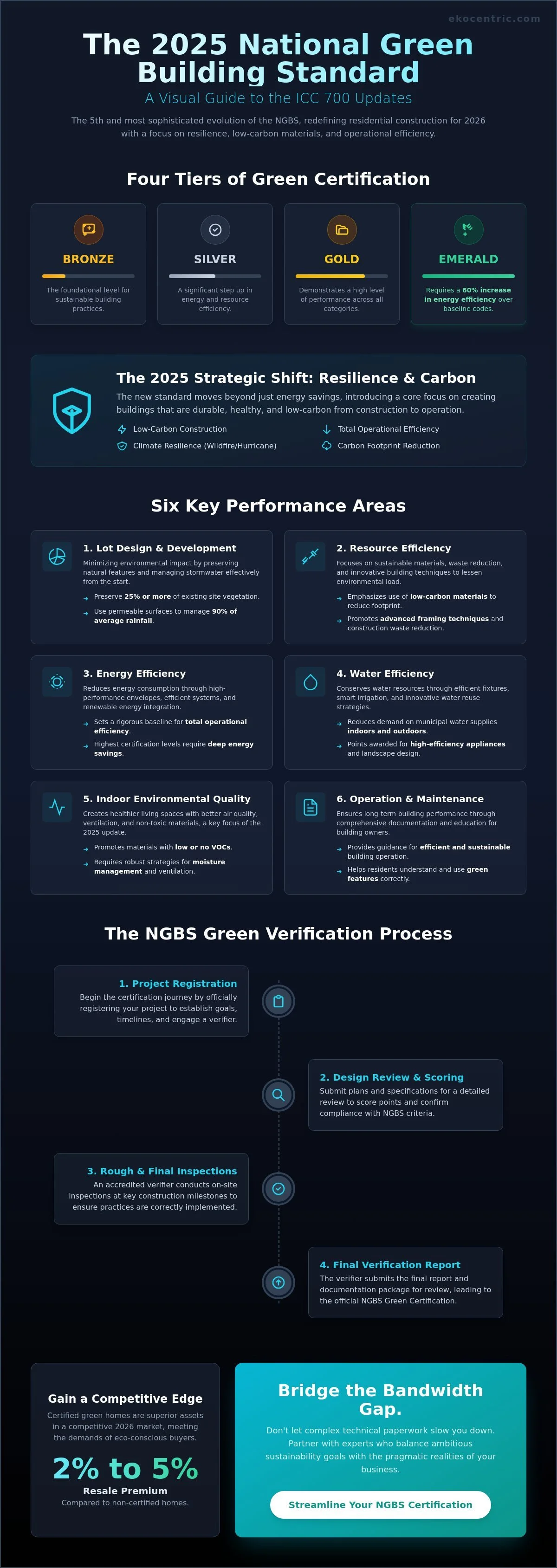
The scoring system for the ICC 700-2025 National Green Building Standard reflects our unwavering dedication to the National Green Building 2025 framework. Projects earn points across six categories to achieve Bronze, Silver, Gold, or Emerald status. Achieving Emerald status requires the highest commitment; it often demands a 60% increase in energy efficiency over baseline codes. This tiered approach allows developers to scale their goals based on project specific needs while maintaining a genuine passion for Sustainability.
Lot Design and Development focuses on minimizing a building's footprint from the very beginning. This includes preserving 25% or more of existing site vegetation and using permeable surfaces to manage 90% of average annual rainfall. Resource Efficiency then addresses the physical structure. By utilizing advanced framing techniques and sustainable material selection, builders can reduce construction waste by 15% or more. These practices aren't just about checkboxes, they're about operational excellence and reducing long-term maintenance costs.
Deep Dive: Energy and Water Efficiency Updates
The National Green Building 2025 updates introduce stricter benchmarks for HVAC performance and insulation. Systems must now meet higher SEER2 ratings and utilize tight building envelopes to prevent energy loss. The 2025 energy baseline requires compliance with the 2024 International Energy Conservation Code (IECC) to ensure every certified home achieves superior thermal performance. Water efficiency has also evolved. Standards now reward smart water management systems that detect leaks in real-time and drought-resistant landscaping that reduces outdoor water demand by 50% compared to traditional turf-heavy designs.
Indoor Environmental Quality and Health
Occupant well-being is a core pillar of the 2025 standard. Requirements for low-VOC materials and advanced ventilation systems ensure that indoor air is free from harmful pollutants. We see a direct connection between IEQ and the health of residents; improved air filtration can lead to a 20% reduction in respiratory issues. The 2025 standard also addresses moisture management with specific mandates for flashing and drainage planes to prevent mold growth. If your team doesn't have the bandwidth to manage these technical requirements, Ekocentric's consulting services can help guide your project toward successful certification.
Resilience and Carbon: The 2025 Strategic Shift
The National Green Building 2025 update moves beyond simple energy efficiency to address the urgent reality of a changing climate. Resilience isn't just a "nice to have" feature anymore; it's a core pillar of the standard because buildings must withstand increasingly frequent extreme weather events. In 2023 alone, the United States experienced 28 separate weather and climate disasters that caused at least $1 billion in damages each. This updated standard requires developers to look at a dual-track carbon strategy. It balances operational carbon, which comes from daily energy use, with embodied carbon, which accounts for the total emissions produced during the manufacturing and transport of building materials.
Building for Resilience in High-Risk Zones
For developers in coastal or fire-prone regions, these updates provide a clear roadmap for protecting assets. These standards align closely with Florida's 2023 building code updates, focusing on storm-hardening techniques like advanced roof-to-wall connections and impact-rated openings. By following the NGBS Green Verification Process, builders can document these structural improvements to satisfy both lenders and insurers. Investing in resilient design helps mitigate rising insurance costs, as many carriers offer premium credits for verified storm-resistant features.
The Path to Carbon Neutrality
Prioritizing material transparency is how the 2025 framework pushes the industry toward a carbon-neutral future. Builders are encouraged to select products with verified Environmental Product Declarations (EPDs) to reduce the project's overall carbon footprint from the start. Electrification is another major focus, as the standard incentivizes high-efficiency heat pumps and induction cooktops over traditional gas-fired systems. To ensure a holistic approach, the 2025 standard officially recognizes whole-building lifecycle assessments as a primary method for measuring a structure's total environmental impact from construction through demolition. Because many teams don't have the internal bandwidth to track these complex metrics, Ekocentric provides the technical oversight needed to manage these sustainability services effectively.
The NGBS Green Verification Process for 2026 Projects
Successfully certifying a project under the National Green Building 2025 updates requires a disciplined, five step approach. This process ensures that every sustainable feature is documented and verified to meet the rigorous ICC 700-2024 standards. Many developers and builders don't have the bandwidth to manage the sustainability side of a project; Ekocentric provides that layer of management to keep your certification on track from groundbreaking to the ribbon cutting.
Step 1: Project Registration and Preliminary Rating: You'll start by registering the project with Home Innovation Research Labs. This initial phase involves a preliminary scoring session to determine which certification level, Bronze, Silver, Gold, or Emerald, is most achievable for your specific site and budget.
Step 2: Design Review and Pre-Construction Planning: Before you pull permits, a verifier reviews your architectural plans and energy models. This stage identifies potential gaps in the National Green Building 2025 requirements, allowing for adjustments before they become costly field changes.
Step 3: Rough-In Inspection and Verification: This is a critical field visit that occurs after framing, plumbing, and electrical are installed but before the drywall goes up. The verifier inspects insulation quality, air sealing, and moisture management techniques that will soon be hidden.
Step 4: Final Inspection and Performance Testing: Once the building is complete, the verifier conducts blower door tests and duct leakage testing. They also verify that all energy efficient appliances and low flow fixtures match the original specifications.
Step 5: Official Certification and Marketing Your Success: After the verifier submits the final report, Home Innovation issues the official green certificate. You can then use this credential to validate your project's performance to investors and residents.
Working with a Certified Green Verifier
Third party verification is the foundation of ANSI-approved credibility. It provides an unbiased stamp of approval that internal checklists simply cannot match. A skilled verifier acts as a pragmatic partner, identifying cost saving opportunities during the design phase, such as optimizing the building envelope to reduce HVAC equipment size. A common pitfall in this process is waiting too long to engage a verifier. Projects that delay this partnership often face expensive retrofits or miss out on easy points because they didn't document early site work. See our National Green Building Standard services for more on how we streamline this oversight.
Marketing Your NGBS Certified Project
Once you achieve certification, it's time to leverage the NGBS Green logo to differentiate your brand. This logo isn't just a badge; it's a promise of lower operating costs and better indoor air quality. You should educate real estate agents on how to explain these benefits to buyers, focusing on the 20% to 30% reduction in utility bills often seen in certified homes. Clear, data driven communication helps buyers understand that a green home is a higher quality, more resilient investment. If you're ready to elevate your next development, you should partner with an experienced consultant to manage the verification details for you.
Scaling Your Sustainability with Ekocentric
Developers and builders often face a significant bandwidth gap when attempting to meet evolving environmental standards. Juggling subcontractors, material procurement, and local building codes leaves little room for the rigorous documentation required by the National Green Building 2025 updates. Ekocentric LLC bridges this gap by acting as a dedicated sustainability arm for your development team. Our mission is to simplify the path to certification while ensuring your project meets its environmental and financial benchmarks.
We take a pragmatic approach to consulting. We recognize that green goals must align with business realities to be successful. Our team doesn't just push for the highest point totals; we identify the most cost-effective path to achieving your desired certification level. This involves a deep dive into your project's specific constraints and opportunities. With a team comprised of LEED Green Raters, HERS Raters, and NGBS Verifiers, we bring a high level of technical authority to the job site. We understand the nuances of the ICC 700 and how to apply them across different jurisdictions.
Local expertise is a critical component of our service. National standards provide the framework, but local conditions dictate the execution. For example, moisture control strategies in the humid Southeast differ greatly from those in arid climates. Our verifiers use regional data to ensure your National Green Building 2025 strategy is resilient against local environmental stressors. This localized focus helps prevent costly design errors and ensures long-term building performance.
Beyond the Checklist: A Partnership Approach
We don't view certification as a simple box-ticking exercise. Instead, we provide an additional layer of project management that oversees every sustainability detail from pre-design to final inspection. Our experts help you integrate NGBS requirements with other programs like LEED or ENERGY STAR. This multi-layered approach maximizes building efficiency and enhances the asset's value. We customize these goals based on your specific project budget, ensuring that sustainability remains an achievable priority rather than a financial burden.
Ready to Certify Your 2026 Project?
The business case for involving a consultant early is clear. Engaging our team during the schematic design phase allows us to optimize the building envelope and mechanical systems before construction begins. This proactive strategy can reduce the need for expensive mid-project adjustments. As you plan your 2026 pipeline, now is the time to review your strategy for the new ICC 700 requirements. Partner with Ekocentric for your next green building project to secure your lead in the sustainable housing market.
Lead the Market with ICC 700-2025 Excellence
Adopting the ICC 700-2025 standard represents a significant evolution in how we define high-performance housing. By focusing on 6 distinct performance categories and a strategic shift toward carbon neutrality, this framework prepares your 2026 projects for a more demanding environmental landscape. Implementing the National Green Building 2025 guidelines ensures your developments remain resilient against Florida's unique climate pressures. Many builders don't have the internal bandwidth to navigate these technical updates alone, but you don't have to manage the sustainability side of your project in isolation.
Ekocentric LLC provides the professional LEED Green Rater and NGBS Verification services you need to succeed. Our mission-driven approach combines deep technical expertise with a genuine passion for environmental stewardship. We're here to act as your pragmatic partner, ensuring every structure you build contributes to a healthier and more sustainable future for everyone. It's time to transform these new standards into a competitive advantage for your next development.
Get Expert NGBS Verification for Your Next Project
We're excited to help you build a more resilient world, one certification at a time.
Frequently Asked Questions
What is the main difference between the 2020 and 2025 NGBS editions?
The primary difference between the two editions is the increased stringency in energy efficiency and the introduction of more robust resilience requirements. The National Green Building 2025 update aligns with the 2024 International Energy Conservation Code, requiring a 10% improvement in energy performance over the previous version. Builders will also find expanded criteria for wildfire and flood resistance, reflecting the standard's focus on long-term durability for residential structures.
Is the 2025 National Green Building Standard mandatory for residential builders?
The 2025 National Green Building Standard is a voluntary, third-party certified program and isn't mandatory by federal law. However, 25 states currently offer incentives or require NGBS compliance for certain affordable housing tax credit programs. Local municipalities may also adopt the ICC 700 as their reach code. Developers often choose this path to meet investor ESG requirements or to qualify for specific Fannie Mae or Freddie Mac green financing programs.
How long does the NGBS Green Verification process typically take?
The NGBS Green Verification process generally follows the construction timeline, beginning at the design phase and ending 30 days after the final inspection. For a typical single-family home, this involves two mandatory on-site inspections: one at the rough-in stage and one at completion. Multifamily projects might take 18 to 24 months to move through the full cycle, depending on the construction schedule and the speed of document submission to Home Innovation Research Labs.
Can multifamily projects use the 2025 NGBS for mixed-use developments?
Mixed-use developments can absolutely use the 2025 NGBS to certify both residential and commercial spaces. Under the ICC 700 guidelines, the non-residential portion can be included in the certification if it occupies less than 49% of the total building square footage. This allows developers to maintain a consistent sustainability strategy across a single asset, ensuring that retail or office components meet the same high standards for indoor air quality and water efficiency as the apartments above.
How does NGBS certification compare to LEED for residential projects?
NGBS is designed specifically for residential construction, while LEED is a broader framework that covers all building types. Many developers find the National Green Building 2025 path more pragmatic because its scoring system is tailored to the nuances of home building and multifamily operations. While LEED is globally recognized, NGBS is often more cost-effective for residential projects, providing a rigorous but accessible roadmap for reaching Bronze, Silver, Gold, or Emerald status.
What are the four certification levels available under the 2025 standard?
The 2025 standard offers four distinct certification levels: Bronze, Silver, Gold, and Emerald. To achieve the Emerald level, a project must demonstrate a 60% or greater reduction in energy consumption compared to the 2006 International Energy Conservation Code baseline. Each level requires a minimum number of points across six environmental categories, ensuring a holistic approach to sustainability that includes water conservation, resource efficiency, and improved indoor environmental quality for all residents.
Does the 2025 NGBS address solar energy and battery storage?
Yes, the 2025 NGBS significantly expands its focus on solar energy and battery storage systems. The updated standard provides specific points for installing photovoltaic panels and implementing "Solar-Ready" design features that simplify future upgrades. It also rewards the inclusion of energy storage solutions, which provide critical backup power during grid outages. These additions help builders create resilient homes that can maintain essential functions during extreme weather events or energy price spikes.
What is the cost associated with hiring an NGBS Green Verifier?
Hiring an NGBS Green Verifier involves fees that are determined by the individual service provider based on the project's scope and location. These professionals are independent contractors, so costs vary depending on whether they're verifying a single-family home or a 300-unit apartment complex. Home Innovation Research Labs requires all verifiers to be accredited and carry insurance, but they don't set fixed pricing. Developers should request quotes from multiple accredited verifiers to ensure competitive rates for their specific region.