RESNET HERS Rater: Building for Efficiency in Central Florida (2026)

By December 31, 2026, every new residential project in Orlando will face a regulatory landscape that makes traditional building methods obsolete. As the 9th Edition of the Florida Building Code takes effect, staying ahead of tighter envelope performance and updated fenestration standards is no longer optional. You've likely felt the pressure of managing complex R405 changes while trying to avoid the costly delays that come with a failed blower door or duct leakage test. Partnering with a certified RESNET HERS rater Orlando transforms these regulatory hurdles into a strategic advantage for your project's success.
We understand that building in Central Florida requires a deep commitment to managing humidity and resource efficiency. This guide explores how energy modeling in the design phase ensures you pass inspections on the first try and achieve HERS Index scores that attract today's energy-conscious buyers. You'll learn how to integrate these high-performance standards seamlessly into your workflow, creating durable homes that stand up to the Florida climate while keeping construction costs in check. Let's look at how specialized expertise helps you build for a more resilient future.
Key Takeaways
Learn why a certified RESNET HERS rater Orlando is essential for navigating Climate Zone 2 challenges and ensuring long-term building durability.
Understand how a lower HERS Index score serves as a powerful marketing tool to increase residential property value and attract energy-conscious buyers.
Discover how to navigate the 9th Edition Florida Building Code updates and choose the most cost-effective compliance path for your project.
Master the step-by-step HERS rating workflow, from preliminary energy modeling to final inspections, to ensure passed inspections on the first try.
See how integrating energy modeling early in the design phase creates a seamless path toward LEED, FGBC, or ENERGY STAR certifications.
Table of Contents
The HERS Index Score: A Strategic Asset for Orlando Builders
Navigating Florida Building Codes & Orlando-Specific Requirements
Partnering with Ekocentric: Expert HERS Rater Services in Orlando
Understanding the Role of a RESNET HERS Rater in West Central Florida
A RESNET HERS rater Orlando serves as a vital third-party expert who bridges the gap between complex architectural designs and actual field performance. These professionals don't just perform inspections; they provide a comprehensive, data-driven analysis of a home's energy efficiency using the Home Energy Rating System (HERS). By evaluating the thermal envelope, HVAC systems, and air distribution, a rater quantifies how a building will actually consume energy. This objective verification is essential for builders who want to move beyond basic compliance and toward the creation of truly high-performance homes.
As the industry prepares for the 9th Edition of the Florida Building Code, which takes effect on December 31, 2026, the role of the rater has become more strategic. These upcoming standards demand significantly tighter building envelopes and more efficient fenestration. A rater acts as your technical partner, identifying potential performance gaps in the energy model before they turn into expensive failures during the final inspection. This proactive involvement ensures that your project remains on schedule and meets the rigorous demands of modern building science.
To better understand the value this system brings to the valuation and appraisal process, watch this helpful video:
Change video
The Difference Between a HERS Rating and a Standard Audit
It's a common mistake to confuse a HERS rating with a standard home energy audit. Audits are typically reactive; they're used to diagnose why an existing home is drafty or has high utility bills. In contrast, a HERS rating is a proactive, design-integrated process. We use advanced energy modeling software to predict a home's performance during the planning phase. Unlike a simple visual inspection, a certified rating carries significant legal weight in Florida. It's the primary tool for demonstrating compliance through the R405 Performance Path, providing the documented proof required by building departments to issue certificates of occupancy.
Why Florida Builders Need a Local Specialist
Central Florida is mostly situated in Climate Zone 2, a region characterized by intense heat and persistent humidity. This environment creates unique challenges for building durability and occupant comfort. A local RESNET HERS rater Orlando understands how these variables affect duct leakage testing and blower door results. Humidity can impact the performance of sealants and testing equipment, requiring a specialist who knows how to manage these field conditions.
Local expertise also means a deep familiarity with the specific filing requirements of area building departments. We provide quick response times for critical field tests, ensuring your construction timeline isn't stalled by waiting for a technician. By integrating our specialized rater services early, you gain a partner who understands the local landscape and is dedicated to the long-term success of your project.
The HERS Index Score: A Strategic Asset for Florida Builders
The RESNET HERS® Index is more than a compliance metric; it's a powerful tool for quantifying building quality. The scale operates from 0 to 100, where a score of 100 represents a home built to the 2006 International Energy Conservation Code standards. Each point below 100 signifies a 1% reduction in energy consumption. By 2026, an "Orlando-average" score for a code-compliant new build will likely fall between 55 and 65, reflecting the stricter standards of the 9th Edition Florida Building Code. For builders, hitting these numbers isn't just about passing inspections; it's about proving the tangible value of the property.
A lower HERS score directly correlates with increased resale value. Modern, tech-savvy homebuyers in Central Florida view the index as a transparency tool that validates their investment. Beyond utility savings, homes with superior energy performance often qualify for reduced insurance premiums in Florida. This is because the same high-performance features that lower a HERS score, such as enhanced building envelopes and superior air sealing, also indicate a more durable and resilient structure. By working with a RESNET HERS rater Orlando, you can transform these technical data points into a compelling narrative for your customers.
Beyond Code: Building Net-Zero Ready Homes in Central Florida
When you push a project toward a HERS score of 50 or lower, you're positioning it as a premium, net-zero ready offering. Achieving these elite scores requires a holistic approach to building science. We focus on optimizing solar orientation to manage the intense Florida sun and integrating high-efficiency HVAC systems designed for humidity control. Essentially, the HERS Index serves as the "miles-per-gallon" rating for homes, providing a clear comparison for energy performance that buyers immediately understand. If you want to differentiate your brand, aiming for scores well below the code minimum is the most effective strategy.
Marketing Your HERS Score to Florida Buyers
The real value of a HERS rating lies in its ability to translate complex engineering into simple financial benefits. You can show potential owners exactly how much they'll save on monthly utility bills by comparing your home's score to a typical resale property. We recommend incorporating the official HERS certificate directly into your sales gallery and listing descriptions. This data-backed approach builds trust and justifies a higher price point. Partnering with Ekocentric allows you to create performance-based marketing collateral that highlights these savings. This level of detail ensures your projects stand out in a competitive market while demonstrating your commitment to environmental stewardship.
Navigating Florida Building Codes & Orlando-Specific Requirements
Navigating the transition to the 9th Edition of the Florida Building Code requires a proactive approach to compliance. Projects with permit dates on or after December 31, 2026, will be subject to more stringent energy conservation requirements based on the 2024 International Energy Conservation Code (IECC). For most builders, the R405 Performance Path is the superior choice over the Prescriptive Path. It allows for significant design flexibility, enabling you to optimize specific components like high-efficiency HVAC or advanced insulation to offset other design constraints. A RESNET HERS rater provides the technical modeling necessary to navigate these trade-offs, ensuring your project meets code without unnecessary construction costs.
A major hurdle in Orlando and other municipalities residential construction is the mandatory blower door test. Failed tests lead to red tags, rescheduling delays, and frustrated subcontractors. Most failures in Central Florida stem from improper envelope sealing or excessive duct leakage. We identify these issues during rough-in inspections, long before they can stall your certificate of occupancy. This level of oversight is essential for maintaining a smooth production schedule and ensuring the building performs as designed. Avoiding these common pitfalls protects your margins and your reputation.
Synergy with Orlando Utilities Commission (OUC) and Duke Energy
Local utility providers like OUC and Duke Energy offer rebate programs for high-efficiency heat pumps and attic insulation. These incentives often require third-party verification to confirm the home meets specific performance tiers. Your RESNET HERS rater acts as the bridge, verifying the field data required for these utility programs. By aligning your HERS testing with local utility "Gold" or "Platinum" standards, you can maximize your ROI while providing a more marketable home. This data-backed verification ensures you don't leave money on the table during the close-out phase.
Humidity Management and Building Science in Zone 2
Orlando’s high dew point makes moisture management a critical factor in building durability. In Climate Zone 2, vapor barrier integrity is vital for maintaining high HERS scores and preventing long-term structural issues. As envelopes become tighter to meet 2026 standards, the interaction between sealing and indoor air quality (IAQ) becomes more complex. We often recommend Energy Recovery Ventilators (ERVs) for the Florida climate. These systems provide necessary fresh air while pre-conditioning it to remove excess humidity, ensuring the home remains healthy and efficient. Integrating these specialized energy services early in the design phase prevents humidity-driven building science challenges before they start.
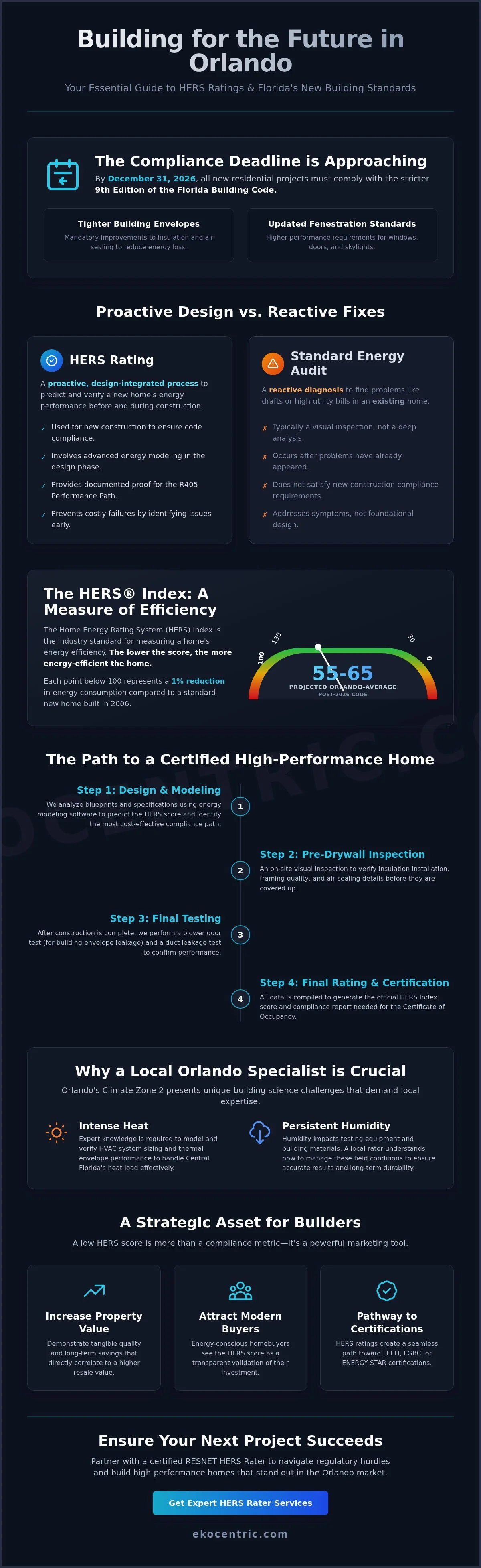
The Step-by-Step HERS Rating Process for Your Next Project
A successful project in Central Florida relies on a structured approach to energy performance. Partnering with a RESNET HERS rater Orlando ensures that efficiency is baked into the home from day one. This process is divided into five critical stages, each designed to verify that the building meets both regulatory standards and your specific performance goals. By following this roadmap, you eliminate guesswork and ensure a smooth path to the final certificate of occupancy.
Step 1: Preliminary Energy Modeling. This plan review occurs before construction begins, allowing for optimization of the building's specifications.
Step 2: Pre-Drywall Inspection. We verify the quality of insulation and the integrity of air sealing before the walls are closed.
Step 3: Final Field Testing. Once construction is complete, we perform blower door and duct blaster tests to measure real-world performance.
Step 4: Software Analysis. We input field data into RESNET-accredited software to generate the final HERS Index score.
Step 5: Official Certification. The final report is submitted to local building authorities, providing the proof required for code compliance.
The Plan Review: Saving Money Before Construction Starts
The design phase is where the most significant savings are found. Our energy modeling often identifies "over-specced" materials that increase costs without providing a meaningful return on efficiency. For example, we might find that optimizing window-to-wall ratios for Orlando’s solar heat gain is more effective than adding extra insulation in areas that don't need it. Early modeling prevents costly mid-construction changes. This proactive analysis ensures your budget is spent where it actually impacts performance, protecting your margins while delivering a superior product.
The Final Inspections: What to Expect On-Site
Final inspections shouldn't be a source of anxiety for your site supervisors. Preparation is key to a successful blower door test. Site supers should ensure all exterior windows and doors are fully latched, plumbing traps are filled, and HVAC filters are removed. We often find common failure points in attic hatches or recessed lighting fixtures that haven't been properly sealed. When these gaps appear, a RESNET HERS rater acts as a troubleshooting partner, helping your team identify and fix leaks in real-time. This collaborative approach ensures you pass the first time and stay on schedule. To streamline your next build, consider integrating our certified HERS rater services into your production timeline.
Partnering with Ekocentric: Expert HERS Rater Services in Central Florida
Choosing a RESNET HERS rater is a decision that defines the longevity and environmental footprint of your project. At Ekocentric, we approach energy efficiency as a core mission rather than a regulatory chore. We're dedicated to helping you build high-quality living spaces that respect the Central Florida environment. This commitment makes us a true partner in your construction journey, providing the technical depth you need to succeed in the 2026 energy landscape. We don't just identify problems; we advocate for the most efficient, durable solutions for your specific build. We believe that specialized industry practices are a crucial and achievable solution to global environmental challenges.
Our team offers a comprehensive suite of services that go far beyond basic code compliance. We provide LEED Green Rater and FGBC services to create a unified approach to sustainability. By layering these certifications, you ensure your project meets the highest industry standards for resource efficiency and environmental stewardship. We purposefully avoid focusing on expiring financial programs that may leave your project ineligible by the time it's permitted. Instead, we focus on building science fundamentals that deliver permanent value and lower operational costs, regardless of changing tax codes or shifting incentives.
The Ekocentric Advantage for Multi-Family and Custom Homes
Large-scale developments and complex custom homes require a rater who can scale with the project's demands. We understand that many builders face significant internal resource gaps, often lacking the specialized staff required to manage rigorous energy documentation and modeling. Our local West Central Florida presence allows us to fill that void effectively. We offer rapid response times for field testing and possess a deep understanding of the local market's unique humidity challenges. We handle the heavy technical lifting and documentation, allowing your team to focus on the physical build while we secure the credentials your project needs to stand out in a competitive market.
Ready to Elevate Your Building Performance?
Starting a consultation with our team is a straightforward process designed to integrate seamlessly into your workflow. We begin with a comprehensive review of your project goals and architectural plans to identify optimization opportunities early. From there, we manage every aspect of the energy modeling and field verification process, ensuring your project remains compliant, durable, and marketable. Working with a dedicated RESNET HERS rater ensures you navigate the 2026 code changes with confidence and professional authority. Schedule your HERS project consultation with Ekocentric today to secure your project's future and build for a more conscious environment.
Building a Resilient Future in Central Florida
The 9th Edition of the Florida Building Code represents a significant shift toward higher performance and resource efficiency. Success in this new era requires more than just meeting minimum standards; it demands a strategic partnership that integrates energy modeling into the very core of your design process. By focusing on building science fundamentals and humidity management, you create homes that are durable, comfortable, and highly marketable to modern buyers. This proactive approach ensures your projects remain competitive as the industry moves toward more stringent requirements.
A certified RESNET HERS rater West Central Florida provides the technical authority needed to navigate these changes while avoiding the costly delays of failed inspections. Our team brings deep expertise in Orlando’s Climate Zone 2, ensuring your projects stand up to the unique environmental pressures of Central Florida. Whether you're aiming for code compliance or advanced certifications, we handle the complex documentation so you can focus on construction. We're here to help you bridge the gap between architectural vision and real-world performance.
Partner with Orlando’s leading RESNET HERS Raters at Ekocentric. As certified LEED Green Raters and Florida Green Building Coalition (FGBC) experts, we're dedicated to your project's success and our shared environmental future. Let's build something better together.
Frequently Asked Questions
Is a HERS rating mandatory for new construction in Orlando in 2026?
A HERS rating is not strictly mandatory for every home, but it is the industry standard for demonstrating compliance with the R405 Performance Path of the Florida Building Code. Most Orlando builders choose this route because it offers more design flexibility than the prescriptive path. As the 9th Edition takes effect in late 2026, the data provided by a rating becomes essential for meeting tighter envelope requirements.
How much does a HERS rating typically add to the cost of a new home build?
The cost of a HERS rating is a small fraction of the total construction budget and often pays for itself through design optimization. By identifying areas where you can use more cost-effective materials without sacrificing performance, the rating process helps lower overall construction expenses. It also prevents the high costs associated with failed inspections and project delays, making it a pragmatic investment for any Central Florida project.
Can a HERS rater help my project qualify for ENERGY STAR® certification?
Yes, a certified rater is a required partner for any project seeking ENERGY STAR® certification. In Orlando, a home must typically achieve a HERS Index score of 85 or lower to qualify, along with meeting specific HVAC and water management checklists. Your rater manages the necessary inspections and documentation to ensure the home meets these national efficiency standards while maintaining its durability in our humid climate.
What is a "good" HERS Index score for an Orlando home?
A "good" score depends on your project goals, but aiming for 50 or lower positions a home as a high-performance leader in the Orlando market. While a code-compliant home in 2026 might score in the mid-50s, reaching lower numbers demonstrates a deeper commitment to resource efficiency. These lower scores are highly marketable, signaling to buyers that the home is built for long-term durability and lower utility consumption.
How long does the onsite HERS testing process take?
Onsite testing, including the blower door and duct leakage tests, typically takes between two and four hours per unit. This timeline can vary based on the size and complexity of the home. To ensure efficiency, site supervisors should have the property ready according to the rater's checklist. Proper preparation prevents the need for re-testing and keeps your production schedule on track during the final construction phase.
Does a HERS rating impact my Florida Building Code compliance?
A HERS rating is the primary tool used to document compliance under the Florida Building Code’s Performance Path. Your RESNET HERS rater Orlando generates the necessary reports that building departments require before issuing a permit and a final certificate of occupancy. This process provides the objective, third-party verification that the home’s energy performance aligns with state-mandated conservation standards and Orlando-specific engineering requirements.
What happens if my project fails the blower door test?
If a project fails a blower door test, the rater uses diagnostic tools like smoke pens or thermal imaging to pinpoint the air leaks. Once the leaks are identified, your team can seal the gaps in real-time or before the next scheduled inspection. We act as a technical partner during this process, providing immediate feedback to ensure the home passes on the second attempt without stalling the closing or the final inspection.
How do I choose the right RESNET HERS rater for a multi-family project in Central Florida?
For multi-family projects, look for a RESNET HERS rater West Central Florida with a proven track record of scaling their services for large developments. You need a partner who understands the logistics of testing multiple units in a single day and can handle the complex documentation required for multi-family certifications. Choosing a rater with local expertise ensures they are familiar with the specific humidity challenges and building department expectations in Orlando.