2026 Florida Building & Energy Code: Key Changes Explained
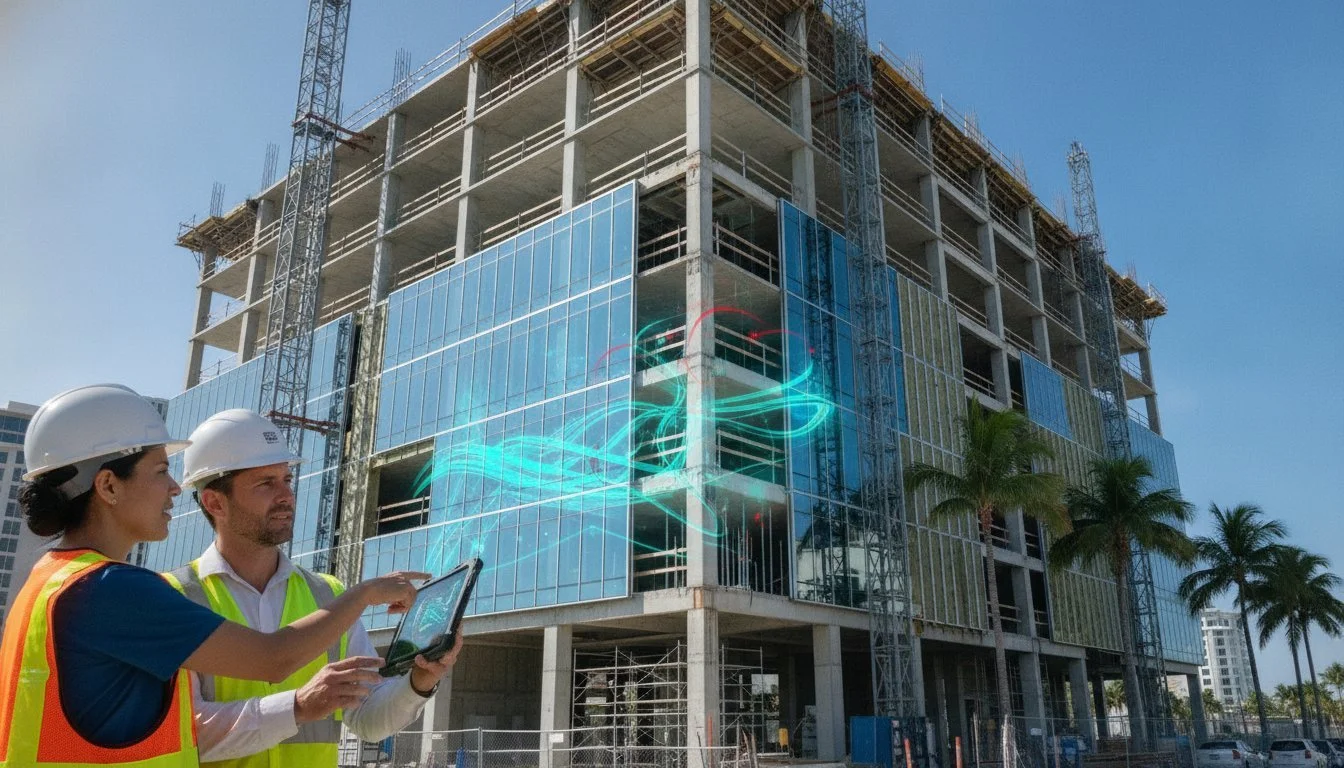
Did you know that the shift to the 9th Edition Florida Building Code is expected to increase costs for coastal new builds by up to 10%? We understand that the complexity of overlapping state mandates and green standards often feels like a moving target, especially when permit rejections and rising compliance costs threaten your project's timeline. The changes coming to the 2026 Florida Building Code and Energy Code represent a rigorous leap in performance standards, from the adoption of ASCE 7-22 wind loads to more stringent SEER2 ratings.
While these updates are demanding, they also offer a strategic opportunity to align your builds with elite certifications. You'll learn how to master the 9th Edition's technical shifts and discover how to synchronize these new 2026 energy standards with LEED BD+C or FGBC benchmarks. Whether you're developing in Florida, Georgia, the Carolinas, or even internationally, we'll provide a clear roadmap for 2026 compliance. This guide previews the essential code updates and explains how a pragmatic partnership can offload your certification management, ensuring your assets remain both valuable and environmentally resilient.
Key Takeaways
Understand the critical December 31, 2026, implementation date for the 9th Edition and how it impacts your project timelines across Florida and the Southeast.
Identify the specific changes coming to the 2026 Florida Building Code and Energy Code, including more rigorous envelope standards and mechanical efficiency requirements.
Compare Florida’s upcoming shifts with evolving code cycles in Georgia and the Carolinas to maintain regional compliance and long-term asset value.
Learn how to leverage mandatory code minimums as a strategic baseline to streamline your path toward LEED BD+C and FGBC certifications.
Discover how partnering with a specialized LEED Green Rater provides the expert capacity needed to navigate complex compliance and optimize building performance.
Table of Contents
The 9th Edition Florida Building Code (2026): Timeline and Structural Scope
Beyond Florida: Southeastern Regional Code Trends (GA, NC, SC)
Navigating Compliance with Ekocentric’s Green Rater Expertise
The 9th Edition Florida Building Code (2026): Timeline and Structural Scope
The Florida Building Commission manages a rigorous three-year cycle to ensure our built environment remains resilient and safe. The Florida Building Code (FBC) serves as the foundational standard for safety and efficiency across the state. As we approach the next major update, the changes coming to the 2026 Florida Building Code and Energy Code represent a significant shift toward higher performance. This 9th Edition is not a minor tweak. It's a comprehensive update that integrates the latest structural science and energy conservation strategies. While our expertise is rooted in the Southeast markets of Florida, Georgia, and the Carolinas, Ekocentric provides these specialized insights for projects across the United States and internationally.
Key Dates for Developers and Architects
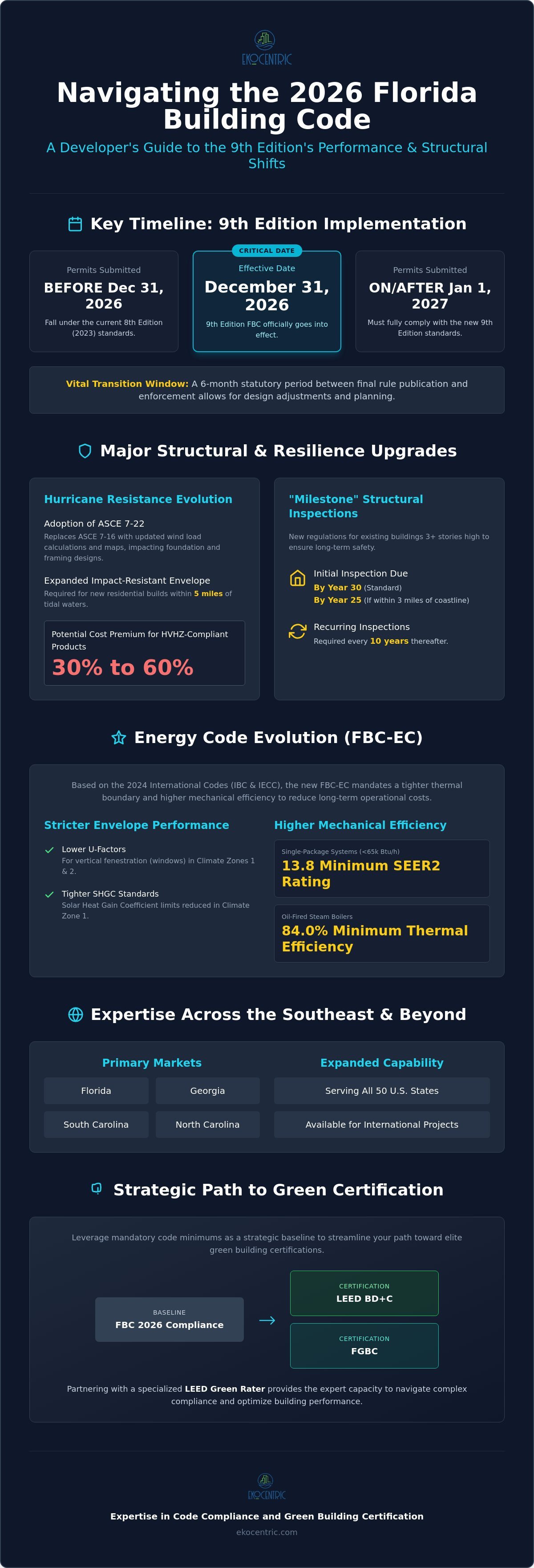
The official effective date for the 9th Edition is December 31, 2026. This date is firm. Projects with permit applications submitted before this deadline typically fall under the 8th Edition (2023). Any project seeking permits on or after January 1, 2027, must fully comply with the new standards. A six-month statutory transition period exists between the publication of the final rule and its enforcement. This window is your vital time to adjust design documents. Coordinating with specialized consulting services during this phase helps you avoid costly permit rejections and project delays before they impact your bottom line.
Structural and Hurricane Resistance Evolution
A major change in the 9th Edition is the adoption of ASCE 7-22. This standard replaces ASCE 7-16 and introduces updated wind load calculations and maps. For Risk Category II structures, these maps may shift design requirements for foundations and framing connections. The 160 mph impact-resistant envelope requirement now extends to new residential construction within five miles of tidal waters. This expansion means more projects will require hardened fenestration and reinforced roof assemblies. These upgrades often carry a 30% to 60% cost premium for products compliant with High-Velocity Hurricane Zone (HVHZ) standards. Early planning is vital for budget accuracy.
Safety regulations are also tightening for existing structures. Buildings three stories or higher now face "milestone" structural inspections by the year they turn 30. This requirement moves to 25 years for buildings within three miles of the coastline. These inspections must then recur every 10 years. This reflects a broader commitment to longevity and safety that defines the 9th Edition's scope. By understanding these structural evolutions now, developers can build more resilient assets that stand the test of time and weather.
Deep Dive into 2026 Energy Code & Envelope Performance
The 2026 Florida Building Code, Energy Conservation (FBC-EC), defines the mandatory minimums for thermal resistance and mechanical efficiency for every new structure in the state. These standards are largely adapted from the 2024 International Building Code (IBC) and the 2024 International Energy Conservation Code (IECC). The changes coming to the 2026 Florida Building Code and Energy Code prioritize a tighter thermal boundary to reduce long-term operational costs. For developers, this means moving beyond basic compliance toward high-performance building strategies that protect both the environment and the asset's bottom line.
Envelope requirements are becoming significantly more stringent. Vertical fenestration in Climate Zones 1 and 2 will see lower U-factors, while Solar Heat Gain Coefficient (SHGC) standards in Climate Zone 1 are tightening. These shifts directly combat Florida's intense solar radiation. Mechanical systems must also evolve; single-package systems under 65,000 Btu/h now require a minimum SEER2 rating of 13.8. Even specialized equipment like oil-fired steam boilers must meet a new 84.0% thermal efficiency floor. These technical adjustments ensure that every component of the building works in harmony to minimize energy waste.
Residential vs. Commercial Energy Shifts
Residential projects are trending toward lower HERS Index scores, reflecting a push for superior performance pathways. For large-scale multi-family developments, commercial envelope improvements will require more sophisticated energy modeling to meet compliance. New software tools are being introduced to handle these updated modeling requirements. It's often beneficial to engage specialized energy rater services early in the design phase to ensure your performance pathway is both achievable and cost-effective.
Addressing the "Performance Gap"
Code-minimum buildings often struggle with real-world Florida humidity if the envelope isn't perfectly sealed. The 2026 code places a heavy emphasis on air leakage testing and duct sealing to close the gap between design intent and actual performance. A building's thermal integrity relies on these invisible details. In the context of 2026 thermal barriers, the building envelope is the continuous system of materials and assemblies that separate the conditioned interior space from the unconditioned exterior environment. Rigorous testing ensures that these barriers remain airtight, preventing moisture intrusion and protecting indoor air quality.
Beyond Florida: Southeastern Regional Code Trends (GA, NC, SC)
While the changes coming to the 2026 Florida Building Code and Energy Code are specific to the Sunshine State, they represent a broader regional shift toward the 2024 International Energy Conservation Code (IECC) baseline. Georgia, North Carolina, and South Carolina are following similar trajectories, updating their standards to reflect modern climate realities and higher efficiency expectations. Developers managing portfolios across state lines face the complex challenge of varying adoption timelines. Florida often leads with its stringent hurricane resistance, but the energy conservation trends are unifying the Southeast into a more cohesive, high-performance market.
Ekocentric bridges these geographic gaps because we're licensed contractors and realtors in Florida, North Carolina, and South Carolina. We don't just read the code; we understand the "how" of implementation. This dual perspective allows us to guide projects through different climate zones, from the humid subtropical coasts of the Carolinas to the Piedmont regions. Having a partner who understands the nuance of each market prevents project delays and ensures consistent asset value. We act as the expert internal capacity your team needs to navigate these overlapping state mandates.
Georgia and Carolina Building Standards
North Carolina and South Carolina present unique challenges due to their internal climate diversity. A project in Charleston requires different thermal strategies than one in the Blue Ridge Mountains. By aligning with the 2024 IECC, these states are narrowing the gap between mandatory law and elite certifications. We help developers streamline compliance by identifying where state codes overlap with programs like NGBS Green Verification or LEED. This regional foresight is a powerful tool for maintaining a competitive edge in the Southeast market. It's about more than compliance; it's about optimizing performance across your entire portfolio.
National and International Reach
Our commitment to environmental stewardship isn't limited by state borders. While we have deep roots in the Southeast, Ekocentric supports sustainable development across all 50 states and on international projects. We apply high-performance US-based green standards to global contexts, ensuring that your sustainability goals remain consistent regardless of local code variations. Whether you're pursuing LEED BD+C Consulting in a neighboring state or a project overseas, we provide the expert capacity your team needs to manage complex certification goals. We ensure your project meets the highest standards of longevity and efficiency, no matter the location.
Strategic Preparation: Aligning FBC 2026 with LEED and FGBC
The changes coming to the 2026 Florida Building Code and Energy Code narrow the gap between mandatory requirements and high-performance building certifications. In previous code cycles, achieving LEED or FGBC status required a massive leap from standard practices. Now, the 9th Edition’s rigorous envelope and mechanical standards provide a built-in head start. Developers who view these code updates as a strategic baseline rather than a hurdle can streamline their path toward elite credentials. Building to code minimum is no longer a sustainable business strategy for those seeking institutional financing or meeting strict Environmental, Social, and Governance (ESG) goals. Investors increasingly demand resilient assets that outperform basic legal requirements to mitigate long-term climate risk.
Strategic alignment starts at the pre-design phase. When you design for the 2026 energy standards, you're simultaneously satisfying many prerequisites for Energy & Atmosphere credits in LEED BD+C. This overlap means the technical documentation required for a permit can often serve as the foundation for your green building submittals. Our team acts as the expert partner to manage this documentation, providing the internal capacity your project needs to navigate these complex requirements without derailing your timeline. Whether your project is in Georgia, the Carolinas, or Florida, we ensure your sustainability goals translate into tangible asset value.
LEED BD+C and NGBS Synergy
The 2026 envelope standards, particularly the increased R-values and tighter fenestration U-factors, align closely with the prerequisites for National Green Building Standard (NGBS) Green Verification. By meeting the new Florida mandates, your project is already checking boxes for energy performance that were previously considered optional. This synergy allows you to maximize your ROI by achieving certification with minimal additional expenditure beyond what the law now requires. We help you map these overlaps early in the design phase to ensure every dollar spent on compliance also earns you valuable certification points. Explore our LEED and NGBS services to see how we bridge the gap between code and performance.
FGBC: The Florida-Specific Certification
The Florida Green Building Coalition (FGBC) remains the premier choice for projects that want to highlight their commitment to the local environment. FGBC standards are designed specifically for Florida’s unique subtropical humidity and storm patterns. Bridging the gap between the 9th Edition FBC and FGBC excellence requires a consultant who understands both the "how" of construction and the "why" of certification. We provide the specialized oversight needed to document compliance for third-party reviewers, ensuring your project stands out in a competitive market. Partner with Ekocentric to align your 2026 projects with FGBC standards.
Navigating Compliance with Ekocentric’s Green Rater Expertise
The changes coming to the 2026 Florida Building Code and Energy Code require more than just a permit-ready set of drawings. They demand a deep understanding of how building systems interact to achieve real-world results. Ekocentric offers a unique advantage as your B2B partner. We aren't just consultants; we're licensed Florida Certified Building Contractors and realtors in Florida, North Carolina, and South Carolina. This dual-perspective allows us to bridge the gap between complex engineering requirements and the practical realities of a job site. We understand the "how" of construction, ensuring that your high-performance goals are achievable without unnecessary friction or budget bloat.
Our mission goes beyond checking boxes for compliance. We're dedicated to environmental stewardship and the creation of superior living spaces. By moving beyond a simple checklist, we help you optimize building efficiency and longevity. Whether you're working in the Southeast or on an international project, our expertise provides the "internal capacity" your team needs to manage these technical shifts. Engaging us early in the design phase allows you to bake compliance into your strategy, avoiding the risk of permit rejections or costly late-stage redesigns.
Why a Green Rater is Essential for 2026
Third-party verification is the cornerstone of a successful high-performance project. A LEED Green Rater provides the independent oversight necessary to ensure your project actually meets its design intent. We manage the certification process from pre-construction to the final walkthrough, acting as a pragmatic partner for developers and architects. Our credentials provide the technical backbone your project requires:
RESNET HERS Rater: We provide the energy modeling and field testing required for performance-based compliance pathways.
ENERGY STAR Rater: Our team verifies that residential and multi-family units meet rigorous efficiency standards for superior comfort.
National Green Building Standard Green Verification: We guide projects through the NGBS process to enhance asset value and marketability.
Partnering for Performance
The ROI of sustainable building is no longer theoretical. It's reflected in increased asset value, lower operational costs, and access to institutional financing. We support architects and developers who lack the internal resources to manage these complex goals. Our B2B consultancy model is designed to be efficient and logical, guiding you through the 9th Edition's demands while positioning your project as a leader in environmental resilience. We're ready to help you navigate the changes coming to the 2026 Florida Building Code and Energy Code with confidence and clarity.
Contact Ekocentric for a 2026 Code & Certification Strategy Session to secure your project's success in the evolving market.
Building Resilience for the 2026 Code Cycle
The changes coming to the 2026 Florida Building Code and Energy Code represent a pivotal moment for developers across the Southeast. By shifting from the 8th Edition to the 9th, projects will face tighter envelope requirements and updated ASCE 7-22 wind load maps. These mandates don't have to be a burden. They serve as a powerful foundation for achieving elite certifications like LEED BD+C or FGBC. Our team brings the unique perspective of a Licensed Florida Certified Building Contractor and specialized LEED Green Rater & NGBS Verifier to your project. We serve Florida, Georgia, and the Carolinas, but our mission to protect the environment extends across the United States and internationally.
Don't let compliance complexities stall your momentum. We provide the expert internal capacity you need to transform regulatory requirements into high-value, resilient assets. Schedule your 2026 Florida Building Code consultation with Ekocentric to align your next project with these evolving standards. Let's build a more sustainable and resilient future together.
Frequently Asked Questions
When does the 9th Edition of the Florida Building Code take effect?
The 9th Edition of the Florida Building Code officially takes effect on December 31, 2026. Any project with a permit application submitted on or after January 1, 2027, must comply with these updated standards. This timeline includes a six-month statutory transition period following the code's publication to allow architects and developers to adjust their design documents and project budgets accordingly.
What are the biggest energy changes in the 2026 Florida Building Code?
The biggest updates involve more stringent thermal resistance and mechanical efficiency minimums. Changes coming to the 2026 Florida Building Code and Energy Code include a minimum SEER2 rating of 13.8 for single-package systems and lower U-factors for vertical fenestration in Climate Zones 1 and 2. These shifts prioritize a much tighter building envelope to combat Florida's intense heat and humidity while reducing long-term operational costs.
Does Ekocentric provide green building consulting outside of Florida?
Yes, we serve a broad geographic area including Georgia, South Carolina, and North Carolina as our primary markets. While we're licensed contractors and realtors in the Southeast, our specialized consulting services are available across the entire United States. We're also available for international sustainable development projects, applying high-performance building standards to global contexts regardless of local code variations.
How does the 2026 Energy Code affect LEED BD+C certification?
The 2026 Energy Code significantly narrows the gap between mandatory state law and voluntary green certifications. Because the new code establishes a more rigorous performance floor, developers can use these mandatory minimums as a baseline for Energy & Atmosphere credits. This synergy makes achieving LEED BD+C status more efficient and cost-effective because the building's standard design is already closer to LEED requirements.
What is the difference between a HERS Rater and a LEED Green Rater?
A HERS Rater focuses specifically on energy modeling and diagnostic testing to produce a HERS Index score for residential performance. In contrast, a LEED Green Rater provides a more comprehensive verification service for residential LEED projects. They oversee multiple categories, including water efficiency and indoor air quality, to ensure the project meets all LEED prerequisites and earns the necessary credits for certification.
Will the 2026 code changes increase the cost of new construction in Florida?
Industry data suggests that the 9th Edition could increase construction costs by 5-10% for coastal builds or envelope-heavy additions. This increase stems from requirements for hardened fenestration, tighter energy specifications, and updated roof assemblies. However, these upfront investments are often offset by significantly lower energy bills and increased asset resilience, which protects the building's value against future climate events.
Can Ekocentric help with FGBC certification for multi-family projects?
Yes, we provide specialized FGBC Certification Consulting for both single-family and multi-family residential developments. Our team understands the unique requirements of the Florida Green Building Coalition standards, which are tailored specifically for our state's climate. We help developers navigate the complex documentation process and act as the expert capacity needed to verify that multi-family assets meet these Florida-specific sustainability benchmarks.
How do the new Florida roofing standards in the 9th Edition impact energy efficiency?
The 9th Edition introduces updated regulations for reroofing and underlayment that enhance the building's overall thermal integrity. By improving the air sealing and structural durability of the roof assembly, these standards work in tandem with the Energy Code to reduce unwanted heat gain. This results in lower cooling loads for HVAC systems and improved performance for the entire building envelope, especially in high-wind zones