Cost Analysis of NGBS vs. FGBC for Florida Builders: 2026 Strategic Guide
The "cheapest" certification path on paper often becomes your most expensive mistake when it fails to align with your actual construction workflow. For developers across Florida and the Southeast, the choice between National Green Building Standard (NGBS) and Florida Green Building Coalition (FGBC) isn't just about the sticker price of registration. It's about how these frameworks interact with the upcoming 9th Edition of the Florida Building Code and your specific project goals. Conducting a rigorous cost analysis of NGBS vs. FGBC for Florida builders is essential to avoid unexpected soft costs that can erode your margins before you even break ground.
We understand the pressure of balancing rising verification fees with the need for high-performance credentials that satisfy lenders and environmentally conscious buyers. You need a streamlined compliance process that doesn't add unnecessary layers of friction to your job site. This guide provides the financial and operational clarity you need to navigate these standards in 2026. We'll explore current fee structures for single-family and multifamily projects, compare verification requirements, and show you how to leverage regional standards to build more resilient, profitable communities across the United States and beyond.
Key Takeaways
Understand the structural differences between the national ANSI-approved NGBS standard and the state-specific FGBC framework to ensure alignment with Florida's unique climate and building codes.
Execute a data-driven cost analysis of NGBS vs. FGBC for Florida builders to accurately forecast registration, certification, and soft-cost expenses for single-family or multifamily projects.
Learn how third-party verification and HERS indexing reduce project risk while optimizing building performance across Florida, Georgia, and the Carolinas.
Explore the long-term ROI of green builds, including higher appraisal values and specialized financing advantages like green bonds that support sustainable development.
Identify the specific project scale and "tipping points" that determine which certification provides the most efficient path to compliance and market leadership.
Table of Contents
The Florida Green Building Landscape: NGBS and FGBC Explained
Building in the Southeast requires a strategy that balances environmental stewardship with the harsh realities of a coastal climate. In 2026, builders are moving away from generic, one-size-fits-all sustainability checklists. They're choosing certifications that offer regional relevance and clear financial pathways. This shift is driven by the need to meet the 9th Edition of the Florida Building Code while maintaining a competitive edge in a market that values resilience. Success depends on more than just choosing a brand. It requires a partner who understands the technical nuances of both national and state frameworks.
A qualified Green Rater provides the oversight needed to mitigate project risk and ensure that your performance goals are actually met in the field. This partnership is essential when performing a detailed cost analysis of NGBS vs. FGBC for Florida builders. Whether you are developing a single-family community in Georgia or a high-rise in Miami, having a dedicated expert to navigate these standards prevents expensive mid-construction pivots. Our team provides NGBS Green Verification and FGBC Certification Consulting to help you bridge the gap between technical compliance and financial optimization.
To better understand this concept, watch this helpful video:
NGBS (ICC 700): The National Heavyweight
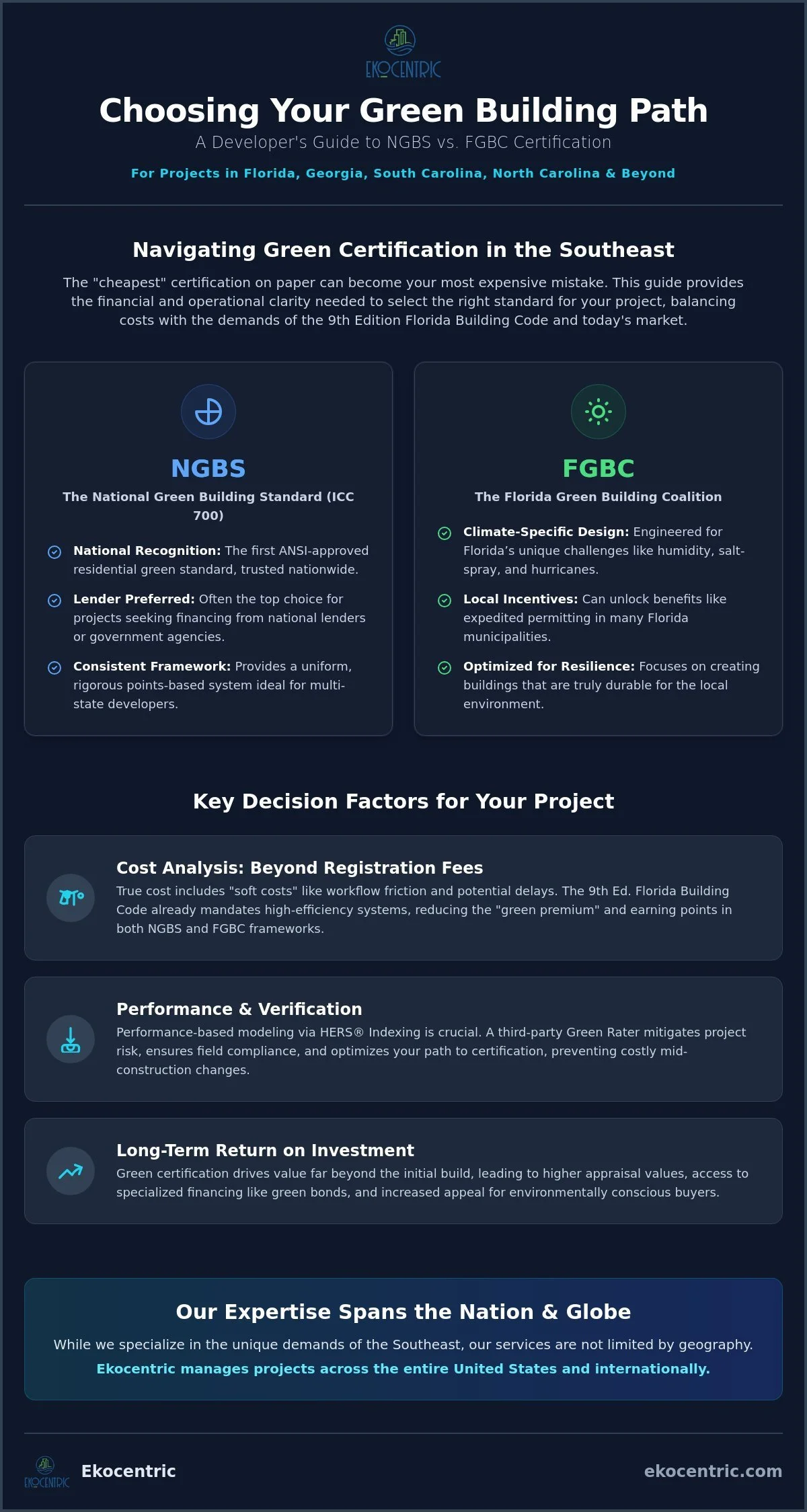
The National Green Building Standard (NGBS), also known as ICC 700, serves as the national benchmark for residential construction. It provides a rigorous, point-based system across six critical categories: site design, resource efficiency, water conservation, energy efficiency, indoor environmental quality, and homeowner education. Because it carries national recognition, it's often the preferred choice for developers seeking financing through national lenders or government agencies. It's a robust framework that brings a level of prestige and consistency to projects from North Carolina down to the Florida Keys. NGBS was the first residential green building standard to receive ANSI approval.
FGBC: Tailored for the Sunshine State
While NGBS offers national scale, the Florida Green Building Coalition (FGBC) provides a standard specifically engineered for the Sunshine State. Florida's environment presents unique challenges like extreme salt-spray, intense humidity, and the constant threat of hurricane-force winds. FGBC certification focuses heavily on these local factors. It ensures that buildings are resilient enough to handle Florida's specific environmental zones. Many local municipalities offer expedited permitting or zoning advantages for FGBC-certified projects. This makes it a powerful tool for builders who want to maximize local incentives while creating homes that are truly optimized for Florida’s climate.
Structural Comparison: Points, Paths, and Performance
The technical architecture of a green certification determines how much friction you'll encounter during the inspection phase. While some industry reports suggest that green building adds significant hard costs, they often overlook how the 9th Edition of the Florida Building Code has already closed the gap. Modern codes require high-efficiency envelopes and HVAC systems that naturally earn points in both systems. A precise cost analysis of NGBS vs. FGBC for Florida builders must account for how these baseline requirements reduce the "premium" typically associated with sustainable construction.
Integration with the Home Energy Rating System (HERS) is the backbone of this performance. In 2026, the industry is moving away from prescriptive checklists toward performance-based modeling. This shift rewards innovative engineering over expensive material mandates. Performance modeling allows your design team to find the most cost-effective way to hit efficiency targets. It's a pragmatic approach that works whether you're building in the humid coastal regions of North Carolina or the high-density urban centers of Florida.
Point Synergies with Florida Building Code
Florida builders already hit the ground running. Standard code requirements for insulation and window U-factors in Climate Zones 1 and 2 provide a significant head start. Achieving NGBS Bronze or Silver often requires only a few strategic upgrades beyond the current Florida Building Code. In contrast, FGBC "Certified" status is highly attainable because it was designed around these exact state mandates. Engaging LEED Green Rater services during the pre-con phase allows you to map these overlaps. This prevents you from paying for credits you've already earned through standard compliance. It's about working smarter, not just spending more on specialized materials.
Flexibility for Multi-family vs. Single-family Builds
For high-density developments in cities like Miami or Atlanta, NGBS offers a distinct advantage in multi-family streamlining. NGBS allows for building-level sampling and verification, which is often more cost-effective for large-scale projects. FGBC remains highly flexible but can sometimes require more granular, unit-by-unit documentation that adds to your soft costs. Owner education is another area of divergence. NGBS requires a comprehensive building manual for tenants, while FGBC focuses on specific maintenance checklists. If you're building across state lines, our team can verify your project's performance to ensure consistency from South Carolina to international markets. Choosing the right path early ensures that your operational goals don't clash with your financial reality.
Hard vs. Soft Cost Analysis for Florida Projects
Understanding the bottom line requires more than just skimming a fee schedule. A comprehensive cost analysis of NGBS vs. FGBC for Florida builders must distinguish between hard construction costs and the soft costs associated with verification. Hard costs, such as high-efficiency HVAC systems or advanced building envelopes, are tangible assets that improve property value. However, soft costs like registration, certification, and rater fees are the variables that often determine a project's true ROI. Our team focuses on balancing these expenses to ensure your sustainability goals don't compromise your margins.
Beyond the obvious fees, there is the "hidden" cost of documentation and project management. A poorly managed certification process can drain dozens of man-hours from your internal team. We step in to manage this administrative burden, allowing your project leads to focus on construction. This efficiency is vital whether you're building a single community in North Carolina or managing a diverse portfolio across the United States and international markets. Pragmatic planning turns green building from a regulatory hurdle into a streamlined operational advantage.
Registration and Certification Fee Structures
Registration and certification fees represent the entry price for green credentials, and the structures vary significantly between the two organizations. For a typical 50-unit, three-story residential development in Florida, the NGBS base certification fee totals 1,800 dollars, while FGBC fees for high-rise residential projects start at 5,000 dollars for buildings up to 50,000 square feet. NGBS offers a distinct advantage for high-volume builders; for those completing over 400 homes per year, the per-home fee drops to 100 dollars. This volume pricing makes NGBS a highly scalable option for developers expanding across Georgia and the Carolinas. In contrast, FGBC’s flat-fee structure for larger buildings can be more predictable for specific high-density urban developments.
The Rater Premium: Why Soft Costs Matter
The rater premium is often the most misunderstood variable in your budget. A skilled NGBS Green Verifier does more than just check boxes; they act as a risk manager for your entire build. While FGBC requires specific field inspections tailored to Florida’s unique environmental zones, NGBS follows a rigorous national protocol that provides the consistency national lenders demand. Early-stage consulting prevents the expensive mid-build change orders that occur when a project falls short of its target tier. By identifying the most cost-effective compliance paths during the design phase, we help builders avoid the friction of failed inspections and the high costs of late-stage retrofits. Investing in expert oversight early is the most effective way to protect your project's financial health.
ket Value and ROI: Beyond the Initial Build
The true value of a green credential reveals itself long after the certificates are framed. While the initial cost analysis of NGBS vs. FGBC for Florida builders often focuses on registration fees, the long-term impact on asset valuation is where the real ROI lives. In 2026, buyers and renters aren't just looking at square footage; they're scrutinizing utility projections and indoor air quality. Research, including studies by Berkeley Lab, shows that homes with high-performance features can sell for an average of 4.1% more than comparable non-certified properties. This premium is a direct result of building a more resilient, lower-maintenance asset that stands out in a crowded market from South Carolina to international territories.
Insurance remains a primary pain point for developers across the Southeast. Florida's volatile insurance market rewards buildings that go beyond the minimum requirements for hurricane resilience and moisture control. Both NGBS and FGBC provide structured pathways for impact-resistant windows and robust building envelopes. These features don't just protect the structure; they provide a documented narrative of risk reduction that can lead to more favorable premiums. It's a cause-and-effect relationship where specialized practices lead directly to lower operational overhead. We're dedicated to helping you build structures that are as financially sound as they are environmentally responsible.
Financing and Lending Incentives
Securing capital for large-scale developments is increasingly tied to ESG (Environmental, Social, and Governance) performance. National lenders like Fannie Mae and Freddie Mac often show a strong preference for NGBS-certified projects, providing better terms or lower interest rates for multi-family builds. On a regional level, FGBC remains the gold standard for qualifying for Florida-specific municipal grants and local zoning bonuses. Whether you're building in Georgia or North Carolina, aligning your project with these standards opens doors to specialized green financing that traditional builds can't access. We help you navigate these complex requirements to ensure your project qualifies for the best possible financial terms.
Long-term Performance and Maintenance
We approach every project as a pragmatic partner, focusing on durability to reduce future warranty claims. Third-party building envelope verification ensures that your team executes the details correctly the first time, preventing expensive moisture intrusion issues later. This commitment to quality control turns a certification into a lower-maintenance asset that holds its value over time. Linking building performance directly to asset valuation is the most effective way for developers to secure their investment. If you're ready to maximize your project's financial performance, explore our NGBS Green Verification and FGBC Certification Consulting services. We'll help you bridge the gap between technical compliance and long-term profitability.
Decision Matrix: Choosing the Right Path for Your Build
Selecting a green building standard is a strategic maneuver that impacts your project's lifecycle from the first permit to the final sale. It's not just about picking a label. It's about choosing the framework that offers the least resistance and the highest return on investment. For developers operating across the Southeast, this decision requires a clear-eyed look at project scale, regional incentives, and long-term asset goals. We're here to help you move beyond generic checklists and toward a tailored plan that works for your specific business reality.
Step 1: Define Project Scale and Geography
Geography often dictates the "tipping point" for certification choice. If your firm manages a multi-state portfolio with projects in Georgia, South Carolina, or North Carolina, the National Green Building Standard (NGBS) provides a consistent national benchmark. This uniformity simplifies internal training and documentation across different state lines. However, if your focus is strictly within Florida, the Florida Green Building Coalition (FGBC) offers deep alignment with local environmental zones and municipal grant programs. You should also consider the building type. While NGBS excels at streamlining high-density multi-family developments, FGBC remains a highly flexible and respected choice for Florida-specific townhome and single-family communities.
Step 2: Perform a Gap Analysis
Before committing to a path, you must understand where your current design stands. A rigorous cost analysis of NGBS vs. FGBC for Florida builders begins with mapping your existing code-compliant plans against certification requirements. By leveraging LEED BD+C consulting or NGBS verification experts, you can identify "low-hanging fruit" credits already baked into your design. This process allows you to calculate an estimated hard-cost premium for each tier. We look at the "cost per point" ratio to determine which standard achieves your target level with the smallest financial lift. This data-driven approach ensures you aren't over-engineering systems that don't contribute to your final score or your bottom line.
Partnering for Performance
We provide comprehensive support for builders across Florida, Georgia, South Carolina, and North Carolina. Our dual expertise as a licensed Florida Building Contractor and an NGBS Green Verifier means we understand the technical realities of the job site as well as the financial goals of the boardroom. We don't just verify performance; we act as a pragmatic partner to help you build more durable, efficient, and profitable assets. Whether you're working on a local development or an international project, our team has the capacity to manage your specialized requirements. Contact Ekocentric for a custom cost-benefit analysis of your next project. We'll help you find the most efficient path to a more sustainable and resilient future.
Building a Resilient and Profitable Future
The path you choose today defines your project's performance for decades. While the initial cost analysis of NGBS vs. FGBC for Florida builders provides a necessary financial roadmap, the ultimate goal is creating spaces that are durable, efficient, and highly marketable. Aligning with these standards reduces operational friction and positions your assets for superior valuation in an increasingly conscious market. Whether you're scaling a multi-family project across Georgia and the Carolinas or focusing on a high-resiliency build in the Florida Keys, the right certification strategy turns technical compliance into a distinct competitive advantage.
As a Licensed Florida Certified Building Contractor, Licensed Realtor in FL, NC, and SC, and an NGBS Green Verifier, we bring a unique perspective to every build. We bridge the gap between technical construction requirements and real estate market performance. Our team is ready to help you navigate these frameworks across the United States and international markets with pragmatic, results-oriented solutions that prioritize your project's longevity. It's time to build smarter and lead the industry toward a more sustainable future.
Optimize Your Project ROI with Ekocentric Certification Consulting. We are your dedicated partners in achieving excellence through specialized building practices.
Frequently Asked Questions
Is NGBS more expensive than FGBC for Florida builders?
The total cost depends on your project's scale and volume. While FGBC often has lower registration fees for individual homes, NGBS volume pricing for builders completing over 400 units per year can significantly lower the per-door investment. A thorough cost analysis of NGBS vs. FGBC for Florida builders should also factor in soft costs. NGBS's streamlined verification for multi-family projects often reduces the administrative hours required for documentation compared to unit-by-unit standards.
Does FGBC certification count toward national green building incentives?
FGBC is a state-specific standard primarily recognized by Florida municipalities and local grant programs. National lenders like Fannie Mae and Freddie Mac typically prefer ANSI-approved standards like NGBS for their specialized green financing programs. If you intend to secure national capital or green bonds, NGBS provides the broad recognition required by institutional investors across the United States.
How does the 2026 Florida Building Code affect green certification points?
The 9th Edition of the Florida Building Code, scheduled for December 31, 2026, raises the baseline for energy efficiency and hurricane resilience. Because the code now requires higher performance for envelopes and HVAC systems, builders can reach certification tiers with fewer additional upgrades. The gap between standard code compliance and green certification has narrowed, making it easier to hit Silver or Gold levels without a massive hard-cost premium.
Can I certify a project in South Carolina or Georgia using FGBC?
No, FGBC is specifically tailored for Florida's unique environmental zones and regulatory framework. For projects in Georgia, South Carolina, or North Carolina, we recommend using the National Green Building Standard. NGBS allows you to maintain a consistent sustainability strategy across your Southeast portfolio while using a framework that is recognized both nationally and internationally.
What are the typical soft costs for an NGBS Green Verifier in Florida?
Soft costs for an NGBS Green Verifier vary based on project density and the complexity of the desired certification tier. These costs cover essential services such as plan reviews, pre-drywall field inspections, and final performance testing. Engaging a rater during the design phase is the most effective way to manage these costs. Early consulting prevents expensive mid-build pivots and ensures your team is only pursuing the most cost-effective points.
How long does the certification process take for NGBS vs. FGBC?
Both certification timelines run parallel to your construction schedule. Verification happens at critical milestones, including the rough-in and final stages. Once the rater submits the final data, NGBS typically issues the certificate within a few weeks. FGBC follows a similar timeline, though builders seeking associated local municipal incentives should account for additional administrative review times at the city or county level.
Are there still tax benefits for green building in Florida after the 45L expiration?
Yes, builders still have access to powerful financial tools. The Federal Section 179D deduction provides significant benefits for energy-efficient commercial and high-rise residential buildings. Florida also offers a Graywater System Tax Credit for systems installed before 2027. Additionally, a new Florida Resilient Building Tax Credit program is set to begin in the 2027 tax year for buildings with specific performance certifications.
Which certification is better for multi-family developments in the Southeast?
NGBS is generally the most efficient choice for multi-family developments. Its verification protocols allow for building-level sampling, which reduces the inspection burden and associated soft costs for large-scale projects. This scalability makes it the ideal standard for developers managing high-density assets across Florida, Georgia, and the Carolinas who require a consistent and recognized performance benchmark.