
2027 Has some HERS Rating Changes coming
The RESNET HERS Rater requirement changes coming in 2027 affect both certification and project standards: candidates must score at least 85% on the Combustion Safety Simulation Exam, and the 301-2022, 310-2020, and 380-2022 standards suite becomes mandatory for homes with building permit dates on or after January 1, 2027. Builders and raters will need to account for these changes in project planning and quality assurance.
Keeping certification current and applying the right standards already takes careful coordination. The changes also touch continuing education, recertification, field QA, and the responsibilities of Raters of Record and Quality Assurance Providers.
This article explains what changes in 2027, which permit-date rule determines the standards suite for a HERS rating, and how QA requirements affect rated homes. You’ll also learn what builders should consider when coordinating with HERS raters so energy modeling, inspections, and testing stay aligned with the applicable requirements.
Key Takeaways
Match the standards suite to the home’s building permit date to keep a HERS rating aligned with the applicable requirements.
Plan for Field QA using the rounded-up review rate and distinguish between non-delegable and delegable reviews.
Account for certification exam thresholds, rating requirements, and continuing education when planning Rater qualification and recertification.
Understand how Raters of Record and Quality Assurance Providers share responsibility for field reviews and energy modeling file checks.
Treat the 2025 ANSI/RESNET standards as future reference standards, subject to adoption, rather than assuming they already apply.
Table of Contents
What new RESNET standards or certification requirements apply to HERS Raters in 2027?
Do 2027 RESNET changes affect HERS ratings, inspections, or energy modeling procedures?
Field QA requirements for Raters of Record
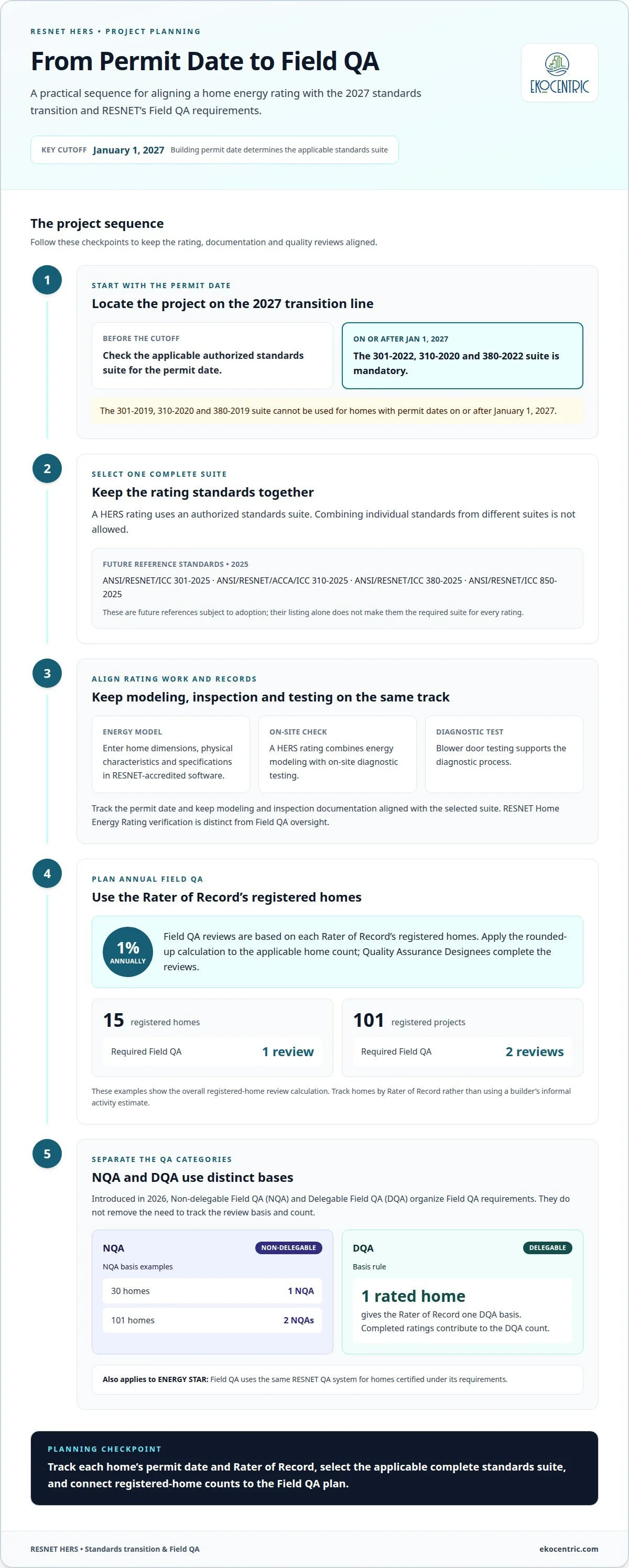
Field quality assurance reviews provide an on-site check of a Rater of Record’s home energy rating work. RESNET’s requirements set an annual review rate of 1% of a rater’s rated homes. Quality Assurance Designees complete the reviews using each Rater of Record’s registered homes as the basis. The result is a measurable verification step within the residential energy services process.
Apply the rounded-up calculation to the applicable home count. A Rater of Record with 15 registered homes requires one Field QA review. With 101 registered projects, the rounded-up 1% rate requires two reviews. The distinction matters for builders coordinating multiple projects: the review count follows the Rater of Record’s registered work, rather than a builder’s informal estimate of activity.
RESNET introduced two Field QA categories in 2026: Non-delegable Field QA (NQA) and Delegable Field QA (DQA). These categories organize Field QA requirements; they don’t remove the need to account for the review basis and resulting review count. For NQA, a basis of 30 homes accrues one NQA, while a basis of 101 homes accrues two. Keep this calculation distinct from the overall registered-home example.
DQA has a separate basis: each rated home gives the Rater of Record one DQA basis, so completed ratings contribute to the DQA count. Field QA also applies to ENERGY STAR quality assurance because the program uses the same RESNET QA system for homes certified under its requirements. This framework supports verification across both HERS and ENERGY STAR activity.
Do state or local building codes add requirements beyond RESNET’s 2027 HERS Rater changes? Building codes and RESNET Field QA address different requirements: the RESNET review rate is 1% annually, while applicable code provisions depend on the jurisdiction and project. A home energy rating can support energy-efficient construction and savings, but Field QA itself is a quality oversight requirement.
For builders, the practical step is to connect registered home counts with the QA review plan early. Track which homes belong to each Rater of Record, then apply the rounded-up rate to determine the review total. For example, 15 homes produce one review, while 101 produce two. This keeps project schedules and diagnostic verification records aligned with the required QA activity.
Field QA is one part of the broader verification system for energy ratings. RESNET’s 1% requirement establishes the review rate, while NQA and DQA distinguish categories used in the system. Understanding the basis behind each count helps builders coordinate HERS and ENERGY STAR work without confusing a QA review with the rating itself or its energy modeling.
Future ANSI/RESNET reference standards
Four ANSI/RESNET standards from 2025 are identified as future HERS reference standards, subject to adoption. Builders should distinguish those future references from the standards suite required for ratings based on 2027 permit dates.
New Standards and Certification Requirements
The future references are ANSI/RESNET/ICC 301-2025, ANSI/RESNET/ACCA/ICC 310-2025, ANSI/RESNET/ICC 380-2025, and ANSI/RESNET/ICC 850-2025. Their inclusion as future references does not itself make them the standards for every HERS rating. Their application depends on adoption for HERS use.
For project planning, identify which standards govern the rating before coordinating training, documentation, and field procedures. A home energy rating uses an authorized standards suite; combining individual standards from different suites is not allowed. This distinction helps builders and raters avoid treating a future reference as a current requirement.
Effects on Ratings and Procedures
The 2025 references point to standards that may shape future rating procedures after adoption. Until then, the permit-date rule determines which currently authorized suite applies. For homes with building permit dates on or after January 1, 2027, use the 301-2022, 310-2020, and 380-2022 suite. The 301-2019, 310-2020, and 380-2019 suite cannot be used for those homes.
A HERS rating combines energy modeling with on-site diagnostic testing. Raters enter the home’s dimensions, physical characteristics, and specifications into RESNET-accredited software. Blower door testing supports the diagnostic process, while the selected standards suite governs the rating. Builders can coordinate project records by tracking the permit date and keeping modeling and inspection documentation aligned with that same suite.
Effective Dates and Transition Deadlines
For HERS ratings in the United States, the 301-2022, 310-2020, and 380-2022 suite becomes mandatory for homes with building permit dates on or after January 1, 2027. The 301-2019, 310-2020, and 380-2019 suite cannot be used for homes with building permit dates on or after that date.
What are the effective dates and transition deadlines for RESNET 2027 requirements? The applicable standards transition is tied to the building permit date, with January 1, 2027, separating the permitted suites. HERS standards addenda compliance is determined by the permit date or an approved alternative date.
Use the permit date as an early coordination point for ratings scheduled across the transition. A project permitted before the cutoff may fall under a different suite than one permitted on or after it. The 2025 standards remain future references subject to adoption, so their listing alone does not replace the 2027 permit-date rule.
HERS Rater and Provider responsibilities
A HERS Rater and a Quality Assurance Provider have distinct roles in RESNET’s energy rating system. The Rater completes inspections, diagnostic testing, and home energy modeling under RESNET standards. The Provider oversees quality assurance, including file checks and mentorship. For builders coordinating multiple project teams, distinguishing these responsibilities helps route technical questions to the right role.
For recertification, HERS raters must earn a minimum number of continuing education credits. That ongoing learning is separate from initial certification training and testing. RESNET plans year-round professional development from February through November 2027, with 14+ live sessions planned. Raters can use those sessions to keep their professional knowledge current as rating practices develop.
Quality assurance also includes reviews of modeling work. RESNET standards require a Quality Assurance Provider to check 10% of a rater’s energy modeling files each year. These file checks focus on modeling records, while Field QA reviews examine work in the field. A project file review and an on-site review serve different oversight purposes, so one shouldn’t be treated as a substitute for the other.
A Quality Assurance Designee must have rated at least 25 homes. RESNET also requires Field QA reviews for Rating Field Inspectors and other associated users who are not the Rater of Record, at a rate of 1%, rounded up. Builders benefit from clear records showing who performed each activity, because QA responsibilities depend on the user’s role and the applicable review category.
Initial certification and Provider oversight are separate processes. A RESNET-accredited Rating Provider certifies a HERS Rater, who then follows RESNET standards for inspections, tests, and home energy modeling. This distinction helps builders identify whether a project question concerns the Rater’s qualification, the Provider’s oversight, or the technical documentation behind an energy rating.
The RESNET HERS Rater requirement changes coming in 2027 affect how teams plan responsibilities across projects. Builders coordinate rating schedules and project documentation; raters complete the technical rating work; Providers oversee quality assurance. These duties connect, but they aren’t interchangeable. A clear assignment of roles helps teams track modeling, testing, file reviews, and field activity without confusing who owns each task.
For a builder managing multiple homes, a practical approach is to organize project records by rater, Provider, and rating file. This makes it easier to follow which records are subject to file review and which work involves Field QA. The RESNET HERS Rater requirement changes coming in 2027 also make ongoing coordination valuable, since teams must keep project responsibilities aligned with applicable rating and QA processes.
RESNET home energy rating verification brings modeling, testing, and oversight together in a documented process. Builders can support a clear performance record by coordinating the responsible Rater and Provider early and maintaining consistent project records. This connects verification activity to each home’s documented characteristics and supports a rigorous assessment of energy performance.
What new RESNET standards or certification requirements apply to HERS Raters in 2027?
The most notable certification threshold for candidates is the RESNET Combustion Safety Simulation Exam. Candidates must score at least 85% on that exam. The threshold is specific to the simulation exam, so it should not be confused with the written exam standards. Candidates must also score at least 80% on the RESNET Core Written Exam and 80% on the RESNET Combustion Safety Written Exam.
Certification also requires completed home energy ratings. Candidates must complete five home energy ratings to qualify, and may need to complete 2-3 remaining ratings with their Quality Assurance Provider after training. That distinction matters when planning the candidate’s path: training and exams alone don’t complete the rating requirement. The ratings are part of qualification, not an optional extension of coursework.
Candidates have a defined completion window: HERS Rater candidates have one year from the time of training to complete certification requirements. This includes keeping exam results and required ratings on track within that period. Candidates who still need field experience after instruction should plan rating opportunities early, rather than leave required work until the end of the window.
The RESNET HERS Rater certification package includes the RESNET National Rater Exam, which includes a Combustion Safety and Work Scope Written Exam. The training package also requires ratings for certification. A live session includes classroom instruction, review, field training, and written and simulation exams in a 2-day in-person session. Candidates should distinguish these course components from the separate requirement to complete ratings.
In practice, use a simple sequence: complete training, prepare for the written and simulation exams, then finish all required home energy ratings. The score thresholds apply independently to each exam, so a passing result on one doesn’t replace another. For example, a candidate who reaches 85% on the simulation still needs the required written-exam scores and completed ratings.
These certification thresholds apply to candidates, while recertification has its own continuing education requirements. Builders coordinating work with a candidate should account for certification progress when planning ratings. Certification depends on meeting each exam threshold and completing the required ratings within one year after training, not on a single exam result.
HERS ratings in the United States must use one complete authorized standards suite; standards from different suites cannot be mixed. HERS standards addenda are incorporated into Chapter 3 of the HERS Standards. The HERS Index scale runs from 0 to 100, with 100 representing energy use of a standard code-built home and 0 representing a home that uses no net purchased energy. Training and testing requirements are separate from the Quality Assurance Provider’s mentorship and certification process.
Do 2027 RESNET changes affect HERS ratings, inspections, or energy modeling procedures?
Yes. The 2027 transition affects which standards suite governs a HERS rating, based on the home’s building permit date. Ratings for homes permitted on or after January 1, 2027, must use the 301-2022, 310-2020, and 380-2022 suite. The change means project teams need to align rating records with the applicable suite from the start.
A HERS rating combines energy modeling with on-site diagnostic testing. The Rater enters the home’s dimensions, physical characteristics, and specifications into RESNET-accredited software. These inputs form the rating model. On-site tests provide measured information about the home, including airtightness and duct leakage. Together, modeling and diagnostics establish the performance basis for the energy rating.
The 2027 standards transition doesn’t mean every inspection or test is replaced. It changes the standards suite used for qualifying ratings. Blower door testing assesses home tightness, while duct testing assesses leakage in the duct system. These diagnostics remain part of the rating process; the applicable suite governs how the rating is completed and documented.
Builders can make the standards transition easier to manage by tying the project record to its permit date. The rating file should use a consistent suite across the modeling and verification work. Mixing individual standards from different suites isn’t allowed. For example, a home permitted on or after January 1, 2027, cannot use the 301-2019, 310-2020, and 380-2019 suite.
Accurate inputs matter because the model represents the home’s physical characteristics and specifications. If plans change, the rating information should reflect the home being evaluated, not an earlier design assumption. Coordinating the model, inspection details, and diagnostic test results keeps the verification record coherent and supports a useful assessment of energy performance.
For homes near the 2027 transition, permit-date documentation is a practical starting point. Project teams can then coordinate the rating schedule, field testing, and modeling around the applicable standards suite. RESNET standards addenda compliance follows the building permit date or an approved alternative date. That date-based approach helps distinguish projects without assuming that every home in a development follows the same timeline.
The HERS score reflects the rating inputs and applicable method; the transition does not set one score for every home. A lower score represents better energy performance on the HERS Index. Builders can use the rating process to understand modeled performance and see where testing verifies the home’s characteristics.
For help coordinating project testing and rating documentation, connect with Ekocentric about RESNET HERS rating services.
Ekocentric: RESNET HERS Rater
Ekocentric provides RESNET HERS Rater services for builders who need home energy rating verification coordinated with project testing and documentation. This support is useful when a project’s permit date affects its standards suite, or when teams need to align energy modeling with on-site diagnostics and quality assurance responsibilities.
For projects pursuing broader building goals, Ekocentric also provides LEED Green Rater Services, National Green Building Standard Green Verification, and FGBC Certification Consulting. These offerings can support project teams working toward energy savings, resilience, and verified performance alongside a HERS rating.
Contact Ekocentric to discuss RESNET HERS rating support for your project.
Build performance planning into the next project
Planning around the RESNET HERS Rater requirement changes coming in 2027 works best when rating coordination is part of project delivery, not a last-minute documentation task. Builders can use performance goals to align decisions across teams, strengthen energy savings, and support homes designed for resilience. Clear responsibilities for energy verification also help maintain a reliable record from planning through completion.
For broader certification goals, Ekocentric also offers LEED Green Rater services, National Green Building Standard Green Verification, and FGBC Certification Consulting. A project-specific discussion can clarify how these verification and certification goals fit together and where each adds practical value.
Contact Ekocentric to discuss the needs of your next project. With informed coordination and a shared focus on better-performing homes, builders can make each project a purposeful step toward more efficient, resilient buildings.
Frequently Asked Questions
What RESNET HERS Rater requirement changes take effect in 2027?
For U.S. homes with building permit dates on or after January 1, 2027, ratings must use the 301-2022, 310-2020, and 380-2022 standards suite. Candidates must also meet the 85% minimum on the RESNET Combustion Safety Simulation Exam. For builders, the permit date helps determine which suite applies; candidate exam results affect qualification, not the home’s HERS score.
Which RESNET HERS Rater training, testing, or credential renewal rules are changing in 2027?
The stated certification threshold change is an 85% minimum score on the Combustion Safety Simulation Exam. Candidates also complete the required training, written exams, and home energy ratings. Recertification is a separate process: HERS raters must earn a minimum number of continuing education credits. RESNET plans professional development sessions from February through November 2027, giving raters opportunities to pursue ongoing learning.
How do the 2027 RESNET HERS Rater requirements differ from current rules?
The main transition is the standards suite used for ratings, determined by the building permit date. Homes permitted on or after January 1, 2027, use the 2022 suite rather than the 2019 suite. Candidate certification also includes the stated simulation exam threshold. The 2025 ANSI/RESNET standards are future references subject to adoption, so their publication does not by itself replace the applicable rating suite.
What will it cost HERS Raters to comply with RESNET requirement changes in 2027?
What penalties or certification risks apply if a HERS Rater does not meet the 2027 requirements?
Certification candidates must complete five home energy ratings and meet the exam thresholds, including at least 85% on the Combustion Safety Simulation Exam. The applicable 2027 standards suite must also be used for homes permitted on or after January 1, 2027.