A Developer’s Guide to Green Certification in 2026
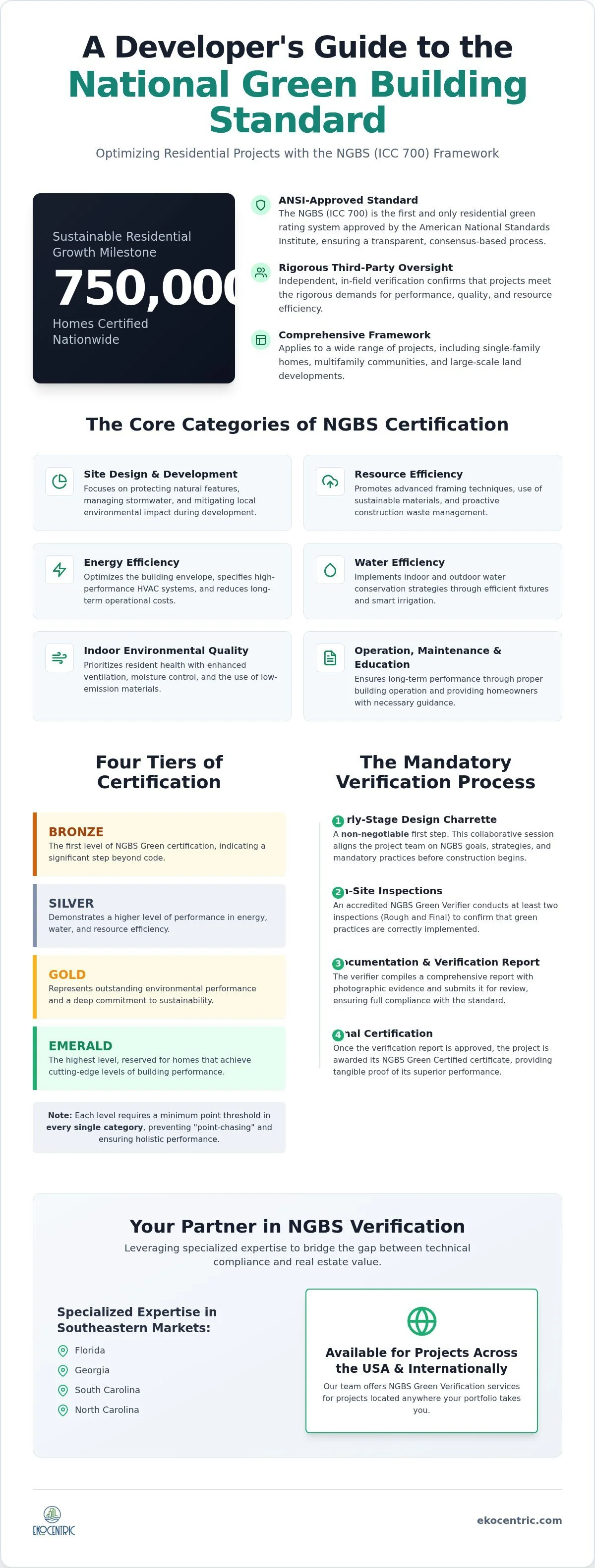
Across the nation, sustainable residential growth has reached new heights, contributing to a milestone of over 750,000 homes certified under the NGBS ANSI Standard as of early 2026. You likely recognize that building to a higher performance level is no longer just an environmental choice; it's a market necessity. However, balancing construction costs with the technical complexity of third-party verification across varying regulatory landscapes can feel like an exhausting hurdle. It's difficult to maintain high performance while keeping your project on schedule and within budget.
This guide will help you master the technical requirements and strategic benefits of the National Green Building Standard (ICC 700) to optimize your next residential project. By understanding the 2025 framework, you can turn compliance into a competitive advantage. We'll provide a clear roadmap to certification, explain the long term ROI of superior building performance, and show you how to identify a reliable verification partner. Wherever you develop across the country, these insights will ensure your project meets the rigorous demands of the modern green building market.
Key Takeaways
Learn how the NGBS ANSI Standard provides a rigorous, consensus-based framework for residential green building that ensures transparent third-party oversight.
Identify the most strategic certification path by comparing the technical requirements and cost structures of NGBS (ICC 700) against LEED for Homes.
Master the core scoring categories, from site design to resource efficiency, to optimize environmental impact and long-term building performance.
Understand the mandatory verification timeline, including why early-stage design charrettes are non-negotiable for successful on-site inspections.
Leverage specialized expertise to bridge the gap between technical compliance and real estate value in Florida, Georgia, the Carolinas, and across the USA.
Table of Contents
What is the NGBS ANSI Standard (ICC 700)?
The National Green Building Standard (ICC 700) stands as the premier residential green rating system in the United States. It's the first and only system of its kind to receive approval from the American National Standards Institute (ANSI). This distinction is critical because it guarantees a transparent, consensus-based development process with rigorous third-party oversight. For developers, the NGBS ANSI Standard provides a comprehensive framework that applies to single-family homes, multifamily communities, and even large-scale land development.
To better understand why this certification is the preferred choice for modern residential developers, watch this helpful video:
As we move through 2026, the ICC 700-2024 has established itself as the current benchmark for excellence. It requires builders to go beyond basic code compliance, focusing on measurable outcomes in energy efficiency, water conservation, and indoor environmental quality. By adopting this standard, you're committing to a level of performance that resonates with savvy buyers and institutional lenders alike.
The Evolution of the ICC 700
The ICC 700 has evolved significantly to keep pace with rapid changes in building science and energy codes. The shift from the 2020 version to the 2024 update includes more aggressive targets for building envelope performance and resource efficiency. These updates ensure that certified projects remain future-proof against rising energy costs and evolving climate demands. ANSI-approved standards carry substantial weight with institutional investors because they provide a standardized, risk-mitigated metric for evaluating green assets. This level of credibility is difficult to achieve with proprietary or non-consensus-based rating systems.
National Reach and Market Adoption
The reach of this standard extends across all 50 states and into international markets, making it a versatile tool for developers with diverse portfolios. While our team provides specialized expertise in Southeastern markets like Florida, Georgia, South Carolina, and North Carolina, we offer NGBS Green Verification services for projects anywhere in the USA. This national adoption is bolstered by alignment with financing programs from Fannie Mae and Freddie Mac, which provide tangible financial incentives for certified buildings. Ultimately, the standard serves as a strategic instrument for optimizing building longevity and ensuring that your residential assets maintain their value over time.
Core Categories and Scoring of the NGBS
Achieving certification under the NGBS ANSI Standard requires a holistic approach across several key performance areas. This isn't a "pick and choose" system where you can ignore one category in favor of another. Instead, the ICC 700 ensures that every certified project meets a baseline of excellence across six critical chapters. Site Design focuses on protecting natural features and managing stormwater to mitigate local environmental impact. Resource Efficiency pushes for advanced framing techniques and proactive waste management to reduce the carbon footprint of the construction process itself.
Energy and Water Efficiency form the technical core of the standard. By optimizing the building envelope and high-performance HVAC systems, developers can significantly lower operational costs. Similarly, indoor and outdoor water conservation strategies ensure long-term resource efficiency. Finally, Indoor Environmental Quality prioritizes resident health through enhanced ventilation and the use of low-emission materials. Balancing these categories is the key to creating a high-quality living space that stands the test of time.
Certification Levels: Bronze to Emerald
The scoring system is divided into four distinct tiers: Bronze, Silver, Gold, and Emerald. Each level requires a specific point threshold in every single category, which prevents "point-chasing" in only one area. It's vital to master the NGBS Green certification process early in the design phase. Certain mandatory requirements must be met regardless of your total point count, making early-stage planning essential. Choosing between Bronze or a more ambitious Emerald target depends on your project budget, local market demands, and specific performance goals.
NGBS Green+ Performance Badges
For developers who want to push beyond the baseline, the NGBS Green+ badges offer a powerful way to highlight exceptional performance in specific niches. These badges don't just add points; they provide a clear, marketable narrative for potential residents and investors. The Wellness badge focuses on resident health, while the Resilience badge is increasingly vital for projects in coastal markets like Florida and the Carolinas that face wind and flood risks. Other designations include Smart Home technology and the prestigious Zero Energy or Net Zero Water badges.
These specialized credentials allow you to differentiate your project in a crowded market by proving a deep commitment to future-proof construction. If you're looking to identify which badges offer the highest ROI for your specific site, our NGBS Green Verification services can provide the technical roadmap you need. We help you bridge the gap between complex scoring requirements and tangible real estate value, whether you're building in the Southeast or anywhere else in the country.
NGBS vs. LEED: Selecting the Right Path
Choosing between the NGBS ANSI Standard and LEED (Leadership in Energy and Environmental Design) isn't about which is "better" in a vacuum. It's about which framework aligns most effectively with your project's specific asset class and long-term goals. While LEED is a globally recognized brand synonymous with sustainability, it was originally designed for commercial office buildings. The NGBS, conversely, was built from the ground up specifically for residential construction. This fundamental difference often results in NGBS providing more logical pathways for single-family and multifamily developers.
Cost is a major driver in this decision. While both require registration and certification fees, the soft costs associated with consulting and verification can vary. LEED often requires more rigorous documentation that may feel administrative rather than performance-based. The NGBS focuses heavily on field-verified performance, which many residential builders find more pragmatic. However, if your project is a high-profile mixed-use development in a major metropolitan area, the prestige of a LEED Gold or Platinum plaque might offer a marketing edge that justifies the additional overhead.
The Multi-Family Decision Matrix
Deciding the right path for a multifamily project involves analyzing more than just green goals. You must consider project size, location, and the specific requirements of your funding sources. Many national financing programs, such as those through Fannie Mae or Freddie Mac, recognize both standards, but the "ease" of certification can be heavily influenced by regional building codes. For instance, in markets like Florida or North Carolina, the NGBS ANSI Standard often aligns more seamlessly with existing code requirements. Engaging a LEED Green Rater early in the process helps you navigate these complexities and ensures your project meets the necessary thresholds for your chosen standard without unnecessary rework.
Synergy Between Standards
While most developers choose one path, dual certification is technically feasible due to the significant overlap in credit requirements. Both standards prioritize energy efficiency, water conservation, and high-quality indoor environments. If your team is already tracking data for one, achieving the second may require only a small amount of additional documentation and verification. Ekocentric helps developers choose the path of least resistance by identifying the specific certification that balances technical efficiency with the highest possible real estate value. We serve as your pragmatic partner to ensure your dedication to environmental stewardship translates into a successful, high-performance asset, whether you're building in the Southeast or anywhere else in the country.
The Verification Process: From Design to Final Inspection
Integrating the NGBS ANSI Standard into your development isn't a passive exercise. It's a technical partnership between the project lead and an accredited NGBS Green Verifier. This independent third party is mandatory to ensure every residential unit meets the rigorous, consensus-based requirements of the ICC 700. Unlike some certification paths that rely heavily on administrative paperwork, the NGBS requires on-site validation. This ensures that high-performance designs actually translate into tangible building longevity and resource efficiency.
The process relies on a specialized scoring tool that tracks credits throughout the construction lifecycle. This tool serves as the single source of truth for the project team, allowing for real-time adjustments to maintain the target certification level. By verifying performance in the field rather than just on paper, developers gain confidence that their assets will perform as intended for decades to come.
Phase 1: Design and Pre-Construction
Success begins with the design charrette. This collaborative session is a non-negotiable first step where architects, engineers, and verifiers align on the target certification level. During this phase, we register the project and establish a baseline score. We identify "low-hanging fruit" credits, such as site-specific stormwater management or advanced framing techniques, which offer high point values with minimal budget impact. Reviewing plans early ensures compliance with mandatory chapters before construction begins, preventing costly mid-project corrections.
Phase 2: Construction and Verification
Verification moves to the job site once construction starts. The Rough-In Inspection happens after framing and mechanical systems are installed but before the drywall is hung. The verifier inspects insulation quality, air sealing, and ductwork integrity. These components are critical for building performance and can't be easily addressed once the walls are closed. It's a vital quality control gate that protects the developer's investment.
The Final Inspection takes place upon project completion. This stage involves performance testing, such as blower door and duct leakage tests, to confirm the building envelope meets the design intent. We also verify the installation of high-efficiency appliances and lighting. Once the verifier collects all field data, they submit the final report for official certification. If you're ready to secure your project's future, contact us for NGBS Green Verification services to ensure a seamless certification journey from design to final sign-off.
Optimizing Building Performance with Ekocentric
Implementing the NGBS ANSI Standard is a complex undertaking that requires more than just a technical checklist. At Ekocentric, we serve as the bridge between technical compliance and real estate value. Our team functions in a dual capacity as both accredited verifiers and strategic real estate advisors. This unique perspective allows us to guide developers through the certification process while simultaneously identifying opportunities to enhance the marketability of their assets. We don't just help you earn a plaque; we help you build a high-performance legacy.
While our roots are deep in the Southeastern markets of Florida, Georgia, South Carolina, and North Carolina, our reach is truly national. We provide specialized expertise across the United States and even internationally, ensuring that your project meets the highest benchmarks regardless of its location. By handling the heavy administrative burden of certification, we allow your team to focus on construction and delivery. Our goal is to streamline the path to certification so you can realize long term operational savings and superior building performance without the friction of navigating multi-state codes alone.
A Comprehensive Sustainability Partner
We take a holistic approach to building performance by integrating the NGBS ANSI Standard with other critical benchmarks like HERS ratings and ENERGY STAR partnerships. Our background as a licensed Florida Certified Building Contractor means our advice is always practical and buildable. We understand the realities of the job site and the constraints of construction budgets. You can explore our full range of Green Verification services to see how we coordinate these various standards into a single, efficient workflow that minimizes redundancy and maximizes results.
Maximizing Real Estate Value
Certified buildings consistently outperform non-certified counterparts in both resale and rental markets. Savvy residents are looking for the lower utility costs and healthier indoor environments that an NGBS-certified home provides. For larger developers, these certifications are essential for attracting institutional capital through ESG-compliant assets. Investors now prioritize projects that demonstrate a clear commitment to resource efficiency and environmental impact. At Ekocentric, we are dedicated to environmental stewardship and the pragmatic success of every developer we partner with, ensuring that your next project sets a new standard for quality and sustainability.
Secure Your Competitive Advantage in Sustainable Development
Adopting the NGBS ANSI Standard is a definitive step toward building excellence and long-term asset value. Success relies on early-stage planning and rigorous on-site verification to ensure designs perform as intended. By prioritizing resource efficiency and resident wellness, you're doing more than meeting a code; you're creating a resilient legacy for the future.
Navigating these technical requirements doesn't have to be a burden on your internal team. Ekocentric acts as your pragmatic partner, bridging the gap between technical compliance and real estate ROI. We bring the expertise of Licensed Florida Certified Building Contractors and Accredited NGBS Green Verifiers to every project. Whether you're building in the Southeast or anywhere across the USA, we provide the specialized oversight needed for LEED, HERS, and ENERGY STAR excellence.
Partner with Ekocentric for your NGBS Green Verification to optimize your next project for maximum performance and marketability. We're ready to help you build a more sustainable future today.
Frequently Asked Questions
Is the NGBS ANSI standard mandatory for all new residential builds?
The NGBS ANSI Standard is a voluntary rating system rather than a universal legal requirement. However, many local jurisdictions and municipalities incorporate these standards into their building codes or offer density bonuses for certified projects. Developers often pursue this certification to satisfy the requirements of green financing programs or to meet internal ESG goals. It remains a strategic choice for those aiming to validate their commitment to high-performance residential construction.
How much does NGBS Green Verification typically cost for a multi-family project?
Total costs for certification involve two separate components: administrative fees paid to the certification body and professional fees for verification services. Fees are typically calculated based on the number of units and building height. While we don't provide flat-rate pricing due to the unique nature of every project, we recommend budgeting for both the registration and the on-site inspections required at the rough-in and final stages of the construction lifecycle.
What is the difference between an NGBS Verifier and a HERS Rater?
A HERS Rater focuses specifically on energy performance modeling and physical testing like blower door and duct leakage assessments. An NGBS Verifier has a broader scope, overseeing the holistic certification across six environmental categories. Because the NGBS ANSI Standard requires energy testing, many of our consultants are cross-trained in both disciplines. This dual expertise ensures that your technical energy data aligns perfectly with your overall green building and sustainability goals.
Can an existing building achieve NGBS certification through remodeling?
Existing buildings can absolutely achieve certification through the standard's dedicated remodeling chapters. The process focuses on improving the performance of the building envelope, mechanical systems, and water fixtures during a renovation. The 2025 update also introduced property-level certification for multifamily communities. This allows developers to certify an entire site rather than just individual buildings, which is a significant advantage for older communities looking to upgrade their market value and longevity.
How does the NGBS ANSI standard impact building insurance or financing?
Certification often acts as a key to specialized financing through national programs like Fannie Mae and Freddie Mac, which offer preferred interest rates for green-certified assets. Some insurance providers also recognize the increased resilience of NGBS-certified buildings, potentially leading to lower premiums. By proving the building is constructed to withstand wind, water, and fire risks, you reduce the long-term liability for both lenders and insurers while creating high-quality living spaces.
What happens if a project fails to meet a mandatory requirement during inspection?
Mandatory requirements are non-negotiable thresholds that must be met for any level of certification. If a project fails an inspection, the developer must correct the deficiency before the verifier can submit the final report. This is why we emphasize the design charrette and the rough-in inspection. Catching a framing or insulation error before the drywall is installed prevents expensive retrofits and ensures the project stays on the path to successful certification.
How long does the NGBS certification process usually take from start to finish?
The timeline for certification mirrors your project's construction schedule. It begins during the design phase with plan reviews and project registration, continuing through the rough-in and final inspections. Once the final inspection is complete and the verifier submits the data, the certification body typically issues the final certificate within a few weeks. Early engagement is the best way to ensure the process doesn't cause any delays to your final certificate of occupancy.
Does NGBS certification expire, or is it permanent for the building?
Certification is permanent for the specific version of the standard used at the time of construction. Once a building earns its plaque, that achievement stays with the property indefinitely. However, as building science evolves, the ICC 700 is updated every few years. While your building won't lose its original status, newer projects will be measured against more recent versions. This ensures the industry continues to push the boundaries of resource efficiency and environmental stewardship.