HERS Rating vs. ERI: Key Differences for Home Builders
What if the biggest obstacle to your project's success isn't the building envelope, but a simple misunderstanding of technical acronyms? For many builders across Florida, Georgia, and the Carolinas, the distinction between various energy metrics feels like a moving target. You likely already know that meeting stringent energy codes is non-negotiable for passing inspections and delivering value to building owners, yet the terminology remains a persistent source of friction during the planning phase.
In construction what is the difference between a HERS rating and an ERI? While these terms are often used interchangeably, they represent different applications of the same underlying ANSI/RESNET/ICC 301 standards. We're here to clear the confusion between HERS and ERI so you can choose the right energy compliance and certification path for your next project. This guide provides a clear breakdown of how these ratings function, how to select the right rater for your specific goals, and how to ensure code compliance across different states. By mastering these nuances, you'll transform complex requirements into a competitive advantage that optimizes performance and builds lasting trust with your clients.
Key Takeaways
Understand that HERS is a specific, branded implementation of the broader Energy Rating Index (ERI) framework found in modern building codes.
In construction what is the difference between a HERS rating and an ERI? Learn to identify which path your local jurisdiction requires to avoid failed inspections and project delays.
Discover how HERS ratings serve as a foundational metric for achieving premium green certifications like LEED and NGBS to maximize building longevity and resource efficiency.
Select the most effective rater to bridge the gap between technical modeling and your long-term environmental stewardship goals across Florida, Georgia, and the Carolinas.
Table of Contents
Defining HERS and ERI: The Foundation of Energy Benchmarking
Building high-performance homes requires more than just quality materials; it demands a precise understanding of the metrics that define success. As energy codes become more sophisticated across Florida, Georgia, and the Carolinas, builders often find themselves caught between different technical standards. One of the most common questions we encounter is: In construction what is the difference between a HERS rating and an ERI? While these two concepts are deeply connected, they serve distinct roles in the lifecycle of a residential project.
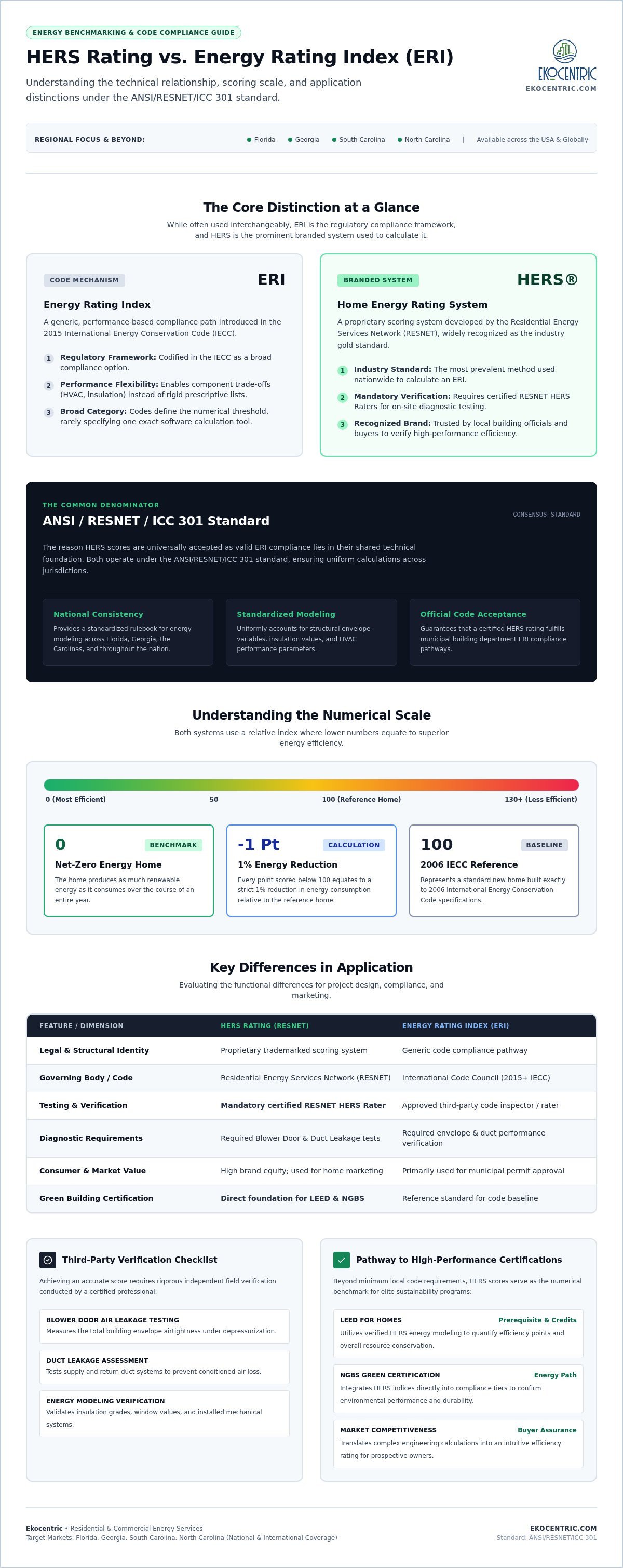
Both systems use a numerical scale where lower scores indicate a more efficient building. A score of 0 represents a net-zero energy home, while higher scores reflect increased energy consumption. However, understanding whether you're chasing a proprietary benchmark or a code-mandated index is essential for passing inspections and meeting your environmental goals. This distinction helps project leads navigate the bridge between simple compliance and true performance optimization.
To better understand this concept, watch this helpful video:
What is a HERS Rating?
The Home Energy Rating System, or HERS Index, is a proprietary scoring system developed by the Residential Energy Services Network (RESNET). It's widely considered the gold standard for measuring a home's efficiency. In this system, a score of 100 represents a standard new home built to the 2006 International Energy Conservation Code specifications. Every point below 100 indicates a 1% reduction in energy consumption compared to that reference home.
Achieving an accurate HERS score requires a certified RESNET HERS Rater. This professional performs rigorous third-party verification, including blower door testing and duct leakage assessments. Because HERS is a recognized brand, it offers builders a powerful marketing tool to communicate tangible value to homeowners who want lower utility bills and a smaller carbon footprint.
What is an Energy Rating Index (ERI)?
The Energy Rating Index (ERI) is a generic performance-based compliance path first introduced in the 2015 International Energy Conservation Code (IECC). Unlike prescriptive paths that mandate specific R-values or window ratings, the ERI gives you the flexibility to innovate. It allows you to trade off different efficiency features, such as high-performance HVAC systems or advanced insulation, to reach a target score required by local building officials.
When building officials ask, "", they're often looking at how you prove code compliance. The ERI is the regulatory framework, while HERS is the most common method used to calculate that index. By focusing on performance rather than a checklist, you can optimize your project for both cost-effectiveness and environmental stewardship.
The Technical Relationship: Is HERS a Type of ERI?
To understand the relationship between these two terms, think of the Energy Rating Index (ERI) as a broad category of measurement and the HERS Index as the most prominent brand within that category. While building codes often list the ERI as a compliance pathway, they rarely specify which calculation method you must use. However, because HERS is built on the exact same technical foundations as the ERI, it's become the default choice for builders across the country. The answer lies in the distinction between a regulatory requirement and a specific, branded tool used to meet that requirement.
Most jurisdictions that allow an ERI pathway for code compliance will readily accept a HERS score as valid proof. This is because HERS isn't just a random number; it's a rigorous assessment based on a national consensus. By using a HERS rating, you're essentially providing a certified ERI score that building officials already trust. This alignment streamlines the inspection process and reduces the risk of failing energy code checks at the finish line.
The ANSI/RESNET/ICC 301 Standard
The consistency of these ratings across different states like Florida, Georgia, and the Carolinas is made possible by the ANSI/RESNET/ICC 301 Standard. This technical rulebook dictates how energy models are calculated nationwide. It ensures that variables like insulation values, HVAC efficiency, and air leakage are measured using a uniform methodology. Without this standard, a rating in one state wouldn't be comparable to another, making it impossible to scale high-performance building practices. This level of precision is what allows us to bridge the gap between technical modeling and true environmental stewardship.
Why HERS is the Most Common ERI Pathway
The dominance of HERS as the preferred ERI pathway stems from a robust infrastructure that other indices haven't matched. There's a widespread network of certified professionals and sophisticated software packages designed specifically for HERS calculations. This ecosystem makes it easier for project leads to find reliable partners who can guide them through complex energy goals. Beyond code compliance, HERS offers significant market recognition. Realtors, lenders, and homeowners increasingly look for HERS scores as a mark of quality and resource efficiency. If you're looking to elevate your project's performance, partnering with a RESNET HERS Rater ensures your project meets both regulatory standards and your own commitment to building a more conscious future.
HERS vs. ERI: Key Differences in Application
While the technical foundation of these two metrics is nearly identical, their application on the jobsite often serves two different masters. One acts as the legal floor you must cross to secure a certificate of occupancy, while the other serves as a ceiling of excellence that differentiates your work in a crowded market. Understanding how to deploy each effectively is vital for builders who view energy efficiency as a core component of high-quality living spaces rather than just another regulatory hurdle.
When you're dealing with local building officials, you're likely discussing the ERI as a compliance path. However, when you're speaking to a potential homebuyer or applying for a premium certification, you're almost certainly using a HERS score. This distinction allows you to navigate the bridge between meeting basic legal requirements and achieving true performance optimization.
Building Code Compliance (ERI)
Modern building codes, including the 2018, 2021, and 2024 versions of the International Energy Conservation Code (IECC), offer the ERI as a flexible performance-based alternative to prescriptive requirements. This is particularly relevant for builders in Florida, Georgia, and the Carolinas, where state-specific energy code adoptions are constantly evolving. The ERI path allows you to choose the most cost-effective efficiency features for your specific design, provided the final score meets the state mandate.
A critical component of the ERI pathway is the "backstop" requirement. To ensure resource efficiency and long-term durability, the IECC mandates that the building envelope (insulation and windows) must still meet minimum performance levels, regardless of how efficient the HVAC system or water heater might be. This prevents builders from "gaming" the score with high-efficiency appliances while neglecting the home's fundamental shell. It's a pragmatic safeguard that ensures every consciously built home maintains a high level of thermal integrity.
Voluntary Certification and Marketing (HERS)
Beyond the legal requirements of the building code, HERS ratings are the primary vehicle for voluntary green building certifications. If your goal is to achieve ENERGY STAR or LEED for Homes, a HERS rating is a non-negotiable requirement. These programs use the HERS Index as a foundational metric to verify that a home is significantly more efficient than a standard new build. This third-party verification provides building owners with the confidence that their investment will deliver lower utility costs and a healthier indoor environment.
In a competitive real estate market, a low HERS score is a powerful differentiator. It translates complex technical data into a simple, recognizable number that realtors and buyers can easily understand. By utilizing Ekocentric's RESNET HERS Rater services, you're not just checking a box for a code official. You're creating a tangible record of your dedication to environmental stewardship and superior construction quality. This transparency builds lasting trust with your clients and positions your brand as a leader in the transition toward a more sustainable future.
Why the Distinction Matters for LEED and NGBS Projects
For builders aiming beyond the minimum requirements of the IECC, the distinction between a generic index and a branded rating becomes even more critical. High-performance projects like those pursuing LEED or National Green Building Standard (NGBS) certification rely on these metrics to validate their environmental impact. While code officials might only look for an ERI score to verify compliance, green building programs specifically require a HERS rating because it carries the weight of RESNET’s quality assurance protocols. This verification is essential for builders who want to prove their commitment to a more environmentally conscious future.
Understanding in construction what is the difference between a HERS rating and an ERI is the first step toward choosing the right certification path for your project goals. By focusing on performance optimization rather than simple compliance, you can leverage these ratings to create high-quality living spaces that stand the test of time.
The Role of the LEED Green Rater
The HERS Index serves as the mandatory baseline for LEED for Homes. You can't achieve certification without first establishing this foundational energy performance metric. However, a HERS rating is just the beginning of the journey. Our LEED Green Rater services look at the project through a holistic lens. We integrate energy modeling with broader sustainability goals like water conservation, material resource efficiency, and indoor air quality. This approach ensures that your dedication to environmental stewardship translates into a building that performs as intended. By using the rating process as a design tool rather than just a final check, we help you optimize the building's performance before the first shovel hits the ground.
NGBS Verification and ERI
The National Green Building Standard (NGBS) provides a flexible path for residential and multifamily developers to earn Bronze, Silver, Gold, or Emerald status. In this framework, your ERI or HERS score directly influences the points awarded in the Energy Efficiency category. Lower scores lead to higher point totals, making the rating process a powerful tool for performance optimization. We often act as the single point of contact for both HERS and NGBS verification; this streamlines the process for developers in Florida, Georgia, and the Carolinas. This pragmatic partnership reduces administrative friction and ensures that your project’s specialized requirements are managed by experts who understand the business realities of complex construction. We act as the bridge between technical energy modeling and high-level green certification, helping you navigate the lack of internal capacity to manage these specialized project requirements. If you're ready to elevate your next development, explore our full suite of certification consulting services today.
Choosing the Right Energy Rating Path for Your Project
Selecting the right path for your project depends on whether you're aiming for basic code compliance or a high-performance label that demonstrates your commitment to environmental stewardship. Builders in Florida, Georgia, and the Carolinas face unique climate challenges that make energy modeling a vital tool for project success. The choice often comes down to your long-term vision for the property. While the ERI provides a flexible route for legal compliance, a HERS rating serves as a comprehensive benchmark that adds tangible value for building owners and ensures resource efficiency.
Assessing Your Compliance Needs
When you're evaluating compliance options, the ERI path often offers more design flexibility than prescriptive or UA trade-off methods. It allows you to leverage high-performance HVAC systems or advanced insulation strategies to offset other design choices, such as larger window-to-wall ratios. Identifying these opportunities during the early design phase prevents costly retrofits and ensures your project hits its efficiency targets without unnecessary expense. Integrating energy modeling during the schematic design phase allows you to identify the most cost-effective path to high performance before construction begins.
This process also identifies the need for specialized field testing required for final certification. Our team provides essential onsite verification, including:
Blower Door Testing to verify envelope tightness and minimize energy waste.
Duct Testing to ensure conditioned air reaches its intended destination efficiently.
Performance Benchmarking to confirm the home meets the specific ERI or HERS score required by local building officials in your jurisdiction.
Selecting a Qualified Rater
Choosing a rater with national experience and a deep understanding of Southeast environmental conditions is essential for long-term building durability. Humidity management and high cooling loads in markets like Florida and South Carolina require a consultant who understands how energy modeling translates to actual comfort and longevity. Understanding in construction what is the difference between a HERS rating and an ERI ensures you select a partner capable of navigating both code mandates and voluntary green standards.
Credentials matter; a partner who is both a RESNET HERS Rater and an NGBS Verifier or LEED Green Rater can provide a seamless transition from code compliance to premium certification. This multi-disciplinary expertise ensures that your project’s specialized requirements are managed with pragmatic business acumen and a sincere dedication to quality. If you're ready to determine the most effective path for your next build, contact Ekocentric for a project consultation to determine your optimal rating strategy.
Elevating Your Build with Performance-Driven Metrics
Mastering the technical nuances of energy benchmarking transforms a regulatory requirement into a powerful asset for your business. We've explored how the Energy Rating Index provides a flexible framework for code compliance, while the HERS Index offers a recognized brand for market differentiation and premium certifications. The distinction is the bridge between meeting a legal minimum and achieving a high-performance standard that ensures building longevity and resource efficiency.
As a licensed Florida Certified Building Contractor and certified RESNET HERS Rater and LEED Green Rater, we bring specialized expertise to projects across Florida, Georgia, and the Carolinas. We understand the pragmatic business realities of residential development and act as your dedicated partner to manage specialized project requirements. By integrating energy modeling early in the design process, you'll deliver high-quality living spaces that stand the test of time and provide superior value to building owners.
Optimize your project's performance with Ekocentric's expert consulting services. Together, we can build a more environmentally conscious future through sustainable and efficient construction practices.
Frequently Asked Questions
Is a HERS rating the same as an ERI score?
A HERS rating is not exactly the same as an ERI score, although they share the same technical foundation. The Energy Rating Index (ERI) is a generic performance category defined by building codes like the IECC. In contrast, the HERS Index is a proprietary system managed by RESNET. Most builders use HERS ratings to satisfy ERI code requirements because the methodology aligns with national standards. It's essentially using a specific, trusted tool to meet a broader regulatory requirement.
Can I use a HERS rating for building code compliance in Florida?
Yes, you can use a HERS rating to demonstrate compliance with the Florida Building Code's performance path. Florida recognizes the ERI pathway; because HERS ratings follow the ANSI/RESNET/ICC 301 standard, building officials accept them as valid proof of energy efficiency. Using this path offers builders more flexibility than prescriptive methods. It allows for trade-offs between different building components while ensuring the home meets the state's stringent resource efficiency and performance mandates.
Who is authorized to perform a HERS rating or ERI verification?
Only a certified RESNET HERS Rater is authorized to perform these ratings and verifications. These professionals must undergo rigorous training and maintain certifications to ensure quality assurance and technical accuracy. For builders, partnering with a rater who also holds credentials as an NGBS Verifier or LEED Green Rater provides a significant advantage. This dual expertise ensures that your project meets both local code requirements and high-level national sustainability standards through accurate third-party verification.
What is a 'good' HERS score for a new home in 2026?
This often comes down to the target score. By 2026, a "good" HERS score typically falls in the 40 to 50 range, representing a home that is 50% to 60% more efficient than a standard 2006 home. As energy codes become more stringent across the Southeast, aiming for scores below 50 ensures your project remains ahead of future regulatory shifts and provides superior value to building owners.
Does every new home require an ERI or HERS rating?
No, not every new home requires an ERI or HERS rating. Builders can often choose between prescriptive, UA trade-off, or performance-based compliance paths. However, many developers prefer the ERI path because it offers the most design flexibility and cost-effective optimization. While not always mandatory, a HERS rating is required if you are pursuing specific green certifications like ENERGY STAR, LEED for Homes, or the National Green Building Standard to validate your environmental stewardship.
How much does a HERS rating typically add to construction costs?
A HERS rating itself involves a professional service fee for modeling and field testing, such as blower door and duct leakage assessments. While there is an upfront cost for the rater, the process often identifies cost-saving opportunities in the building envelope or HVAC system. By optimizing performance early, you can often reduce equipment costs or avoid expensive over-insulation. The investment typically pays for itself through increased property value and verified resource efficiency for the owner.
What happens if my building doesn't meet the target ERI score?
If a project fails to meet its target ERI score, you must identify and remediate the performance gaps before final inspection. Common issues include excessive air leakage or under-performing ductwork. This is why early-stage energy modeling is so critical. By identifying potential failures during the design or framing stages, you can make adjustments to the building shell or mechanical systems. A certified rater will then perform follow-up testing to confirm the building finally meets the necessary compliance threshold.
How do HERS ratings impact LEED BD+C certification?
For LEED for Homes and specific LEED BD+C projects, a HERS rating is a foundational requirement for the Energy and Atmosphere category. It provides the essential data needed to calculate points for energy performance. Within the LEED framework, the HERS Index is the specific tool used to verify that the project exceeds baseline efficiency standards. A low HERS score is vital for achieving higher certification levels like Gold or Platinum.