Guide to ERV and Balanced Ventilation Systems
Building a tight, energy efficient envelope is a victory for sustainability, but it often creates a secondary crisis: stagnant air and trapped moisture. In the humid climates of Florida, Georgia, and the Carolinas, simply meeting ASHRAE 62.2 standards isn't enough to protect your structure or your occupants. You've likely felt the frustration of trying to balance moisture control with rigorous efficiency goals, only to find that traditional exhaust-only methods fall short. Transitioning to ERV and Balanced systems isn't just a technical upgrade; it's a commitment to superior building performance and environmental stewardship.
This guide will help you discover how Energy Recovery Ventilators (ERVs) and balanced ventilation systems optimize indoor air quality while securing critical points for LEED, NGBS, and FGBC certifications. We understand that navigating certification-specific requirements can be daunting when you're managing complex project timelines. By focusing on actual performance rather than just paperwork, you can ensure long-term building durability and health. We'll explore the core differences between these systems and provide a clear strategy to earn your green building credentials with confidence, turning a compliance headache into a competitive asset for your next project.
Key Takeaways
Understand the fundamental mechanics of balanced ventilation and how it differs from traditional exhaust-only strategies to ensure superior indoor air quality.
Learn why managing latent heat is the critical factor for maintaining occupant health and building durability in the high-humidity climates of the Southeast.
Discover the specific pathways to secure high-value points for LEED, NGBS, and FGBC certifications through the strategic use of ERV and Balanced systems.
Evaluate the design benefits of unitized versus centralized ventilation to optimize efficiency and minimize static pressure in multi-family developments.
Recognize how early-stage consulting transforms simple code compliance into long-term building performance and significant resource efficiency.
Table of Contents
The Science of Energy Recovery: Sensible vs. Latent Heat Transfer
Achieving Certification Points: ERVs in LEED, NGBS, and FGBC Frameworks
Strategic Implementation for Residential and Multi-Family Developments
Maximizing Building Performance with Expert Sustainability Consulting
Defining Balanced Ventilation and ERV Fundamentals
High-performance construction requires a departure from traditional exhaust-only ventilation. These older methods rely on simple fans to pull air out, which forces the building to suck replacement air through every crack and crevice. In the humid Southeast, this isn't just inefficient; it's a recipe for mold and structural decay. We've seen how tight envelopes without proper airflow management lead to poor indoor air quality and moisture traps that compromise the entire project.
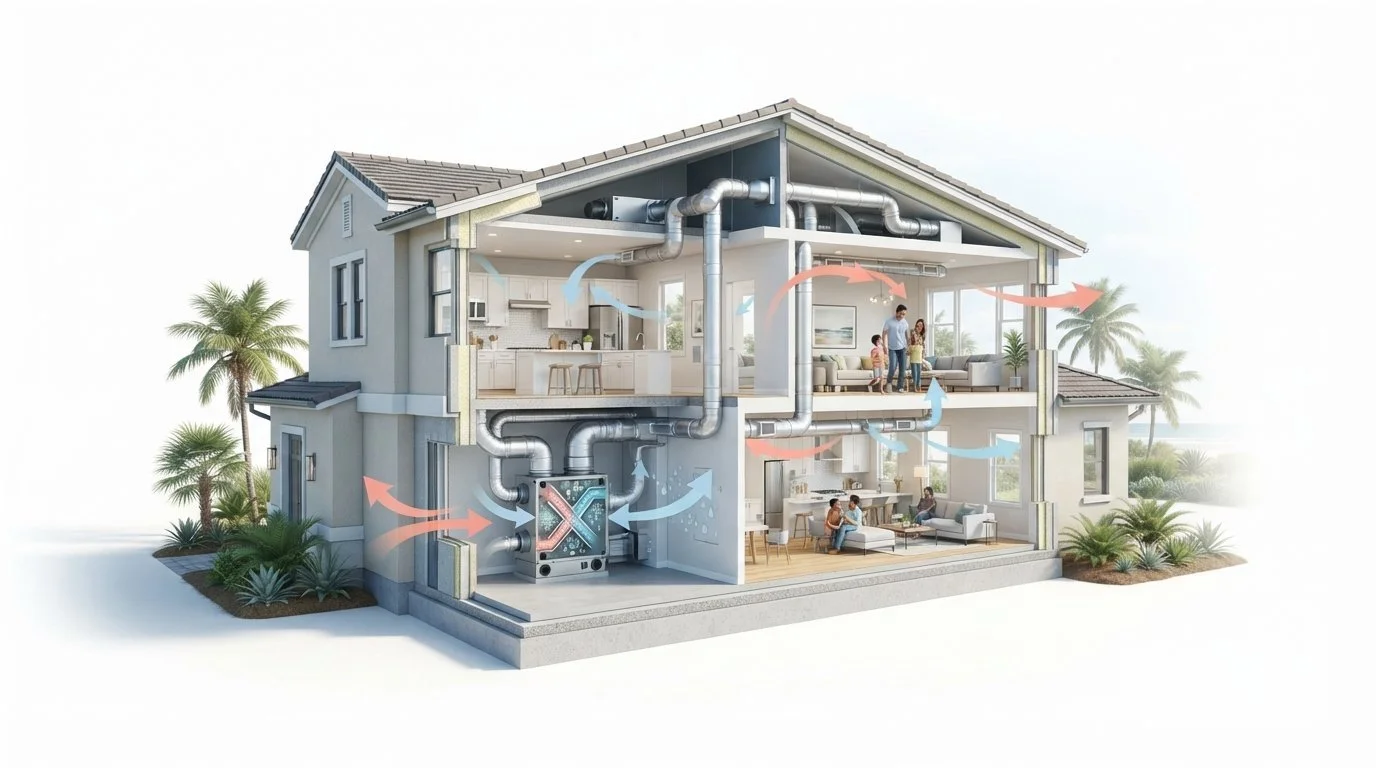
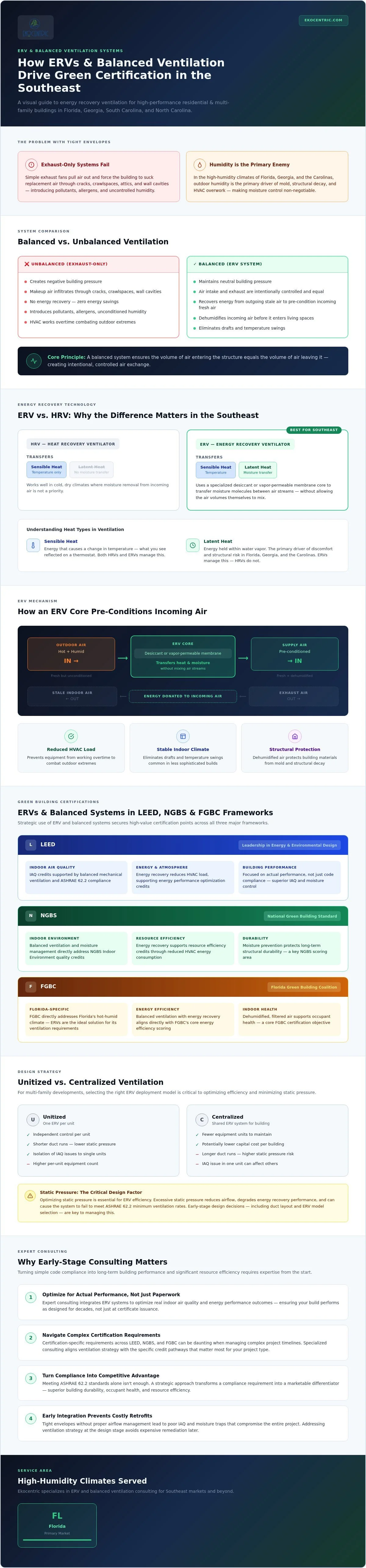
A balanced system is a foundation for building pressure control by ensuring the volume of air entering the structure equals the volume of air leaving it.
Implementing ERV and Balanced systems allows developers to manage this exchange intentionally. Unlike a standard Heat Recovery Ventilator (HRV) that only transfers sensible heat, energy recovery ventilation also manages latent heat, or moisture. This distinction is vital for projects in Florida, Georgia, or South Carolina where outdoor humidity is often the primary enemy of building longevity. Choosing an ERV ensures that fresh air is dehumidified before it ever enters the living space, protecting both the structure and the occupants.
Balanced vs. Unbalanced Systems: Pressure Dynamics
Unbalanced systems create a pressure imbalance that compromises the building envelope. When a home has negative pressure, it pulls makeup air from the path of least resistance, which often means crawlspaces, attics, or wall cavities. This uncontrolled leakage introduces pollutants, allergens, and unconditioned humidity into the home. Maintaining neutral pressure through ERV and Balanced systems is the most effective way to prevent these issues. This precision protects the integrity of the envelope and ensures the building performs as designed for decades.
The ERV Advantage: Why It Outperforms Standard Fans
Standard fans are blunt instruments that offer no energy recovery and very little control. ERVs use a specialized core to pre-condition incoming fresh air using the energy from the outgoing stale air. This process significantly reduces the load on the primary HVAC system, preventing the equipment from working overtime to combat outdoor extremes. By stabilizing indoor temperatures and humidity, ERVs eliminate the drafts and temperature swings common in less sophisticated builds. For architects aiming for LEED or NGBS certifications, our specialized consulting services help integrate these systems to optimize actual performance rather than just ticking boxes on a checklist.
The Science of Energy Recovery: Sensible vs. Latent Heat Transfer
Understanding the physics of air exchange is vital for any project aiming for high-performance results. Sensible heat refers to the energy that causes a change in temperature, which is what you see reflected on a thermostat. In most environments, managing sensible heat is a straightforward task of exchanging warmth between air streams. However, in the Southeast, temperature is only half of the equation. Latent heat represents the energy held within water vapor, and it's the primary driver of discomfort and structural risk in regions like Florida and the Carolinas.
The ERV core utilizes a specialized desiccant or vapor-permeable membrane to transfer moisture molecules from the humid air stream to the drier one without allowing the actual air volumes to mix.
In hot-humid climates, ERV and Balanced systems are indispensable because they address both energy types simultaneously. While a standard ventilator might bring in fresh air that's a comfortable 72 degrees, if that air is saturated with humidity, your HVAC system has to work twice as hard to remove the moisture. ERVs solve this by "pre-conditioning" the air, stripping away the latent load before it ever enters the building envelope. This proactive approach is a cornerstone of environmental stewardship, ensuring we don't waste energy fighting the natural climate of our region.
Moisture Management in High-Humidity Regions
Summer in Georgia or South Carolina can be brutal on building materials. When outdoor air is saturated, ERV and Balanced systems act as a critical gatekeeper. By dehumidifying incoming fresh air, these systems prevent the relative humidity inside the home from spiking, which is the most effective way to stop mold growth before it starts. This latent heat recovery creates a powerful synergy with high-efficiency heat pumps. It allows the cooling equipment to focus on its primary job of sensible cooling, rather than being overwhelmed by moisture removal tasks it wasn't designed to handle alone.
Energy Efficiency and the HERS Index
Building performance isn't a theory; it's a measurable outcome. Integrating an ERV has a direct, positive impact on the RESNET HERS Rating by lowering the total energy consumption of the home. Because these systems are balanced, they work in harmony with Blower Door test results to prove the building is both tight and properly ventilated. This precision reduces peak demand on the electrical grid, which is a win for both the developer and the community. For project leads looking to validate these efficiency gains, our RESNET HERS Rater services provide the technical proof required for elite certifications.
Achieving Certification Points: ERVs in LEED, NGBS, and FGBC Frameworks
Navigating the technical landscape of green building certifications requires more than just high-quality hardware. It demands a strategic approach to performance. For developers and architects in the Southeast, ERV and Balanced systems represent a powerful tool to secure points across multiple rating systems. Whether you're pursuing LEED BD+C or the National Green Building Standard (NGBS), these systems address the critical intersection of energy efficiency and indoor environmental quality. Our role as LEED Green Raters and NGBS Green Verifiers is to bridge the gap between design intent and field-verified results.
In the LEED framework, balanced ventilation is a key driver for the Enhanced Indoor Air Quality strategies. By providing a dedicated source of fresh, pre-conditioned air, you're not just meeting the prerequisite for ASHRAE 62.2; you're actively improving the occupant experience. Similarly, the Florida Green Building Coalition (FGBC) emphasizes air exchange rates that protect against the state's extreme humidity. Implementing an ERV ensures these requirements are met without sacrificing the building's energy budget. A Green Rater verifies ERV installation for LEED certification by conducting a visual inspection of the unit and ducting while performing airflow testing to confirm the system meets the design specifications outlined in the project's energy model.
LEED Green Rater Verification Requirements
Third-party verification is the cornerstone of any credible certification. During the construction process, we look for precise documentation that proves ASHRAE 62.2 compliance. This includes verified airflow measurements and proof of proper commissioning. A common pitfall we see during final walkthroughs is a failure to account for static pressure in the ductwork, which can lead to insufficient air exchange. Catching these issues early ensures you don't lose valuable points at the finish line.
NGBS Green+ Badges and Ventilation
The NGBS offers an opportunity to go beyond the baseline through Green+ Badges, specifically the Indoor Air Quality badge. This recognizes projects that integrate advanced technologies like smart building sensors for demand-controlled ventilation. For multi-family developments in regions like Georgia and North Carolina, ERV and Balanced systems provide the long-term performance verification that investors and residents now expect. By focusing on actual building performance, you create high-quality living spaces that stand out in a competitive market.
Strategic Implementation for Residential and Multi-Family Developments
Multi-family projects present unique mechanical challenges that single-family homes don't face. When designing for density, the choice between unitized and centralized ERV and Balanced systems becomes a pivot point for both budget and performance. Unitized systems provide individual control and easier tenant billing, while centralized systems can offer streamlined maintenance for large-scale operations. However, unitized units are increasingly popular because they simplify compartmentalization, a core requirement for NGBS and LEED certifications. We've found that giving each unit its own dedicated ventilation path often results in higher tenant satisfaction and fewer indoor air quality complaints.
Successful implementation depends on meticulous ductwork design. High static pressure is a silent performance killer that forces fans to work harder, increasing energy use and noise levels. We advocate for short, straight duct runs and properly sized grilles to ensure the system operates at peak efficiency. Long-term durability also hinges on maintenance. If filters aren't accessible, they won't be changed, leading to degraded air quality and system strain. Our Sustainability Consulting Services help project leads identify these operational hurdles during the design phase to prevent costly retrofits after the drywall is up.
Multi-Family Challenges: Compartmentalization and Airflow
Maintaining air balance in high-density buildings is essential for preventing cross-contamination between units. ERVs play a vital role in meeting NGBS compartmentalization standards by providing a dedicated, balanced air stream that reduces the reliance on air moving through demising walls. Acoustic performance is equally critical. Tenants won't use a system that sounds like a jet engine. Selecting units with low sone ratings and using vibration isolation mounts ensures the ventilation remains a silent benefit rather than a nuisance for the occupants.
Integration with Smart Building Technology
The integration of demand-controlled ventilation (DCV) is the next frontier in building optimization. By using sensors to monitor CO2 or VOC levels, ERV and Balanced systems can ramp up during high-occupancy events and scale back when rooms are empty. This saves significant energy while maintaining pristine air quality. Looking ahead to 2026, we expect to see more automated IAQ management integrated directly into building management systems (BMS). This allows developers to monitor performance across an entire portfolio from a single dashboard, ensuring every unit meets the high standards of environmental stewardship.
If you're ready to optimize your next multi-family project for long-term health and efficiency, contact us at +1.813.484.5300 or info@ekocentric.com to ensure your ventilation strategy delivers actual performance.
Maximizing Building Performance with Expert Sustainability Consulting
Achieving elite building performance requires more than selecting the right equipment; it demands a partner who understands how every system interacts within the envelope. Waiting until the construction phase to address ventilation is a common mistake that leads to expensive mechanical redesigns and compromised efficiency. By engaging in early-stage consulting, developers can integrate ERV and Balanced systems into the initial architectural vision. This proactive approach ensures that ventilation isn't an afterthought but a strategic pillar of the building's longevity and health.
Our team focuses on the actual performance of the structure rather than just the paperwork. We help you navigate the technical nuances of certification while ensuring the mechanical systems are sized and installed for optimal results. This dedication to precision is what sets a high-performance project apart from one that merely meets the bare minimum of local codes.
Proactive Design: The Ekocentric Approach
The most impactful decisions happen during the design charrette. This is where we align your aesthetic goals with the mechanical realities of high-performance builds. Our LEED and NGBS Consulting services provide the technical depth needed to navigate complex requirements without slowing down your timeline. We work closely with architects to ensure that ERV and Balanced systems are seamlessly integrated into the building's footprint. This collaboration prevents the friction that often occurs between design intent and field implementation, securing your path to certification from day one.
The Business Case for High-Performance Ventilation
Today's market rewards developers who prioritize occupant health and resource efficiency. "Certified Healthy" spaces are a powerful marketing tool that attracts discerning tenants and buyers who value indoor air quality. Beyond marketability, superior moisture and mold prevention through balanced ventilation significantly reduces long-term liability for the owner. This is a pragmatic business strategy. Optimizing actual building performance creates a durable, efficient, and high-quality living space that delivers a superior ROI over the building's lifecycle. It's a commitment to environmental stewardship that also protects your bottom line.
As a licensed Florida Certified Building Contractor and NGBS Green Verifier, Ekocentric brings a pragmatic perspective to every project. We understand the business realities of financing and construction schedules, acting as an indispensable partner who fills the gap in your internal resources. We provide specialized consulting and verification across FL, GA, SC, and NC to ensure your project exceeds expectations. For a comprehensive project consultation, reach out to us at +1.813.484.5300 or info@ekocentric.com to secure your building's future.
Securing Your Building's Future with High-Performance Ventilation
Designing for durability in hot, humid climates requires a proactive approach to air exchange. You've discovered how ERV and Balanced systems act as a critical gatekeeper against moisture while significantly reducing the load on your HVAC equipment. By prioritizing latent heat recovery and precise pressure control, you aren't just meeting code; you're creating a high-performance asset that stands out in the FL, GA, SC, and NC markets.
Meeting the rigorous standards of LEED, NGBS, and FGBC certifications is a complex journey, but it's one you don't have to navigate alone. As a Licensed Florida Certified Building Contractor, NGBS Green Verifier, and LEED Green Rater, Ekocentric provides the specialized expertise needed to bridge the gap between architectural vision and field-verified performance. We're here to help you move beyond the paperwork to achieve tangible results for your occupants and the environment.
Optimize your next project with Ekocentric’s Certification Consulting and ensure your building performs at its peak. Building an environmentally conscious future is an achievable goal, and we're ready to help you reach it.
Frequently Asked Questions
What is the difference between an ERV and a balanced ventilation system?
An ERV is a specific type of technology used to achieve balanced ventilation. While balanced ventilation refers to the mechanical strategy of equalizing the volume of incoming fresh air and outgoing stale air, an ERV adds the critical component of energy recovery. This allows ERV and Balanced systems to transfer heat and moisture between air streams, pre-conditioning the air before it enters the living space for better efficiency.
How many LEED points can I earn by installing an ERV system?
The exact point value depends on your specific LEED rating system, but an ERV typically contributes to multiple categories including "Minimum Indoor Air Quality Performance" and "Annual Energy Use." In LEED for Homes, meeting ASHRAE 62.2 through balanced ventilation is a prerequisite. Beyond that, the energy efficiency gains from recovering sensible and latent heat help secure additional points that move your project toward Silver, Gold, or Platinum status.
Do ERVs work effectively in high-humidity climates like Florida?
Yes, ERVs are specifically designed to excel in high-humidity regions by managing latent heat transfer. Unlike basic ventilators, an ERV core uses a specialized membrane to pull moisture out of the incoming fresh air. This prevents the outdoor humidity common in the Southeast from overwhelming your cooling system, which protects your building envelope from moisture-related damage and ensures a healthier indoor environment for all occupants.
Is an ERV required for NGBS Green certification?
The National Green Building Standard (NGBS) does not strictly mandate an ERV, but it requires a ventilation system that complies with ASHRAE 62.2 standards. Using an ERV is often the most strategic way to meet these requirements while earning high-value points in the Indoor Environmental Quality and Energy Efficiency chapters. It's a preferred solution for developers who want to optimize actual performance rather than just meeting the baseline code.
What are the maintenance requirements for a multi-family ERV system?
Maintenance primarily involves regular filter inspections and core cleaning to ensure long-term performance. Filters should typically be checked every three to six months, depending on the local environment. In multi-family developments, ensuring that units are installed with accessible service panels is critical for your team. Neglecting these simple tasks can lead to increased static pressure, higher energy costs, and a decline in indoor air quality for your tenants.
How does an ERV impact a home's HERS Index score?
An ERV improves a home's HERS Index score by reducing the total energy demand on the primary heating and cooling systems. By pre-conditioning the fresh air, the HVAC equipment doesn't have to work as hard to reach the thermostat setpoint. As a RESNET HERS Rater, we verify these efficiency gains through performance testing, which often results in a lower, more competitive HERS score that increases the property's market value.
Can an ERV replace a traditional dehumidifier in the Southeast?
An ERV is not a standalone dehumidifier, but it significantly reduces the dehumidification load on your primary HVAC system. It works by transferring moisture from the incoming fresh air to the outgoing stale air stream. In extremely tight buildings or very humid climates, you might still need a supplemental dehumidifier to manage internal moisture loads, but an ERV ensures your ventilation strategy doesn't actively worsen the humidity problem.
What is the typical lifespan of a high-performance ERV unit?
Most high-performance ERV units have an expected operational lifespan of 10 to 15 years when they receive proper maintenance. The core itself is quite durable, but moving parts like fans and motors may eventually require service or replacement. Investing in quality ERV and Balanced systems ensures that your building continues to benefit from superior air quality and energy recovery long after the initial construction and certification phases are complete.