Guide to the Florida Water Star Program for Builders
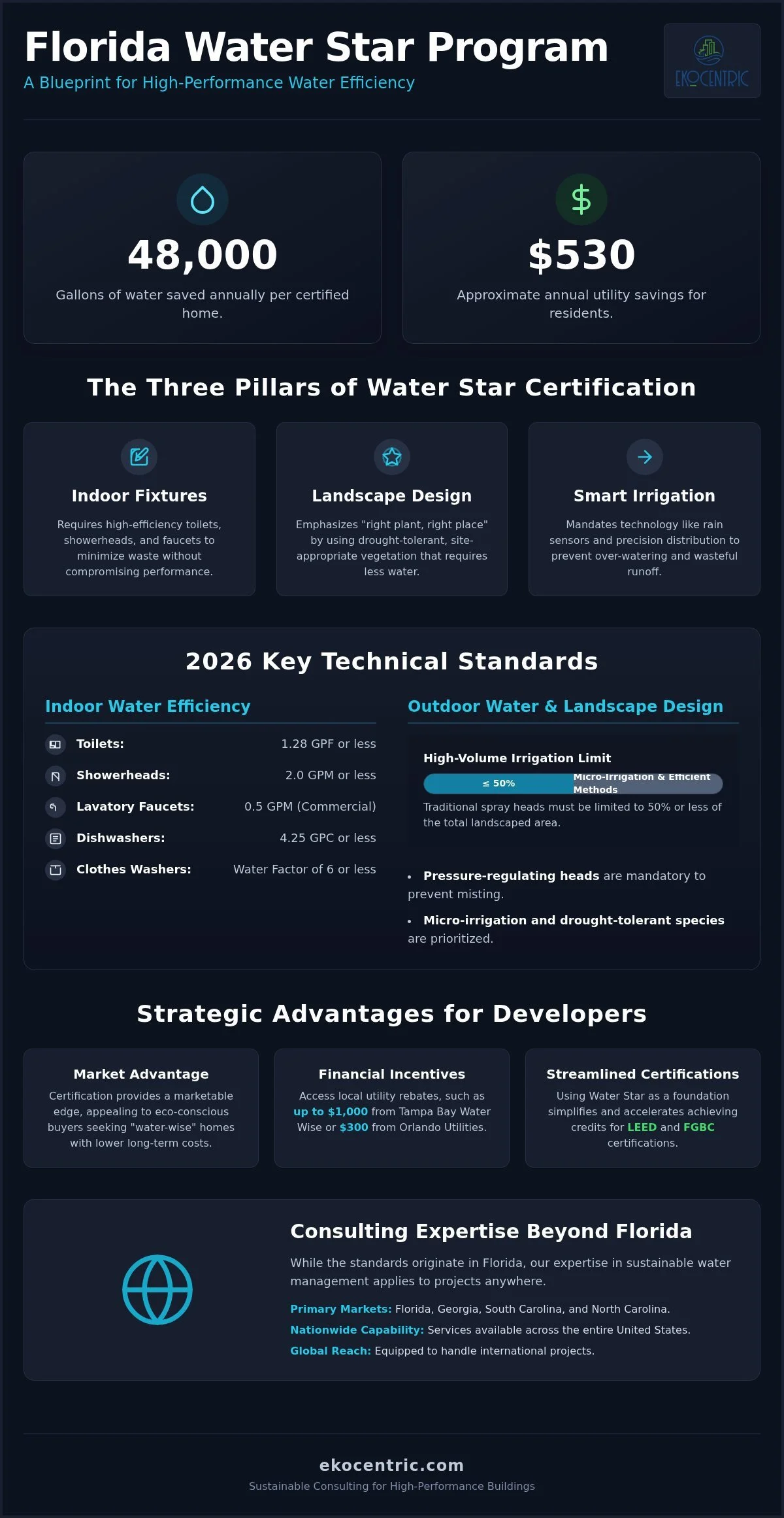
Did you know a single home certified under the Florida Waterstar program can save up to 48,000 gallons of water every year? For builders and developers across the Southeast, meeting rigorous water conservation codes often feels like a constant battle against rising utility costs and overlapping certification requirements. It's challenging to manage the distinct demands of LEED, FGBC, and local mandates while trying to protect your project’s ROI. We recognize that you need a pragmatic way to bridge the gap between technical compliance and high-performance building results.
This guide demonstrates how the Florida Water Star standards serve as a foundational efficiency engine for your next project. By adopting these criteria, you can reduce annual utility bills for future tenants by approximately $530 while streamlining your path toward LEED BD+C and FGBC certifications. We will examine the latest 2026 technical updates and explain how to integrate these water-saving benchmarks into your workflow. Whether your firm is based in North Carolina or operates internationally; these strategies ensure your developments are both environmentally responsible and market-ready.
Key Takeaways
Understand how the Florida Waterstar program functions as a voluntary efficiency engine to optimize water use in residential and commercial developments.
Learn the specific 2026 technical standards for indoor fixtures and landscaping that help your projects exceed basic building codes.
Discover how to streamline your path to LEED and FGBC certifications by using Water Star as a foundational credit-earner.
Master the certification process by engaging an accredited inspector during the design phase to reduce developer overhead and ensure compliance.
Apply these sustainable water management principles to projects across the United States and internationally to enhance global building performance.
Table of Contents
What is the Florida Water Star Program?
The Florida Waterstar program is a voluntary certification designed to push building performance far beyond the minimum requirements of the Florida Building Code. It provides a rigorous technical framework for developers who want to build high-quality, resource-efficient structures. This program applies to everything from single-family homes to large-scale commercial and multifamily projects. By focusing on verifiable efficiency standards, it ensures that every drop of water is used purposefully. It's not just a "green" label; it's a performance-driven roadmap for modern construction.
While the Florida Building Code sets a baseline for safety and efficiency, it doesn't always account for the unique hydrologic challenges of the Southeast. This program fills that gap. It offers a clear set of criteria that address the most significant points of water waste in any development. Whether you're building in Florida, Georgia, or the Carolinas, these principles establish a higher standard of environmental stewardship that resonates with stakeholders and tenants alike.
The Three Pillars of Water Star Certification
The program organizes its requirements into three distinct categories to ensure holistic efficiency. First, indoor fixtures must meet high-efficiency standards. This includes toilets rated at 1.28 gallons per flush or less and showerheads that don't exceed 2.0 gallons per minute. Second, the landscape design focuses on "right plant, right place" principles. We prioritize drought-tolerant, site-appropriate vegetation that thrives without constant intervention. Finally, irrigation systems must utilize smart technology. This involves rain sensors and precision distribution to eliminate wasteful over-watering of sidewalks or driveways.
The Business Case for Builders and Developers
Adopting the Florida Waterstar program isn't just about environmental ethics; it's a strategic business move. Eco-conscious buyers specifically look for "water-wise" homes that promise lower long-term costs. This certification provides a marketable edge that distinguishes your project in a crowded real estate market. It's a tangible proof point of quality construction that builds trust with potential residents.
Financial incentives also play a significant role in the project's bottom line. Many local governments and utilities recognize the value of these builds. For instance, the Orlando Utilities Commission offers rebates up to $300, while the Tampa Bay Water Wise program provides up to $1,000 for certified single-family homes. Beyond these immediate wins, developers see a substantial operational ROI. In multifamily and commercial builds, reducing water consumption in common areas significantly lowers monthly utility overhead. This efficiency directly increases the net operating income of the property, making it more attractive to investors and future owners.
Technical Requirements for Certification in 2026
Achieving success in the Florida Water Star Program depends on meeting rigorous technical benchmarks that go beyond basic plumbing codes. For 2026, the program emphasizes a holistic "water budget" approach. This requires builders to account for every point of consumption from the kitchen tap to the furthest corner of the landscape. Precision is the priority here. You'll need to ensure every fixture and irrigation head is selected for its verifiable performance rather than just its aesthetic appeal.
Indoor Water Efficiency Standards
Indoor requirements focus on high-performance fixtures that maintain user comfort while minimizing waste. To meet the standard, toilets must be WaterSense labeled and use 1.28 gallons per flush or less. Commercial lavatory faucets should be restricted to 0.5 gallons per minute. Showerheads must not exceed 2.0 gallons per minute. These aren't just suggestions; they're verified performance metrics. For residential projects, ENERGY STAR qualified dishwashers (4.25 gallons per cycle or less) and clothes washers (water factor of 6 or less) are essential components of the scoring system. In commercial or multifamily settings, leak detection systems are now a critical requirement to prevent catastrophic resource loss. If you're managing complex indoor facilities, professional consulting services can help you calculate these budgets accurately during the design phase.
Outdoor Design: More Than Just Plants
The outdoor criteria represent some of the most significant changes for developers. High-volume irrigation, such as traditional spray heads, must be limited to 50% or less of the total landscaped area. This shift forces a move toward micro-irrigation and drought-tolerant species. Pressure-regulating heads are mandatory to ensure even distribution and prevent misting. Additionally, smart soil-moisture sensors or weather-based controllers must be installed to override scheduled watering when natural rainfall is sufficient.
Effective outdoor design relies heavily on hydrozoning. This practice groups plants with similar water needs together to prevent over-watering some areas while under-watering others. You'll also need to verify that soil amendments and specific mulch depths are utilized to maximize moisture retention. Unirrigated buffer zones are now a standard expectation for projects seeking higher tiers of certification. These zones act as natural filters and reduce the overall demand on local water supplies.
Success starts on paper. You must provide detailed landscape and irrigation plans before the first inspection occurs. These documents act as the blueprint for the Florida Waterstar program verification process. They ensure every sensor, head, and plant aligns with the technical manual's requirements. By identifying potential conflicts in the design phase, you avoid costly retrofits during the final walk-through. Clear documentation is the bridge between a sustainable design and a certified reality.
Integrating Water Star with LEED and FGBC
Navigating multiple green building standards often feels like a logistical puzzle. However, smart developers use the Florida Waterstar program as a foundational efficiency engine to streamline higher-level certifications. Instead of viewing each rating system as a separate hurdle, you should see them as complementary layers. This approach, often called certification stacking, allows you to satisfy the requirements of several programs simultaneously. It eliminates redundant work and reduces the overhead associated with managing multiple certification bodies. We've seen that when these standards are integrated from the start, the path to a high-performance building becomes much clearer.
One of the biggest advantages of this integration is the reduction of certification fatigue. By hiring a single consultant to manage multiple ratings, you unify your inspection schedules. Instead of hosting different verifiers for every individual badge, a single site visit can often confirm compliance for several programs at once. This pragmatism isn't just about saving time; it's about protecting your project's ROI while maintaining a deep commitment to environmental stewardship. Whether you're building in Georgia, South Carolina, or pursuing international projects, these streamlined workflows ensure your team stays focused on construction rather than paperwork.
Water Star as a Foundation for LEED BD+C
For projects pursuing LEED BD+C, the Florida Waterstar program provides a direct path to satisfying critical prerequisites. LEED’s Outdoor Water Use Reduction credits align closely with Water Star’s landscape and irrigation benchmarks. By implementing the smart sensors and hydrozoning strategies we discussed earlier, you're already earning points toward your LEED goals. When you partner with a LEED Green Rater from our team, we simplify the submission process by using a single set of verified data to fulfill both programs' requirements. This unified data collection ensures accuracy and prevents the inconsistencies that can arise from having disconnected teams.
Meeting FGBC Standards with Ease
The synergy between Water Star and the Florida Green Building Coalition (FGBC) is even more pronounced. Because both programs are tailored to the specific environmental needs of the Southeast, their criteria overlap significantly. Achieving Water Star certification can automatically satisfy numerous points within the FGBC home and commercial standards. This point-for-point advantage is particularly valuable when working with local municipalities that prioritize regional sustainability benchmarks. Our approach to FGBC Certification Consulting focuses on this integration. We manage the verification process to ensure that your Water Star data boosts your FGBC score without extra effort. This makes it easier for builders in Florida and North Carolina to achieve the marketable green credentials they need to stay competitive.
The Florida Water Star Certification Process
The path to certification isn't a post-construction hurdle; it's a collaborative journey that begins during the design phase. To successfully navigate the Florida Waterstar program, you must integrate its requirements into your project's DNA from day one. This proactive approach ensures that every pipe, fixture, and plant choice aligns with the technical manual's rigorous standards. While the program’s name focuses on Florida, we bring this same level of technical precision to projects in Georgia, South Carolina, and North Carolina. Our reach extends across the entire United States, and we're equipped to manage international certifications for developers seeking world-class water efficiency.
Engaging an Accredited Inspector
Third-party verification is the cornerstone of program integrity. You can't simply self-certify your work. You need an accredited inspector who understands the nuances of the 2026 technical updates. There's a significant difference between a standard builder and a Water Star Accredited Professional. An Accredited Professional has undergone specialized training to master the program's complexities. Engaging our team as your consultant during the design phase is a pragmatic business decision. We identify potential compliance issues on paper before they become expensive mistakes in the field. This early-stage consulting prevents the need for costly retrofits during the final walk-through.
Once the design is finalized, the application process moves to the official Florida Water Star portal. This is where we submit your project details and landscape plans for initial review. This step provides the administering agency with a clear roadmap of your project's efficiency goals and ensures everyone is aligned before construction begins.
The Inspection Walkthrough: What to Expect
The field verification is where the "as-built" reality meets the "on-paper" promise. During this walkthrough, your inspector tests every indoor fixture to ensure they meet the flow rates we discussed in previous sections. We check for "no-leak" compliance across all units; a critical step for commercial and multifamily projects. We also verify that the irrigation installation matches the approved plans exactly. We look for the mandatory pressure-regulating heads and verify that smart soil-moisture sensors are functioning correctly.
Common pitfalls often involve minor oversights, such as failing to install the required mulch depth or using non-labeled fixtures. These small errors can lead to inspection failure and delay your certificate. By having a partner who manages the inspection process, you reduce developer overhead and ensure a smooth final review. After the field data is verified, the administering agency conducts a final review and issues the official certificate. This badge of honor becomes a powerful tool in your marketing arsenal. If you're ready to secure your project's future, contact us for specialized certification consulting today.
Sustainable Consulting Beyond Florida
While the Florida Waterstar program originated to address regional water supply challenges, its technical framework provides a blueprint for sustainable development everywhere. Builders who operate across the Southeast often face a fragmented landscape of local codes and certification requirements. We bridge this gap by applying these rigorous water-efficiency standards to projects in Georgia, South Carolina, and North Carolina. Our mission is to ensure that your building’s performance isn't limited by state lines. We provide the regional expertise necessary to navigate specific building codes while maintaining a unified vision for environmental stewardship.
Our reach doesn't stop at the regional level. Ekocentric serves developers across the entire United States and provides consulting for international projects. This global perspective allows us to bring best practices from diverse markets to your specific site. Whether you're managing a single multifamily build in Charlotte or a multi-state commercial portfolio, we offer a pragmatic partnership that prioritizes longevity and resource efficiency. We don't just look at water; we analyze how water, energy, and building materials work together to create a high-quality living space. This cause-and-effect relationship between specialized practices and positive outcomes is what drives our commitment to every project we touch.
Serving the Southeast: FL, GA, NC, and SC
Adapting water-wise strategies for the varied climates of the Carolinas and Georgia requires a nuanced approach. While Florida focuses heavily on high-volume irrigation limits, projects in the Piedmont or coastal Carolinas might prioritize different soil amendments or native plant selections. Managing these variables across a multi-state portfolio is streamlined when you work with a single sustainability partner. As a LEED Green Rater in regional markets, we ensure that your water-saving goals align perfectly with broader certification requirements. This unified strategy reduces administrative overhead and keeps your project on schedule.
The Future of National Green Building Standards
The industry is shifting toward holistic performance. Programs like the National Green Building Standard (NGBS) and ENERGY STAR now work in tandem with the Florida Waterstar program to define what a "green" building truly is. For 2026, "safe harbor" designs are becoming the industry standard. These pre-approved paths guarantee compliance and reduce the risk of failure during final inspections. We help you integrate these national benchmarks into your local projects to ensure they remain competitive and compliant for years to come. If you're ready to optimize your project’s ROI and environmental impact, reach out to Ekocentric for a comprehensive sustainable development consultation.
Building a Water-Wise Future
Integrating the Florida Waterstar program into your development strategy is more than a compliance check; it's a commitment to long-term resource efficiency and project longevity. By mastering the 2026 technical standards, you can achieve significant operational savings for tenants while effortlessly earning critical credits toward LEED and FGBC certifications. This foundational approach ensures your projects remain competitive in an increasingly eco-conscious market.
As a licensed Florida Certified Building Contractor, NGBS Green Verifier, and LEED Green Rater, our team understands the technical demands of high-performance construction. We provide the expert oversight needed to reduce developer overhead and prevent costly retrofits. Whether you're building in Georgia, the Carolinas, or managing an international project, we're ready to help you navigate complex certification goals with pragmatic, results-oriented solutions.
Partner with Ekocentric for your next green building certification. Let's work together to create resilient, marketable spaces that respect our natural resources and stand the test of time. Your dedication to environmental stewardship starts with a single, efficient drop.
Frequently Asked Questions
Is the Florida Water Star program mandatory for new construction?
Participation in the Florida Waterstar program is voluntary, though its standards are increasingly influential. Some local governments have adopted these criteria into their specific building codes to help meet regional water supply goals. Even when it isn't mandated, builders use the program to demonstrate a commitment to resource efficiency that far exceeds the baseline requirements of the Florida Building Code.
How much can a developer save by certifying a multifamily project?
Developers capture significant value through reduced impact fees and lower operational overhead. While individual homeowners can save up to $530 on annual utility bills, multifamily projects see scaled ROI through reduced common-area water costs. These efficiencies directly improve the property’s net operating income, making the asset more attractive to investors and reducing the long-term cost of ownership.
Can I use the Florida Water Star program for projects in Georgia or North Carolina?
Yes, you can apply these high-performance principles to developments in Georgia, North Carolina, and South Carolina. While the official certification is state-specific, the technical standards for indoor fixtures and smart irrigation represent universal best practices. Ekocentric applies these rigorous criteria to projects across the United States and internationally to help developers achieve superior building performance regardless of their location.
What is the difference between Florida Water Star and ENERGY STAR?
The primary difference lies in their focus; Water Star targets indoor and outdoor water conservation, whereas ENERGY STAR prioritizes energy efficiency and thermal envelope performance. These programs are designed to be complementary rather than redundant. Certifying under both ensures a holistic approach to sustainability that addresses the two largest utility expenses for future residents and commercial tenants.
Does Florida Water Star require a specific type of turfgrass?
The program doesn't mandate a single grass species, but it does require site-appropriate, drought-tolerant landscaping. You must group plants with similar water needs together through a practice known as hydrozoning. High-volume irrigation is restricted to 50% or less of the landscaped area, which often encourages builders to utilize native groundcovers and micro-irrigation over traditional turf layouts.
How do I find an accredited Florida Water Star inspector?
You should partner with a consultancy that employs Water Star Accredited Professionals to ensure program integrity. Accredited inspectors provide the mandatory third-party verification required for official certification. Ekocentric offers these specialized services, managing the entire inspection process to reduce developer overhead and ensure your project meets the 2026 technical requirements without unnecessary delays.
Can an existing building be retrofitted for Water Star certification?
Existing buildings can be retrofitted to meet the certification criteria. The process involves upgrading indoor fixtures to high-efficiency models and optimizing irrigation systems with smart controllers and pressure-regulating heads. This is a pragmatic solution for owners looking to reduce operational costs and enhance the marketability of older multifamily or commercial assets in a competitive real estate market.
How long does the certification process take from start to finish?
The certification timeline typically aligns with your project's construction schedule. It begins with a design-phase review to identify potential issues and concludes with a final field verification once all fixtures and landscaping are installed. Engaging a consultant early in the process prevents delays, ensuring the certification is finalized shortly after the building reaches substantial completion.