Benefits of FGBC High-Rise Residential Certification in Miami
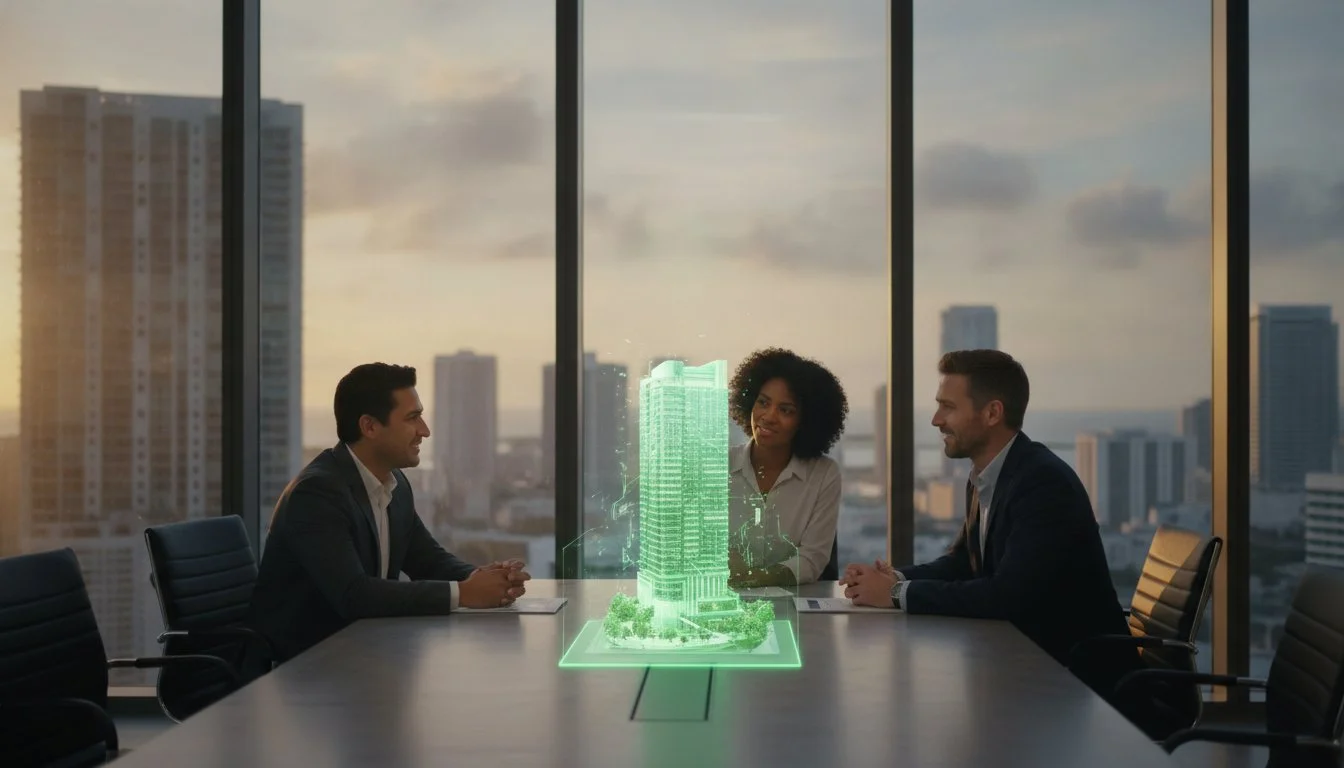
While national labels like LEED often grab the headlines, the most effective way to future-proof a Miami high-rise in 2026 isn't found in a one-size-fits-all national checklist. Developers in South Florida face a unique set of challenges, from the stringent High-Velocity Hurricane Zone (HVHZ) requirements to the relentless humidity that drives up cooling costs. You've likely noticed that generic green claims no longer carry the weight they once did with savvy investors or tenants. This is why understanding the specific benefits of FGBC high-rise residential certification Miami is essential for any project aiming for true longevity and market distinction.
We understand that you're managing complex timelines, especially with the 9th Edition of the Florida Building Code taking effect on December 31, 2026. It's a lot to handle when your internal team is already stretched thin. In this guide, you'll discover how Florida-specific green certification optimizes building performance, reduces operational costs, and increases asset value for Miami high-rises. We'll break down how this standard provides a pragmatic roadmap to lower utility bills, increased weather resilience, and the third-party proof required to justify premium pricing in a competitive landscape.
Key Takeaways
Discover why FGBC is the only rating system specifically engineered to address Florida's unique heat, humidity, and hurricane risks for buildings over five stories.
Learn how the benefits of FGBC high-rise residential certification Miami include significantly lower operational costs and enhanced long-term asset value through third-party verification.
Understand the strategic advantages of choosing a regional standard over national frameworks like LEED to better align with South Florida's environmental and regulatory demands.
Identify the critical path for implementation, from early-stage design integration to selecting a consultant with dual technical and real estate expertise.
See how partnering with a specialized consultant bridges internal resource gaps for high-performance projects across the Southeast and international markets.
Table of Contents
What is FGBC High-Rise Residential Certification?
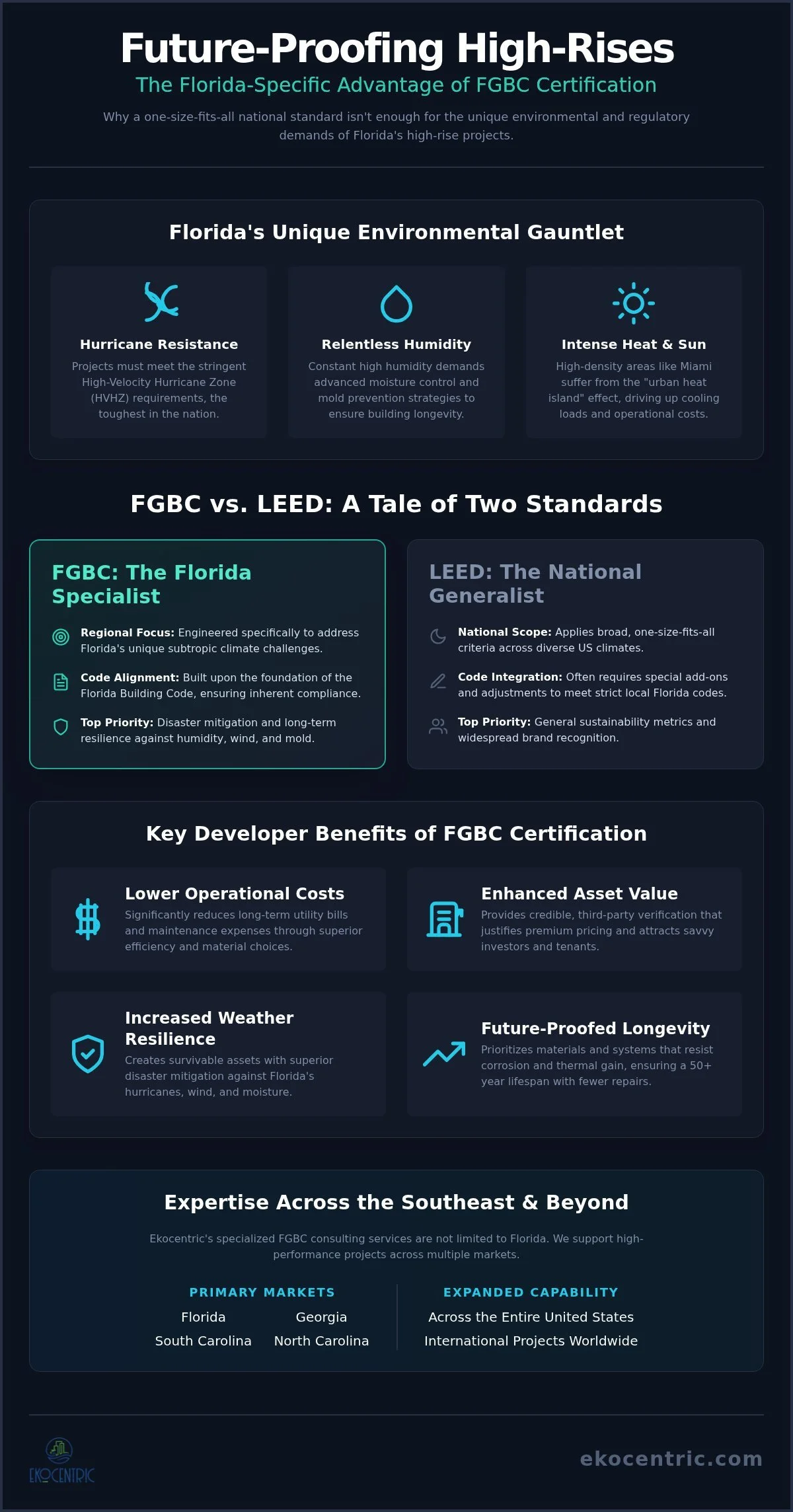
The Florida Green Building Coalition (FGBC) High-Rise Residential Building Standard is a rigorous, state-specific rating system designed exclusively for residential structures exceeding five stories. Unlike national certifications that apply broad criteria across diverse climates, FGBC focuses on the environmental challenges unique to the subtropics. This isn't just about "being green" in a general sense. It's about engineering a building that can thrive in Florida’s intense heat, high humidity, and seasonal hurricane threats. As we move through 2026, developers are increasingly recognizing that the benefits of FGBC high-rise residential certification Miami offer a more practical and resilient roadmap than generic national alternatives.
While FGBC offers various standards, the high-rise residential version is distinct from commercial standards because it prioritizes the long-term health and comfort of permanent residents. It addresses specific multi-family challenges like individual unit metering and acoustic privacy, which aren't primary concerns in office settings. For developers working with specialized FGBC consulting services, this means a more streamlined path to compliance that actually reflects how people live in South Florida. This expertise is relevant whether you're building in Miami, Atlanta, or Charleston, as Ekocentric provides these services across the Southeast and internationally.
Florida-Specific Sustainability Strategies
The FGBC framework goes beyond energy efficiency to tackle the specific "silent killers" of Miami buildings: moisture and mold. In our coastal environment, traditional building practices often fail to keep up with the vapor pressure that drives humidity into wall cavities. FGBC standards mandate advanced moisture control and mold prevention strategies that are vital for high-rise longevity. Additionally, the standard places a heavy emphasis on disaster mitigation. By prioritizing wind resistance and impact-rated systems, developers create assets that aren't just sustainable, but survivable. Urban rooftop designs also benefit from "Florida-friendly" landscaping requirements, which utilize native species to manage stormwater and reduce irrigation needs in the heart of the city.
Meeting Miami's Unique Building Requirements
Miami-Dade County operates within a High-Velocity Hurricane Zone (HVHZ), requiring the most stringent building codes in the nation. One of the primary benefits of FGBC high-rise residential certification Miami is its inherent alignment with these local mandates. While national programs might require additional "add-ons" to meet local code, FGBC is built upon the foundation of the Florida Building Code. This certification also addresses the "urban heat island" effect prevalent in high-density districts like Brickell. By incentivizing reflective roofing and shaded pedestrian areas, FGBC helps developers mitigate localized temperature spikes, ultimately lowering cooling loads for the entire structure. This pragmatic approach ensures that your project remains compliant with local environmental regulations while delivering a high-quality living space that stands out in a saturated market.
Core Benefits of FGBC Certification for Miami Developers
The benefits of FGBC high-rise residential certification Miami are most evident when looking at the long-term bottom line and the specific environmental stress of South Florida. National standards don't always account for the high salt content in coastal air or the specific thermal loads of a glass-walled tower in the subtropics. FGBC fills this gap by prioritizing materials and systems that resist corrosion and thermal gain. This focus results in a building that requires less frequent maintenance and fewer expensive repairs over its 50-year lifespan. By choosing a state-specific framework, you're investing in a building that's engineered to perform in its actual environment, not a theoretical one.
Operational Efficiency and Lower Utility Costs
Miami's energy grid faces significant peak demand challenges, especially during the sweltering summer months. FGBC standards require sophisticated energy modeling that accounts for these local peaks. By optimizing HVAC systems for constant 24/7 humidity management, developers can prevent the "over-cooling" common in many luxury towers. This doesn't just save energy; it protects the building's interior finishes from moisture damage. Additionally, water conservation strategies required by the certification reduce the municipal burden and lower utility bills for residents. These savings are a powerful selling point that translates directly into higher tenant satisfaction and lower turnover.
Insurance Advantages and Risk Mitigation
Florida's property insurance market is increasingly complex and expensive. Third-party verification through FGBC serves as a vital signal to underwriters that your high-rise exceeds the minimum requirements of the Florida Building Code. A robust building envelope designed for the High-Velocity Hurricane Zone (HVHZ) doesn't just protect lives during a storm; it lowers long-term liability. By addressing potential moisture intrusion at the design phase, you mitigate the risk of mold-related litigation that often plagues coastal developments. This proactive approach to risk management can be a decisive factor in securing favorable financing and insurance terms in a tight market.
Market Differentiation in Miami Real Estate
In the luxury markets of Brickell, Edgewater, and Sunny Isles, buyers expect more than just a view. They want documented proof of quality and sustainability. The FGBC seal acts as a mark of excellence that separates your project from a saturated market of developments making unverified "green" claims. It tells sophisticated investors that the building is resilient, efficient, and built to last. Partnering with a team that offers comprehensive FGBC certification consulting ensures these advantages are integrated from day one. This specialized expertise is equally valuable for developers managing portfolios across the Southeast, from Georgia to the Carolinas, as it establishes a high standard of quality that buyers across the region recognize and trust.
FGBC vs. LEED: Which is Right for Your Miami High-Rise?
Choosing between LEED and FGBC isn't a matter of which system is "better" in a vacuum. It's about which framework provides the most tangible return on investment for your specific project. While LEED carries significant global prestige, it can sometimes feel disconnected from the daily technical realities of the South Florida environment. This is where the benefits of FGBC high-rise residential certification Miami become clear. By focusing on the specific stressors of our region, FGBC provides a more direct path to building performance without the administrative overhead often associated with national programs. It's a pragmatic choice for developers who prioritize local resilience alongside marketability.
Regional Relevance and Climate Specificity
National models often use baseline assumptions for energy and water that don't fully apply to a high-density coastal city. LEED might award points for strategies that are less critical in a tropical climate, whereas FGBC is designed to tackle humidity and water scarcity head-on. For instance, FGBC’s requirements for drainage and moisture management are specifically calibrated for Florida’s intense rainfall patterns and high water table. This regional focus ensures that every credit you pursue contributes directly to the longevity of your Miami asset. While LEED remains an excellent choice for international visibility, FGBC offers the local practicalities that keep a building operational and efficient under the intense Florida sun.
Cost-Effectiveness and Process Efficiency
From a pragmatic business perspective, the total cost of certification is a major factor. FGBC generally offers lower registration and certification fees compared to national alternatives. More importantly, the verification process is streamlined for project teams already working within the Florida regulatory environment. Because the standards align closely with the Florida Building Code, your contractors and engineers won't have to learn an entirely new vocabulary or documentation set. This efficiency reduces the burden on your internal resources, allowing your team to focus on project delivery rather than chasing obscure paperwork. It makes the path to a high-performance building much more achievable for mid-sized and large-scale developments alike.
Ekocentric provides specialized FGBC and LEED consulting to help you weigh these options based on your specific asset goals. Our dual expertise in technical contracting and real estate allows us to identify where these systems can even complement each other. Some developers choose to pursue both, using LEED for its broad brand recognition and FGBC to ensure the building's technical performance is optimized for the local climate. This strategic approach is effective not just in Florida, but across our core markets in Georgia, South Carolina, and North Carolina, where regional weather patterns demand specialized attention and expert oversight.
Implementation: The Path to FGBC High-Rise Certification
Achieving a high-performance building in Miami’s dense urban core requires a deliberate strategy that begins long before the first shovel hits the ground. The path to certification is a structured journey that transforms sustainability from an abstract goal into a measurable asset. To fully capture the benefits of FGBC high-rise residential certification Miami, you must treat the process as an integrated part of your development timeline rather than a final checklist. This proactive approach prevents costly retrofits and ensures that every design choice contributes to long-term operational savings and building longevity.
Strategic Planning from the Pre-Design Phase
Early integration is the most effective way to identify high-ROI credits. During the pre-design phase, your project team should set clear performance targets that align the architect’s vision with resource efficiency goals. We often see developers focus on "low-hanging fruit" such as high-performance glazing and native landscaping; these provide immediate returns without significantly altering construction budgets. By establishing these benchmarks early, you ensure the project remains on track through the permitting process. This is especially vital as we approach the transition to the 9th Edition of the Florida Building Code on December 31, 2026. Projects permitted before this date fall under the 8th Edition, so timing your design phase is a critical business decision.
Third-Party Verification and Field Testing
A critical component of the FGBC standard is the involvement of a designated evaluator. This third-party expert provides the objective verification that investors, tenants, and insurers now require as proof of quality. For high-rise projects, this includes rigorous field testing such as blower door tests to measure building envelope airtightness and duct leakage testing to ensure HVAC efficiency. In the High-Velocity Hurricane Zone (HVHZ) of Miami-Dade, these tests aren't just for "green" points; they're essential for verifying that the building can withstand extreme weather. Coordinating these site visits is essential to avoid construction delays. A pragmatic partner understands how to schedule these inspections without disrupting the flow of subcontractors, ensuring that building performance is verified in real-time as the structure rises.
Documentation Management
The final hurdle is the collection and organization of evidence across energy, water, and material categories. Common pitfalls often involve missing data points or late-stage documentation scrambles that can jeopardize your desired certification level. Partnering with Ekocentric for seamless compliance allows your project team to focus on their core responsibilities while we manage the technical complexities. Our dual expertise in technical contracting and real estate ensures that every piece of documentation serves a dual purpose: meeting the certification requirements and enhancing the marketability of your project. If you're ready to optimize your next project, explore our specialized FGBC and LEED consulting services to bridge the gap between vision and reality.
Why Partner with Ekocentric for Your Miami FGBC Project?
Choosing a partner for your sustainability goals is a strategic business decision that impacts your project's risk profile and eventual market performance. Many firms offer basic green rater services, but they often lack the technical depth to understand how these requirements interact with complex high-rise systems. At Ekocentric, we bridge this gap by functioning as a pragmatic partner that solves the lack of internal resources problem. We don't just provide a checklist; we provide a clear roadmap that ensures the benefits of FGBC high-rise residential certification Miami translate into measurable asset value and operational excellence.
Technical Mastery and Regulatory Compliance
Our foundation is built on technical authority. As a Licensed Florida Certified Building Contractor, we approach every project with an understanding of structural integrity and mechanical efficiency that purely administrative consultants lack. This technical lens is vital when navigating the transition to the 9th Edition of the Florida Building Code, which takes effect on December 31, 2026. We ensure every credit you pursue is technically sound and contributes to the real-world performance of the building envelope. This expertise allows us to identify potential conflicts between sustainability goals and local High-Velocity Hurricane Zone (HVHZ) requirements before they become costly field changes.
The Real Estate Perspective
What truly sets us apart is our dual expertise in both construction and commerce. We hold realtor licenses in Florida, North Carolina, and South Carolina, giving us a unique vantage point on what buyers and investors actually value. We don't view green features as mere technical specs; we see them as powerful selling points. We help you translate the benefits of FGBC high-rise residential certification Miami into a narrative of luxury, resilience, and fiscal responsibility. This market-driven approach ensures that your investment in certification maximizes the property's valuation and accelerates absorption rates in a competitive Miami skyline.
Serving the Southeast and Beyond
While our roots are deep in Florida, our mission for environmental stewardship extends across the United States and into international markets. We provide specialized FGBC and LEED consulting for diverse portfolios, with a strong focus on the growing markets of Georgia, South Carolina, and North Carolina. Our scalable service model allows us to support local developers and global investment groups alike. Whether you're planning a landmark tower in Brickell or a multi-family project in the Carolinas, we offer the insightful, mission-driven partnership needed to create high-quality living spaces that stand the test of time.
Integrated Expertise: Technical building knowledge paired with real estate market insights.
Regional Authority: Deep understanding of Southeast climate challenges and regulatory shifts.
Scalable Solutions: Capacity for national and international projects of any scale.
If you're ready to optimize your building's performance and secure a third-party verified mark of quality, our team is prepared to guide you through every phase of the process. Explore our full range of sustainability consulting services and let's build a more resilient future together.
Secure Your Project’s Legacy in the Miami Skyline
Choosing a certification path that prioritizes Florida's specific environmental demands ensures your high-rise is built for longevity and performance. By focusing on regional climate stressors like humidity and hurricane-force winds, you don't just meet code; you exceed it. This proactive approach is the most effective way to realize the full benefits of FGBC high-rise residential certification Miami, turning technical compliance into a powerful market advantage that resonates with sophisticated investors.
At Ekocentric, we bring a unique perspective as both a Licensed Florida Certified Building Contractor and a Licensed Realtor. This dual expertise allows us to bridge the gap between complex engineering requirements and real-world market value. Whether your portfolio is centered in Florida, Georgia, South Carolina, or North Carolina, we provide the pragmatic oversight needed to manage specialized project goals without straining your internal resources. We understand the business realities of 2026 and offer the technical mastery required to navigate them successfully.
Ready to optimize your building's performance? Schedule your FGBC High-Rise consultation with Ekocentric today. We're committed to helping you build a more resilient and profitable future through expert environmental stewardship.
Frequently Asked Questions
Is FGBC certification mandatory for Miami high-rises?
FGBC certification is a voluntary standard, but it's frequently used to satisfy municipal green building requirements within Miami-Dade County. Many developers select this path because it aligns seamlessly with local High-Velocity Hurricane Zone (HVHZ) mandates. It's a pragmatic choice that provides the third-party verification investors demand without the administrative friction often found in national programs.
How much does FGBC high-rise certification cost for a typical project?
The Florida Green Building Coalition sets certification fees based on the total square footage of the building. These costs include a registration deposit and a final certificate fee once the project is verified. Because the standard is regional, the documentation requirements are often more straightforward for local contractors, which helps keep the overall project budget predictable and focused on performance rather than paperwork.
Can a project achieve both LEED and FGBC certification simultaneously?
Yes, a project can pursue both certifications to maximize its market reach. While LEED provides broad brand recognition for international investment groups, the benefits of FGBC high-rise residential certification Miami ensure the building's mechanical systems are specifically optimized for tropical humidity. This dual-track approach allows you to capture global prestige while securing the technical resilience required for the South Florida environment.
What is the minimum height requirement for FGBC high-rise residential certification?
The FGBC High-Rise Residential Building Standard is specifically designed for residential structures that exceed five stories. Buildings with five stories or fewer are typically evaluated under the FGBC Multi-Family or Residential standards. This distinction ensures that the high-rise certification addresses the specific vertical challenges, such as increased wind loads and complex water distribution systems, found in taller urban towers.
How long does the FGBC certification process take from start to finish?
The certification timeline generally follows the project's development lifecycle, from pre-design through the end of construction. Final verification usually occurs a few months after the building is commissioned and all field testing data is submitted. Engaging a consultant early in the design phase is the best way to ensure that site visits and documentation don't interfere with your construction schedule or certificate of occupancy.
Does FGBC certification help with Miami-Dade 40-year recertification?
While FGBC is a separate voluntary program, the rigorous documentation it requires can simplify future Milestone Inspections and recertification processes. The standard mandates detailed records of building envelope integrity and structural connections. Having this third-party verified data available demonstrates a history of proactive maintenance, which is an invaluable asset for building owners and associations as the structure ages.