Hiring a Green Building Consultant: A Developer’s Guide to Certification & Performance
A 2017 study by the University of Texas at Austin found that green-certified homes are worth an average of $25,000 more than comparable non-certified properties. For a developer, this isn't just a badge of environmental stewardship; it's a critical component of asset valuation and market competitiveness. Because standards evolve quickly with the release of LEED v5 and the ICC 700-2025 National Green Building Standard, hiring a green building consultant has become a strategic necessity for managing technical complexity. You shouldn't have to choose between a sustainable vision and your project's bottom line.
We understand the pressure of managing intricate certification paperwork while trying to meet the strict requirements of the upcoming 9th Edition of the Florida Building Code. The risk of failing to meet performance standards is a liability no project lead wants to carry. This guide will show you how to select a partner with dual expertise in construction and real estate to mitigate these risks. You'll learn how to identify a consultant who optimizes building performance and secures high-value certifications like LEED and NGBS. We'll examine the criteria for finding a partner who ensures your project delivers long-term value across the Southeast and throughout the world.
Key Takeaways
Understand how mandatory ESG reporting and the need to close the "performance gap" have shifted green building from a voluntary choice to a core risk management strategy.
Learn why hiring a green building consultant with a Licensed Building Contractor background is essential for translating complex design goals into successful field implementation.
Compare the benefits of LEED v5, NGBS 2025, and FGBC certifications to select the framework that best optimizes your asset’s ROI and marketability.
Identify the critical role of climate-specific expertise in the Southeast and how this specialized knowledge scales to support projects across the United States and internationally.
Discover how a unified verification process—integrating LEED, NGBS, and ENERGY STAR—streamlines project timelines and ensures your building meets high-performance standards.
Table of Contents
Why Developers and Architects are Hiring Green Building Consultants in 2026
Navigating Key Certifications: LEED, NGBS, and Florida Green Building Coalition
Optimizing Performance with Ekocentric’s Consulting Services
Why Developers and Architects are Hiring Green Building Consultants in 2026
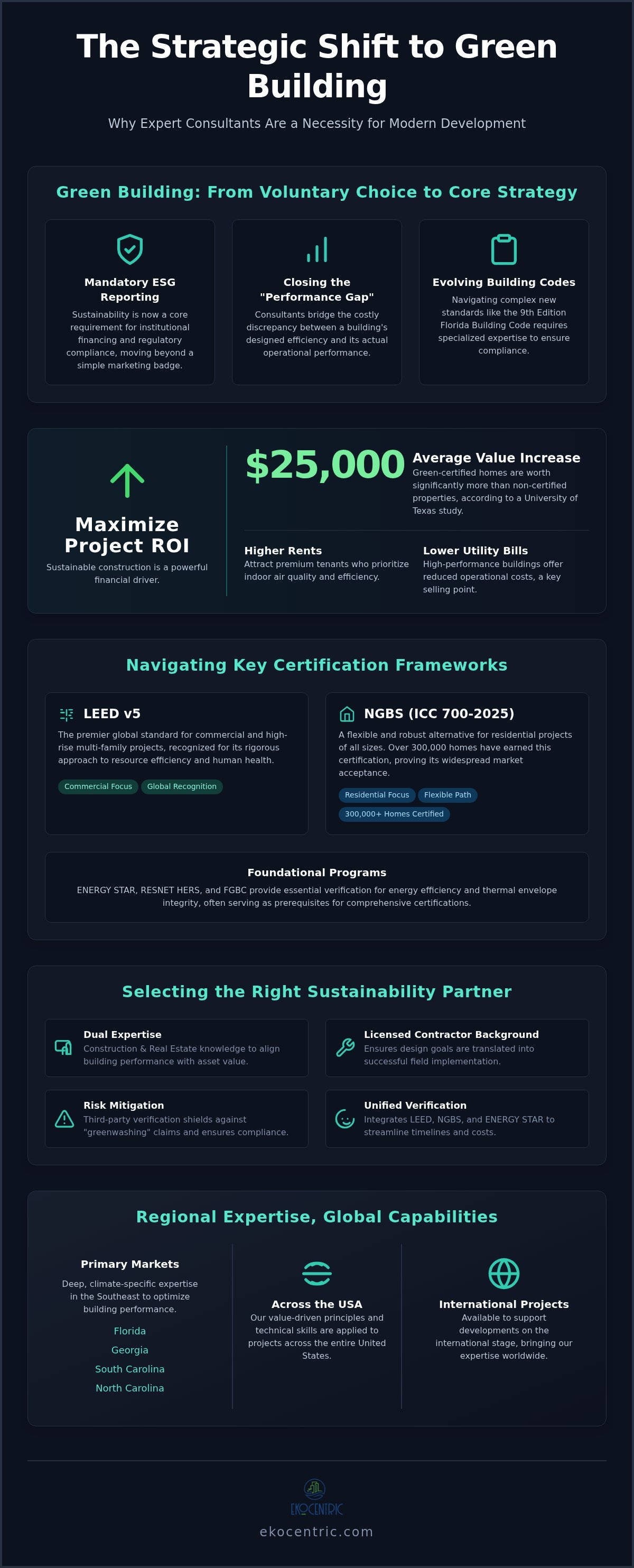
In 2026, the landscape of commercial and residential development has fundamentally changed. Sustainability is no longer a voluntary marketing badge; it's a core requirement for institutional financing and regulatory compliance. As ESG reporting becomes mandatory for many developers, the technical burden of proving a building's performance has grown exponentially. This shift is a primary driver for hiring a green building consultant early in the design phase. It's about more than just paperwork. It's about ensuring that the vision on the blueprints actually translates to the physical structure.
A significant challenge facing modern projects is the "Performance Gap." This is the discrepancy between how a building is designed on paper and how it actually operates once occupied. Without specialized oversight, energy-intensive systems often fail to meet their projected efficiency, leading to higher operational costs and potential legal disputes. Consultants bridge this gap by providing rigorous oversight and utilizing specialized technical equipment. From blower door tests to duct leakage diagnostics, these tools verify that the building envelope is airtight and efficient before the first tenant moves in. Managing the complex documentation for LEED v5 or the ICC 700-2025 National Green Building Standard requires a level of precision that most internal teams simply aren't equipped to handle.
Mitigating Liability and Compliance Risks
Relying on internal staff to manage specialized certification services can lead to expensive oversights. Third-party verification acts as a shield against "greenwashing" claims, providing an objective audit of a project’s environmental impact. This is particularly vital as the 9th Edition of the Florida Building Code takes effect on December 31, 2026. This new code aligns with the 2024 International Energy Conservation Code, demanding much stricter performance metrics. A LEED Green Rater provides a layer of security for residential projects, ensuring that every credit claimed is backed by field-verified data that stands up to scrutiny.
Maximizing Project ROI and Asset Value
The financial argument for sustainable construction is stronger than ever. High-performance buildings command higher rents from tenants who prioritize indoor air quality and lower utility bills. Beyond immediate leasing gains, research has shown that green-certified homes can be worth an average of $25,000 more than comparable non-certified properties. By hiring a green building consultant, developers can optimize these returns through precise energy modeling and resource efficiency strategies. While our expertise is rooted in the specific climate demands of Florida, Georgia, and the Carolinas, we apply these value-driven principles to projects across the United States and on the international stage. Expert consulting ensures that your asset remains resilient and competitive in a market that increasingly values longevity over short-term savings.
Navigating Key Certifications: LEED, NGBS, and Florida Green Building Coalition
Choosing a certification framework is a critical decision that dictates a project's technical requirements and long-term marketability. LEED BD+C remains the premier global standard for commercial and high-rise multi-family construction. It's recognized worldwide for its rigorous approach to resource efficiency and human health. However, the National Green Building Standard (NGBS) has gained significant traction as a flexible alternative for residential projects of all sizes. With the release of the ICC 700-2025 standard in April 2026, NGBS provides a robust path for developers who want a high-performance building without some of the administrative overhead often associated with other systems. Over 300,000 homes have already earned this certification, proving its widespread acceptance in the current market.
Base-level programs like ENERGY STAR and RESNET HERS are excellent starting points for any developer. They focus heavily on energy efficiency and the integrity of thermal envelopes. Yet, comprehensive certifications like LEED or FGBC go much further by addressing indoor air quality, water conservation, and sustainable material sourcing. Hiring a green building consultant early in the process helps you determine which path aligns with your specific asset goals and budget. This strategic choice ensures your project doesn't just meet a baseline, but stands out as a leader in sustainability across the Southeast and beyond.
LEED Green Rater vs. LEED BD+C Consulting
In the LEED ecosystem, roles are distinct and strictly defined to ensure project integrity. BD+C consulting usually begins during the architectural design phase to integrate sustainability into the building's core systems and site selection. Conversely, the residential side requires a different type of specialist. A LEED Green Rater is a mandatory third-party verifier for residential LEED projects. These professionals perform the on-site inspections and diagnostic testing required to confirm that the construction actually meets the designed performance targets. Without this specialized verification, a residential project cannot achieve LEED status, making the rater an indispensable partner for multi-family developers.
State-Specific Standards: The FGBC Advantage
Florida presents unique environmental challenges, from extreme humidity to high-velocity hurricane zones. The Florida Green Building Coalition (FGBC) offers standards like "Home Certification V12" and "Commercial Certification Version 3" specifically tailored to these tropical conditions. Many developers in the Sunshine State prioritize FGBC because its credits focus on local resilience, disaster mitigation, and indigenous landscaping. It's often more attainable and relevant for regional projects than broader national standards. Ensuring your consultant is a licensed Florida Certified Building Contractor is vital for successfully navigating these state-specific credits and municipal requirements. If you're ready to evaluate which standard fits your next project, you can explore our full range of certification services. This regional expertise is the foundation we use to support projects throughout the United States and on the international stage.
Key Criteria for Selecting the Right Sustainability Partner
Finding a qualified partner requires looking beyond basic entry-level designations. While many individuals hold a LEED Green Associate (GA) title, this only indicates a general awareness of green building principles. When hiring a green building consultant for a complex commercial or multi-family project, you need a partner with advanced credentials like LEED AP (Accredited Professional) with a BD+C specialty or a certified LEED Green Rater. These designations signify a deep mastery of technical requirements and the ability to manage the rigorous field verification processes. Your consultant should also possess in-house capabilities for RESNET HERS rating and advanced energy modeling. This ensures that the data driving your project's efficiency is accurate and actionable from day one.
The right partner acts as an extension of your team, filling the gap in internal resources that many developers face. They should provide a seamless blend of technical expertise and pragmatic business sense. This means they don't just point out problems; they provide constructive, achievable solutions that align with your operational realities. Whether you are seeking NGBS Green Verification or FGBC Certification, your consultant must have the specialized equipment and the certified expertise to back up every claim. This level of dedication transforms a simple service into a mission-driven partnership aimed at creating a more environmentally conscious future.
Construction Literacy vs. Theoretical Consulting
Theoretical knowledge isn't enough to navigate the realities of a job site. A consultant who doesn't understand the "means and methods" of construction can inadvertently create delays or suggest impractical solutions. This is why a Licensed Florida Certified Building Contractor background is a game-changer. It means your consultant speaks the same language as your general contractor and subcontractors. They can identify potential issues in the building envelope or HVAC integration before they become costly change orders. This practical field experience is what separates a paperwork-shuffler from a true project advocate. Whether your project is in Georgia or an international location, this construction-first mindset ensures that sustainability goals never compromise the build schedule.
The Real Estate Angle: Valuation and Marketability
A building’s performance is only as valuable as its perceived worth in the market. Hiring a green building consultant who also holds real estate licenses in Florida, North Carolina, or South Carolina provides a unique advantage. They understand how to translate technical metrics into a compelling value proposition for buyers and investors. For instance, leveraging the HERS Index provides a clear, transparent score of a home's energy performance. This transparency often leads to faster sales and can even help tenants or buyers qualify for specialized financing. By bridging the gap between technical certification and market demand, we help developers maximize their ROI while creating high-quality living spaces that stand the test of time.
Regional Expertise and National Scale: Where to Hire
Building science is inherently local. While the physics of heat transfer remains constant, the environmental stressors vary wildly by geography. When hiring a green building consultant, you need a partner who understands the micro-climates of your specific site. In the Southeast, this means managing extreme humidity and the constant threat of severe weather. A consultant without regional knowledge might specify materials that fail in high-moisture environments, leading to mold or structural degradation. We believe that true environmental stewardship requires a deep understanding of how a building interacts with its specific surroundings.
Deep Roots in the Southeast (FL, GA, SC, NC)
Our primary focus centers on Florida, Georgia, South Carolina, and North Carolina. These states share specific challenges like salt-air corrosion and intense solar gain. We navigate the intricacies of the 9th Edition of the Florida Building Code, which takes effect on December 31, 2026. This new code requires impact-resistant building envelopes for wind events of at least 160 mph in many categories. Our established relationships with local building departments and utility providers across these four states allow us to streamline the approval process. For developers managing multi-state portfolios, having a single partner who understands the regulatory nuances of the entire Southeast corridor is a massive operational advantage.
Scaling Beyond Borders: National and International Projects
While our roots are in the South, our expertise is not geographically limited. We serve projects across all 50 US states, utilizing remote verification technologies and a network of field specialists to maintain high-performance standards. This national reach is critical for developers who need consistent sustainability reporting across diverse markets. We also provide international consulting, helping overseas teams adapt US-based frameworks like LEED v5 or NGBS 2025 to global construction practices. Our mission is to provide achievable solutions to global environmental challenges, regardless of where your project is located.
The logistics of hiring a green building consultant for an international project involve more than just understanding the rating system. It requires an ability to translate technical requirements into local construction methods while maintaining the integrity of the certification. We bridge this gap by providing clear, actionable guidance that ensures your international assets meet the same rigorous efficiency standards as your domestic projects. If you're ready to secure your project’s performance regardless of its location, view our full range of consulting and rater services. We are dedicated to being your pragmatic partner in environmental stewardship, whether you're building in Charlotte, Miami, or abroad.
Optimizing Performance with Ekocentric’s Consulting Services
A certification plaque is a symbol of achievement, but it doesn't guarantee a building will operate as intended. Real asset value comes from closing the performance gap between design models and actual utility costs. By hiring a green building consultant who prioritizes field-verified data over theoretical calculations, developers ensure their investments deliver on their promises. Our approach integrates LEED, NGBS, and ENERGY STAR requirements into a single, streamlined workflow that begins at the earliest stages of project planning. We focus on the longevity and resource efficiency of the structure to ensure it remains a high-quality living space for decades.
We guide your team through initial design charrettes to establish clear sustainability goals. From there, we provide continuous oversight, energy modeling, and rigorous testing to ensure every system is optimized. This comprehensive support is designed to remove the burden of certification paperwork from your internal staff, allowing you to focus on the broader goals of your development. Our mission is to transform specialized industry practices into achievable solutions that benefit both the environment and your bottom line.
The Ekocentric Advantage: Dual Expertise
Our unique position comes from combining a Licensed Florida Certified Building Contractor background with real estate licensing across Florida, North Carolina, and South Carolina. This dual expertise allows us to view every project through two lenses: the technical realities of construction and the financial requirements of the real estate market. We aren't just verifiers; we are pragmatic partners invested in your project's success. We understand that you need specific credentials to qualify for financing and the internal capacity to manage complex goals. Explore our full range of sustainability services to see how we can support your specific goals with a mission-driven approach.
Next Steps for Your Sustainable Build
Preparation is the key to a successful certification journey. You should begin by assembling a project team that is committed to high-performance standards from the outset. Timeline expectations vary depending on the scope, but typically, LEED and NGBS verification processes align with your standard construction schedule when integrated early. With LEED v5 now active and the ICC 700-2025 NGBS standard released in April 2026, now is the time to align your projects with the latest industry benchmarks. Hiring a green building consultant early prevents the risk of failing to meet performance standards late in the build. Contact Ekocentric to optimize your building performance today. Whether you are building in the Southeast, across the United States, or internationally, we provide the expert guidance needed to secure your project's future.
Securing Your Project’s Legacy in a High-Performance Market
The shift toward mandatory ESG reporting and performance-based standards like LEED v5 and NGBS 2025 has redefined the developer's role. Success in this landscape requires more than just meeting a checklist; it demands a deep integration of building science and market strategy. By hiring a green building consultant who understands both the construction process and the drivers of real estate valuation, you protect your asset from the performance gap while maximizing your long-term ROI. Whether you're navigating the unique humidity of the Southeast or managing a portfolio across the United States, your choice of partner determines the resilience of your build.
Ekocentric brings a unique perspective as a Licensed Florida Certified Building Contractor and a Licensed Realtor in FL, NC, and SC. Our expertise as a LEED Green Rater and NGBS Verifier ensures that your project meets the highest standards of resource efficiency and quality. We're dedicated to helping you create spaces that are as profitable as they are environmentally responsible. Partner with Ekocentric for your next sustainable project and join us in building a more conscious future. Together, we can turn specialized industry challenges into your most significant competitive advantages.
Frequently Asked Questions
What is the primary role of a green building consultant?
A green building consultant guides a project from the initial design phase through final certification. Their responsibilities include conducting sustainability assessments, advising on resource-efficient materials, and performing energy modeling. By managing the complex documentation required for standards like LEED or NGBS, they ensure the project meets its performance targets without delaying the construction timeline.
How much does hiring a green building consultant typically cost?
The cost of hiring a green building consultant varies based on the project's total square footage, the complexity of the systems, and the specific certification level you want to achieve. Fees usually cover administrative management, technical site inspections, and diagnostic testing. Developers should view these costs as a strategic investment in the building's long-term operational efficiency and overall market valuation.
Can a consultant help with both LEED and NGBS certifications?
Yes, a qualified consultancy can manage both LEED and NGBS frameworks simultaneously. While LEED BD+C is often the choice for high-profile commercial assets, NGBS provides a rigorous and flexible path for residential developments. Using a single partner for both certifications ensures a consistent sustainability strategy across a diverse property portfolio, whether located in the Southeast or elsewhere.
What is the difference between a LEED AP and a LEED Green Rater?
A LEED AP is an accredited professional who manages the design strategy and documentation for Building Design and Construction (BD+C) projects. In contrast, a LEED Green Rater is a mandatory third-party verifier specifically for residential LEED projects. They perform the hands-on field inspections and diagnostic testing, such as blower door and duct leakage tests, required to verify the building's actual performance.
Do I need a green building consultant for a residential project in Florida?
It's highly recommended, especially as the 9th Edition of the Florida Building Code takes effect on December 31, 2026. This new code requires stricter adherence to energy conservation and impact-resistant envelopes. A consultant with a Licensed Florida Certified Building Contractor background ensures your residential project complies with these state-specific mandates while maximizing the asset's resilience against tropical climate stressors.
How early in the design process should I hire a consultant?
You should involve a consultant during the pre-design phase or the initial design charrette. Hiring a green building consultant at this stage allows for the most cost-effective integration of high-performance strategies. Early collaboration ensures that energy-saving features are built into the architectural plans from the start, which prevents expensive design changes or retrofits during the later stages of construction.
What certifications are most important for commercial developers in 2026?
LEED v5 is the current gold standard for commercial developers, emphasizing decarbonization and ecological conservation since its 2025 launch. For projects in Florida, Georgia, and the Carolinas, FGBC Commercial Certification Version 3 is also vital for addressing regional climate resilience. These frameworks help developers meet mandatory ESG reporting requirements while attracting high-value tenants who prioritize sustainable workspaces.
Does Ekocentric provide consulting services outside of Florida?
Yes, we provide comprehensive consulting and rater services across all 50 US states and for international projects. While we maintain a Southeast hub focusing on Florida, Georgia, and the Carolinas, our expertise scales to meet global sustainability goals. We adapt US-based standards like LEED and NGBS to diverse construction environments, ensuring consistent performance regardless of the project's location.