Green Building and Affordable Housing: A Developer’s Guide to Sustainable Impact in 2026
What if the perceived 20% price gap for sustainable materials is actually the key to shielding your 2026 projects from Florida’s increasingly volatile insurance premiums and rising energy costs? Most developers feel the pressure of limited bandwidth and worry that high-performance certifications will break an already tight budget. You likely agree that providing simple shelter isn't enough anymore. These homes must survive 140 mph winds and remain affordable to operate for families on fixed incomes. Integrating Green Building and Affordable Housing is no longer a luxury; it's a pragmatic strategy for long-term viability in a changing climate.
You'll discover exactly how to balance cost-efficiency with high-performance sustainability to create resilient, healthy, and truly affordable communities. We've designed this guide to help you meet Florida building codes and resilience standards while simplifying the LEED, FGBC, and NGBS verification processes. We will explore the specific technical pathways and management strategies that reduce tenant utility bills by up to 30% without draining your internal resources.
Key Takeaways
Understand why true affordability in 2026 requires "operational affordability," where high-performance design significantly reduces long-term utility burdens for residents.
Learn to implement core pillars like zero-energy ready construction and the "Breathe Easy" approach to ensure superior indoor air quality and habitability.
Evaluate the most effective certification pathways, comparing LEED and NGBS to identify which framework best supports your project’s specific sustainability and financing goals.
Discover how to bridge the "bandwidth gap" in Green Building and Affordable Housing by utilizing early-stage consulting to streamline the design and verification process.
Identify how specialized partnerships can simplify complex sustainability management, allowing your team to deliver resilient, high-impact communities efficiently.
The Intersection of Green Building and Affordable Housing in 2026
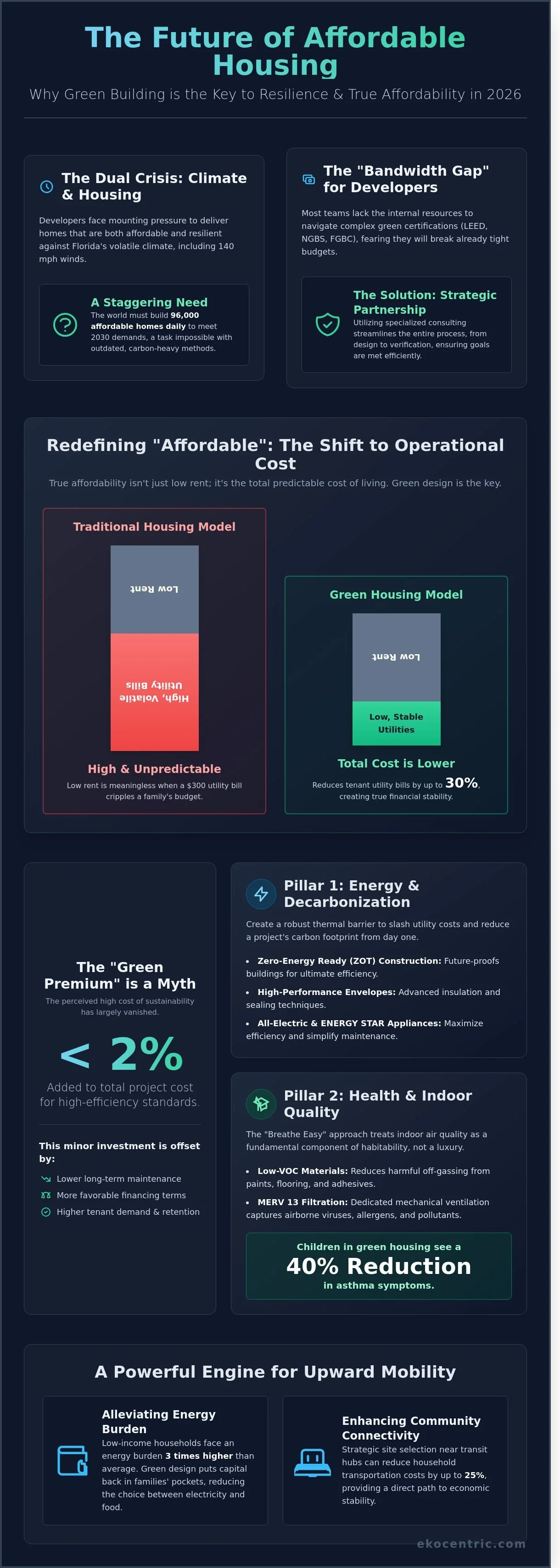
The integration of Green Building and Affordable Housing in 2026 represents a shift from optional "green" features to a mandatory baseline for structural resilience. We've moved past the era where sustainability was viewed as a luxury add-on. Today, savvy developers define success through "Operational Affordability." This concept recognizes that a low monthly rent check is meaningless if the resident is burdened by a $300 utility bill. By utilizing high-performance envelopes and ENERGY STAR appliances, we ensure that the total cost of living remains predictable and low for those who need it most.
Industry data now shows that the "green premium" for sustainable construction has largely vanished. Recent cost analyses indicate that building to high-efficiency standards often adds less than 2% to total project costs. This minor upfront investment is frequently offset by lower long-term maintenance requirements and more favorable financing terms from institutional investors. Many developers don't have the internal bandwidth to track these evolving certification requirements, which is why professional sustainability management services have become a standard component of the modern development team.
Market drivers have also evolved to prioritize resident health. In 2026, tenants and housing authorities demand superior indoor air quality to combat rising respiratory issues in urban environments. ESG (Environmental, Social, and Governance) requirements now mandate these health-focused designs, making green certification a prerequisite for securing capital in the affordable housing sector.
The Dual Crisis: Housing Shortage and Climate Change
UN-Habitat reports that the world must produce 96,000 affordable homes every single day to house an estimated 3 billion people by 2030. This massive volume of construction can't rely on outdated, carbon-heavy methods that exacerbate environmental degradation. In 2026, housing infrastructure is the primary tool for climate solution. Building to LEED or FGBC standards has transitioned from a "best practice" to a "standard practice" to ensure new units don't become immediate environmental liabilities.
Beyond the Build: The Social Impact of Green Design
Sustainable design is a powerful engine for upward mobility. Low-income households often face an energy burden three times higher than average earners, frequently forcing a choice between electricity and food. By prioritizing Green Building and Affordable Housing, we keep more capital in the pockets of families. Strategic site selection further enhances this impact by creating community connectivity. Placing residents near transit hubs can reduce household transportation costs by up to 25%, providing a direct path to economic stability.
Core Pillars of Sustainable Affordable Development
Integrating Green Building and Affordable Housing requires a shift from minimum building code compliance to maximum long-term performance. Sustainable development isn't just about adding solar panels; it's about a holistic framework that prioritizes the people inside the walls. By focusing on resource efficiency, developers can reduce embodied carbon, which accounts for roughly 11% of all global greenhouse gas emissions. Selecting smart materials and optimizing structural designs prevents waste and lowers the total carbon footprint of a project before the first tenant moves in.
Energy and Decarbonization Strategies
Transitioning to all-electric, zero-energy ready (ZOT) construction is a pragmatic move for multi-family units. High-performance envelopes use advanced insulation and sealing techniques to create a robust thermal barrier. This barrier reduces utility volatility, ensuring that a $50 monthly increase in regional energy costs doesn't force a family to choose between electricity and groceries. Property managers now use smart energy monitoring systems to track performance across 100% of units, allowing for predictive maintenance that saves thousands in emergency repairs.
The Health-Housing Link: Indoor Environmental Quality
The "Breathe Easy" approach treats indoor air quality as a foundational element of habitability. Detoxifying a home involves more than just opening a window; it requires low-VOC materials and dedicated mechanical ventilation with MERV 13 filtration. Research indicates that children living in green-certified affordable housing see a 40% reduction in asthma symptoms. This directly impacts school and work attendance, creating a cycle of stability for residents. Thermal comfort is a vital component of this health link, providing a refuge from Florida's 95-degree summer days.
Resilience in the Florida Context
Florida's climate demands a focus on passive survivability. This means building homes that stay safe during the 72 hours following a hurricane when the power grid is often down. Using impact-resistant windows and continuous load paths keeps the structure intact during high winds. Flood mitigation involves elevating critical infrastructure at least 2 feet above the base flood elevation. Incorporating Florida-friendly landscaping can reduce outdoor water use by 60%, preserving local aquifers while mitigating the urban heat island effect. If you're looking to integrate these standards into your next project, our sustainability services provide the technical expertise to meet these rigorous goals.
Navigating Certification Pathways: LEED, NGBS, and FGBC
Selecting a certification pathway is a strategic business decision that directly affects a project's capital stack. For developers, the synergy between Green Building and Affordable Housing is often driven by financing requirements. Many lenders, including Fannie Mae and Freddie Mac, offer preferential interest rates for certified properties. For instance, Fannie Mae’s Green Rewards program can provide a 15-basis point reduction in interest rates. This lower cost of debt increases the feasibility of affordable projects while ensuring the building remains a high-value asset for decades.
LEED for Homes and the Green Rater Role
LEED BD+C: Homes remains the most recognized global benchmark for sustainability. It relies on a rigorous third-party verification process to ensure that environmental goals aren't just promised, but actually built. A central figure in this process is the LEED Green Rater. These professionals provide essential on-site verification, performing mandatory inspections and performance testing like blower door and duct leakage tests.
Many developers don't have the internal bandwidth to manage the complex documentation required for these credits. Integrating professional LEED Green Rater services into the project team ensures that every sustainability metric is met. This layer of management protects the developer from "greenwashing" risks and guarantees that the building's performance matches its design specifications. It's a pragmatic approach to delivering healthier, more durable homes to residents who need them most.
NGBS and FGBC: Practical Alternatives
While LEED offers prestige, the National Green Building Standard (NGBS) provides a streamlined, cost-effective alternative specifically tailored for residential multi-family projects. NGBS is popular in the affordable housing sector because its scoring system follows traditional construction phases. This makes it easier for site supervisors to track progress without radical changes to their existing workflows.
Regional projects in the Southeast often benefit from the Florida Green Building Coalition (FGBC) standards. FGBC tailors its criteria to Florida’s unique climate and strict building codes. It emphasizes moisture control and disaster resilience, which are critical in a state prone to hurricanes. Since its inception in 2000, FGBC has certified over 28,000 projects. Choosing the right certification depends on your specific goals:
LEED: Best for projects seeking national recognition and the highest tier of green financing.
NGBS: Ideal for multi-family developers who want a clear, points-based system with lower administrative overhead.
FGBC: The top choice for Florida builders focusing on regional resilience and state-specific environmental challenges.
Each pathway strengthens the link between Green Building and Affordable Housing by reducing long-term operating costs. Lower utility bills for tenants mean higher rent collection rates for owners, creating a more stable and resilient community investment.
Overcoming Implementation Barriers: From Design to Verification
Many developers and builders don't have the internal bandwidth to manage the technical nuances of sustainability. It's a common reality that leads to missed deadlines and failed certifications. For Green Building and Affordable Housing to succeed, the process must start with expert guidance before the first shovel hits the ground. Without this oversight, the administrative burden of tracking energy metrics often overwhelms project managers who are already juggling subcontractor schedules and supply chain delays.
Integrated Project Delivery for Green Builds
Bringing architects, builders, and consultants together at the start prevents expensive mid-course corrections. Industry studies suggest that late-stage design changes can increase project costs by 12% or more. Utilizing sustainable development consulting during the pre-construction phase ensures every team member understands the specific requirements for Florida Green Building Coalition (FGBC) or LEED standards. This proactive approach manages the heavy documentation burden. It allows builders to stay focused on the physical construction while consultants handle the administrative rigors and submittal tracking.
Technical Verification and Performance Testing
Real-world performance rarely matches a blueprint without rigorous field testing. HERS Raters play a critical role here by verifying that energy goals are actually met on-site. Blower door tests identify air leaks that could lead to moisture issues, while duct leakage testing ensures systems don't lose up to 25% of their conditioned air to unconditioned spaces. These tests are mandatory for ENERGY STAR certification and provide the data needed to prove a project's long-term viability.
Avoiding common pitfalls requires a dedicated partner who understands the "as-built" verification process. For example, failing to document Grade I insulation installation with high-resolution photos can disqualify a unit from certain certifications. Practical management ensures that these small but vital details are captured in real-time. This level of oversight ensures the final Green Building and Affordable Housing project delivers the utility savings promised to the residents.
Ready to streamline your next project and ensure every unit meets peak performance standards? Partner with our expert sustainability consultants today.
Scaling Success: Partnering for Sustainable Affordable Housing
Building affordable units requires a delicate balance between tight budgets and high expectations. Most developers don't have the internal bandwidth to manage the technical nuances of sustainability alone. This is where specialized consultants become a strategic asset rather than an added cost. By outsourcing this oversight, teams often avoid the 15% to 20% cost premiums associated with poorly managed green initiatives. Ekocentric acts as a pragmatic partner, ensuring that Green Building and Affordable Housing goals align with project timelines and financial constraints.
We simplify the path to LEED and FGBC certification by acting as an integrated member of your development team. Our approach isn't about checking boxes; it's about finding the most cost-effective way to reach high-performance benchmarks. We understand that every dollar saved in the certification process is a dollar that can go back into community services or additional units. This results-oriented mindset allows us to bridge the gap between visionary environmental goals and the hard realities of the construction industry.
Why Expertise Matters in Affordable Housing
The regulatory environment in Florida is shifting quickly. In 2023, the state saw a surge in demand for resilient infrastructure as insurance premiums rose across the board. Developers can't afford to guess which credits to pursue. Our team provides LEED BD+C consulting to streamline the documentation process from day one. We've seen Florida-based projects achieve FGBC certification 25% faster by integrating our HERS Raters early in the design phase. This expertise allows builders to focus on construction while we handle the rigorous compliance requirements.
A Vision for 2026 and Beyond
By 2026, the definition of a standard building will change significantly. New codes will likely mandate higher energy-efficiency levels to combat rising heat indices and extreme weather patterns. Future-proofing your assets now prevents expensive retrofits in the next decade. We help you build for the climate of tomorrow by focusing on:
Envelope durability to withstand 150+ mph winds
Advanced HVAC systems that reduce tenant energy burdens by 30%
Water conservation strategies that mitigate rising utility costs
The intersection of Green Building and Affordable Housing is where true community resilience begins. Our unwavering dedication to environmental stewardship ensures your portfolio remains competitive and equitable for decades. It's time to build a greener, more sustainable future today.
Leading the 2026 Shift Toward Resilient Development
The landscape of residential development is changing rapidly. By 2026, the fusion of Green Building and Affordable Housing will be the baseline for developers who prioritize long term durability and resident health. Success requires a mastery of certification pathways like LEED BD+C v4.1 and the FGBC 2023 standards. These frameworks ensure that every unit isn't just a roof; it's a high performing asset that reduces utility burdens for families. Many teams don't have the internal bandwidth to manage the rigorous verification required for these designations. Partnering with specialists who understand the specific climate risks of the Southeast is the most practical way to scale your impact.
We're ready to help you navigate these complexities with confidence. As a LEED Green Rater and BD+C Expert, I provide the technical oversight needed to clear every hurdle from design to final inspection. We also serve as a Florida Green Building Coalition (FGBC) Specialist with a deep commitment to creating resilient Florida communities. Contact Ekocentric for expert LEED and FGBC consulting to streamline your next project. Your dedication to better housing is the catalyst for a more sustainable future. Let's work together to build homes that stand the test of time.
Frequently Asked Questions
Is green building more expensive for affordable housing projects?
Green building typically adds only 1% to 2% to the total construction cost of affordable housing developments. While initial outlays for high-efficiency HVAC systems or insulation might seem higher, the long-term savings on maintenance and utilities quickly offset these costs. Developers often find that integrated design reduces material waste by 15% during the construction phase; this makes the "green premium" negligible for most builders.
What is the role of a LEED Green Rater in affordable housing?
A LEED Green Rater provides the mandatory third-party verification required to ensure a project meets the U.S. Green Building Council's rigorous standards. They perform on-site inspections and performance testing, such as blower door tests, to validate energy efficiency. By catching installation errors early, a Rater helps developers avoid 100% of the costly retrofits that often occur after a building is occupied. This oversight ensures the project's sustainability goals are actually met.
How does FGBC certification differ from LEED for Florida projects?
FGBC certification is specifically tailored to Florida's unique sub-tropical climate, while LEED is a global standard applicable anywhere. FGBC focuses on regional challenges like high humidity and hurricane resilience, which are critical for the 22 million residents in the state. While LEED is highly prestigious, FGBC often offers a more cost-effective path for local developers. It uses a points-based system that rewards drought-tolerant landscaping and moisture control measures specific to Florida's environment.
Can green building standards help with affordable housing financing?
Green building standards are essential for securing financing through programs like the Low-Income Housing Tax Credit, which often awards 5 to 10 extra points to certified projects. These points are frequently the deciding factor in winning competitive state funding rounds. By committing to Green Building and Affordable Housing standards, developers can access specialized loan products from lenders like Fannie Mae that offer interest rate reductions of 10 to 15 basis points for certified sustainable properties.
What are the most cost-effective green materials for affordable housing?
Low-VOC paints and LED lighting are the most cost-effective green materials, offering immediate health benefits and a 75% reduction in lighting energy use. Using advanced framing techniques can reduce lumber needs by 5% to 10% without compromising structural integrity. These choices demonstrate that Green Building and Affordable Housing don't require expensive luxury finishes. Selecting durable, locally sourced materials also lowers transportation emissions and long-term replacement costs for the building owner.
How does energy efficiency impact the long-term affordability for tenants?
Energy efficiency reduces monthly utility bills for tenants by an average of 20% to 30%, which is vital for households spending over 10% of their income on energy. Lower bills mean tenants have more disposable income for food, healthcare, and education. This stability leads to a 15% reduction in tenant turnover rates for property managers. High-performance envelopes and ENERGY STAR appliances ensure that these homes remain truly affordable throughout their 50-year life cycle.
Does Ekocentric provide NGBS verification for multi-family builds?
Yes, Ekocentric provides comprehensive NGBS verification for multi-family builds of all sizes. Our team has managed certifications for projects ranging from small 10-unit developments to large-scale 300-unit complexes. We handle the entire verification process, from the initial design review to the final inspection. This allows you to focus on construction while we ensure your project meets the 2020 NGBS criteria for energy, water, and resource efficiency.
How can I manage the bandwidth required for green certification?
You can manage the bandwidth required for green certification by partnering with an expert consultant like Ekocentric to handle the documentation and technical requirements. Many builders don't have the internal resources to track the 50+ credits required for a typical certification. We act as your project's sustainability department, managing the workflow and ensuring deadlines are met. This partnership frees your team to focus on core construction tasks while we navigate the complexities of the certification process.