The Real Cost to Build a Green Home in Florida: 2026 Budgeting Guide
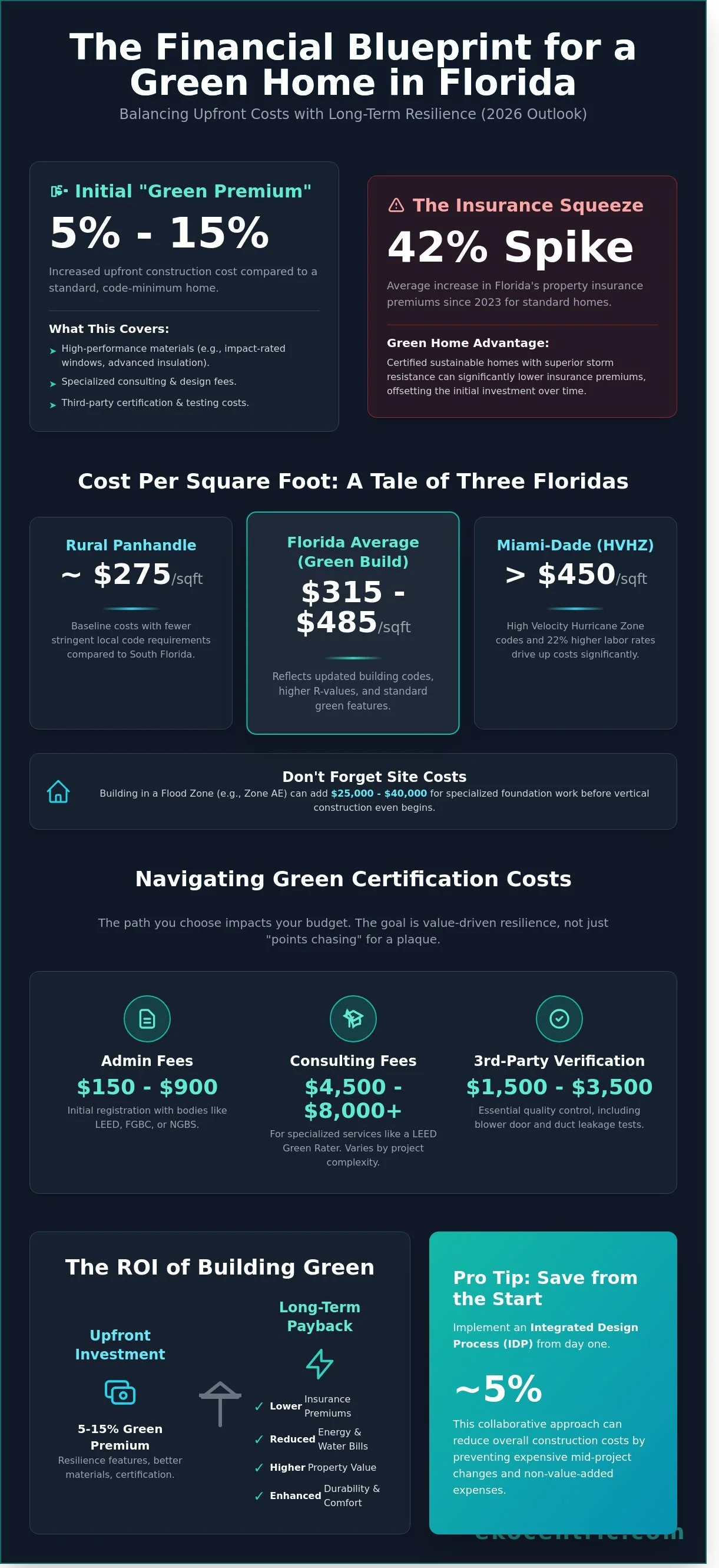
Building a standard home in Florida is no longer the safe financial bet it used to be. When you calculate the actual cost to build a green home in Florida, the initial 5% to 12% construction premium looks remarkably different when compared to the 42% spike in property insurance premiums recorded by the Insurance Information Institute since 2023. You've probably noticed that traditional builds aren't keeping up with our state's aggressive humidity or the rising price of keeping a home at 72 degrees. It's a frustrating reality that demands a more resilient approach to residential development.
We'll show you exactly how to budget for a sustainable home that counters these pressures, focusing on precise drivers like airtight envelopes and the $1,500 to $5,000 fees associated with third party certifications. This guide breaks down hard and soft costs while helping you choose between LEED and FGBC to maximize your property's value in the 2026 market. You'll gain a clear strategy to balance upfront expenses with long term resilience, ensuring your project is both environmentally responsible and financially sound.
Key Takeaways
Identify the 2026 "green premium" to establish a realistic budget that accounts for Florida’s evolving building codes and unique climate demands.
Compare the administrative fees and market recognition of LEED, FGBC, and NGBS to choose the certification body that offers the highest value for your specific project.
Analyze how specialized resilience features like ICF and HVHZ-rated glass influence the total cost to build a green home in Florida while significantly enhancing property durability.
Discover how certified sustainable homes translate into lower insurance premiums and shorter payback periods through superior energy performance and storm resistance.
Learn how implementing an Integrated Design Process can reduce overall construction costs by up to 5% while protecting your budget from non-value-added expenses.
The Baseline: Understanding the Green Premium in Florida (2026)
In 2026, the concept of a green building in Florida has shifted from an optional luxury to a necessity for long-term resilience. We define "green" as a structure that achieves high performance through airtight envelopes, advanced moisture management, and superior energy efficiency tailored to our humid subtropical climate. While these features provide immense value, they currently carry a green premium of 5% to 15% over conventional construction. This increase stems from both hard costs, like high-efficiency HVAC systems and impact-rated triple-pane windows, and soft costs, including specialized consulting services, HERS ratings, or FGBC certifications.
To better understand the current financial landscape of custom construction in the state, watch this helpful video:
Relying solely on the cost per square foot metric often fails to account for the total value of a home. A standard build might seem cheaper upfront, but it lacks the durability required for Florida's intensifying weather patterns. When you calculate the cost to build a green home in Florida, you're investing in a structure designed to withstand 160 mph winds and extreme heat. This upfront investment translates to lower insurance premiums and reduced maintenance costs over the life of the mortgage. Resilience is a financial strategy, not just an environmental one.
Regional Cost Variations Across the Sunshine State
Location dictates a significant portion of your budget. In 2026, a luxury green build in Miami-Dade can exceed $450 per square foot due to stringent High Velocity Hurricane Zone (HVHZ) requirements and a 22% higher labor rate compared to the state average. Conversely, rural Panhandle projects might see costs closer to $275 per square foot. Local labor shortages in 2026 have specifically impacted the installation of specialized green materials, as certified installers for items like heat pump water heaters or solar shingles are in high demand. Site elevation also plays a critical role. Homes in Flood Zone AE require specialized foundation work that can add $25,000 to $40,000 to the initial site preparation costs before vertical construction begins.
The Evolution of Florida Building Standards
The gap between standard and sustainable builds is closing rapidly. Recent updates to the Florida Building Code have mandated higher R-values for insulation and more efficient cooling systems for all new permits. By 2026, the baseline for any legal build is already quite high, meaning the jump to a certified green home is smaller than it was a decade ago. Developers must now account for mechanical ventilation and tighter building envelopes as a standard requirement. For a high-performance residence in 2026, the average cost to build a green home in Florida typically ranges from $315 to $485 per square foot depending on the level of certification and local finishes.
Strategic Certification: LEED vs. FGBC vs. NGBS Costs
The cost to build a green home in Florida is heavily influenced by the certification path you select during the design phase. Administrative and registration fees represent a small fraction of the budget, typically ranging from $150 to $900. The real financial variance lies in the soft costs of consulting and the hard costs of meeting specific technical thresholds. Selecting a program that aligns with Florida's unique climate prevents "points chasing," a common mistake where builders spend $5,000 or more on niche upgrades just to satisfy a checklist requirement that offers little actual ROI.
Third party verification adds another layer to the budget. You should expect to allocate between $1,500 and $3,500 for on site performance testing, including blower door tests and duct leakage assessments. These tests aren't just bureaucratic hurdles; they're essential quality control measures that ensure the home actually performs as designed. Developers who skip rigorous early planning often see these costs spike by 20% when they're forced to make mid construction corrections to meet certification standards.
LEED Green Rater and BD+C Expenses
LEED (Leadership in Energy and Environmental Design) remains the most recognized name globally, but it demands a higher level of documentation. For a single family residential project in the 2026 Florida market, LEED BD+C consulting fees often fall between $4,500 and $8,000. This doesn't include the LEED Green Rater fees, which cover the mandatory on site inspections and final submittals to the GBCI. Because many builders don't have the internal bandwidth to manage the sustainability side of a project, Ekocentric’s specialized LEED services provide a pragmatic way to consolidate these management tasks and avoid expensive filing errors.
The Florida Green Building Coalition (FGBC) Advantage
For many local projects, the Florida Green Building Coalition (FGBC) offers the most logical path. It's specifically tailored to our environment, focusing heavily on disaster resilience and moisture control. Registration fees are significantly lower than national alternatives, often staying under $250 for residential builds. Since the National Green Building Standard (NGBS) and LEED apply to the entire country, they sometimes miss the nuances of Florida's 90% humidity days. FGBC rewards builders for using Florida friendly landscaping and high efficiency dehumidification, which are practical necessities here. Working with a local expert ensures you aren't paying for "green" features that don't make sense in a sub tropical climate. If you're looking to maximize your budget, you might consult with a Florida based rater to see which standard fits your specific site conditions.
Climate-Specific Cost Factors: Resilience as a Value Driver
Building in Florida requires a shift from minimum code compliance to maximum resilience. The cost to build a green home in Florida is heavily influenced by the 2026 focus on durability and climate adaptation. Insulated Concrete Forms (ICF) represent a prime example of this shift. While ICF adds roughly $12 per square foot to the shell cost compared to traditional wood framing, it provides an R-value of R-22 or higher and survives 250 mph winds. This investment pays for itself through a 40% reduction in cooling loads and significantly lower insurance premiums.
Insulation is the highest ROI item in a cooling-dominant climate. Moving to open-cell spray foam in the attic creates a conditioned space, which protects HVAC ductwork from extreme heat. Moisture management is equally critical for long-term value. In Florida's 70% average humidity, installing an Energy Recovery Ventilator (ERV) for approximately $2,200 prevents mold growth and maintains indoor air quality. These systems are no longer luxury add-ons; they're essential components of a healthy, sustainable structure.
High-Velocity Hurricane Zones (HVHZ) Impacts
Construction in Miami-Dade or Broward counties requires adherence to High-Velocity Hurricane Zone (HVHZ) standards. These regulations add 15% to structural costs due to stricter tie-down requirements and pressure-tested materials. Metal roofing has become the 2026 standard for resilient builds, costing $16 per square foot but lasting 50 years. Impact-rated windows typically cost $75 per square foot, while standard non-impact windows average $28 per square foot.
Energy Efficient Systems for the Florida Heat
Variable-speed HVAC systems are vital for managing the cost to build a green home in Florida over the long term. These units cost $3,500 more than single-stage alternatives but pay for themselves within 4 years through superior dehumidification and energy savings. Achieving certification through Ekocentric's consulting services often requires ENERGY STAR appliances, which reduce plug loads by 15% compared to non-rated models.
Smart home automation also impacts the green build budget. Integrating automated shading and peak-load management adds $2,500 to the initial costs. However, these systems optimize energy use during peak afternoon heat, ensuring the home remains comfortable without straining the electrical grid. This pragmatic approach to technology ensures that every dollar spent on the budget contributes to a more sustainable and resilient future.
The ROI of Sustainability: Beyond the Initial Build Cost
The initial cost to build a green home in Florida usually carries a 4% to 8% premium over standard construction. While that upfront figure matters, savvy developers and homeowners focus on the payback period. Most Florida green builds reach a break-even point within 6 to 9 years through operational savings alone. This calculation doesn't even include the "Health Premium." By 2026, indoor air quality (IAQ) has become a top priority for buyers. High-performance filtration and low-VOC materials reduce respiratory issues, potentially saving families over $500 annually in healthcare-related costs and lost productivity.
Operational Savings and Utility Bill Reduction
Utility expenses are a permanent tax on homeownership. A LEED-certified home in Orlando typically saves $120 per month compared to a code-minimum house. In Jacksonville, where seasonal temperature swings are more pronounced, these savings often hit $145 monthly. These figures reflect the impact of high-efficiency heat pump water heaters, which consume 65% less energy than standard electric tanks. Low-flow fixtures reduce water consumption by 30%, which is vital as Florida municipalities project a 5% annual increase in water rates through 2028. Investing in efficiency today is the only way to future-proof against these rising costs.
Insurance Resilience and Market Demand
Florida's insurance market is volatile, but green certifications provide a necessary "paper trail" for underwriters. Homes certified by the Florida Green Building Coalition (FGBC) or LEED demonstrate a level of resilience that standard homes lack. In 2025, data showed that certified resilient homes qualified for insurance premiums 12% lower than their non-certified neighbors. This is a direct result of superior moisture management and wind-resistance standards required for certification.
Market demand is also shifting due to "Climate Migrants." These are buyers moving to Florida from states like California or New York who specifically hunt for sustainable, high-performance housing. This demand drives impressive resale trends. By early 2026, certified green homes in the Southeast were selling for a 9.5% premium compared to traditional builds. Developers are also finding that these certifications help them secure preferential "Green Financing" with interest rates roughly 0.40% lower than standard commercial loans. It's a pragmatic business move that aligns perfectly with environmental stewardship.
If you're ready to maximize your project's value and ensure long-term resilience, explore our sustainability management services to see how we help builders achieve these certifications efficiently.
Navigating the Process: How to Manage Green Build Costs
Building a sustainable residence requires a shift from traditional linear construction to an Integrated Design Process (IDP). By bringing consultants, architects, and engineers together during the pre-design phase, owners typically reduce the total cost to build a green home in Florida by 3% to 5%. This early collaboration identifies systems that pull double duty, such as right-sizing HVAC units based on high-performance insulation. This prevents the common mistake of overspending on oversized equipment that actually performs poorly in our unique climate.
Filtering out "greenwashing" is equally critical for the budget. Some products claim eco-friendliness but offer zero measurable impact on energy bills or indoor air quality. A certified HERS Rater provides the energy modeling needed to prove performance before the first shovel hits the ground. Working with a builder who has a portfolio of FGBC or LEED certified projects ensures they understand the specific sequencing required for airtight envelopes and moisture management. They know that a green home isn't just a standard house with solar panels; it's a holistic system.
The Role of a Sustainable Building Consultant
Many developers don't have the internal bandwidth to track complex certification requirements. A consultant acts as a project manager for sustainability, preventing expensive mid-build corrections that occur when a project fails to meet specific energy benchmarks. By managing the heavy documentation burden, they allow the builder to focus on the physical construction. You can explore Ekocentric’s consulting offerings to see how professional oversight streamlines the certification path and protects your financial investment.
Avoiding Common Budget Pitfalls in Florida
Off-the-shelf green plans often fail because they don't account for Florida's high vapor pressure. A common pitfall is spending $25,000 on a massive solar array before optimizing the building envelope. It's much cheaper to reduce energy demand through superior windows and sealing than it is to generate power for a leaky house. To keep the cost to build a green home in Florida under control, follow this final checklist:
Prioritize the building envelope and insulation over high-tech gadgets.
Hire a HERS Rater during the design phase, not after framing is complete.
Verify that the builder has completed at least three certified projects in the last 24 months.
Ensure the HVAC design includes dedicated dehumidification for Florida's humid shoulder seasons.
Taking these steps ensures your budget goes toward features that provide a real return on investment. Effective management turns sustainability from a luxury add-on into a core, cost-effective component of your new home.
Secure Your Competitive Edge in Florida’s Sustainable Market
Building for the 2026 market means moving beyond basic compliance to achieve true climate resilience. While the initial cost to build a green home in Florida typically carries a 5% to 12% premium, the long-term value is undeniable. Strategic selection between FGBC, LEED, or NGBS certifications allows you to align your budget with specific project goals while ensuring a measurable return through lower utility bills and increased asset durability. These certifications aren't just badges; they're essential tools for risk mitigation in our unique environment.
Navigating these technical requirements shouldn't slow your timeline. At Ekocentric, our Florida-based expertise in FGBC and LEED standards ensures your project meets its sustainability targets without unnecessary overhead. With expert LEED Green Raters on staff, we've established a proven track record of reducing certification friction for developers across the state. We handle the complex management side so your team can focus on the build. We're committed to making high-performance construction a standard for every developer we support.
Partner with Ekocentric to optimize your green building certification costs.
We're ready to help you turn your vision for a sustainable future into a profitable and lasting reality.
Frequently Asked Questions
Is it significantly more expensive to build a green home in Florida than a regular one?
No, the initial price premium for a sustainable residence typically ranges from 2% to 5% over standard construction. For a $500,000 project, this represents a $10,000 to $25,000 increase in the total budget. These costs are often recovered within 5 to 7 years through lower utility bills and reduced maintenance. Many appraisers now value certified green homes 7% higher than traditional builds, meaning the cost to build a green home in Florida often results in immediate equity gains.
How much does FGBC certification cost compared to LEED in Florida?
Florida Green Building Coalition (FGBC) certification fees are generally lower, ranging from $150 to $350 for registration and processing. In contrast, LEED for Homes registration and certification fees through the USGBC start at approximately $600 for members. When you include the necessary third-party verification, an FGBC project usually requires a total investment of $2,500. LEED projects often require $4,000 to $6,000 because they involve more rigorous documentation and specialized testing protocols.
Does building a green home in Florida help with insurance costs?
Yes, homeowners frequently see 10% to 25% reductions in annual premiums by meeting specific resilience standards. Green building programs like LEED and FGBC reward builders for using impact-rated windows and secondary water barriers that exceed minimum Florida Building Code requirements. These upgrades satisfy wind mitigation credits used by major insurers. By investing in a resilient envelope, a typical homeowner can save $800 to $1,200 every year on their property insurance policy.
What are the soft costs associated with green building certifications?
Soft costs for sustainable projects usually account for 1% to 3% of your total construction budget. These expenses cover professional services like energy modeling, HERS Rater inspections, and the administrative time required for document submittals. For a 2,500 square foot home, you should budget between $3,000 and $7,500 for these consulting fees. Hiring an expert ensures the project stays on track so the builder doesn't have the bandwidth issues that often stall certification efforts.
Can I build a green home in Florida without a consultant?
While you can attempt it, 85% of successful certified projects use a consultant to navigate the complex technical requirements. Most developers don't have the bandwidth to manage the sustainability side of a project while also supervising subcontractors. A consultant like an Ekocentric professional prevents costly errors during the blower door test or insulation inspection phases. Their expertise often identifies $5,000 in material efficiencies that would otherwise be missed during the design phase.
Which green building materials have the best ROI in Florida?
Unvented attics using open-cell spray foam and high-performance Low-E windows offer the fastest return on investment, typically within 4 to 6 years. Upgrading to a variable-speed heat pump HVAC system can also reduce your monthly cooling expenses by 30% compared to standard units. These choices are critical when calculating the cost to build a green home in Florida. They provide immediate comfort benefits and protect the structure from the high humidity levels common in the 2026 climate.
How does the High-Velocity Hurricane Zone (HVHZ) affect green build costs?
Building within an HVHZ, such as Miami-Dade or Broward County, adds $15 to $30 per square foot to the total construction cost. These areas require specific missile-impact glass and reinforced roof-to-wall connections that naturally align with green building durability goals. While the upfront investment is higher, these structural requirements create a tighter building envelope. This synergy makes it easier to achieve high-performance energy targets because the home is already built to extreme airtightness standards.
What is the average cost per square foot for a LEED-certified home in Florida in 2026?
The average cost for a LEED-certified home in 2026 currently ranges from $215 to $260 per square foot. This figure accounts for recent 2025 labor market shifts and the rising cost of sustainable raw materials. Luxury projects seeking LEED Platinum status can reach $350 per square foot or more if they include advanced solar arrays and battery storage. Most builders find that standard LEED Silver or Gold targets stay within 5% of the local market rate for high-quality new construction.