Green Building Certification for Small Contractors in Florida: 2026 Buying Guide
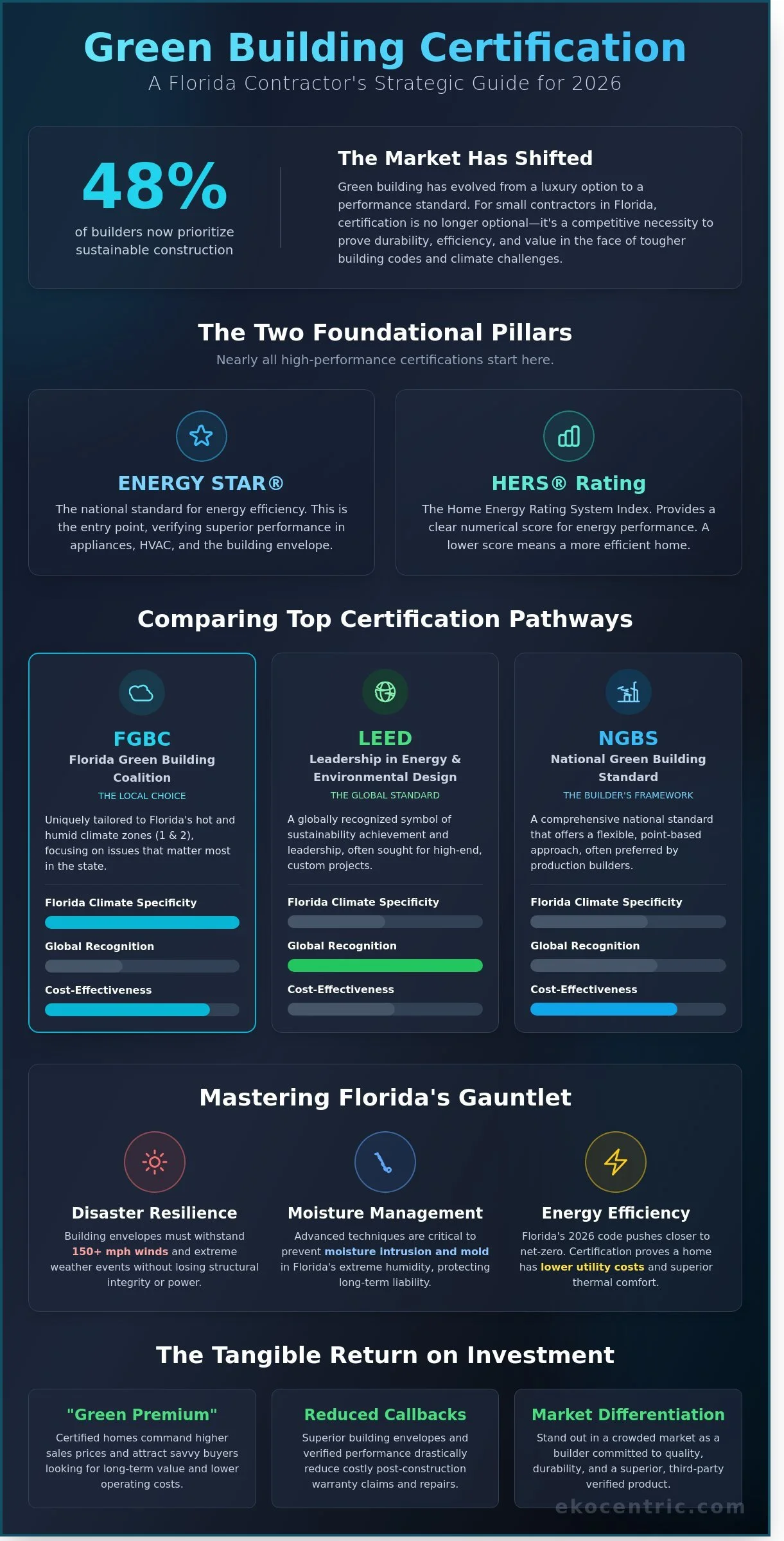
Why would a small builder choose to add more paperwork to a project when Florida's 2023 building codes are already some of the toughest in the country? You likely feel the weight of administrative tasks and the reality that most small teams don't have the bandwidth to manage complex sustainability goals. It's frustrating to see project costs rise while traditional incentives like the 45L tax credit expire by the summer of 2025. However, securing a green building certification for small contractors in Florida isn't just about a plaque on the wall. It's a strategic move to stay competitive in a market where the 2023 Dodge Construction Network report indicates that 48% of builders now prioritize sustainable construction for over half of their projects.
This guide shows you how to increase project value and durability through efficient, streamlined pathways. You'll discover how to match certification requirements with local codes to avoid redundant work. We provide a clear comparison of LEED, FGBC, and NGBS to help you choose the most cost-effective framework for your next build in the 2026 market.
Key Takeaways
Understand why green building has shifted from a luxury option to a performance standard for high-performance residential construction in the 2026 Florida market.
Compare the specific benefits of the Florida Green Building Coalition (FGBC) against national standards like LEED and NGBS to identify the most efficient pathway for your projects.
Master the nuances of green building certification for small contractors in Florida by integrating disaster resilience and advanced moisture management into your building envelope design.
Streamline your workflow by learning how to manage the certification process and documentation burden without overextending your team's internal bandwidth.
Calculate the tangible return on investment, from achieving a "Green Premium" on sales prices to reducing costly post-construction callbacks and warranty claims.
Understanding Green Building Certification for Florida Contractors
In 2026, green building certification for small contractors in Florida represents a commitment to building science that goes beyond basic code compliance. It's a verified process where third-party raters evaluate a structure's energy efficiency, water conservation, and indoor air quality. Green building certification systems like LEED and the Florida Green Building Coalition (FGBC) provide the structural framework for these high-performance standards. What was once an optional luxury for custom estates has become the baseline for residential durability in the Sunshine State.
Small contractors are uniquely positioned to lead this sustainable niche. You often have more direct oversight of the construction envelope than massive production builders. This agility allows you to pivot quickly to adopt new materials like insulated concrete forms (ICF) or advanced heat pump technologies. Organizations like the FGBC and ENERGY STAR remain the primary certification bodies active in Florida. These programs ensure a home can withstand 150 mph winds and extreme humidity, which are non-negotiable requirements for the 2026 market.
The Value Proposition for Small-Scale Builders
Building to these standards helps you differentiate your brand in a crowded real estate market. It reduces long-term liability by ensuring superior building envelopes that prevent moisture intrusion and mold. High-end residential developers now seek partners who understand the technical nuances of these certifications. If you don't have the internal bandwidth to manage the sustainability side of a project, specialized consulting services can bridge the gap. This allows you to focus on the craftsmanship while experts handle the complex documentation and HERS rating coordination.
Why 2026 is the Year to Certify
The 2026 Florida Building Code updates have pushed efficiency requirements closer to net-zero readiness. Market demand has shifted toward resilient homes that can survive extreme weather events without losing power or structural integrity. Buyers aren't just looking for aesthetic appeal. They want homes with verified HERS scores that guarantee lower utility costs. By focusing on permanent asset value rather than short-term incentives, you build a reputation for quality that lasts. Certification proves a home is a safe, efficient, and durable investment. It shows an unwavering dedication to protecting the planet while delivering a superior product to your clients.
FGBC Certification: Tailored specifically for Florida's unique hot and humid climate.
ENERGY STAR: The national standard for energy-efficient appliances and HVAC systems.
LEED for Homes: A globally recognized symbol of sustainability and high-end performance.
Comparing Top Certification Pathways: FGBC, LEED, and NGBS
Selecting the right green building certification for small contractors in Florida is a strategic business decision. It's not just about a plaque on the wall; it's about matching your project's technical needs with the right market expectations. Every successful certification begins with two foundational pillars: an ENERGY STAR certification and a HERS Rating. A Home Energy Rating System (HERS) Index score provides a numerical value for energy performance. For example, a home with a HERS Index of 50 is 50% more efficient than a standard new home built to the 2006 reference code. These metrics serve as the entry point for almost all higher-level certifications in the state.
Florida Green Building Coalition (FGBC): The Local Choice
The FGBC standard is uniquely tailored to Florida's climate zones 1 and 2. While national programs apply broad rules to the entire country, FGBC focuses on the specific challenges of high humidity, intense solar heat, and salt spray. The coalition has certified more than 30,000 projects since its inception in 2000, making it a dominant force in the local market. Small contractors appreciate the flexibility of the FGBC point system. You can prioritize disaster mitigation and indoor air quality without being forced into expensive national requirements that don't always apply to a tropical environment. This local focus often leads to faster recognition from Florida-based lenders who understand the value of a resilient, moisture-managed home.
LEED and NGBS: National Recognition for Florida Projects
For builders working on high-profile residential developments, the U.S. Green Building Council (USGBC) offers the LEED for Homes rating system. This is widely considered the gold standard for sustainability across the globe. The process is rigorous. It involves mandatory third-party verification by a LEED Green Rater who conducts on-site inspections at the framing and final stages. This high level of oversight ensures that the home's performance is verified, not just promised. If you're building in a luxury market, the LEED brand carries significant weight with buyers who prioritize environmental stewardship.
The National Green Building Standard (NGBS) provides an excellent middle-ground for many residential builds. It's particularly effective for small-scale multi-family projects or single-family builds that want national credibility with a slightly more streamlined documentation process than LEED. NGBS is the only residential program with ANSI approval, providing a structured pathway that balances cost with performance. Whether you choose the local expertise of FGBC or the prestige of a national brand, the goal remains the same: creating healthier, more efficient spaces. If your team lacks the internal bandwidth to manage these complex requirements, Ekocentric can provide the expert management needed to secure your certification efficiently.
Navigating Florida-Specific Requirements: Resilience and Moisture
Florida's environmental challenges require a specialized approach to green building certification for small contractors in Florida. You can't separate energy efficiency from disaster resilience in a state where hurricane landfalls occur regularly. According to the National Oceanic and Atmospheric Administration (NOAA), Florida has experienced over 120 tropical cyclones since 1851. This reality makes structural hardening a core component of any sustainability rating system, such as those provided by the Florida Green Building Coalition (FGBC).
Disaster Mitigation as a Sustainability Pillar
Sustainable design in the Sunshine State starts with exceeding the 2023 Florida Building Code, 8th Edition. While the code provides a safety baseline, green certifications reward contractors who implement advanced hardening techniques. Using impact-resistant materials rated for Wind Zone 4, which covers speeds of 150 mph or greater, doesn't just protect the envelope. It preserves the embodied energy of the entire structure. If a home survives a storm intact, the environmental cost of rebuilding is avoided entirely.
Small contractors find that these resilience measures lead to direct financial benefits for their clients. Florida Statute 627.0629 mandates that insurance companies provide discounts for wind-mitigation features. By integrating these into a green project, you're providing a dual value: environmental stewardship and long-term cost reduction. This pragmatic approach is why many builders seek specialized consulting services to ensure every possible credit is captured during the design phase.
Indoor Environmental Quality in Humid Climates
Florida's average humidity levels often exceed 70 percent. This makes moisture management the most critical factor for indoor environmental quality. Achieving a green building certification for small contractors in Florida requires a deep understanding of how materials react to heat. Mold is the enemy. Green certifications prioritize mold prevention through airtight envelopes and right-sized HVAC systems. Using Manual J and Manual S calculations ensures that air conditioners run long enough to dehumidify the space rather than just cooling it quickly and leaving it damp.
Ventilation is equally vital. LEED and FGBC standards often require mechanical ventilation that meets ASHRAE 62.2 specifications. This introduces filtered outside air without compromising the building's thermal performance. Choosing low-VOC (Volatile Organic Compound) materials is another high-scoring strategy. In Florida's heat, off-gassing from traditional paints and adhesives happens faster. Specifying Greenguard Gold certified materials ensures that the indoor air remains healthy even when the home is sealed tight against the summer heat.
Water conservation is the final piece of the puzzle. With the Floridan Aquifer facing increased pressure, certifications like Florida Water Star offer a roadmap for success. These programs help builders reduce indoor and outdoor water use by 40 percent compared to standard new construction through smart irrigation and high-efficiency fixtures.
Implementation Strategy: Managing Certification with Limited Bandwidth
Small contractors in Florida often face a resource gap when pursuing high-performance builds. Between managing subcontractors and navigating the 2023 Florida Building Code, 8th Edition, finding time for complex paperwork feels impossible. Success requires a shift from reactive construction to proactive management. By following a structured four step implementation strategy, you can achieve green building certification for small contractors in Florida without inflating your overhead.
Step 1: Early-Stage Integration. Certification goals must be set during the design and planning phase. Waiting until the framing stage to decide on LEED or FGBC standards can increase costs by 15% due to retrofitting requirements. Finalize your target credits before the first permit is pulled.
Step 2: Selecting a Consulting Partner. Don't try to become an expert in technical manuals. Partner with a specialist who can manage the documentation burden. This allows your team to focus on the physical build while the consultant handles the administrative heavy lifting.
Step 3: Training Field Crews. Your crews and subcontractors need to understand that green building isn't just about materials; it's about installation precision. A 30 minute on-site orientation regarding air sealing and insulation grading can prevent failed inspections later.
Step 4: Streamlining Verification. Align your third-party inspection schedule with your standard construction milestones. This prevents "double-trips" for HERS Raters or FGBC evaluators, saving both time and mobilization fees.
The Role of Professional Consulting
Many developers and builders don't have the internal bandwidth to manage the sustainability side of a project. Ekocentric's services act as your external sustainability department, providing the technical expertise needed to cross the finish line. We specialize in outsourcing the LEED Green Rater and FGBC verification process, ensuring that every credit is documented correctly from day one. This partnership helps you avoid common documentation pitfalls, such as missing thermal bypass checklists or incomplete material logs, which stall certification for 65% of unassisted projects.
Field-Level Best Practices for Small Teams
Efficiency on the job site is the only way for small teams to stay profitable while meeting green building certification for small contractors in Florida. Start by creating a "Green Checklist" for every subcontractor. This simple one-page document should outline specific requirements, such as low-VOC adhesive use or proper waste diversion. Integrate HERS rating milestones directly into your standard construction timeline; for example, schedule the blower door test immediately after the drywall is hung but before the baseboards are installed. Finally, use mobile apps to capture real-time photo documentation of "hidden" details like wall cavity insulation. This provides irrefutable evidence for final verification without requiring a consultant to be on-site every hour.
Ready to streamline your next project? Explore our consulting services to see how we handle the certification details so you can stay focused on the build.
The ROI of Green Certification for Small Florida Businesses
Small contractors often worry about the upfront costs associated with high-performance standards. However, the data shows that green building certification for small contractors in Florida is a strategic investment rather than a simple expense. A 2023 analysis of regional real estate trends indicates that certified homes command a 5% to 8% price premium over conventional builds. This "Green Premium" directly boosts your profit margins while satisfying a growing market demand for resilient, energy-efficient housing.
Operational savings provide another layer of financial benefit for the builder. By following rigorous certification standards, you naturally implement better building science. This includes superior envelope sealing and optimized HVAC sizing. These practices lead to a 15% reduction in warranty claims and post-occupancy callbacks. When you eliminate common moisture issues and comfort complaints, you protect your reputation and your revenue. Building a portfolio of high-performance homes establishes you as a leader in the field, making your business more resilient to market shifts.
Increased resale value through verified performance metrics.
Lower risk of structural issues related to mold or indoor air quality.
A distinct competitive advantage in a crowded Florida market.
Streamlined permitting in many Florida jurisdictions that prioritize green projects.
Marketing Your Certified Status
Certification provides a powerful narrative for your brand. You should use official FGBC or LEED logos prominently in your real estate listings and digital marketing. Educate your buyers on the tangible benefits, such as a 25% reduction in monthly utility costs and improved indoor health. When you position yourself as a "Certified Green Builder," you're not just selling a house. You're selling a high-performance asset that attracts sophisticated buyers and secures your place in future municipal or commercial bids.
Partnering with Ekocentric for Seamless Certification
We understand that most small builders don't have the internal bandwidth to manage the technical side of sustainability. We bridge the gap between building science and construction reality by handling the documentation, HERS rating, and verification for you. You can review our comprehensive service offerings to see how we streamline green building certification for small contractors in Florida. Requesting a project-specific consultation is the first step toward finding the most cost-effective pathway for your business. We're here to ensure your commitment to the environment translates into a successful, profitable reality.
Building a Resilient Future in Florida
Navigating the 2026 landscape requires a sharp focus on Florida’s unique environmental pressures. By 2026, building for resilience against 150 mph winds and high humidity isn't just a choice; it's a market necessity. Small contractors gain a competitive edge by choosing the right pathway, whether it's the Florida Green Building Coalition (FGBC) standards or LEED for residential projects. These certifications prove your commitment to quality and help your business stand out in a crowded market.
Managing the technical requirements of green building certification for small contractors in Florida shouldn't distract you from your core construction goals. Most small teams don't have the internal bandwidth to track every credit or moisture control metric. That's where expert support makes the difference. Our team includes Florida Green Building Coalition (FGBC) expert certifiers and experienced LEED Green Raters who specialize in residential builds. We take a pragmatic approach that fits your specific workflow.
Let Ekocentric manage your project’s sustainability side, explore our services today.
Sustainable building is a powerful way to protect the planet while creating healthier homes for your clients. We're excited to help you lead the way in Florida’s green building revolution.
Frequently Asked Questions
Which green building certification is the easiest for a small contractor in Florida to start with?
The Florida Green Building Coalition (FGBC) certification is the most accessible starting point for small contractors. It aligns specifically with Florida's unique climate zones and regional building codes. Since it focuses on local priorities like hurricane resilience and humidity control, it's often more intuitive than national programs. It's a practical way to enter the market without the heavy administrative burden of more complex systems.
How much does it typically cost to certify a single-family home in Florida?
Certifying a single-family home typically costs between $1,500 and $3,500 in total fees according to industry averages. This includes the registration fee, which is currently $150 for members of the Florida Green Building Coalition, and the cost of an independent rater. These costs vary based on the project's complexity and the specific level of certification you're targeting. You'll also need to account for any additional high-performance materials required to meet the standards.
Do Florida home buyers actually care about green certifications in 2026?
Yes, buyer demand for sustainable homes is at an all-time high in 2026. A 2025 survey by the National Association of Realtors found that 63 percent of buyers value energy efficiency and resilience against extreme weather. Homes with green building certification for small contractors in Florida often sell faster because they promise lower utility bills and better indoor air quality. Buyers view these certifications as a third-party seal of quality and long-term value.
Can I achieve FGBC certification if I am already following the Florida Building Code?
You can't achieve certification by simply meeting the minimum Florida Building Code requirements. While the code provides a solid baseline, FGBC requires you to earn points across categories like site preservation and water conservation. However, contractors following the 8th Edition Florida Building Code are already meeting about 25 percent of the requirements for a basic Bronze level certification. It's a strong foundation, but you'll need to implement additional sustainable practices to cross the finish line.
What is the difference between a HERS Rater and a LEED Green Rater?
A HERS Rater focuses specifically on energy performance and provides the Home Energy Rating System Index score. A LEED Green Rater provides a broader scope of verification, ensuring the project meets all LEED for Homes requirements, including material selection and site impact. Most green building certification for small contractors in Florida will require a HERS score as a prerequisite for more holistic programs. Think of the HERS Rater as the energy specialist and the Green Rater as the project's sustainability auditor.
How long does the certification process take from start to finish?
The certification process typically spans the entire duration of construction, plus four to eight weeks for final documentation review. You should register the project during the design phase to ensure all inspections occur at the right time. Once the final inspection is complete, the certifying body usually issues the official certificate within 60 days. Delays often happen if documentation isn't organized, so keeping a digital trail of all receipts and photos is vital.
Are there any Florida-specific grants for small contractors building green?
While state-level grants are limited, many Florida municipalities offer local incentives like expedited permitting or density bonuses. For example, the City of Orlando provides a Green Building Incentive Program that offers property tax rebates for LEED-certified buildings. You should check with your specific county's building department to see if they offer local grants or fee waivers for sustainable projects. These local programs are designed to offset the initial costs of higher-efficiency systems.
Is it possible to certify an existing home during a major renovation in Florida?
It's definitely possible to certify an existing home through the FGBC Remodeling Standard or LEED for Residential Interiors. These programs focus on upgrades to the building envelope and mechanical systems during the renovation process. To qualify, you must document the improvements made to energy efficiency and water usage compared to the home's original state. It's a growing market, especially in historic coastal communities where full demolition isn't an option.