What is a HERS Rating and What is it Used For? A 2026 Guide for Builders

If your 2026 building project meets the minimum energy code, are you actually building a "green" home, or just a legal one? In an industry where 90% of home shoppers now prioritize energy efficiency according to recent market trends, simply hitting the baseline isn't enough to stay competitive. As a builder, you've likely asked, "What is a HERS Rating and what is it used for?" while trying to bridge the gap between basic compliance and high performance. Most developers don't have the internal bandwidth to untangle complex energy modeling on their own. It's frustrating when you aren't sure if your design will hit the mark for LEED or FGBC certification until it's too late to make cost-effective changes.
We understand that your goal is to build resilient, sustainable homes without getting bogged down in technical logistics. You'll discover how the HERS Index measures energy performance and why it's the essential benchmark for modern green building certifications. This guide breaks down the scoring system, shows you how to improve your numbers, and explains how a certified HERS Rater streamlines your path to a successful project.
Key Takeaways
Understand the industry-standard "miles-per-gallon" sticker for homes by learning what is a HERS Rating and what is it used for? within the 2026 construction landscape.
Discover how early-stage energy modeling and design collaboration ensure your project hits its performance targets long before the first nail is driven.
Learn to use HERS data as a pragmatic tool for validating ESG claims and securing a competitive advantage in a market that demands transparent sustainability.
Identify the critical differences between meeting the "floor" of legal code compliance and climbing the performance-based "ladder" of the HERS Index.
Explore how a professional partnership provides the necessary bandwidth to navigate complex green building certifications as a seamless extension of your team.
What is a HERS Rating? Defining the Industry Standard
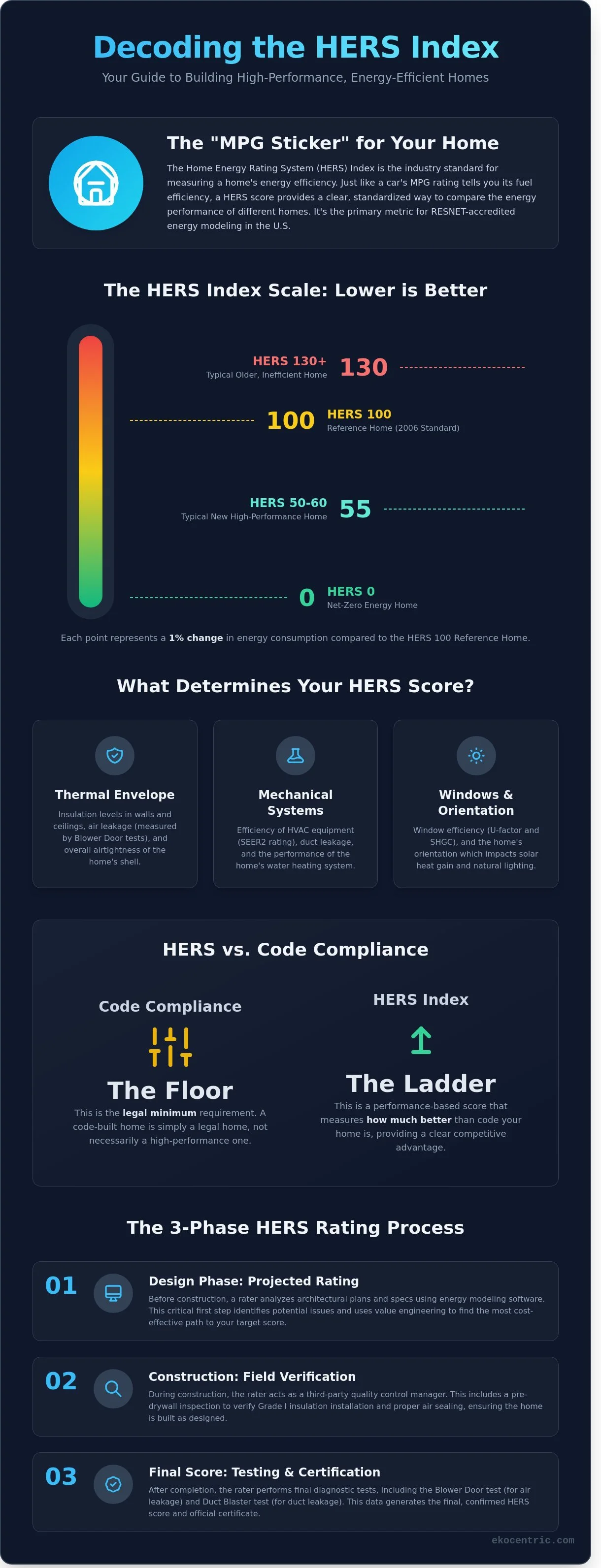
If you're a builder or developer looking to stay competitive in 2026, you've likely asked: What is a HERS Rating and what is it used for? The Home Energy Rating System (HERS) Index is the nationally recognized system for inspecting and calculating a home's energy performance. It functions as a "miles-per-gallon" sticker for houses, providing a standardized score that allows for an apples-to-apples comparison between different properties. The HERS Index serves as the primary metric for RESNET-accredited energy modeling.
Across the globe, various regions utilize a House Energy Rating (HER) or House Energy Rating Scheme (HERS) to quantify efficiency, but in the United States, the RESNET standard is the definitive benchmark. This system gives buyers and builders a clear, data-driven picture of how much energy a home will consume. Because the scoring system is inverse, a lower score represents a more energy-efficient home. This transparency helps builders validate their commitment to sustainability while giving homeowners a reliable way to predict their future utility costs.
To better understand this concept, watch this helpful video:
Understanding the 100-Point Scale
The scale relies on a "Reference Home" baseline. A score of 100 represents a home built to the 2006 International Energy Conservation Code (IECC) standards. Each point on the scale signifies a 1% change in energy efficiency compared to that 2006 baseline. A home with a HERS 50 score is exactly 50% more efficient than the reference house. Conversely, an older home might score 130, meaning it's 30% less efficient than the baseline. Achieving a HERS score of 0 or lower is the ultimate goal for Net-Zero projects. A score of 0 means the home produces as much energy as it consumes, typically through on-site renewables like solar panels.
The Variables That Determine Your Score
A certified rater determines your score by analyzing several critical building components. Thermal envelope performance is the foundation, focusing on insulation levels and air leakage measured through professional Blower Door testing. Mechanical systems are equally vital. Raters inspect HVAC efficiency, duct leakage, and water heating systems to ensure they meet modern performance standards. Finally, the building's orientation and window specifications, specifically the U-factor and Solar Heat Gain Coefficient (SHGC), are factored into the model. For builders who don't have the internal bandwidth to track these complex variables, Ekocentric provides specialized management services to ensure every project hits its target score.
How the HERS Rating Process Works: From Plans to Final Score
The HERS rating process is a comprehensive quality control journey that begins long before a single shovel hits the dirt. Understanding what is a HERS Rating and what is it used for? starts with recognizing it as a data-driven roadmap for energy performance. Builders who wait until completion to think about their score often face costly retrofits. Instead, the most successful projects integrate the rater into the design phase to ensure the home meets 2026 efficiency standards from day one. This proactive approach turns a simple score into a powerful tool for environmental stewardship and structural integrity.
Phase 1: The Projected Rating
The process kicks off with sophisticated energy modeling software like Ekotrope or REM/Rate. A rater analyzes your architectural plans, window specifications, and HVAC layouts to create a digital "Projected Rating." This stage is where we identify design flaws that could tank a score, such as excessive west-facing glass or insufficient attic insulation. We use value engineering to find the most cost-effective path to your target. For instance, upgrading to a 16 SEER2 heat pump might be more economical than increasing wall insulation to R-25, depending on the specific climate zone. This collaboration ensures the design is both sustainable and financially viable for the developer.
Phase 2: Field Verification and Diagnostics
Once construction begins, the rater transitions into a third-party quality control manager. This involves two critical site visits. First is the pre-drywall inspection. We verify that the insulation is installed to Grade I standards, meaning there are no gaps or compressions. Even a 5% gap in insulation can reduce its effective R-value by 20%, so this step is vital for performance. Every home must be certified by an accredited Rating Provider to ensure the "as-built" performance matches the "as-designed" model.
The second visit occurs at completion for final diagnostic testing. We perform a blower door test to measure air leakage and a duct blaster test to check for HVAC leaks. These tests provide the empirical data needed to issue the final HERS certificate. If you don't have the internal bandwidth to manage these technical requirements, our team can provide an additional layer of management to keep your project on track. This rigorous verification process is exactly what is a HERS Rating and what is it used for?; it's the ultimate proof of a home's resilience and efficiency.
What is a HERS Rating Used For? Beyond Energy Savings
While reduced monthly bills represent the most immediate benefit, understanding what is a HERS Rating and what is it used for requires looking at the broader development lifecycle. In 2026, the building industry has shifted significantly. Developers now use HERS data to substantiate Environmental, Social, and Governance (ESG) claims for institutional investors. This third-party verification transforms a simple energy score into a robust asset for corporate transparency and reporting.
A HERS rating provides a vital competitive edge in a market where buyers are increasingly sensitive to utility volatility. It's no longer just about "being green"; it's about proving performance. Explore our specialized consulting services to see how HERS integrates with your project and helps you stay ahead of these market shifts.
The Key to Green Building Certifications
A HERS rating acts as the technical foundation for the industry's most prestigious labels. It's a mandatory prerequisite for LEED for Homes and ENERGY STAR certification. Without a certified HERS score, reaching the National Green Building Standard (NGBS) or Florida-specific benchmarks like FGBC becomes nearly impossible. A HERS test is one of the smartest steps you can take to ensure your project meets these rigorous requirements while providing a clear roadmap for performance. This verification ensures that every component, from insulation to HVAC systems, works in harmony.
Market Differentiation and Asset Value
Sustainability pays. Data from 2024 and 2025 market reports indicates that homes with low HERS scores command a "green premium," often selling for 3% to 7% more than conventional builds. Buyers in 2026 prioritize transparency. Providing a HERS certificate at the point of sale serves as a verified certificate of quality, giving homeowners peace of mind about their investment.
This process also serves as a critical tool for risk mitigation. By using third-party verification during the construction phase, builders create a documented trail of performance. This helps avoid future building envelope litigation by proving the home was built to high standards from day one. When clients ask what is a HERS Rating and what is it used for?, the answer is simple: it's your strongest tool for building market resilience and protecting your reputation as a quality builder.
Validation: Substantiates ESG claims for stakeholders.
Appraisal: Supports higher valuations through documented energy performance.
Quality Control: Identifies construction defects before they become costly liabilities.
HERS vs. Code Compliance: Understanding the Difference
Many builders mistake the energy code for a HERS rating, but these two systems serve different masters. Building code represents the legal floor. It's the absolute minimum efficiency level required to secure a Certificate of Occupancy. In contrast, HERS functions as a performance ladder that measures how far a home exceeds those minimums. Builders often ask, what is a HERS Rating and what is it used for? when they're trying to differentiate between basic legal mandates and market-leading performance. Meeting code doesn't guarantee a low HERS score. If a project has poor installation quality, such as gaps in insulation or leaky ductwork, it might pass a prescriptive code check while still receiving a mediocre HERS Index of 70 or higher.
The prescriptive path of code requires specific R-values for every individual wall and ceiling; however, the performance path of HERS allows a builder to meet overall efficiency targets through integrated system design. This distinction is vital for project budgets. By focusing on the house as a single unit, you gain the ability to prioritize the most cost-effective upgrades rather than following a rigid checklist that might not fit your specific architectural design.
The Performance Path Advantage
Using the HERS Index for code compliance offers significant design flexibility. Builders can often trade off expensive components, like high-end windows with a 0.25 U-factor, for better air sealing and high-efficiency HVAC systems. This approach frequently results in lower construction costs. For example, spending $600 on meticulous air sealing to reach 2.0 ACH50 can sometimes save a builder $2,500 in specialized insulation or glazing costs while still achieving the same energy outcome. It's about working smarter, not just adding more materials.
The Rise of the HERS Carbon Index
As we move into 2026, projects are increasingly tracking the HERS Carbon Index alongside traditional energy scores. This index measures operational CO2 emissions, providing a clear number for a home's environmental impact. With more than 40 U.S. municipalities currently exploring or implementing carbon-neutral mandates, reporting these metrics now prepares your business for future regulations. This data is no longer just for marketing; it's a tool for long-term resilience. If you're ready to optimize your next project's performance, explore our technical consulting services to see how we manage these complex requirements.
Partnering with a HERS Rater: The Ekocentric Approach
Understanding What is a HERS Rating and what is it used for? is the first step toward high-performance building. Implementing it effectively requires a partner who understands the technical nuances of the 2026 building landscape. Many developers and builders don't have the internal bandwidth to manage the sustainability side of a project. Ekocentric acts as an extension of your team, providing the pragmatic expertise needed to navigate complex rating requirements. We focus on delivering a greener and more sustainable future through actionable data that identifies exactly where a building loses energy. See how our LEED Green Rater services build on the foundation of a HERS rating to elevate your project's performance and marketability.
Florida-Specific Expertise
Florida's environment demands more than standard energy modeling. We specialize in navigating the state's unique climate challenges, specifically focusing on humidity control and high cooling loads that can account for 40% to 60% of a residential energy bill. Our team maintains deep knowledge of the Florida Green Building Coalition (FGBC) requirements, which are often more stringent than national baselines. We ensure your projects meet local resilience standards, building for environmental stresses like extreme heat and 150-mph wind zones. This local focus ensures that a HERS index of 50 in Orlando performs as intended under real-world conditions, protecting the structure from mold and moisture intrusion.
Streamlined Project Management
We prevent costly construction delays through proactive plan reviews and precise scheduling. Our process ensures that energy goals are integrated during the design phase, not as an afterthought. When builders ask What is a HERS Rating and what is it used for?, they're often looking for a way to differentiate their product in a crowded market. We translate technical data into clear insights, allowing you to make informed choices about materials and systems.
Clear communication is our priority. We don't just hand over a report; we explain how the data impacts your bottom line and project timeline. By identifying potential failures before the drywall goes up, we save builders an average of three to five days in inspection delays. Contact Ekocentric to schedule your HERS rating consultation and streamline your path to certification.
Future-Proof Your Projects With Precision Energy Modeling
The construction landscape in 2026 demands more than just meeting the bare minimum of building codes. A HERS Index Score provides a clear, numerical benchmark that translates complex building science into a marketable asset. By integrating this process early, you ensure your homes meet the rigorous RESNET standards that today's buyers expect. Understanding What is a HERS Rating and what is it used for? allows your team to move beyond guesswork and focus on data-driven performance. This transparency builds trust with homeowners and verifies that your builds are truly climate-resilient.
Many Florida builders don't have the internal bandwidth to manage every detail of sustainability certifications. That's where expert guidance becomes a competitive advantage. Our team consists of RESNET Accredited HERS Raters with deep expertise in LEED, FGBC, and NGBS frameworks. We specialize in helping Florida-based professionals navigate the unique challenges of our local climate while maximizing building longevity. Partner with Ekocentric for your next HERS Rating to streamline your path toward a more sustainable and profitable future. Let's build something that lasts.
Frequently Asked Questions
Is a HERS rating mandatory for all new homes in 2026?
Mandatory HERS ratings depend on your specific jurisdiction's adoption of the International Energy Conservation Code (IECC). By 2026, 32 states have adopted versions of the IECC that require a HERS Index or an Equivalent Rating Index (ERI) for code compliance. Builders in these regions must achieve a specific score, often 52 or lower, to secure a certificate of occupancy. Even where not legally required, developers use them to prove building resilience.
How much does a HERS rating typically cost for a single-family home?
A HERS rating for a standard 2,200 square foot single-family home typically costs between $1,500 and $2,800. This fee covers the initial plan analysis, mid-construction duct leakage testing, and the final blower door test. Complex custom homes with three or more HVAC zones may see costs rise toward $4,500. Investing in this process ensures your project meets high sustainability standards while providing a clear roadmap for energy efficiency.
Can a HERS rating be performed on an existing home or only new construction?
You can perform a HERS rating on an existing home to identify specific areas for energy improvement. While the industry often focuses on new builds, it's a vital tool for deep energy retrofits. A rater evaluates the current envelope and mechanical systems to establish a baseline score. This allows homeowners to target upgrades that will have the highest impact on comfort and long-term utility costs.
What is the difference between a HERS Rater and an ENERGY STAR Rater?
A HERS Rater provides the foundational energy analysis, while an ENERGY STAR Rater verifies that a home meets additional requirements set by the EPA. Every ENERGY STAR certified home requires a HERS rating, but not every HERS-rated home meets those standards. The ENERGY STAR process includes 4 extra checklists for water management and HVAC commissioning. Understanding what is a HERS Rating and what is it used for helps builders decide if they should pursue these certifications.
How long does the on-site HERS inspection process take?
The on-site inspection process usually takes 2 to 4 hours for each of the two primary visits. During the pre-drywall phase, the rater spends about 90 minutes verifying insulation and air sealing. The final inspection requires 3 hours to conduct blower door and duct leakage testing. Larger projects or multi-family buildings will naturally require more time for comprehensive data collection. This timeline ensures every detail of the home's energy performance is accurately captured.
Will a low HERS score help me qualify for a Green Mortgage?
A low HERS score is a primary requirement for securing a Green Mortgage through lenders like Fannie Mae or Freddie Mac. Most Green Home Choice programs require a score of 50 or lower to qualify for preferential interest rates or higher loan-to-value ratios. These financial products recognize that energy-efficient homes have 20% lower default risks. Providing this data builds confidence with lenders and helps buyers manage their total cost of homeownership.
What happens if my home doesn't achieve the HERS score I targeted in the design phase?
If a home misses its target HERS score, the rater identifies specific failures such as excessive air leakage or under-performing HVAC equipment. Builders can then perform targeted remediation, like additional caulking or duct sealing, before a final re-test. This highlights the importance of asking what is a HERS Rating and what is it used for during the design phase. Catching issues early prevents costly delays and ensures the final structure meets your sustainability goals.