Green Building Code Compliance in Florida: A 2026 Developer’s Guide
If your 2026 development strategy treats sustainability as an optional "add-on," you're likely looking at a stalled certificate of occupancy before the first foundation is even poured. We understand that the overlapping layers of state and local mandates often feel like a moving target that drains your team's internal resources. Achieving green building code compliance Florida standards shouldn't be a source of anxiety or project delays. Instead, it's a pragmatic necessity for building resilient, high-performing assets in an increasingly regulated market.
You already know that meeting the rigorous demands of Florida Statute 255.2575 is non-negotiable for modern state-funded and many private sector projects. This guide provides the expert clarity you need to choose the most efficient certification pathway, whether you're leaning toward LEED, FGBC, or NGBS. We'll detail a streamlined roadmap that simplifies your paperwork, manages your compliance risks, and ensures a faster path to your final inspections.
Key Takeaways
Understand the critical shift from voluntary green initiatives to mandatory statutory requirements under Florida Statute 255.2575 for state-funded and municipal projects.
Learn how to navigate the 2026 framework for green building code compliance Florida to ensure your developments meet evolving resilience and energy-efficiency standards.
Compare certification pathways like LEED, FGBC, and NGBS to identify the most cost-effective strategy that aligns with your project’s specific budget and timeline.
Follow a step-by-step roadmap for integrating sustainable goals into the initial design phase and utilizing a Green Rater to maintain compliance during active construction.
Discover how specialized consulting provides the essential management layer needed to streamline complex certifications while allowing your team to focus on core development tasks.
Understanding Florida’s Green Building Landscape in 2026
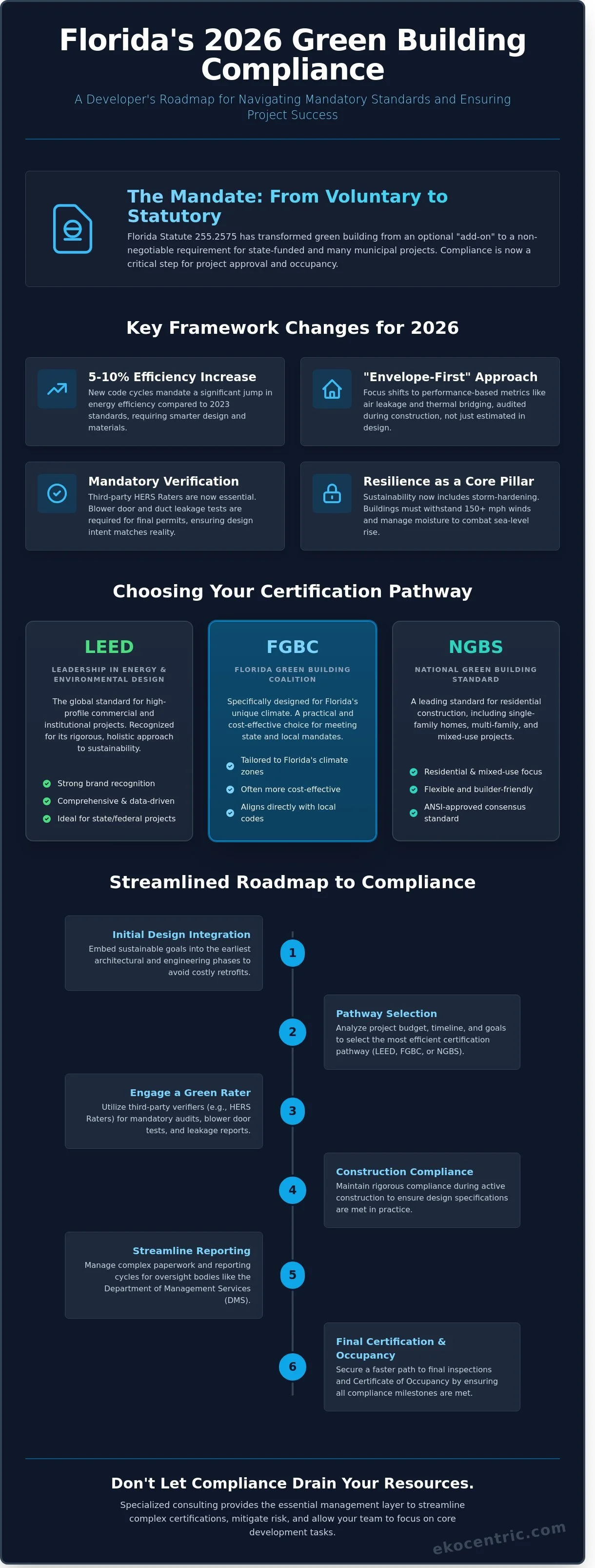
Florida's building sector has reached a critical juncture. By 2026, the definition of green building code compliance Florida professionals must navigate has moved from elective "best practices" to mandatory statutory requirements. This evolution is driven by the state's 8th and 9th Edition code cycles, which prioritize long-term durability and resource efficiency. Compliance now requires a deep integration of green building principles to ensure every new project can withstand both intense humidity and increasing regulatory pressure.
The shift from voluntary initiatives to mandatory standards is a response to Florida's unique environmental demands. For years, builders viewed sustainable certifications as optional marketing tools. Today, state law mandates specific energy and moisture control benchmarks that mirror previously voluntary standards like ENERGY STAR® or LEED. The 2026 landscape focuses heavily on the "envelope-first" approach, where air leakage and thermal bridging metrics are audited during the construction process rather than estimated during design.
To better understand the nuances of these regulatory shifts, watch this helpful video:
The role of third-party verification has become the standard for 2026 builds. Local jurisdictions now frequently require blower door testing and duct leakage reports from certified HERS Raters before issuing final permits. This layer of oversight ensures that the theoretical energy savings promised in the design phase actually manifest in the finished structure. Many developers who don't have the internal bandwidth to manage the sustainability side of a project rely on these experts to bridge the gap between architectural intent and green building code compliance Florida mandates.
The Evolution of the Florida Building Code
Recent code updates have fundamentally changed how we view energy performance. The Florida Energy Conservation Code now mandates specific air infiltration limits that were once only found in high-level voluntary programs. Florida's unique geography, split between Climate Zones 1 and 2, means developers must tailor their insulation and HVAC strategies to specific local humidity levels. What works for a project in the Panhandle won't meet compliance in the Keys, making localized expertise vital for 2026 projects. These updates require a 5% to 10% increase in efficiency compared to the 2023 standards.
Resilience as a Core Compliance Pillar
Resilience is no longer a separate category from sustainability. In Florida, a building that isn't storm-hardened isn't sustainable. The 2026 standards bridge this gap by including moisture management and structural integrity under the "green" umbrella. Sustainable design now serves as a primary tool to mitigate risks like sea-level rise, which is projected to impact coastal infrastructure by 6 to 10 inches by 2030. The intersection of the High Velocity Hurricane Zone (HVHZ) requirements and energy standards creates a robust framework for high-performance buildings that can withstand 150+ mph winds while maintaining peak efficiency.
Key Statutory Requirements: Florida Statute 255.2575
Florida's commitment to resilience is codified in Florida Statute 255.2575, which mandates that all state-funded buildings must be designed and constructed to meet sustainable standards. This law isn't just a suggestion; it's a requirement for state agencies, county governments, and school districts. For developers working on public projects, achieving green building code compliance Florida means following rigorous energy-efficiency and water-conservation protocols from the start of the design phase.
The state measures success through a "cost-effective" threshold. This means the long-term savings in energy and water must outweigh the initial costs of green features within a specific timeframe, often calculated over a 20-year lifecycle. The Department of Management Services (DMS) acts as the oversight body. They expect detailed reporting on energy consumption and certification status to ensure taxpayers see a return on investment through reduced utility bills. If you don't have the internal bandwidth to handle these reporting cycles, Ekocentric can manage the sustainability side of your project to keep you in compliance.
Who Must Comply with Section 255.2575?
While the statute primarily targets state-funded construction, its reach is expanding. By 2026, more local municipalities are adopting "green" ordinances that mirror these requirements for private developers. Public-private partnerships (P3s) are especially sensitive to these rules. If a project uses even a fraction of state or local funding, the entire structure often falls under these statutory mandates. It's a pragmatic shift toward long-term durability in Florida's unique climate, ensuring that green building code compliance Florida remains a standard for any project involving public resources.
Recognized Rating Systems for Statutory Compliance
To prove compliance, the state recognizes several third-party certification systems. Each offers a different pathway for developers depending on the project type and location:
LEED (Leadership in Energy and Environmental Design): The global gold standard used for high-profile projects that require international recognition.
Florida Green Building Coalition (FGBC): A regional advantage because it focuses specifically on Florida's humidity and hurricane risks.
Green Globes: A flexible, web-based alternative that many developers find more streamlined for commercial renovations.
Choosing the right system depends on your project's specific goals. FGBC often provides a regional advantage for residential developers due to its focus on local environmental factors. LEED remains the top choice for municipal office buildings and university structures. Regardless of the pathway, documentation must be submitted to the DMS to verify that the building meets the required sustainability benchmarks.
Choosing the Right Certification Pathway for Florida Projects
Selecting a certification pathway isn't just about a plaque on the wall; it's a strategic business decision that impacts your project's timeline and bottom line. Developers in 2026 often weigh LEED, FGBC, and NGBS based on complexity and soft costs. LEED typically carries a 2% to 5% premium on hard costs but offers unmatched global recognition. FGBC provides a more localized, cost-effective approach for those focusing on green building code compliance Florida requirements. For public sector projects, Florida Statute 255.2575 mandates high-performance standards, making these pathways a legal necessity rather than an elective choice. Successful developers align their certification goals with their specific budget early in the pre-construction phase to avoid mid-cycle pivots.
Aligning your goals requires a pragmatic look at your resources. If you don't have the internal bandwidth to manage the sustainability side of a project, specialized consulting services bridge the gap. For residential developments, a LEED Green Rater is indispensable. They provide the mandatory third-party verification that ensures your energy models match real-world performance. This level of oversight reduces long-term liability and guarantees the 15% to 30% energy savings often promised in project brochures. We've seen that field-verified performance is the only way to ensure a project's resilience against Florida's intensifying climate pressures.
LEED BD+C: The International Benchmark
LEED BD+C remains the gold standard for high-rise and commercial projects in markets like Miami and Orlando. It attracts Class A tenants who prioritize ESG reporting. While the documentation is rigorous, LEED BD+C consulting simplifies the credit-earning process by identifying high-yield strategies during design. This prevents expensive retrofits. The prestige factor is tangible; LEED-certified buildings often see a 7% increase in asset value over non-certified counterparts. It's a powerful tool for developers looking to attract international investment or high-tier corporate leases.
FGBC: The Florida-First Approach
The Florida Green Building Coalition (FGBC) offers a system tailored to our unique climate. FGBC certification consulting is vital because it addresses 100-degree days and 90% humidity levels that national standards might overlook. It's incredibly flexible for projects ranging from single-family homes to massive land developments. FGBC focuses heavily on water conservation and disaster resilience, which are critical for Florida's 23 million residents. By choosing FGBC, you're prioritizing the local ecosystem while maintaining a leaner budget than international frameworks require. It's a pragmatic, mission-driven choice for regional growth.
A Step-by-Step Roadmap to Green Building Compliance
Achieving green building code compliance Florida requires a disciplined, lifecycle approach. It isn't a box to check at the end of a project. It's a series of strategic milestones that begin during the initial design phase. Developers who integrate these goals early avoid the 5% to 15% cost premiums often associated with last minute compliance scrambles. By treating sustainability as a core design pillar, you ensure the project remains resilient and marketable in a shifting regulatory environment.
Pre-Construction: Setting the Foundation
Success begins with a preliminary gap analysis against current Florida building codes. This audit compares your standard architectural plans with the rigorous requirements of the 8th Edition Florida Building Code. It's the time to select sustainable materials that meet both structural needs and certification standards. Choosing high performance glass or advanced insulation systems now prevents expensive change orders during the framing stage. You must also establish a documentation workflow for subcontractors. Many projects fail to achieve certification because a single trade didn't track their material origins or waste diversion rates. Clear communication at this stage ensures everyone knows their role in the sustainability mission.
Construction Phase: Monitoring and Verification
The construction phase is where the bandwidth gap becomes most apparent. Most builders don't have the internal resources to monitor every technical detail of energy efficiency while managing timelines. This is why site visits from a HERS Rater or LEED Green Rater are indispensable. These experts identify field errors that standard building inspectors might overlook. For example, a minor 3% gap in building envelope sealing can cause a failed blower door test. This failure prevents you from obtaining a Certificate of Occupancy on schedule, which creates a significant financial bottleneck.
Mid-construction inspections verify that the physical installation matches the energy model. If a subcontractor installs a lower grade of insulation than specified, the rater catches it before the drywall goes up. This level of oversight provides the pragmatic solutions needed to keep a project moving. The final verification involves functional testing of all mechanical and electrical systems. This ensures the building operates as a cohesive, energy-efficient unit. It provides the data needed for final certification and a smooth transition to building operation.
For expert guidance that bridges the gap between design and reality, view our sustainability management services.
Partnering with Ekocentric for Seamless Florida Compliance
Builders often hit a wall when project complexity outpaces their internal resources. Most development teams don't have the bandwidth to track every shifting regulation or manage the technical documentation required for 2026 standards. Ekocentric provides that critical additional layer of management. We don't just point out problems; we solve them. Our team acts as an extension of your staff, ensuring that green building code compliance Florida remains a streamlined part of your workflow rather than a bottleneck. By managing the technical minutiae of energy modeling and material sourcing, we allow your team to focus on construction timelines and budget management. This partnership transforms a complex regulatory burden into a clear, manageable roadmap for success.
Hiring a specialized firm is about more than just checking boxes. It's about risk mitigation. A single oversight in the design phase can lead to costly retrofits during the final inspection. We bridge the gap between architectural intent and field execution. Our consultants provide the professional authority needed to navigate the Florida Green Building Coalition (FGBC) requirements and HERS rating systems with precision. This proactive approach ensures that your green building code compliance Florida targets are achieved without sacrificing your profit margins or project schedule. We take the lead on documentation, so your team stays focused on the build.
Expert Consulting Tailored to Florida Developers
Florida presents unique challenges like high humidity levels and intense solar gain that can compromise building envelopes. We specialize in translating these environmental hurdles into actionable construction tasks. Whether you're aiming for a low HERS Index score or meeting the latest Florida Building Code requirements, our expertise ensures your project stays on track. We offer our professional services for LEED and NGBS verification, providing the third-party validation that approximately 78 percent of modern institutional lenders now require for sustainable development. Our deep roots in Florida building standards give us the insight to anticipate local regulatory shifts before they impact your site.
Building a Sustainable Future Together
The Ekocentric approach combines mission-driven passion with grounded, professional authority. Our founders' unwavering dedication to the environment ensures that we never settle for the bare minimum. We believe that sustainable projects should also be resilient projects. This commitment leads to tangible outcomes, such as an average 20 percent reduction in long-term operational costs for our clients. We align our strategies with your specific business goals, recognizing that green building must be both pragmatic and profitable. Our focus on resilience means your assets are better protected against the extreme weather events that define the Florida market. Contact us today to streamline your next development and secure the technical expertise your project deserves.
Future-Proofing Your Development for 2026 and Beyond
Navigating the 2026 regulatory environment requires more than just checking boxes. Florida Statute 255.2575 mandates that state-funded buildings achieve high-performance ratings, shifting the standard for all new construction. Whether you're pursuing LEED certification or utilizing Florida Green Building Coalition (FGBC) frameworks, these technical requirements demand early planning and precise execution. Most developers don't have the internal bandwidth to track every evolving detail of green building code compliance Florida requires for modern projects. It's about more than just meeting a legal baseline; it's about building resilient, energy-efficient structures that can withstand the specific climate demands of the 21st century.
Ekocentric brings specialized LEED Green Rater expertise and deep knowledge of FGBC standards to your job site. We offer a pragmatic approach to the management challenges you face, ensuring your project meets every statutory requirement without draining your team's resources. Let Ekocentric manage the complexities of your green building compliance. View our services today.
You're building the future of the Sunshine State. Let's make sure it's a sustainable one that lasts for generations.
Frequently Asked Questions
Does Florida law require all new buildings to be green certified?
No, Florida law doesn't require all new buildings to be green certified. While the Florida Building Code mandates strict energy efficiency, mandatory third-party certification applies primarily to state-funded projects. Most private developers choose certification to ensure green building code compliance Florida standards meet market demand and long-term resilience goals.
What is the difference between the Florida Energy Code and green building certification?
The Florida Energy Code is a mandatory legal baseline, whereas green building certification is a voluntary performance standard. The Energy Code focuses strictly on thermal envelopes and mechanical efficiency to meet state law. Certifications like LEED or FGBC expand this scope to include water conservation, indoor air quality, and sustainable site development.
How does Florida Statute 255.2575 affect municipal building projects?
Florida Statute 255.2575 requires all state-funded buildings to meet a recognized sustainable rating system. Since its 2008 enactment, this law ensures that county and municipal buildings lead the way in environmental stewardship. It forces public projects to achieve certifications like LEED or FGBC, setting a high standard for the 67 counties across the state.
Can a private developer benefit from green building code compliance even if it is not mandated?
Private developers benefit through increased asset value and faster lease-up rates. Data shows green-certified buildings in Florida often command a 5% to 10% premium in resale value compared to non-certified structures. Achieving green building code compliance Florida also reduces operational costs by roughly 20%, which directly improves the project's net operating income.
What are the most common reasons Florida projects fail green building inspections?
Most Florida projects fail inspections due to excessive duct leakage or poor insulation grades. Duct leakage must stay below 4 cfm per 100 square feet of conditioned floor area to pass many high-performance standards. Builders often struggle with Grade I insulation installs, which require zero gaps or compressions in the thermal envelope.
How much does it cost to hire a LEED Green Rater in Florida?
A LEED Green Rater in Florida typically charges between $3,000 and $7,500 for a standard multi-family project. This cost covers the registration, field inspections, and final documentation submittals. While fees vary by project size, investing in a professional rater ensures the project avoids costly mid-construction corrections.
Is FGBC certification recognized outside of the state of Florida?
The Florida Green Building Coalition (FGBC) certification is specifically designed for Florida's unique sub-tropical climate and isn't used outside the state. It focuses on local challenges like high humidity and hurricane resilience. For developers looking for national recognition, LEED or ENERGY STAR remain the preferred standards for multi-state portfolios.
How does green building compliance impact property insurance rates in Florida?
Green building compliance can lead to insurance premium reductions of 5% to 15%. Many Florida insurers offer discounts for buildings that exceed code-minimum wind and water resistance standards. By documenting these features through certification, owners prove their property is a lower risk during extreme weather events.