What Sustainability Accreditations Should a Contractor Have in 2025 and 2026?
LEED, FGBC, Green Globes, ENERGY STAR NGBS which is the right path for you?
By 2026, a standard contractor license will no longer be enough to win high-value urban development bids. You’ve likely noticed that developers now prioritize partners who can prove their environmental impact through rigorous technical data. It’s easy to feel overwhelmed by the sheer volume of green standards, especially when your team lacks the internal bandwidth to manage mountains of certification paperwork. Knowing what sustainability accreditations should a contractor have 2025 or 2026 is the difference between leading the market and missing out on the next major project.
We understand that you want to focus on construction, not administrative hurdles. This guide clarifies the most valuable credentials, such as LEED, ENERGY STAR, and FGBC, that will define the green building landscape over the next 24 months. You’ll learn how to integrate these standards into your bidding process and how to find a pragmatic partner to handle the technical verification. We’ll show you how to transform sustainability from a compliance headache into a powerful competitive advantage for your business.
Key Takeaways
Learn why sustainability credentials have transitioned from optional marketing to mandatory prerequisites for securing institutional financing and winning major commercial bids.
Identify what sustainability accreditations should a contractor have 2025 or 2026 to meet global benchmarks like LEED BD+C and the National Green Building Standard (NGBS).
Gain insights into technical energy performance standards, including the baseline requirements for ENERGY STAR and the role of HERS Raters in verifying building efficiency.
Discover the importance of regional resilience through Florida-specific certifications that address unique subtropical climate challenges often missed by national standards.
Bridge the "Bandwidth Gap" by understanding how to manage the administrative burden of green certifications through expert sustainability consulting and strategic outsourcing.
The New Standard: Why Contractor Accreditations Are Mandatory in 2026
The construction industry is hitting a critical turning point. By 2026, the definition of a "Green Contractor" has evolved from someone who simply recycles site waste to a professional who manages complex environmental data. Institutional lenders now require rigorous proof of performance before releasing funds. This shift eliminates "greenwashing" because Green building certification systems now rely on real-time verification and rigorous third-party audits. When developers ask what sustainability accreditations should a contractor have 2025 or 2026, they're looking for a partner who can protect their investment from future regulatory shifts and climate volatility.
To better understand how these requirements are changing the management of modern buildings, watch this helpful video:
In the 2026 market, data-backed verification is the only currency that matters. Gone are the days of vague "eco-friendly" promises. Today, contractors must demonstrate technical fluency in systems that track carbon footprints and energy intensity. This level of transparency is a prerequisite for any firm bidding on high-value commercial projects or seeking institutional financing. It's about proving you have the unwavering dedication to build a healthier, more resilient future through measurable results and pragmatic building solutions.
The Evolving Procurement Landscape
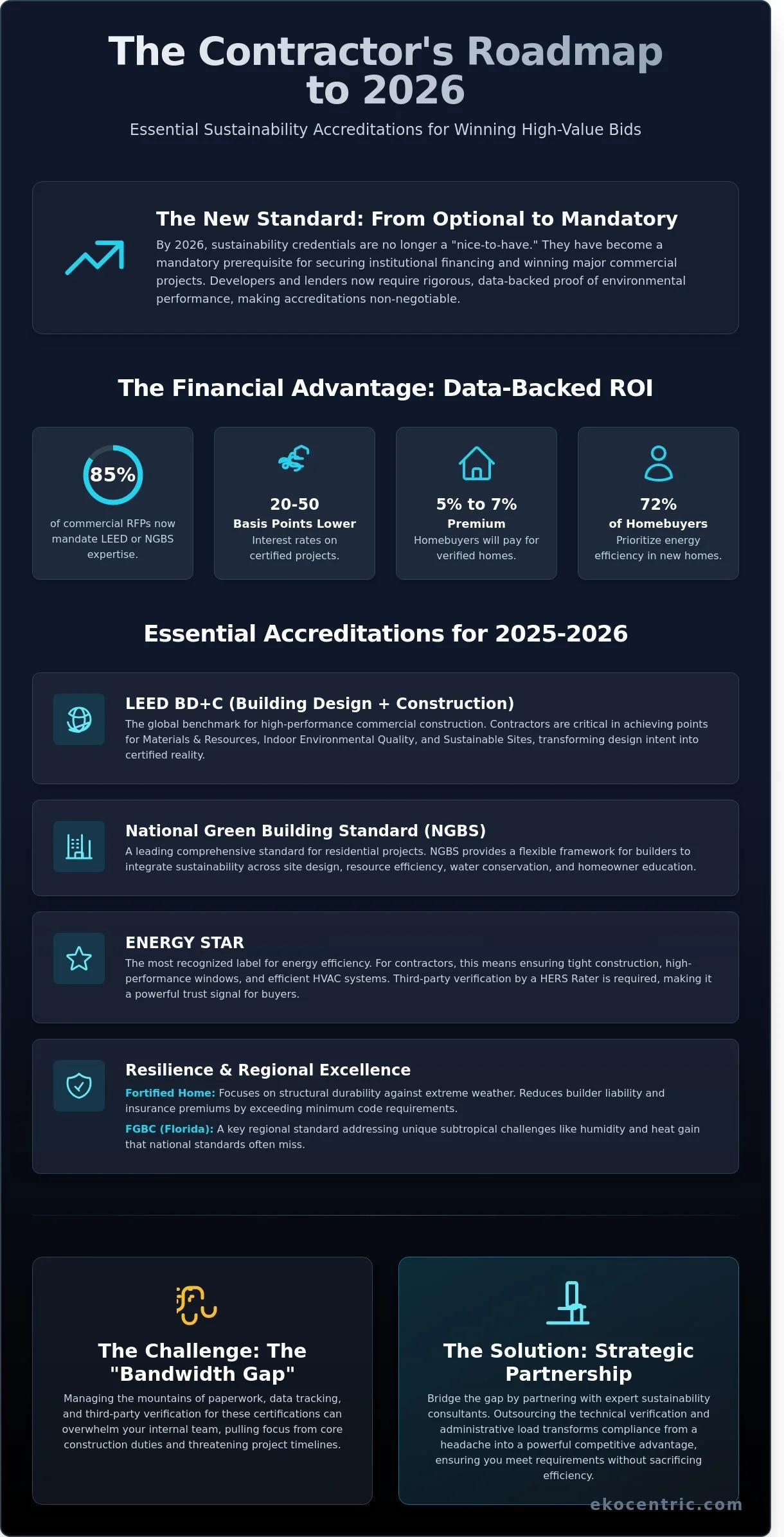
Major developers now mandate LEED or NGBS expertise in over 85% of commercial RFPs. This isn't just about ethics; it's a financial necessity. Projects with high-level certifications often secure interest rates between 20 and 50 basis points lower than traditional builds. Insurance providers also offer reduced premiums for buildings that meet strict durability standards. For residential builders, these credentials serve as a vital trust signal. Data shows that 72% of new homebuyers prioritize energy efficiency, and they're often willing to pay a 5% to 7% premium for homes with verified performance labels like ENERGY STAR or FGBC.
Project Resilience as a Core Competency
Efficiency is no longer the only goal. In 2026, resilience is the priority. Contractors must prove they can build structures that withstand long-term environmental shifts, such as increased flood risks or extreme heat waves. Accreditations like the Fortified Home standard reduce builder liability by ensuring compliance with codes that exceed minimum requirements. By focusing on durability, contractors minimize the risk of future litigation related to moisture intrusion or structural failure. If your team doesn't have the internal bandwidth to manage these complex requirements, specialized sustainability services can bridge the gap. Understanding what sustainability accreditations should a contractor have 2025 or 2026 is the first step in reducing long-term project risk and ensuring building code compliance.
Essential Green Building Certifications for Project Execution
Building in the coming years requires a clear roadmap to meet environmental goals. When considering what sustainability accreditations should a contractor have 2025 or 2026, the focus shifts toward frameworks that provide a manual for construction management. These certifications don't just reward the finished building; they dictate how the job site is run. LEED and NGBS are the primary tools that transform a standard construction site into a high-performance project.
LEED BD+C and the Role of the Contractor
LEED BD+C is the framework for high-performance construction management. While architects set the design intent, the contractor's performance determines if the project actually achieves its rating. You'll find the most impact in categories like Materials and Resources or Indoor Environmental Quality. For instance, LEED v4.1 requires a minimum 50% diversion rate for construction waste to earn basic credits. Managing these logistics requires a team that understands the documentation process. A LEED Green Rater is a mandatory partner for residential projects. They provide the third-party verification needed to prove that the sustainable features in the blueprints were installed correctly in the field. This verification is a non-negotiable step to ensure the building performs as promised.
NGBS: The Practical Residential Alternative
The National Green Building Standard (NGBS) provides a streamlined path for residential and multi-family developers. It's often the preferred choice for regional builders because its requirements align closely with standard residential building codes. NGBS offers four distinct levels of achievement: Bronze, Silver, Gold, and Emerald. This tiered system allows for flexibility based on the project's scope. The framework focuses on the entire lifecycle of the home. It starts with site preparation to minimize soil erosion and extends to the operational phase with energy-efficient appliances. Many builders find that NGBS is easier to integrate into their existing workflows than other global standards. If your team lacks the internal bandwidth to track these rigorous requirements, our green building services can bridge that gap and ensure your project stays on track for certification.
Deciding what sustainability accreditations should a contractor have 2025 or 2026 depends on your project type. LEED remains the global gold standard for commercial and mixed-use developments. NGBS is the pragmatic leader for the residential sector. Both require a dedicated approach to documentation and on-site management. Having a team familiar with these Green Rater requirements ensures that your sustainability goals don't get lost in the daily grind of the construction site. It's about turning a vision for a greener future into a tangible, certified reality.
Energy Performance and Technical Verification Credentials
Contractors often confuse building to code with building for performance. In 2025 and 2026, this distinction will define a company's reputation. Building to code is simply meeting the legal minimum requirements; it's the lowest quality home you can legally build. Performance standards, however, use data to prove a building actually works. Determining what sustainability accreditations should a contractor have 2025 or 2026 requires a shift from prescriptive checklists to verified results. Technical credentials provide the proof that a project delivers on its promises of lower bills and better comfort.
The Power of the ENERGY STAR Label
The ENERGY STAR label remains the gold standard for consumer trust. According to EPA data, over 90% of American households recognize the blue label, making it a powerful marketing tool. By 2026, contractors must master ENERGY STAR for New Construction Version 3.2. This version aligns with the 2021 International Energy Conservation Code (IECC) and demands tighter building envelopes and higher-efficiency HVAC systems. It isn't just about choosing better appliances. It requires a rigorous third-party verification process where every duct system and insulation install is inspected. This oversight reduces callbacks and ensures the home performs as designed from day one.
HERS Ratings and Performance Benchmarking
The Home Energy Rating System (HERS) Index is the industry's "miles per gallon" sticker for houses. A HERS Index of 100 represents a standard new home built in 2006, while a score of 0 represents a net-zero energy home. In the 2025 market, a low HERS score is a competitive necessity. Research from Freddie Mac shows that homes with high-energy efficiency ratings sell for approximately 2.7% more than unrated homes. Contractors should partner with a RESNET HERS Rater during the design phase to optimize the building's thermal boundary before a single nail is driven.
Partnering with experts who understand these benchmarks allows builders to focus on their craft while ensuring compliance. If you don't have the internal bandwidth to manage these technical requirements, specialized consulting through professional sustainability services can bridge the gap. Using performance data to prove ROI is the most effective way to close deals with savvy clients in 2026. Buyers want to see the math behind the "green" claims. When you're asked what sustainability accreditations should a contractor have 2025 or 2026, the answer always includes credentials that prioritize technical verification over marketing fluff.
Regional Excellence: Florida-Specific Accreditations and Resilience
Florida builders operate in a unique environment where high humidity and salt air are constant factors. National standards often provide a great baseline, but they can overlook the specific atmospheric pressures of the subtropics. When determining what sustainability accreditations should a contractor have 2025 or 2026, looking at regional expertise is essential. Localized certifications ensure that a building doesn't just save energy; it survives the environment it's built in.
Navigating the FGBC Standards
Adopting the Florida Green Building Coalition (FGBC) framework offers the most comprehensive roadmap for the Sunshine State. It breaks down sustainability into five core categories: energy, water, site, health, and materials. Unlike generic programs, FGBC integrates directly with the 8th Edition of the Florida Building Code that took effect in 2024. This alignment simplifies the inspection process and ensures compliance with strict state environmental laws.
Water Conservation: FGBC emphasizes Florida-friendly landscaping to reduce irrigation needs by up to 50% compared to traditional turf.
Disaster Mitigation: Credits are awarded for reinforced masonry and advanced roof-to-wall connections.
Moisture Management: The standard requires specific vapor barrier placements to prevent mold in 90% humidity environments.
FGBC is the most relevant certification for Florida-based residential builders because it addresses the specific moisture and heat challenges of a subtropical climate. It provides a clear path for builders who don't have the internal bandwidth to design these complex systems from scratch.
Building for the Coast: Resilience Beyond Energy
In a state where 75% of the population lives in coastal counties, "green" is a synonym for "resilient." A home with zero net energy is a failure if a storm surge destroys its foundation. Accreditations that focus on coastal durability are becoming mandatory for high-end developers. For example, salt-spray corrosion can reduce the lifespan of standard HVAC units by 50% within just five years. Specialized certifications prioritize stainless steel components and protective coatings for mechanical systems.
Resilience also means addressing high-wind events and flooding. Builders should look for credentials that emphasize impact-resistant glass and elevated mechanical platforms. These choices protect the investment and lower long-term maintenance costs for the owner. Understanding what sustainability accreditations should a contractor have 2025 or 2026 requires a shift toward these durability metrics. Expert consulting helps teams integrate these localized requirements without slowing down the construction schedule.
Ready to lead the Florida market with high-performance, resilient builds? Explore how our expert consulting can streamline your certification process by visiting our green building services page.
Beyond the Badge: Managing Your Sustainability Bandwidth
Builders often hit a plateau where technical expertise meets administrative exhaustion. Determining what sustainability accreditations should a contractor have 2025 or 2026 is only half the battle. The "Bandwidth Gap" describes the common struggle where internal teams lack the time to manage the mountain of paperwork required for high-level certifications. Industry data suggests that administrative overhead can increase by 15% when a firm attempts to manage LEED or NGBS documentation without dedicated staff. This often leads to missed submission deadlines or lost credits that could have been easily secured with better oversight.
Project managers are already stretched thin with site safety, supply chain delays, and subcontractor schedules. Adding the responsibility of tracking low-VOC material logs or verifying recycled content percentages can push a team past its breaking point. This is why the business case for outsourcing is so strong. It shifts the burden of proof from your builders to a specialist who understands the specific evidence required by third-party agencies. It's a pragmatic approach that protects your project's certification status while keeping your core team focused on the physical build.
Partnering for Success
A sustainability consultant acts as a vital extension of your project team. They provide that additional layer of management required to keep complex certifications on track from the pre-construction phase through final occupancy. By partnering with Ekocentric’s professional consulting services, you significantly reduce the administrative weight on your project managers. Our experts handle the rigorous data entry and coordination with HERS Raters or LEED Green Raters. This ensures every prerequisite is met without distracting your staff from their primary construction duties.
Your 2026 Sustainability Roadmap
Preparation for the 2026 building cycle begins with a thorough audit of your current credentials and project pipeline. You need to identify which upcoming builds require specific standards like LEED v4.1, NGBS, or the Florida Green Building Coalition (FGBC) criteria. If you're still asking what sustainability accreditations should a contractor have 2025 or 2026, start by looking at your target market's demands and investor requirements for ESG reporting. Developing a long-term partnership with a Green Rater now will streamline your future builds and create a repeatable, efficient process for every site.
To prepare your firm for the next two years, follow these final audit steps:
Review Current Staff Knowledge: Identify gaps in your team's understanding of updated 2025 energy codes.
Analyze Regional Requirements: Some municipalities are moving toward mandatory green standards by 2026.
Select a Verification Partner: Secure a consultant who can scale with your project volume.
Update Subcontractor Agreements: Ensure your contracts include specific language regarding the documentation of sustainable materials.
Don't let the administrative burden of green building slow your growth. Explore our full range of certification consulting services to prepare your next project for the high standards of 2026 and beyond.
Future-Proofing Your Construction Strategy for 2026
The construction landscape is shifting rapidly as we approach 2026. National building standards are moving toward mandatory high-performance benchmarks. Contractors must pivot from viewing green certifications as optional perks to recognizing them as essential project requirements. Determining what sustainability accreditations should a contractor have 2025 or 2026 is the first step toward maintaining a competitive edge in a market that prioritizes technical verification and energy efficiency. Florida-based projects specifically require a focus on resilience to withstand regional climate pressures and meet stringent state-level criteria.
Many developers find they don't have the internal bandwidth to navigate these complex regulatory waters alone. That's where we step in. As LEED Green Rater Certified professionals and FGBC Certification Experts, we bring deep experience in Florida-specific resilience standards to every project. We'll handle the technical details so you can focus on building. Partner with Ekocentric to manage your building certifications and ensure your next project exceeds the standards of tomorrow. Let's build a more resilient future together.
Frequently Asked Questions
What is the most important sustainability certification for a contractor in 2026?
LEED v5 is the most critical sustainability accreditation for a contractor in 2025 or 2026. This updated standard from the U.S. Green Building Council focuses heavily on decarbonization, resilience, and occupant health. Contractors with this credential show they're ready to meet the 2030 carbon reduction targets. It's a clear signal to developers that you can handle the technical demands of modern, eco-friendly construction.
How much does it cost to get LEED certification for a building project?
Registration for a LEED project typically starts at $1,500 based on current 2024 USGBC fee schedules. Certification fees are separate and often calculated at roughly $0.06 per square foot for most commercial projects. These costs cover the third-party review process that ensures your project meets rigorous international standards. Budgeting for these fees early is essential for project success and long-term asset value.
Do I need a LEED Green Rater for every residential project?
You only need a LEED Green Rater if you're specifically pursuing a LEED for Homes or LEED for Cities and Communities certification. These specialists verify that residential buildings meet specific sustainability criteria through on-site inspections and rigorous documentation. While they aren't required for every standard home build, they're indispensable partners for projects seeking this high-level global recognition of environmental stewardship.
Is NGBS better than LEED for multi-family construction?
NGBS is often more practical for multi-family construction because it's specifically designed for residential environments rather than commercial ones. The 2020 NGBS update provides clear, flexible pathways for developers to achieve high performance without the commercial-focused complexity found in some LEED tracks. Many builders find NGBS more cost-effective for 50-plus unit developments while still maintaining a high standard of green building excellence.
Can a small contracting firm achieve these sustainability accreditations?
Small contracting firms can absolutely achieve these sustainability accreditations by focusing on individual credentials like LEED AP or Green Associate. These certifications prove your expertise without requiring the massive overhead of a large corporation. We've seen firms with fewer than 10 employees successfully lead multi-million dollar green building projects by partnering with expert consultants who provide the extra bandwidth needed for management.
How long does the sustainability certification process typically take?
The sustainability certification process typically takes 12 to 18 months from the design phase through final verification. This timeline accounts for the rigorous documentation, mid-construction inspections, and final on-site testing needed to prove compliance. Early planning is vital because it prevents delays during the final construction stages. Starting the process during the pre-design phase ensures that every sustainability goal is met efficiently.
What is the difference between a HERS Rater and a LEED Green Rater?
A HERS Rater focuses specifically on energy performance and assigns a score based on the Home Energy Rating System. A LEED Green Rater evaluates a much broader range of factors including water efficiency, material selection, and indoor air quality. While both roles involve on-site testing, the LEED Green Rater provides a more holistic view of the building's total environmental impact and health outcomes.