Types of Green Building Certifications: A 2026 Guide for Developers
Did you know that LEED-certified buildings command a 7-10% premium on property values compared to conventional construction? With the global green building market projected to reach $702.54 billion in 2026, choosing from the various types of green building certifications is no longer just a checkbox for compliance; it's a vital strategy for long-term asset value. You've likely felt the pressure to deliver high-performance projects while simultaneously worrying about the complexity of third-party documentation or whether a specific framework will align with your local building codes.
It's common to feel like your internal team lacks the specialized capacity to manage these intricate rating processes. We're here to help you turn that uncertainty into a competitive advantage. This guide promises to help you discover the most influential green building frameworks and learn how to select the right certification to maximize your project’s environmental impact and operational efficiency. We'll provide a clear comparison of LEED v5, NGBS, and FGBC, offering a pragmatic roadmap to ensure your next development stands as a beacon of sustainability and financial success.
Key Takeaways
Discover why third-party verification has become a non-negotiable standard for securing high-value real estate investments and ensuring long-term asset resilience in 2026.
Compare the most prominent types of green building certifications, such as LEED v5 and NGBS, to identify the framework that best supports your project’s scale and sustainability vision.
Evaluate regional and specialized performance standards, like FGBC and ENERGY STAR, to tailor your building’s efficiency to specific climates and operational needs.
Apply a strategic decision matrix to select a certification that resonates with your target investors while maximizing your project's environmental credibility.
Understand the critical role of expert consulting in navigating complex documentation to prevent project delays and ensure a seamless path to final certification.
Table of Contents
Understanding the Landscape of Green Building Certifications
Regional & Specialized Ratings: FGBC and Performance Standards
Decision Matrix: Selecting the Right Certification for Your Build
The Path to Certification: Why Partner with a Green Building Consultant?
Understanding the Landscape of Green Building Certifications
A green building certification represents much more than a plaque on a lobby wall. It is a rigorous, third-party verified performance standard that ensures a structure meets specific environmental and operational benchmarks. As we move through 2026, the various types of green building certifications have transitioned from a niche marketing tool to a fundamental requirement for high-value real estate. Developers now face a market where institutional investors and tenants view these credentials as a baseline for quality and risk management.
The industry has shifted away from simple box-checking exercises. Today, certification is a core component of Environmental, Social, and Governance (ESG) strategies. Modern frameworks now prioritize aggressive decarbonization and net-zero energy goals. This evolution reflects a global commitment to creating a more resilient built environment. For those looking for the gold standard, Leadership in Energy and Environmental Design (LEED) remains the most recognized framework globally, though other specialized systems are gaining ground. These systems provide a transparent, data-driven way to report on sustainability progress to stakeholders and investors who now demand climate accountability.
To better understand how these various systems compare in a residential context, watch this helpful breakdown:
The Value Proposition: Beyond Environmental Impact
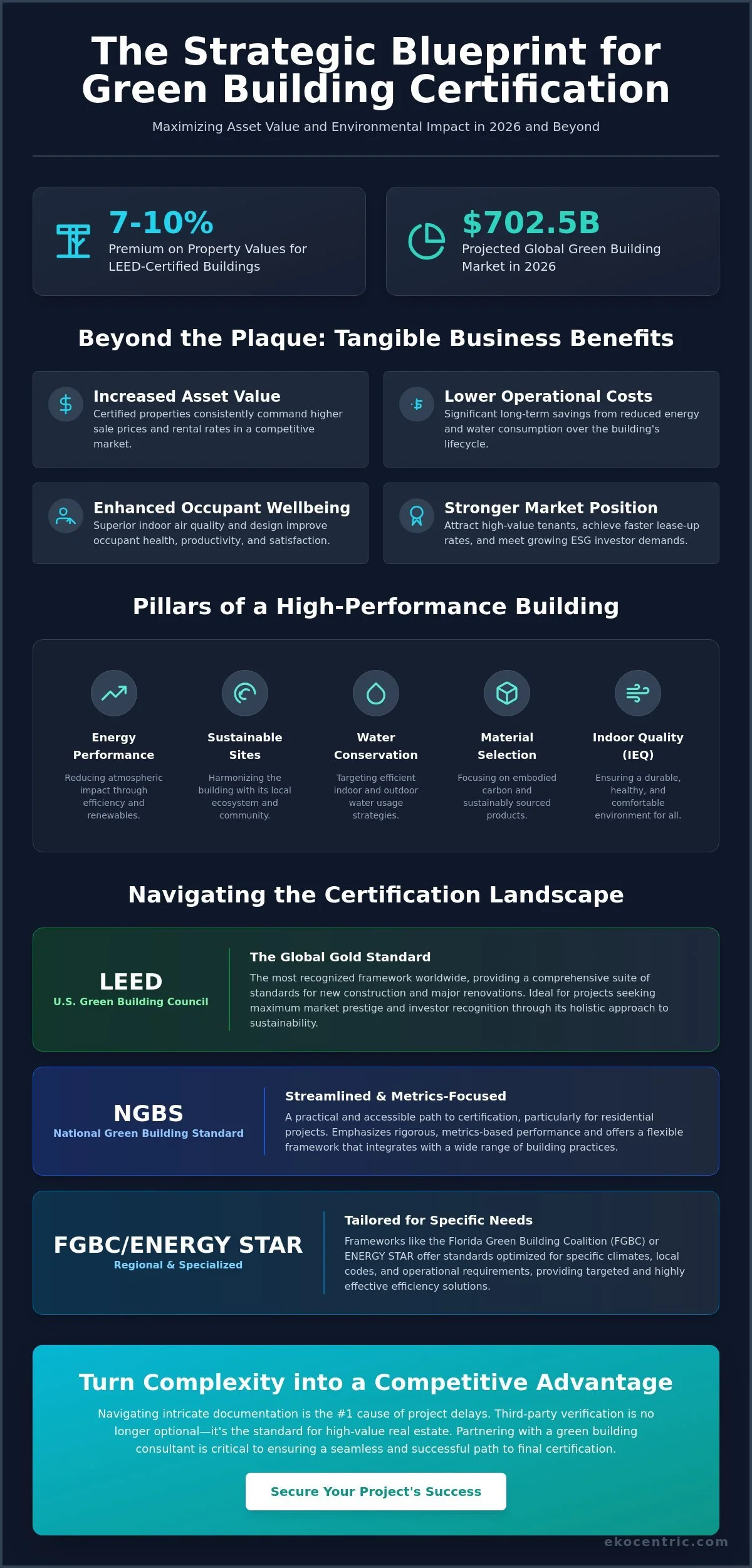
Investing in certification delivers tangible business benefits that extend far beyond environmental stewardship. Certified buildings consistently command a 7-10% premium on property values, according to 2026 market data. This increased asset value is driven by lower operational costs; energy and water efficiency measures significantly reduce utility expenses over the building’s lifecycle. Additionally, spaces designed for high indoor environmental quality lead to improved occupant health and higher productivity. For developers, this translates to faster lease-up rates and lower tenant turnover, making specialized consulting services a vital part of the modern development process.
Core Components of Modern Rating Systems
While each system has its own nuances, modern rating systems generally share several foundational pillars. Energy performance is paramount, focusing on reducing atmospheric impact through efficiency and renewable integration. Sustainable site development emphasizes the building's relationship with its local ecosystem, while water conservation strategies target both indoor and outdoor usage. Material selection has also evolved to include a focus on embodied carbon, looking at the environmental impact of products from extraction to installation. Finally, indoor environmental quality ensures the building is both durable and healthy for its inhabitants. These components work together to create a high-performance asset that stands the test of time.
The Big Three: LEED, NGBS, and EDGE Certifications
Selecting from the various types of green building certifications often comes down to a balance between global prestige and operational practicality. While LEED offers the highest market recognition, NGBS and EDGE provide streamlined, metrics-focused paths for specific project types. This choice isn't just about a plaque; it's about matching your project’s identity with a framework that maximizes its long-term value.
LEED BD+C and the Necessity of the Green Rater
LEED Building Design and Construction (BD+C) is the industry benchmark for new construction and major renovations. Managed by the U.S. Green Building Council (USGBC), this framework provides a comprehensive suite of standards that address everything from carbon emissions to material health. For residential projects, the process requires a specialized expert: the LEED Green Rater. This professional provides the mandatory onsite verification that serves as the backbone of the system's credibility. They perform thermal bypass inspections and blower door testing to ensure the building actually performs as designed. Without this rigorous third-party assessment, the certification lacks the data-driven proof that investors and high-end tenants now demand.
NGBS: The Residential Powerhouse
The National Green Building Standard (NGBS) has emerged as the premier choice for residential and multifamily developments. It is specifically designed to address the unique operational realities of housing, offering four certification tiers: Bronze, Silver, Gold, and Emerald. This flexibility allows developers to select a performance level that aligns with their specific budget and sustainability goals. Because it is ANSI-approved, NGBS carries significant weight with local jurisdictions and financial institutions. If you're managing a complex multifamily build, utilizing expert NGBS Green Verification services can help streamline the documentation process and avoid costly project delays.
EDGE: Efficiency Through Metrics
For developers who prioritize speed and resource efficiency, EDGE (Excellence in Design for Greater Efficiencies) offers a highly pragmatic alternative. It focuses on a clear, data-driven threshold: a building must demonstrate a 20% reduction in energy use, water use, and embodied energy in materials compared to local benchmarks. This metrics-heavy approach is particularly effective for international portfolios where clear, comparable data is essential for ESG reporting. While it may lack the broad brand recognition of LEED, it provides an efficient roadmap for achieving significant environmental impact with a lower administrative burden.
Finding the right fit for your project doesn't have to be overwhelming. You can reach out to a certified LEED Green Rater to discuss which framework will best protect your investment and the planet.
Regional & Specialized Ratings: FGBC and Performance Standards
While global frameworks like LEED provide international prestige, regional types of green building certifications offer the granular precision required to navigate specific environmental stressors. For developers operating in unique climates, such as the American Southeast, a generic approach can lead to missed opportunities in operational resilience. Regional standards are not just alternatives; they are specialized tools designed to harmonize a project’s sustainability goals with its geographic reality. These frameworks often provide a more direct path to compliance by acknowledging the specific building codes and environmental risks of a particular area.
Building for the Sunshine State: FGBC Certification
Florida's environment presents distinct challenges that national ratings may not fully capture. The Florida Green Building Coalition (FGBC) certification specifically addresses the state's high humidity, intense solar heat gain, and the constant threat of hurricane-force winds. These standards are meticulously tailored to the Florida ecosystem, making them an exceptionally practical choice for local developers. Because FGBC criteria are built to align with Florida-specific building codes, the certification process often avoids the friction and extra costs associated with global systems that may not account for local regulatory nuances. This alignment ensures that environmental stewardship and code compliance work in tandem rather than in opposition. It’s a pragmatic solution for projects that need to be both sustainable and storm-hardened.
Performance Ratings: ENERGY STAR and HERS
Beyond holistic certifications, performance-specific ratings provide the verifiable data that today’s market demands. As Yale experts explain green building certifications, programs like ENERGY STAR for Buildings focus on objective, measured results. Engaging a certified ENERGY STAR Rater allows developers to bridge the gap between architectural intent and actual operational efficiency. This third-party verification is crucial for establishing trust with stakeholders who are increasingly wary of claims that lack empirical backing.
The RESNET HERS Index serves as the industry’s "miles-per-gallon" sticker for homes. A lower HERS score directly correlates with reduced resource consumption and improved indoor comfort. This transparency significantly boosts property valuation, as appraisers can now more easily quantify the long-term financial benefits of energy efficiency. By integrating these performance metrics into a broader certification strategy, you create a robust, multi-layered value proposition. This unified framework ensures your project meets global sustainability trends while remaining deeply rooted in local performance realities. It’s about building smarter, not just greener, to ensure every project reaches its full potential.
Decision Matrix: Selecting the Right Certification for Your Build
Choosing between the various types of green building certifications requires a clear-eyed assessment of your project’s DNA. It isn't just about environmental stewardship; it's about market positioning and risk management. You must evaluate your project type, your target investors, and your long-term operational goals before committing to a specific framework. A high-rise commercial office in a major metropolitan hub has vastly different certification needs than a single-family residential development in a coastal Florida community.
Commercial vs. Residential Considerations
LEED BD+C remains the undisputed leader for the commercial sector. Its global brand equity is a magnet for institutional investors and international corporations seeking high-performance office space. However, the residential landscape is more nuanced. We've seen a significant rise in NGBS and LEED for Homes within the multifamily sector. These frameworks are specifically calibrated for the operational realities of housing. They focus on occupant comfort and durability in ways that generic commercial standards might overlook. Tailoring your certification to the specific asset class ensures that you aren't just earning a badge, but actually improving the living or working experience for your tenants.
Balancing Initial Costs with Long-term ROI
Developers often worry about the "green premium," but the math in 2026 tells a different story. You need to analyze soft costs, such as certification fees and expert consulting, against hard costs like high-performance glazing or advanced HVAC systems. While LEED often carries higher administrative fees, its impact on property valuation is well-documented. Conversely, NGBS and FGBC offer more affordable entry points while still providing a rigorous path to efficiency.
The primary driver for your business case should be projected energy savings and asset resilience. We focus on these verifiable performance metrics because they provide a stable ROI that isn't dependent on fluctuating government programs. By ignoring expiring tax incentives like the 45L credit, you can build a financial model that remains accurate and relevant for the entire lifecycle of your 2026 project. This pragmatic approach ensures your building remains a high-value asset regardless of shifts in the political or regulatory landscape.
The documentation process is often the biggest bottleneck for any project. If your internal team lacks the capacity to manage the rigorous rating process, it can lead to costly project delays and missed certification goals. Partnering with a dedicated expert ensures that your documentation is handled with precision from day one. You can secure your project’s future by choosing the right LEED and NGBS consulting partner to navigate these complex requirements on your behalf.
The Path to Certification: Why Partner with a Green Building Consultant?
The administrative burden of managing various types of green building certifications is often the most significant hurdle in a development timeline. While the vision for a sustainable project is inspiring, the reality of managing thousands of pages of third-party documentation can lead to catastrophic project delays. A specialized consultant acts as an indispensable partner by bridging the critical gap between visionary architectural design and the technical rigors of third-party verification. We identify "low-hanging fruit"—those high-impact, low-cost credits often overlooked by general teams—to ensure you maximize your rating without inflating your construction budget. Outsourcing these specialized technical requirements isn't just a convenience; it's a pragmatic business decision to protect your schedule and your ROI.
Expertise in LEED, NGBS, and FGBC
At Ekocentric, we provide a mission-driven approach to technical consulting that goes beyond simple compliance. We believe that true environmental stewardship requires a deep commitment to the building's entire lifecycle. This begins with early-stage involvement in the design process. When we join the team during pre-design, we can integrate sustainability goals into the foundational plans, which prevents the need for expensive retrofits later. Our team ensures every project aligns with Florida-specific environmental standards, navigating the unique humidity and energy requirements that national software often fails to capture. We don't just check boxes; we advocate for the longevity and health of the spaces you create.
From Design to Final Verification
The lifecycle of a certified project follows a disciplined path through planning, design, construction, and final rating. Each phase requires precise data collection to satisfy third-party auditors. For residential developments, the human element is particularly vital. A certified LEED Green Rater provides the mandatory onsite verification that software simply cannot replicate. They perform the physical inspections and performance testing required to prove the building meets the standard. This hands-on approach ensures that the energy efficiency and indoor air quality promised in the design are actually delivered in the finished product.
By partnering with experts who understand the nuances of the rating process, you can focus on the broader goals of your development while we handle the technical heavy lifting. This collaboration ensures your project reaches the finish line with its certification intact and its market value secured. Ready to certify your next project? Contact our team for a consultation to discover how we can streamline your path to a high-performance build.
Building a Resilient Future Through Strategic Certification
The decision to pursue third-party verification is an investment in the longevity and marketability of your development. As we navigate the evolving landscape of 2026, selecting the right types of green building certifications ensures your project aligns with both global ESG expectations and local environmental realities. By matching your specific asset class to the strengths of LEED, NGBS, or FGBC, you create a high-performance space that delivers verifiable resource efficiency and superior occupant health.
We're dedicated to helping you turn complex technical requirements into tangible business advantages. Our team brings deep LEED BD+C and Green Rater expertise to every project, alongside our role as NGBS Green Verification leaders and specialized Florida Green Building Coalition certifiers. We take the administrative burden off your shoulders so you can focus on your core mission of creating exceptional living and working environments. Explore our full range of Green Building Certification Services to see how we can streamline your path to success. The future of construction is green, and with the right partner, your next project will lead the way.
Frequently Asked Questions
What is the most widely recognized green building certification?
LEED (Leadership in Energy and Environmental Design) is the most globally recognized standard. With the launch of LEED v5 in 2025, it remains the primary choice for international investors seeking high-performance assets. It covers all building types and provides a rigorous framework for decarbonization. This global reach makes it a baseline requirement for large-scale commercial developments and high-end residential projects looking for maximum brand equity.
How do LEED and NGBS certifications differ for residential projects?
LEED and NGBS differ primarily in their structural focus and flexibility. While LEED is a comprehensive global standard, the National Green Building Standard (NGBS) is specifically designed for residential and multifamily projects. NGBS offers a flexible point system that aligns closely with residential construction practices. Developers often choose NGBS for its streamlined verification process, while LEED is preferred when global prestige is the top priority for the project.
Why should a Florida developer choose FGBC over LEED?
Florida developers often choose FGBC because it specifically addresses the state's unique climate challenges like high humidity and hurricane resilience. While LEED is a global framework, FGBC is tailored to Florida’s specific building codes and environmental stressors. It provides a cost-effective, pragmatic path to certification that ensures a building is storm-hardened. This regional focus often results in fewer administrative hurdles during the approval process compared to international standards.
What does a LEED Green Rater actually do on a project site?
A LEED Green Rater provides the mandatory onsite verification required for residential certification. They perform critical inspections, including thermal bypass checks and blower door testing, to ensure the building meets design efficiency. This role is essential because it provides the data-driven proof that the structure actually performs as intended. By acting as an independent third party, the rater protects the integrity of the various types of green building certifications for homeowners and investors.
How much does it cost to get a building green certified in 2026?
In 2026, the cost depends on the project size and the chosen framework. For LEED New Construction, registration fees typically range from $1,200 to $2,750, while certification fees fall between $2,500 and $22,000. FGBC certification for commercial buildings under 25,000 square feet is approximately $3,000. These figures cover administrative costs and third-party review. Developers must also account for the technical support needed to manage the rigorous documentation and onsite verification required for these frameworks.
Can a building have more than one green certification?
Yes, buildings can and often do carry multiple certifications to meet diverse ESG goals. A developer might combine a holistic framework like LEED or NGBS with a performance-specific rating like ENERGY STAR. This "stacking" strategy provides a comprehensive value proposition to investors by proving both broad environmental stewardship and specific energy efficiency. It’s an effective way to maximize asset value and ensure the building meets multiple types of green building certifications benchmarks simultaneously.
What are the minimum requirements for ENERGY STAR certification for new homes?
ENERGY STAR certification for new homes requires a building to meet strict energy efficiency thresholds set by the EPA. This includes specific requirements for high-performance windows, tight ductwork, and advanced heating and cooling systems. Every project must be verified by a certified rater who performs onsite testing to confirm the home is at least 10% more efficient than those built to standard code. This verification ensures the home delivers verifiable savings and comfort.
How does green certification impact the resale value of a commercial property?
Green certification significantly boosts resale value by providing independent proof of lower operational costs and better asset quality. Research from 2026 indicates that LEED-certified buildings command a 7-10% premium on property values compared to non-certified structures. This increase is driven by the demand for high-performance spaces that use 25% less energy on average. Investors view these buildings as lower-risk assets with better long-term resilience and faster lease-up rates.