For nationwide developers and project teams, choosing the right hurricane-resilient green building certification often means looking beyond local options to find standards that fit specific project goals and regional hazards. While certifications like the Florida Green Building Coalition (FGBC) focus regionally on energy efficiency, water conservation, and storm resilience, national providers like Ekocentric help navigate how these standards compare across broader portfolios.
It makes sense to weigh upfront costs against the resilience and energy goals a certification is designed to support. At Ekocentric, we help project teams understand what regional frameworks like FGBC involve, how certification options differ in cost and storm-resilience focus, and what planning and documentation they require nationwide.
Project type, certification pathway, and applicable standard all shape the process. Ekocentric guides you through the differences between state-specific and national frameworks, offering a practical starting point for choosing an approach that supports durable, resource-efficient buildings while meeting your exact project requirements.
Key Takeaways
Compare certification options by project type, storm-resilience priorities, documentation needs, and total project costs, not the label alone.
FGBC standards are tailored to Florida and address energy efficiency, water conservation, and storm resilience.
NGBS Green +RESILIENCE connects resilience practices to identified natural hazards and requires supporting project documentation.
Plan certification tasks early so design choices, verification, and required records stay aligned with the selected standard.
Use the decision guide to narrow the options that best match your project’s goals and certification pathway.
Table of Contents
Certification costs and construction premiums
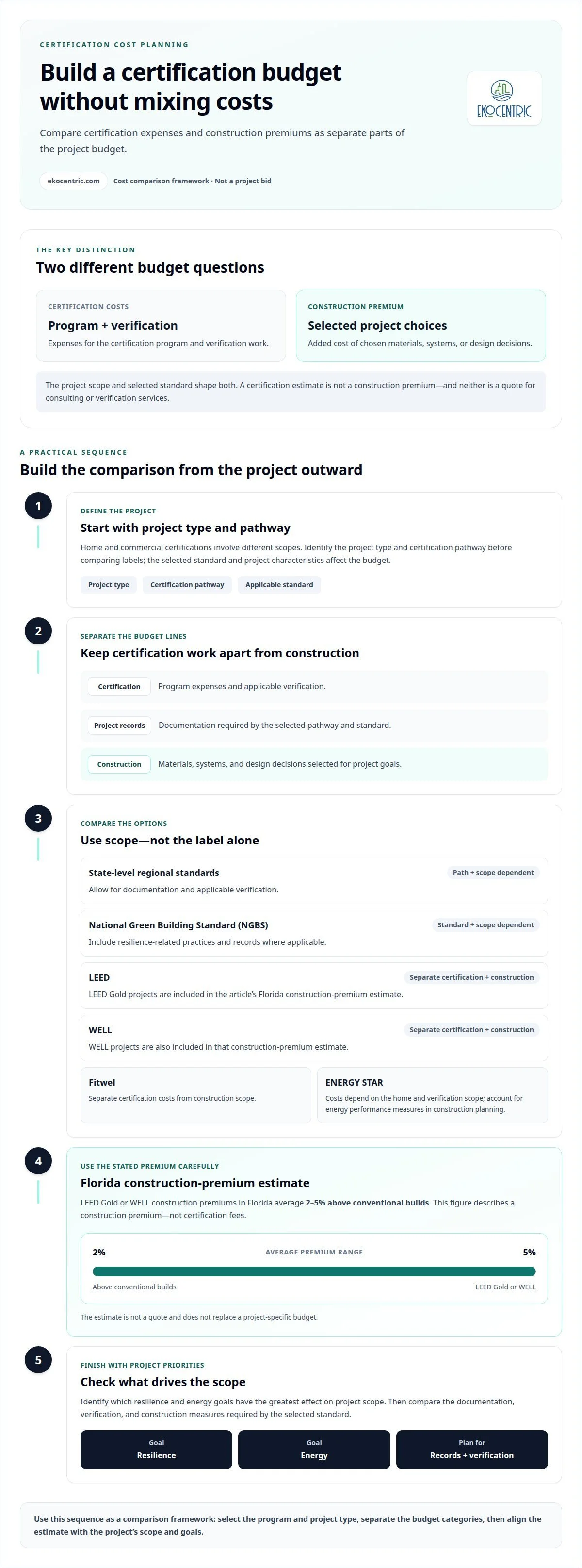
Separate certification fees from construction premiums in a Florida project budget: they cover different things. Certification costs include program and verification expenses, while a construction premium reflects the added cost of selected materials, systems, or design decisions. For hurricane-resilient construction, the project scope and chosen standard shape both.
LEED Gold or WELL construction premiums in Florida average 2-5% above conventional builds. These figures describe different costs: a certification estimate is not a construction premium, and neither is a quote for consulting or verification services.
OptionCost comparisonBudget considerationState-level regional standardsDepends on the certification path and project scopeAllow for documentation and applicable verificationNational Green Building Standard (NGBS)Depends on the selected standard and project scopeInclude resilience-related practices and records where applicableLEEDCertification and construction costs are separateLEED Gold projects are included in the 2-5% premium estimateWELLWELL projects are included in the 2-5% premium estimateFitwelSeparate certification costs from construction scopeENERGY STARDepends on the home and verification scopeAccount for energy performance measures in construction planning
Use the table as a comparison framework, not a bid. Regional program and NGBS budgets depend on the selected pathway, documentation, and project characteristics. Home and commercial certifications involve different scopes, so comparing them by label alone can distort the budget. For example, a commercial project pursuing LEED Gold should budget certification work separately from construction choices that contribute to its premium.
Certification alone does not set insurance premiums or establish eligibility for tax incentives. Those decisions depend on applicable policy terms and program rules, so don’t treat a certification label as a guaranteed discount or credit.
To build a useful estimate, start by selecting the certification program and project type. Then separate certification, verification, documentation, and construction measures in the budget. Finally, identify which resilience and energy goals have the greatest effect on scope. This sequence makes regional standards, NGBS, LEED, WELL, and Fitwel easier to compare without confusing certification expenses with the cost of meeting project goals.
Florida Green Building Coalition (FGBC) certification
The Florida Green Building Coalition (FGBC) is a nonprofit organization that promotes sustainability through Florida-focused education and certification programs. Its standards address the state’s climate, combining energy efficiency, water conservation, and storm resilience. This regional focus helps project teams assess building practices against Florida-specific priorities, rather than treating sustainability as energy performance alone.
FGBC certification is not a single, universal checklist. Available pathways cover different project types, including commercial buildings, high-rise residential buildings, and local governments. The high-rise residential certification applies to buildings four stories or more. Local government certification may assess policies and operations, including environmental protection, transportation, waste reduction, land use, and community education.
For building projects, FGBC criteria include categories that connect site and material decisions to Florida conditions:
Hurricane impact resistance: Review the project’s approach to protecting the building from storm impacts.
Salt-air material durability: Consider how material choices address coastal exposure.
Florida-native landscaping: Connect landscaping choices with water conservation.
Energy and water: Organize project practices around efficiency and resource use.
These categories help explain why FGBC is relevant to hurricane-resilient green building certification in Florida. A coastal project, for example, may need to consider salt-air durability alongside storm resistance and water-conscious landscaping. The standard brings environmental conservation, economic efficiency, and improved social outcomes into its certification priorities.
Project teams can make the pathway easier to manage by matching evidence to the selected project type and criteria. First, identify whether the building is commercial, residential, or high-rise residential. Then map planned practices to the relevant categories, and organize design records and supporting documents as decisions are made. Testing requirements depend on the project type, certification pathway, and applicable standard.
FGBC also offers education through workshops, resources, and training for builders and homeowners. These resources help explain certification practices, while project documentation shows how the chosen pathway is addressed. Examples include the Gulf Stream Historic Hotel pursuing FGBC Silver certification and Lincoln Car Dealership holding FGBC Commercial Bronze certification. Together, they illustrate the range of building contexts covered by FGBC.
To assess whether FGBC fits, compare the project type and Florida-specific priorities with the available pathway. A team focused on storm resilience, durable materials, water conservation, and energy efficiency can use those criteria to shape its certification plan. FGBC certification consulting can help organize the work around the selected standard.
Storm and hurricane resilience
Florida projects can compare resilience by examining hazard assessments, structural practices, and the scope of each certification. The distinction matters: broad sustainability goals and focused storm criteria address different project needs.
Green Certifications with Resilience Requirements
NGBS Green +RESILIENCE directly links building practices to identified natural hazards. Under the 2025 NGBS, an approved professional assesses vulnerability to one and up to two natural hazards. Projects then implement resilience practices aligned with those hazards and meet the standard’s minimum point requirements.
The 2020 NGBS takes a measurable approach to enhanced resilience and durability, requiring projects to demonstrate 30% beyond applicable IBC or IRC structural requirements. FGBC also addresses Florida priorities, including hurricane impact resistance. These pathways differ from broader programs that may emphasize efficiency without making resilience their central certification focus.
FORTIFIED Home and Green Certifications
FORTIFIED Home and green building certifications serve different purposes. FORTIFIED Home is a resilience-focused standard, while programs such as FGBC combine storm considerations with sustainability priorities, including energy efficiency and water conservation. Compare the actual criteria addressed by each pathway rather than treating one label as a substitute for another.
For example, a multifamily project may prioritize a broad sustainability framework while also identifying storm hazards and resilience practices. The certification choice should reflect the project’s goals and documentation needs. A green label alone does not show that every hurricane-related risk has been addressed.
LEED Hurricane-Resistant Design
LEED certification should not be treated as a standalone requirement for hurricane-resistant design in Florida. LEED addresses broader building sustainability goals, while storm-related building practices require separate, project-specific attention. Teams should distinguish certification criteria from the structural decisions needed to address site hazards.
For instance, a LEED project can pursue energy and resource goals while separately documenting relevant wind- and impact-resistant practices. This distinction helps teams avoid assuming that green certification automatically covers every storm-protection measure.
Local Hurricane Requirements
Florida projects must account for applicable building-code requirements as well as voluntary certification criteria. State-specific considerations include wind-borne debris requirements, Florida product approval numbers, hurricane strap specifications, and High-Velocity Hurricane Zone (HVHZ) requirements for South Florida. These are separate from a green certification’s scoring system.
This distinction also highlights an important limitation: certification doesn’t guarantee hurricane protection or replace code compliance and project-specific hazard planning. Before finalizing design documentation, map site hazards, applicable requirements, and the chosen certification criteria. Projects in hurricane-prone areas should consider local hazards alongside sustainability goals.
Certification planning and documentation
Start certification planning before design decisions become difficult to change. In Florida, the selected program, project type, and climate priorities shape the records the team needs. A focused plan connects each criterion to a responsible team member, supporting evidence, and a point in the project schedule. This keeps environmental goals and resilience measures visible throughout design and construction.
Certification timelines vary by program. Typical Florida LEED timelines are 12-24 months, while typical NGBS timelines are 6-18 months. Typical FGBC timelines are 3-12 months. These ranges make early coordination important: teams need to align documentation and verification with design, construction, and project milestones. A certification schedule should identify when evidence is created, who maintains it, and when it must be submitted.
For NGBS Green +RESILIENCE, documentation connects hazard planning with measures occupants can understand and maintain. The applicable standard version matters:
2020 NGBS: Projects document enhanced resilience building practices and describe their features and benefits in a homeowner or multifamily occupant manual.
2025 NGBS: Projects provide owners or occupants with maintenance education through a homeowner’s or operations manual.
2020 NGBS Green +RESILIENCE: Projects demonstrate on-site renewable energy and a battery energy storage system.
These records serve different purposes. Resilience documentation explains which practices address hazards and what those practices do. Maintenance education supports continued operation after handover. Renewable energy and battery records show how the project meets the specified criteria. Keep relevant evidence together, linking each selected practice to project documents and manual content.
A practical workflow starts with the standard and version. Next, map each criterion to a drawing, specification, test result, or manual entry. Assign an owner to each record, then update the evidence when plans or installed products change. For example, a change to a specified resilience measure should prompt a review of related documentation and occupant instructions. This keeps records aligned with the current design.
For a Florida project pursuing hurricane-resilient certification, build documentation into routine project controls. Maintain a criteria tracker, record decisions as they happen, and schedule reviews at design and construction milestones. Assign an owner to the operations or homeowner manual before handover. A structured record set helps the team show how climate-focused practices support resilience, energy goals, and ongoing maintenance.
Which green building certifications include hurricane resilience requirements in Florida?
For Florida projects, distinguish certifications with stated hazard-related criteria from programs centered on other performance goals. NGBS Green +RESILIENCE and FGBC offer clear resilience-related pathways; other labels may support complementary energy or indoor-environment objectives.
Program or pathwayResilience connectionWhat to compareNGBS Green +RESILIENCE, 2025 NGBSHazard assessment and aligned resilience practicesIdentified hazards and required pointsNGBS Green +RESILIENCE, 2020 NGBSEnhanced resilience and durability criteriaStructural benchmark and documentationFGBCFlorida-focused resilience criteriaProject type and applicable pathwayLEEDEnergy savings and broader building performanceSeparate energy goals from hazard criteriaENERGY STARHome energy performanceEnergy rating alongside storm planningWELLIndoor air quality, including MERV-13 filtrationIndoor-environment goals alongside resilienceFitwelCompare project criteria with hazard prioritiesWhether the selected pathway addresses hazards
The 2025 NGBS pathway begins with an approved professional’s vulnerability assessment covering one and up to two natural hazards. Projects then apply resilience practices aligned with the identified hazard and meet the NGBS minimum points threshold. This creates a direct link between assessment, selected strategies, and certification evidence.
The 2020 NGBS pathway uses a different benchmark. It requires at least 30% enhanced resilience and durability beyond applicable IBC or IRC structural requirements. It also calls for on-site renewable energy and battery energy storage for NGBS Green +RESILIENCE projects. The version therefore affects both the measures and records teams should plan.
FGBC offers another Florida-specific route, with criteria addressing hurricane impact resistance. LEED and ENERGY STAR can support energy objectives, but energy performance should be evaluated separately from hazard-focused criteria. Florida ENERGY STAR-certified homes typically require a HERS index below 55, while Florida LEED projects routinely document energy savings of 20-30% over code minimum.
WELL’s MERV-13 minimum concerns air quality, not a substitute for hazard planning. For any program, compare the actual criteria, evidence, and project type before selecting a path. A team may prioritize NGBS Green +RESILIENCE or FGBC for explicit resilience criteria, then assess whether another certification advances separate goals. Keep code compliance and site-specific hazard planning distinct from voluntary certification.
Comprehensive site planning should remain part of the project team’s wider review. For the 2025 NGBS, an approved professional must assess vulnerability to one and up to two natural hazards. The assessment helps identify which resilience-focused practices are relevant, while certification also depends on reaching the minimum points threshold. This makes the hazard assessment and the selected practices connected parts of the pathway, rather than separate considerations.
The 2025 NGBS includes guidance on preventing damage from natural hazards and improving resilience using strategies listed in HUD's Designing for Natural Hazards Series. Projects seeking NGBS Green +RESILIENCE must also implement other relevant NGBS practices to meet the minimum points threshold. Teams can use the guidance when considering practices for identified hazards, then confirm that the selected measures satisfy the applicable NGBS criteria. When comparing certification routes, keep the project’s hazard priorities in view and do not treat a general performance label as evidence that hazard-related criteria have been met.
Ekocentric: LEED Green Rater Services
Ekocentric supports project teams with LEED Green Rater Services, National Green Building Standard Green Verification, FGBC Certification Consulting, and LEED BD+C Consulting. Turn to Ekocentric when your team needs to align certification criteria, verification, and project documentation with its selected pathway.
For a Florida project pursuing FGBC, consulting can help organize the certification process around the applicable project type and criteria. NGBS Green Verification supports project verification under that standard, while LEED services address their respective certification pathways. These services support certification planning; they don’t replace project-specific hazard assessment, code compliance, or design and construction decisions.
To coordinate certification requirements and records, contact Ekocentric to discuss your project.
Turn Certification Goals Into a Project Plan
Choose the certification pathway that supports your project’s priorities, then build its requirements into the project plan. Treat resilience, energy performance, and documentation as connected decisions, not separate tasks to address near completion. This helps keep certification goals aligned with project delivery and the building’s long-term performance.
For hurricane-resilient green building certification in Florida, Ekocentric supports projects through FGBC Certification Consulting, National Green Building Standard Green Verification, and LEED Green Rater Services. Contact Ekocentric to discuss how your selected pathway fits the project’s scope and certification objectives.
Contact Ekocentric about your project and take the next step toward a more resilient, resource-efficient building.
Frequently Asked Questions
What is FGBC certification?
FGBC certification is a voluntary building sustainability program administered by the Florida Green Building Coalition. Start by identifying the project category and certification pathway that fit the building. Then review that pathway’s criteria and organize project records to show how the work addresses them. This initial scope review helps distinguish certification requirements from separate code and permitting obligations before evidence is assembled.
How does Florida Green Building Coalition certification address hurricane resistance?
For a project team, the practical task is to connect the selected FGBC criteria with project records. Create a tracker that identifies each applicable criterion, the responsible team member, and the drawing, specification, or other supporting evidence. Keep revisions traceable as project decisions change. This makes the certification submission easier to review without implying that certification guarantees storm performance.
What building codes and wind-load standards apply to hurricane-resistant construction in Florida?
The Florida Building Code is identified in the article as the 8th Edition. A project team should keep code-related plans and product documentation distinct from records prepared for a voluntary certification. For a clear review trail, label documents by building component and applicable approval or requirement. The project’s location and characteristics guide which requirements apply; certification records don’t replace code compliance.
What hurricane-resilient features are required for Florida homes, including roofs, windows, and connections?
No single feature list applies identically to every Florida home. Evaluate roofs, windows, and structural connections against the requirements applicable to the specific project, and record decisions in the construction documents. RESNET Home Energy Rating verification addresses a home’s energy rating, not its hurricane protection. Keep energy verification and storm-related documentation as separate workstreams so each review addresses its own performance goals.
What are the costs of hurricane-resilient green building certification in Florida?
The budget depends on the chosen certification pathway and the work needed to document the building. For an existing property, first inventory available plans, product records, and operating information. For new construction, track certification evidence as project documents develop. Then separate certification and verification activities from physical improvements included in the construction scope. This breakdown helps the team compare project options without conflating different expenses.
What steps are required to certify a new or existing Florida building as green and hurricane resilient?
Start by defining the building type and project goals, then select a matching certification pathway. Assign responsibility for each criterion and create a central record set. For an existing building, gather current building and operations records; for new construction, capture decisions as plans and specifications evolve. Before submission, reconcile the evidence with final project documents and prepare any owner or occupant guidance required by the selected standard.
Which Florida counties or cities have additional hurricane-resilient building requirements?
Building requirements can vary by location and project, so check which requirements apply to your building.