LEED vs NGBS for Residential Projects: Which Certification Fits Your Build in 2026?
The most prestigious green certification isn't always the most profitable choice for your specific residential development. Deciding between LEED vs NGBS for residential projects often feels like a high-stakes gamble where a single wrong move leads to excessive documentation and stagnant ROI. You've likely felt the frustration of trying to map complex requirements to your project's unique footprint while worrying if the market will actually reward your environmental commitment.
We believe that sustainability should be a practical solution rather than an operational burden. You need a clear strategy that enhances asset value and ensures resource efficiency without drowning your team in overhead. This guide provides an expert comparison of LEED v5 and the recently released ICC 700-2025 NGBS standard to help you select the most cost-effective path for your 2026 builds. We'll explore a decision-making framework designed to minimize verification hurdles and maximize the long-term resilience of your high-quality living spaces.
Key Takeaways
Differentiate between the global prestige of LEED v5 and the residential-specific focus of the 2025 NGBS standard to align with your project goals.
Contrast LEED’s mandatory prerequisites with the category-specific minimums of NGBS to determine which scoring system suits your operational capacity.
Evaluate the soft costs and administrative requirements of LEED vs NGBS for residential projects to reduce overhead during the verification process.
Identify the optimal certification path for your specific project type, whether you're developing high-end urban infill or large-scale suburban production housing.
Understand how third-party verification from a Green Rater or NGBS Verifier transforms visionary sustainability goals into tangible asset value.
Table of Contents
Understanding LEED for Homes and NGBS in the 2026 Residential Landscape
Structural Differences: Rigor, Flexibility, and Point Systems
Cost vs. Value: Analyzing the Financial Impact of Certification
Understanding LEED for Homes and NGBS in the 2026 Residential Landscape
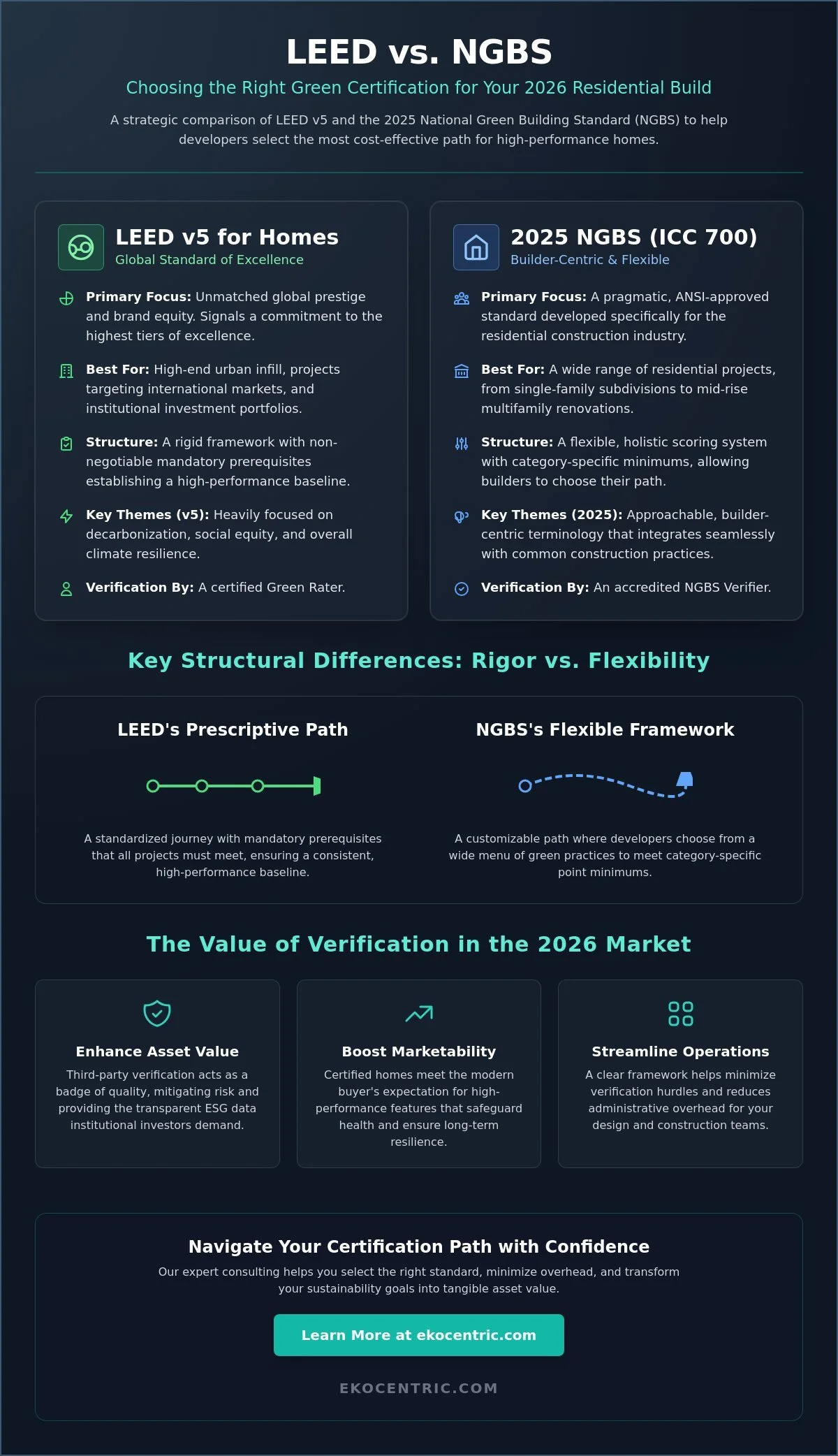
In 2026, the baseline for residential development has shifted. Buyers and investors no longer view high-performance features as luxury upgrades. They see them as essential safeguards for asset value and personal health. Choosing between LEED vs NGBS for residential projects is a strategic decision that impacts everything from financing to long-term marketability. Both standards offer a roadmap to environmental stewardship, but they serve different project profiles and organizational goals. Our specialized consulting services help developers navigate these complex requirements to ensure their builds meet the highest standards of longevity and resource efficiency.
LEED for Homes is a globally recognized framework for high-performance buildings, maintained by the U.S. Green Building Council (USGBC). In contrast, the National Green Building Standard (NGBS), or ICC-700, is an ANSI-approved standard developed specifically for the residential sector. These frameworks ensure that builders don't just guess at sustainability; they prove it through rigorous third-party testing and documentation. This verification is vital as the market moves beyond simple energy savings to include climate resilience and indoor air quality.
To better understand how these certifications compare in the broader context of sustainable architecture, watch this helpful video:
Market competitiveness in 2026 hinges on measurable performance. Institutional investors now demand transparent ESG data before committing capital to a portfolio. A certified build provides this verification, acting as a badge of quality that mitigates risk. The modern shift toward holistic sustainability means that your project must address water conservation, material health, and site impact to remain relevant. Whether you choose LEED or NGBS, the goal is the same: creating high-quality living spaces that stand the test of time.
The Global Prestige of LEED Certification
For developers targeting international markets or institutional portfolios, the LEED for Homes rating system provides unmatched brand equity. This standard, particularly through the LEED BD+C for Residential track, signals a commitment to the highest tiers of global excellence. The USGBC ensures these standards evolve with the latest building science; for example, the rollout of LEED v5 focuses heavily on decarbonization and equity. Institutional investors often prefer LEED because its rigorous prerequisites offer a standardized metric they can recognize across diverse geographic regions.
The Residential Focus of NGBS Green
The National Association of Home Builders (NAHB) spearheaded the development of NGBS to create a standard that speaks the language of residential construction. The recently released ICC 700-2025 edition, which hit the market in April 2026, continues this builder-centric tradition. This ANSI-approved framework offers incredible flexibility across various densities, from single-family subdivisions to mid-rise multifamily renovations. Many builders find its terminology more approachable. It provides a pragmatic path to high-quality living spaces without sacrificing the rigor of mandatory third-party verification from an accredited verifier.
Structural Differences: Rigor, Flexibility, and Point Systems
The architecture of a green certification determines the design boundaries of your project. When evaluating LEED vs NGBS for residential projects, developers must look beyond the final plaque and understand how these systems shape the construction process. LEED is often characterized by its rigid, non-negotiable prerequisites that serve as a high-performance baseline. On the other hand, the 2025 National Green Building Standard offers a more holistic, category-based approach. Both systems have evolved to integrate with modern smart building technology; however, they apply different pressures on your design and engineering teams.
This structural choice impacts your project's ability to pivot during construction. LEED’s rigorous documentation demands early and constant attention to detail, whereas NGBS provides a framework that many production builders find more adaptable to high-volume workflows. As decarbonization and climate resilience become central to 2026 builds, these frameworks act as essential tools for creating high-quality living spaces that satisfy both institutional investors and modern residents.
Prerequisites vs. Minimum Scoring Thresholds
LEED operates on a "pass-fail" foundation of prerequisites. If your project fails to meet a single mandatory requirement, such as specific site location criteria or tobacco-free environment policies, it cannot be certified. This can occasionally disqualify certain urban infill sites before the design even begins. Conversely, the National Green Building Standard (NGBS) requires minimum scores across every single category, including Energy, Water, and Site Development. This approach ensures a balanced building performance while offering architects more design flexibility. You don't get stuck on a single "deal-breaker" prerequisite, provided the overall performance meets the category thresholds.
Energy Performance and the HERS Index
Both systems rely on third-party energy modeling to verify that design intent translates into actual performance. The HERS Index, administered by a RESNET HERS Rater, is a critical metric for both certifications. In 2026, energy thresholds have tightened significantly to meet new climate resilience goals. A lower HERS score directly influences the final certification level, whether you are aiming for LEED Platinum or NGBS Emerald. This data-driven approach removes the guesswork from resource efficiency. If you find the technical requirements of these energy models overwhelming, exploring specialized consulting services can help align your design with these rigorous 2026 standards.
Cost vs. Value: Analyzing the Financial Impact of Certification
Financial viability often dictates the ultimate choice between LEED vs NGBS for residential projects. While both systems require an upfront investment, they yield different returns in terms of administrative overhead and market positioning. Developers must weigh the direct costs of registration and certification against the long-term asset value and reduced operational expenses. In the 2026 market, resource efficiency is no longer just an environmental goal; it's a primary driver for utility cost management and tenant retention. An academic comparison of LEED and NGBS suggests that while scoring structures differ, both paths significantly enhance the quality of the built environment compared to standard code construction.
Choosing the right standard involves analyzing the "soft costs" that accrue during the design and construction phases. These include registration fees paid to the certifying bodies, such as the USGBC or Home Innovation Research Labs, and the internal labor required to manage documentation. For large-scale developments, the administrative burden of LEED’s online portal can be more time-intensive than the field-heavy verification process favored by NGBS. However, the prestige associated with a LEED plaque often commands a higher premium in specific high-end urban markets, potentially offsetting the higher initial overhead.
Soft Costs and Documentation Hurdles
LEED certification is famously documentation-heavy, requiring meticulous record-keeping through every stage of the build. This rigor ensures a high-performance outcome but can strain a team's internal capacity. Conversely, NGBS relies more on on-site inspections by an accredited verifier, which many production builders find more compatible with fast-paced construction schedules. Delays in documentation can stall project financing or slow down the closing process. Our Ekocentric services are designed to streamline these administrative processes, allowing your team to focus on construction while we manage the complex verification requirements.
Market Differentiation and Resale Premium
Consumer awareness varies by region and project type. High-end buyers in metropolitan areas often recognize LEED as the "gold standard" of green building, which can lead to higher appraisal values and faster sales. For suburban subdivisions or affordable housing, NGBS offers a recognizable mark of quality that emphasizes lower utility bills and healthier indoor air. For institutional developers, the choice between LEED vs NGBS for residential projects is increasingly driven by ESG reporting requirements. Institutional capital often flows more easily toward projects with globally recognized certifications that provide transparent, standardized data on resource efficiency and environmental impact.
Selecting the Right Standard for Your Specific Project Type
The decision between LEED vs NGBS for residential projects is essentially a strategic alignment of your site’s DNA with a certification’s scoring logic. It isn't a competition of prestige as much as it is a calculation of efficiency. A high-rise in a dense urban core has a vastly different point potential than a master-planned suburban community. By matching the certification to the project type, you reduce the friction of compliance. This ensures the verification process supports your construction timeline instead of creating administrative bottlenecks. Our team helps you identify these "natural" point opportunities early in the design phase to maximize your investment.
Market demand in 2026 continues to favor projects that can prove their environmental credentials through third-party verification. However, the path you take should reflect your operational realities. For instance, a developer managing a global portfolio of luxury assets may prioritize the international brand recognition of LEED. Meanwhile, a regional builder focused on production-scale housing may find the residential-centric language of NGBS more compatible with their existing subcontractors and workflows. Both standards result in high-quality living spaces, but the administrative journey to get there varies significantly based on density and location.
Multi-family Developments vs. Single-family Homes
NGBS is frequently the preferred choice for massive multi-family tracts and production housing because its verification process was built for volume. Its structure allows for a streamlined approach to repetitive units, which is highly efficient for projects with hundreds of similar floor plans. LEED shines in high-rise residential and mixed-use buildings where complex mechanical systems and urban density are the norms. Both systems offer pathways to handle common areas; however, LEED’s integrated approach to the entire building envelope often provides a more cohesive strategy for buildings with significant shared amenities and complex commercial-residential overlaps.
Urban Infill vs. Suburban Subdivisions
Location dictates your "natural" point potential from day one. LEED heavily rewards projects in dense urban cores through its "Location and Transportation" category. If your site is walkable and near public transit, you've already secured several points without changing a single design element. Conversely, NGBS provides robust pathways for master-planned suburban communities. It rewards site design and development practices that preserve natural resources on larger parcels. This makes it a pragmatic choice for developers who want to emphasize environmental stewardship in areas where transit-oriented points are simply out of reach.
To determine the best fit for your next development, consider this quick assessment checklist:
Is the project located in a high-density area with existing transit? LEED may offer a smoother path to higher certification levels.
Is this a high-volume production build with multiple similar units? NGBS often reduces the documentation burden per unit.
Does the project involve a significant renovation of an existing structure? NGBS has traditionally offered more flexible pathways for residential retrofits.
Are you seeking to attract institutional investors with a global portfolio? The global recognition of LEED provides a standardized metric for ESG reporting.
To ensure you select the path that maximizes your asset value and minimizes verification hurdles, explore our LEED and NGBS verification services today.
Expert Verification: Why Your Choice of Green Rater Matters
Verification is the essential mechanism that transforms a sustainability vision into a high-performance asset. Whether you're navigating LEED vs NGBS for residential projects, the integrity of your certification rests on the accuracy of third-party oversight. A LEED Green Rater or an NGBS Verifier acts as an independent guardian of quality. They ensure that the green features promised in the blueprints are actually installed correctly on-site. This objective validation provides institutional investors and homeowners with the confidence that their investment will deliver long-term resource efficiency and durability.
Many developers make the mistake of treating verification as a final checklist. In reality, the most successful projects integrate their rater or verifier from the pre-design phase. This early collaboration allows for a proactive analysis of potential hurdles before they become expensive field changes. By closing the gap between design intent and as-built performance, you ensure that the finished structure truly functions as a high-quality living space. A dual-certified consultant provides the most objective project path, as they can pivot between standards to find the best fit for your specific operational goals.
The Role of the LEED Green Rater and NGBS Verifier
Critical inspections occur when the building’s bones are still visible. During thermal bypass and framing inspections, your verifier checks for gaps in the insulation and air sealing that could compromise energy performance for decades. These on-site visits are mandatory for both certifications, which ensures that field-built quality matches the engineering models. Ekocentric’s expertise in these technical assessments prevents costly mid-construction corrections. We act as a pragmatic partner, identifying issues when they're still simple to fix. This keeps your project on schedule and protects your bottom line.
Navigating Florida’s Unique Environmental Requirements
Building in Florida introduces specialized challenges like extreme humidity and hurricane resilience that national standards don't always address in isolation. A skilled consultant understands how to leverage the synergy between national certifications and the Florida Green Building Coalition (FGBC) standards. We help you map LEED and NGBS points to Florida-specific building codes. This ensures your project is optimized for the local climate through advanced moisture management and high-wind structural integrity. Choosing a partner who deeply understands the Florida market ensures your build isn't just green on paper, but resilient and efficient in the face of local environmental pressures. Our mission is to help you build better, ensuring your residential project stands as a testament to environmental stewardship and engineering excellence.
Building a Resilient Future Through Strategic Certification
Choosing between LEED and NGBS is a strategic move that defines your project's legacy. We've explored how LEED offers global brand equity for high-density urban builds while NGBS provides a pragmatic, flexible framework for production housing. Successfully navigating LEED vs NGBS for residential projects requires more than just picking a standard; it requires a partner who can bridge the gap between design intent and field performance.
As Florida-based sustainability experts, we bring the technical depth of a certified LEED Green Rater and an accredited NGBS Green Verifier to every project. We're dedicated to helping you build high-quality living spaces that are as resilient as they are efficient. Don't let documentation hurdles or complex requirements slow your progress. Partner with Ekocentric for your LEED or NGBS verification today and ensure your 2026 builds lead the market in environmental stewardship. We look forward to helping you achieve a more sustainable and prosperous future for your residential portfolio.
Frequently Asked Questions
Is LEED more difficult to achieve than NGBS for residential projects?
LEED is often perceived as more challenging because of its non-negotiable prerequisites and intensive documentation requirements. If a project fails to meet a single prerequisite, it cannot be certified. NGBS is equally rigorous in its technical standards, but its structure is designed specifically for residential workflows. Many builders find the NGBS scoring system more intuitive for traditional construction schedules.
Can a residential project be dual-certified in both LEED and NGBS?
Yes, a project can achieve dual certification, though it requires managing two separate sets of documentation and verification processes. While there is significant overlap in energy efficiency and material requirements, the administrative overhead usually increases. Developers typically choose this path when they need the global prestige of LEED but want the residential-specific validation offered by the NGBS framework.
Which certification is better for a multi-family apartment complex?
The choice between LEED vs NGBS for residential projects in the multi-family sector depends on density and location. NGBS is generally more efficient for large-scale garden-style or mid-rise developments due to its unit-based scoring logic. LEED often provides a better framework for high-rise urban towers where mixed-use components and complex mechanical systems require a more integrated architectural approach.
How much does a LEED Green Rater cost compared to an NGBS Verifier?
Verification fees vary based on project scope, location, and the total number of units being inspected. While registration fees for the certifying bodies are fixed, rater and verifier fees are determined by the consultant’s level of involvement. Generally, LEED requires more intensive documentation review, which can influence the time spent by the rater compared to the field-heavy verification process of NGBS.
Does LEED or NGBS have higher energy efficiency requirements in 2026?
Both standards have significantly tightened their energy thresholds for 2026 to align with modern decarbonization goals. LEED v5 and the 2025 NGBS both require performance levels well above standard building codes. Because both systems rely on HERS ratings and third-party energy modeling, the final energy performance of a certified building is comparable regardless of the specific certification path chosen.
Is NGBS recognized by international investors for ESG reporting?
NGBS is increasingly recognized by institutional and international investors as a robust metric for ESG reporting within the North American market. Its ANSI-approved status provides the transparency and third-party verification that investors require for risk mitigation. While LEED has broader global name recognition, NGBS provides the granular residential data that many specialized real estate investment funds now prioritize.
What is the difference between LEED BD+C and LEED for Homes?
LEED for Homes is a specific rating system designed for single-family and low-to-mid-rise residential buildings. LEED BD+C is a broader framework that includes a "New Construction" track often used for high-rise residential towers. The primary difference lies in the verification process; LEED for Homes requires mandatory on-site inspections by a Green Rater, whereas other BD+C tracks may use different documentation methods.
How does the Florida Green Building Coalition (FGBC) compare to LEED and NGBS?
FGBC is a state-specific standard that focuses heavily on Florida’s unique environmental challenges, such as intense humidity and hurricane resilience. While LEED vs NGBS for residential projects is a national comparison, FGBC provides a localized alternative that often overlaps with their requirements. Many Florida developers use FGBC to demonstrate a commitment to both global excellence and local environmental stewardship.