Top NGBS Innovations for Better Green Building Results
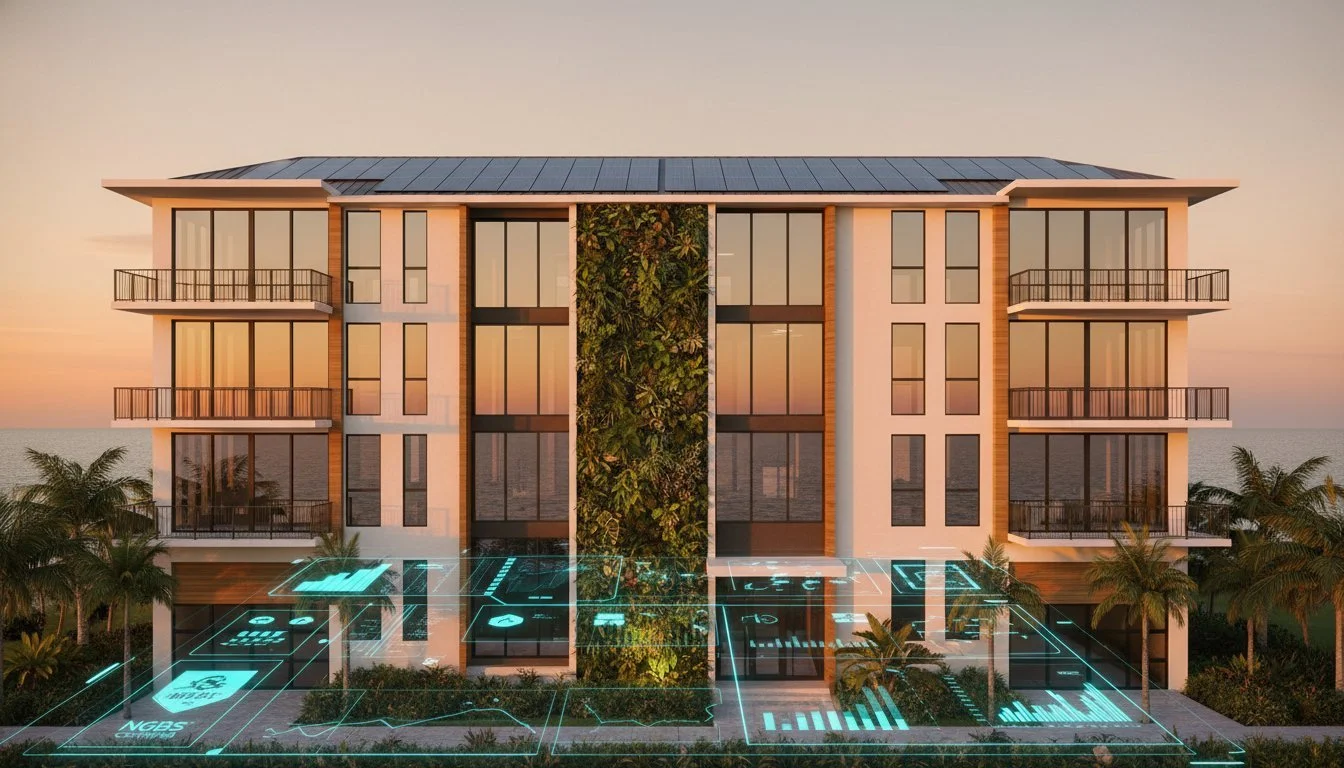
What if your next residential project could serve as a risk-mitigation powerhouse and a streamlined ESG reporting tool all at once? We understand that aligning with the 2021 IECC while managing the heavy administrative weight of ESG reporting often feels like a moving target. New innovations for NGBS under the ICC 700-2025 standard, approved in April 2026, provide a clear and pragmatic path forward. This latest edition shifts certification from a simple green checklist to a comprehensive strategy for environmental stewardship and project longevity.
You'll learn how to master the newest technical updates, resilience designations, and ESG alignment to future-proof your residential developments against rising market demands. We're committed to helping you turn complex code requirements into achievable solutions that protect both the planet and your bottom line. This article provides a roadmap for 2026 compliance, explores the high-impact "Plus" badges for wellness and resilience, and explains how the new performance-based pathways simplify your reporting requirements. With over 600,000 homes already certified, it's time to leverage these tools to create high-quality living spaces that stand the test of time.
Key Takeaways
Understand the transition to the ICC 700-2025 standard and how mandatory testing for air infiltration ensures verifiable high-performance results.
Explore how new innovations for NGBS, including the +WIND and +FIRE resilience designations, help project teams mitigate climate risk in high-stakes regions.
Simplify institutional reporting with the NGBS-GRESB crosswalk to align your residential portfolio with global ESG standards efficiently.
Discover the new performance-based compliance paths for existing multifamily communities that offer flexibility for sustainable renovations.
Learn why early engagement with an NGBS Green Verifier is the most effective way to prevent costly compliance errors during the construction phase.
Table of Contents
The Evolution of NGBS: What Is New in the 2025-2026 Standard?
Technical Innovations: Alignment with 2021 IECC and Zero Emissions
Navigating NGBS Innovations with Ekocentric’s Expert Verification
The Evolution of NGBS: What Is New in the 2025-2026 Standard?
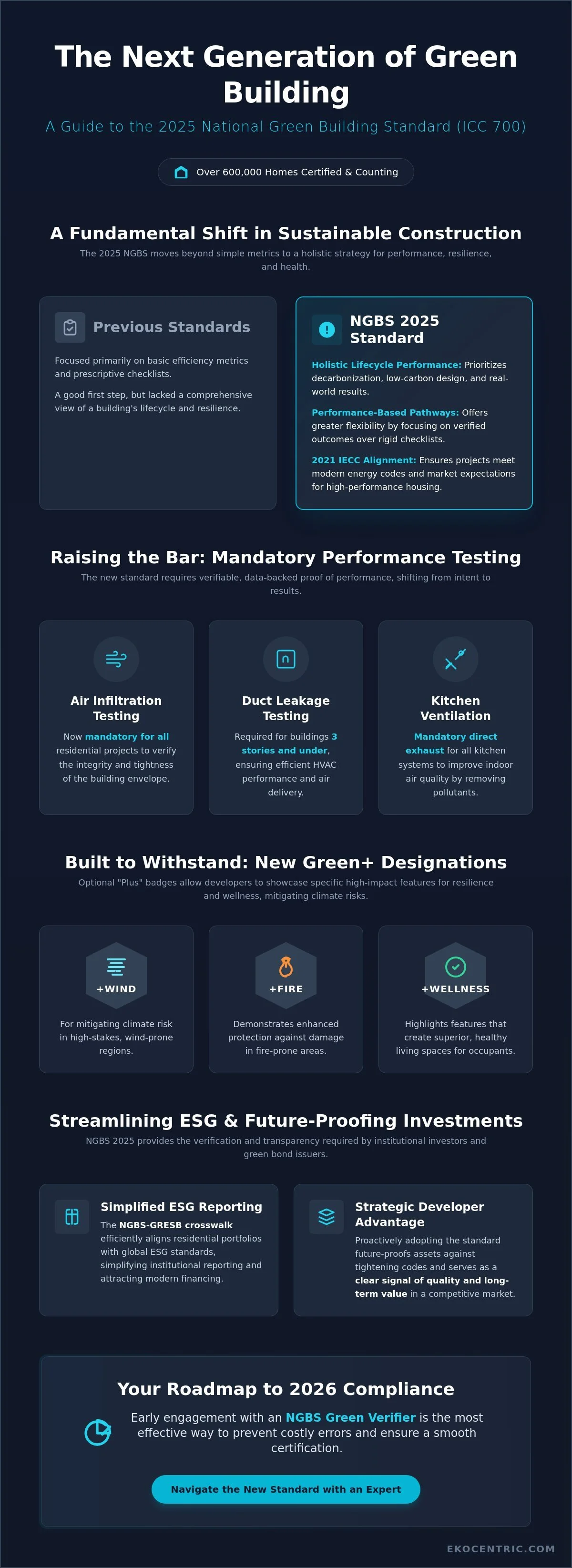
The National Green Building Standard (NGBS) reached a major milestone on April 21, 2026. This fifth edition, known as the ICC 700-2025, represents a fundamental shift in how we define sustainable residential construction. It isn't just about reducing energy consumption anymore. It's about creating assets that are demonstrably resilient and healthy for their occupants. This update was approved by the American National Standards Institute (ANSI), confirming its status as the premier consensus-based standard for the residential sector.
New innovations for NGBS are driven by a rigorous consensus process involving builders, architects, and sustainability experts. This ensures the standard remains a practical tool for the field rather than a purely academic exercise. By adopting these updates, developers gain a strategic advantage over local code cycles that often lag behind market expectations for high-performance housing. It allows project teams to go beyond the status quo, delivering homes that meet the rising demand for durability and environmental stewardship.
To better understand how these updates translate into tangible project benefits, watch this overview of the new resilience and wellness features:
Key Differences Between the 2020 and 2025-2026 Versions
Structural changes in the 2025-2026 version reflect a maturing industry. While previous iterations focused heavily on basic efficiency metrics, this edition prioritizes holistic building lifecycle performance. It introduces specialized chapters that address decarbonization through low-carbon design and performance-based compliance. For example, the 2025 version strengthens energy performance pathways to align with the 2021 International Energy Conservation Code (IECC). This shift allows for greater flexibility, especially in multifamily and mixed-use projects, by focusing on actual results rather than a rigid checklist of features. It ensures that every aspect of the project, from site development to interior air quality, contributes to a superior living experience.
Why Developers Are Transitioning to the New Standard Now
Waiting for local municipalities to mandate these changes is a risky strategy. Forward-thinking developers use the 2025-2026 standard to future-proof their assets against tightening energy codes. Beyond regulatory compliance, institutional investors and green bond issuers now require the level of transparency and verification that only a rigorous third-party standard provides. In a competitive 2026 market, achieving these credentials serves as a clear signal of quality and long-term value. Our team at Ekocentric provides the technical National Green Building Standard Green Verification needed to navigate these transitions smoothly. This proactive approach helps teams avoid costly mid-construction compliance errors while securing the credentials required for modern financing.
Technical Innovations: Alignment with 2021 IECC and Zero Emissions
The 2025-2026 update brings technical rigor that demands a proactive approach from project leads. New innovations for NGBS include a shift toward mandatory performance testing for all residential projects. This isn't just a recommendation anymore. Every home or unit must now undergo air infiltration testing to verify the integrity of the building envelope. For buildings three stories and under, duct leakage testing is also a mandatory requirement. These technical shifts ensure that the "green" label is backed by hard data rather than just intent.
Kitchen ventilation has also seen a significant upgrade. The newest standard mandates direct exhaust for kitchen ventilation systems. This move specifically targets indoor air quality by ensuring pollutants are removed from the living space rather than recirculated. It's a pragmatic response to the growing body of research regarding the health impacts of indoor combustion and cooking byproducts. By prioritizing direct exhaust, developers create a healthier environment that residents can trust.
Navigating the 2021 IECC Energy Code Alignment
The latest standard aligns closely with the 2021 International Energy Conservation Code (IECC), often exceeding its baseline requirements. Project managers need to integrate these thresholds into their pre-construction planning to avoid costly field adjustments later. For 2026 compliance, the mandatory air infiltration threshold is capped at a maximum of 3.0 air changes per hour (ACH50) for homes in most climate zones. This level of airtightness requires precise detailing at the framing and air-sealing stages. Our National Green Building Standard Green Verification services help teams identify these critical paths early in the design phase.
The Path to the +ZERO EMISSIONS Designation
The introduction of the +ZERO EMISSIONS badge represents a bold step toward decarbonization. This designation is part of the expanded NGBS Green+ Designations, which allow developers to highlight exceptional performance in specific areas. To achieve this badge, buildings must demonstrate a zero-emission profile through full electrification and the strategic use of onsite renewable energy.
This specific path aligns with the federal Zero Emission Buildings (ZEB) definition, providing a standardized way to communicate a project's carbon footprint to stakeholders. By moving away from onsite combustion, developers can future-proof their assets against potential natural gas bans and satisfy the growing demand for low-carbon housing. It's a clear, cause-and-effect relationship; specialized design choices lead to superior environmental outcomes and long-term asset value. Adopting these new innovations for NGBS ensures your project remains relevant as market preferences shift toward zero-carbon living.
Strengthening Resilience: The New NGBS Green+ Designations
Building for the future requires more than energy efficiency. It demands structures that can withstand the increasing frequency of extreme weather events. New innovations for NGBS have evolved to treat resilience as a core performance metric rather than an optional add-on. The 2025-2026 standard introduces a revamped suite of Green+ badges that provide a measurable framework for building durability. To achieve the specific Resilience designation, a project must demonstrate at least a 30% enhancement in resilience and durability beyond the structural requirements of the International Building Code (IBC) or International Residential Code (IRC). This path also requires the integration of on-site renewable energy and battery energy storage systems, ensuring the building remains functional when the grid fails.
These designations allow developers to target specific regional risks with precision. The +WIND and +FIRE badges certify that a structure employs advanced hardening techniques designed to survive hurricanes and wildfires. Meanwhile, the +WATER RESILIENCE badge addresses the dual challenges of drought and flash flooding through superior site management and resource-efficient fixtures. For projects in areas prone to seismic activity or soil instability, the +EARTH RESILIENCE badge provides a verified pathway to ensure long-term structural integrity. Each badge represents a pragmatic solution to localized environmental threats, turning climate risk into a managed asset.
Why Resilience Is the New ROI for 2026 Developments
Resilience is rapidly becoming a primary driver of project return on investment. As insurance premiums climb in high-risk zones, buildings with third-party resilience certifications present a lower risk profile to underwriters. This can lead to more favorable terms and enhanced asset valuation. Market demand is also shifting. According to the NAHB 2020 "What Homebuyers Want" Survey, buyers are willing to spend more than $2,000 upfront for homes certified to above-code standards for health and wellness. This willingness to invest in quality confirms that consumers prioritize safety and longevity. By adopting these new innovations for NGBS, developers create a clear cause-and-effect relationship; higher construction quality leads to better tenant retention and protected capital.
Implementing Resilience Designations in Florida Projects
Florida builders operate in a unique environment where humidity and high-velocity wind zones are daily realities. The NGBS resilience badges are designed to work in tandem with the Florida Building Code (FBC), providing an extra layer of verification that goes beyond the minimum legal requirements. These badges are particularly powerful when integrated into a comprehensive FGBC certification strategy. By layering these standards, project teams can address Florida-specific moisture management and salt-air corrosion issues while achieving national recognition for excellence. This proactive approach ensures that your development isn't just code-compliant, but is positioned as a market-leading, climate-ready asset.
ESG Integration and Performance-Based Compliance Paths
Administrative burden often stalls sustainability initiatives. New innovations for NGBS tackle this head-on by streamlining the path from project verification to corporate disclosure. The newly updated NGBS-GRESB crosswalk is a prime example. This tool allows Real Estate Investment Trusts (REITs) and institutional developers to map their building-level certification data directly into global reporting frameworks. It transforms a green badge into a powerful financial reporting asset, significantly reducing the time spent on manual data entry for ESG disclosures. By using the AXIS online platform, project teams can manage this data with greater precision and speed than ever before.
Efficiency isn't just for new construction. The 2025-2026 standard introduces an enhanced performance-based compliance path in Chapter 11, specifically designed for existing buildings and mixed-use communities. By integrating with ENERGY STAR Portfolio Manager, the standard now allows for seamless building benchmarking and long-term performance tracking. These changes mean that property managers can use real-world utility data to demonstrate compliance. This offers a pragmatic way to certify older assets without the constraints of prescriptive code requirements. It's a clear solution for developers who need to upgrade their entire portfolio's performance without starting from scratch.
Bridging the Gap Between Construction and ESG Reporting
Institutional investors now demand verifiable, third-party data to satisfy corporate social responsibility (CSR) goals. The alignment between NGBS and GRESB ensures that every point earned on-site translates into measurable value at the corporate level. Using these new scoring tools, project teams can maximize their GRESB points while providing the transparency that modern capital markets require. It’s no longer just about building a better project. It's about proving that performance to the world. We're dedicated to helping you turn these technical requirements into tangible business advantages that attract high-quality investment.
Flexible Compliance for Existing Building Renovations
Renovating older properties presents unique challenges, especially when balancing historic preservation with modern energy standards. The revamped Chapter 11 offers the flexibility needed for deep energy retrofits. This performance-based path allows teams to focus on actual outcomes, like reduced energy intensity, rather than rigid structural changes that might compromise a building's character. It opens the door for a wider range of assets to achieve high-performance status. This ensures that sustainability is accessible for the entire housing stock, not just new developments. If you're managing a diverse real estate portfolio, our team can help you leverage these updates to streamline your reporting. Explore our NGBS Green Verification for your portfolio to see how we simplify the certification process.
Navigating NGBS Innovations with Ekocentric’s Expert Verification
The Green Rater is the linchpin of the 2025-2026 certification process. With the shift toward performance-based compliance and mandatory testing, having an expert on-site isn't just a requirement; it's a safeguard. We ensure that technical specifications translate into field-verified results. This prevents the common pitfall where a project looks green on paper but fails to meet the rigorous new infiltration or duct leakage thresholds during final inspection. Our team acts as the bridge between design intent and physical reality, providing the technical oversight necessary to secure your investment.
New innovations for NGBS, such as the specialized resilience and wellness designations, require more than just technical knowledge. They require market insight. We help developers select the badges that provide the highest strategic value for their specific location and asset type. Whether it's the +WIND designation for a coastal Florida development or +ZERO EMISSIONS for an institutional portfolio, we guide the selection process to maximize both environmental impact and project ROI. This strategic consulting ensures that every dollar spent on green features contributes directly to the asset's long-term durability and marketability.
Beyond Verification: A Pragmatic Partner for Developers
We recognize that many project teams lack the internal capacity to manage complex documentation and evolving standards. Our role is to act as a mission-driven extension of your team. We bridge the gap between architectural vision and technical certification by providing clear, actionable feedback at every stage. This results-oriented approach ensures that environmental stewardship remains a practical goal rather than an administrative burden. We transform complex data into a streamlined pathway for success. By managing the technical nuances of the ICC 700-2025 standard, we allow your team to focus on delivery while we handle the intricacies of National Green Building Standard Green Verification.
Ready to Future-Proof Your Next Project?
Success under the 2026 standard begins long before the first shovel hits the ground. Early-stage engagement with an NGBS Green Verifier allows for the integration of high-performance strategies when they are most cost-effective. We provide a preliminary project assessment to identify the most efficient route to compliance. This helps you navigate the technical nuances of the 2025-2026 standard from day one. By identifying potential roadblocks early, we eliminate the risk of mid-construction changes that can derail budgets and timelines.
Don't leave your project’s compliance to chance. Partnering with an experienced team ensures your development is resilient, healthy, and fully aligned with modern ESG expectations. Our commitment to your success is rooted in deep industry knowledge and a passion for creating a more sustainable future. Partner with Ekocentric for your next certification to secure the credentials your project needs to thrive in a competitive market.
Leading the Way with the 2026 NGBS Standard
The transition to the ICC 700-2025 standard marks a pivotal shift for the residential building industry. By embracing the 2021 IECC alignment and the revamped Green+ badges, you aren't just following a checklist; you're building a legacy of durability. New innovations for NGBS have successfully bridged the gap between complex technical requirements and the practical business need for streamlined ESG reporting. This evolution ensures that your projects remain competitive in a market that increasingly values health, safety, and environmental stewardship.
Navigating these updates requires a partner who understands the nuances of both national standards and local challenges. Our team of Certified NGBS Green Verifiers brings a proven track record with LEED and FGBC certifications to every project. We specialize in Florida-specific resilience strategies, helping you turn climate risks into measurable asset value. Maximize your project’s value with our NGBS Green Verification services to ensure your next development meets the highest benchmarks for performance. Let's work together to build high-quality living spaces that protect our planet and your capital for years to come.
Frequently Asked Questions
What is the main difference between the 2020 and 2025 NGBS?
The primary difference is the 2025 version's strict alignment with the 2021 International Energy Conservation Code (IECC). It shifts significantly toward performance-based compliance and introduces more stringent air leakage requirements. This fifth edition also expands the scope for existing multifamily properties, allowing communities with multiple buildings to pursue a unified property certification path that was not as robust in the 2020 version.
Does the new NGBS require mandatory blower door testing?
Yes, the ICC 700-2025 standard mandates air infiltration testing for all residential projects to verify envelope integrity. This requirement ensures that every certified unit meets specific airtightness thresholds, such as the 3.0 ACH50 limit in most climate zones. By requiring mandatory testing, the standard provides builders and occupants with verifiable data that the home will perform as designed, reducing energy waste and moisture risks.
How does the +ZERO EMISSIONS badge impact my building design?
The +ZERO EMISSIONS badge requires a design shift toward full electrification and the integration of on-site renewable energy. Project teams must eliminate on-site combustion for space heating, water heating, and cooking. This designation aligns with federal Zero Emission Buildings (ZEB) definitions. It encourages the use of high-efficiency heat pump technology and solar arrays, creating a clear pathway for developers to demonstrate a project's commitment to decarbonization.
Can I still use the 2020 NGBS for projects starting in 2026?
Project registration for the 2020 standard generally remains available for a set transition period after the 2025-2026 version is released. However, adopting the new innovations for NGBS found in the 2025 standard is recommended for projects seeking maximum future-proofing. Using the latest standard ensures your development meets the most current municipal energy codes and satisfies the rigorous reporting requirements of modern institutional investors and green bond issuers.
What are the benefits of the new NGBS Resilience Plus designations?
The Resilience Plus designations provide a verified 30% enhancement in durability beyond the structural requirements of the International Building Code. These badges, such as +WIND and +FIRE, help mitigate regional climate risks and can lead to more favorable insurance terms. By building to these above-code standards, developers create safer living environments that protect both the residents and the long-term capital investment against extreme weather events.
How does NGBS certification help with GRESB reporting?
NGBS certification streamlines GRESB reporting through a formalized crosswalk that maps building data directly to global ESG frameworks. This integration allows REITs and institutional owners to use their third-party verified NGBS results to satisfy institutional investor demands for transparency. It significantly reduces the administrative burden of manual data entry while providing the high-quality, reliable data necessary for competitive GRESB scoring and corporate social responsibility disclosures.
Is NGBS certification more affordable than LEED for residential projects?
NGBS is specifically tailored for the residential sector, which often results in a more streamlined and cost-effective verification process compared to broader standards like LEED. While both are prestigious, the NGBS certification fees and the focused nature of the Green Verifier’s role often make it the pragmatic choice for multifamily developers. It delivers high-performance results and institutional recognition without the administrative complexity often associated with non-residential certification systems.
What role does an NGBS Green Verifier play in the new standard?
An NGBS Green Verifier provides the mandatory third-party oversight and performance testing required to confirm a project meets the ICC 700-2025 standard. They act as an expert partner, helping teams navigate new innovations for NGBS and identifying potential compliance errors before they become costly mid-construction issues. Their role is to ensure that the final building actually delivers the energy efficiency and resilience promised during the design phase.