Choosing a RESNET HERS Rater for Production Builders: A 2026 Buying Guide

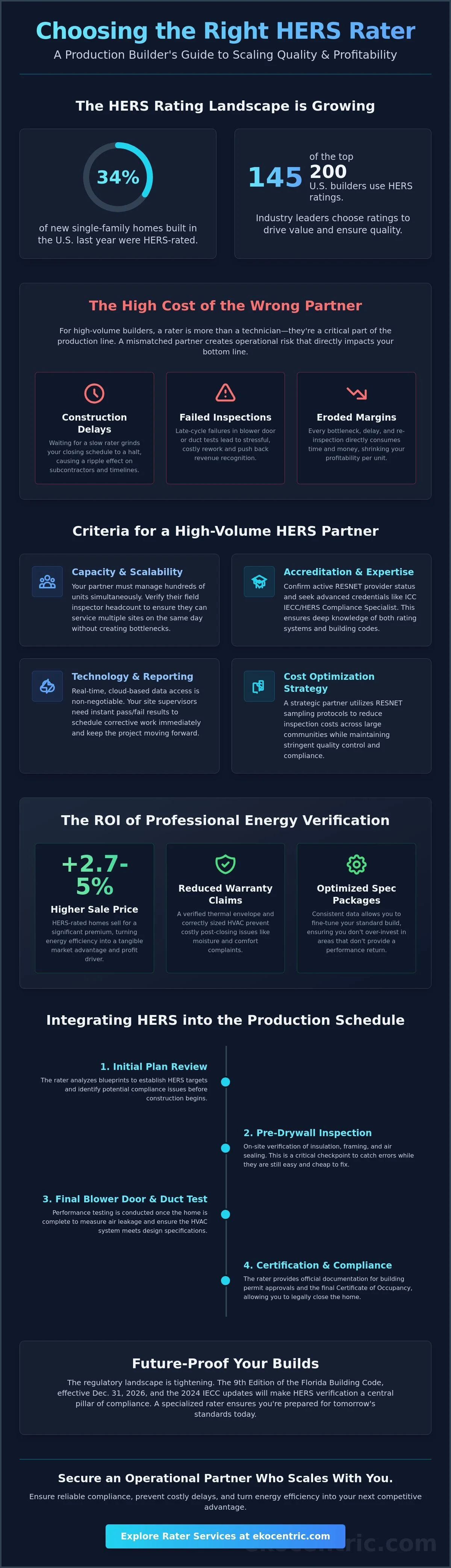
Did you know that 34% of all new single-family homes built in the U.S. last year were HERS-rated? For the top 200 builders, that number is even higher, as 145 of these industry leaders now choose ratings to drive value and ensure quality. Finding the right RESNET HERS rater for production builders is no longer just about meeting a code requirement. It's about securing an operational partner who understands your volume and respects your construction timeline.
You've likely dealt with the frustration of a site supervisor waiting on a slow rater or the stress of a failed energy inspection late in the build cycle. These bottlenecks don't just cost time; they erode your margins. This guide will show you how to select a rater that scales with your production volume while ensuring reliable compliance with the 9th Edition of the Florida Building Code and national standards. We'll explore how the right partner integrates into your schedule, navigates updated requirements like ANSI/RESNET/ICC 301-2022, and turns energy efficiency into a powerful marketing tool that builds a more sustainable future for your homeowners.
Key Takeaways
Understand why high-volume development requires a HERS Rater who acts as a strategic partner rather than just a field technician.
Learn how to evaluate a rater's internal capacity and field inspector availability to prevent costly scheduling delays across your communities.
Discover how to leverage RESNET sampling protocols to optimize inspection costs while maintaining strict quality control.
Identify the critical touchpoints, from initial plan reviews to pre-drywall inspections, that ensure your builds meet the 9th Edition Florida Building Code.
Master the criteria for selecting a RESNET HERS rater for production builders that can seamlessly integrate certifications like FGBC and LEED into your workflow.
Table of Contents
Why Production Builders Require a Specialized RESNET HERS Rater
High-volume homebuilding is a precision machine where every gear must turn in sync to maintain profitability. A standard rater might handle a handful of custom homes each month, but a RESNET HERS rater for production builders manages hundreds of units across diverse communities simultaneously. These professionals aren't just technicians with specialized equipment. They're logistics experts who verify the Home Energy Rating System (HERS) Index for every home in your pipeline. Their primary mission is to ensure that each build meets specific design targets required for both marketability and strict regulatory compliance.
Relying on a rater who lacks the infrastructure to scale creates immediate operational risk for your business. If a rater can't get to a site for a scheduled blower door test, your closing schedule grinds to a halt. In production environments, a single day of delay ripples through dozens of subcontractors and pushes back revenue. Specialized partners bring the field capacity and administrative speed needed to keep your production machine running without friction.
To better understand how a professional rater maintains quality during the inspection process, watch this helpful video:
Meeting the 2026 Energy Code Mandates
The regulatory environment is shifting toward higher performance standards. The 9th Edition of the Florida Building Code, effective December 31, 2026, incorporates updates from the 2024 International Energy Conservation Code (IECC). This shift makes HERS verification a central pillar of code compliance. A specialized rater provides the official documentation required for building permit approvals and final Certificates of Occupancy. Without this data, you don't just lose a green certification; you lose the ability to legally close the home and hand over keys to the buyer.
The ROI of Professional Energy Verification
Energy performance is a core asset that directly impacts your bottom line. Research shows that HERS-rated homes sell for an average of 2.7% more than unrated homes, while those with exceptionally low scores can command premiums of 3% to 5%. Beyond the sales price, professional energy verification significantly reduces long-term warranty claims. By ensuring the thermal envelope is perfect and HVAC systems are sized correctly, you avoid costly post-closing issues like moisture intrusion and comfort complaints. Consistent data allows you to optimize your standard spec packages, ensuring you aren't over-building in areas that don't provide a performance return. You can explore our full range of RESNET HERS Rater services to see how we support these high-volume goals.
Criteria for Selecting a High-Volume HERS Rating Partner
Choosing a RESNET HERS rater for production builders involves more than checking a box on a certification list. You need a partner whose operational infrastructure matches your build cycle. Start by verifying their active standing within the RESNET provider network. A rater in good standing ensures that your homes are registered correctly, which is vital for maintaining your reputation and compliance record. Beyond basic accreditation, look for advanced credentials like the ICC IECC/HERS Compliance Specialist. This level of expertise proves the rater understands the nuances of both the energy rating system and the building codes that govern your permits.
Capacity is the ultimate test for any high-volume partner. Ask direct questions about their field inspector headcount. If a rater only has two or three people on staff, they can't reliably service a community with 100 or more annual starts. You need to know that if three blower door tests are scheduled for the same morning across different sites, your rater has the staff to cover them all. Real-time data access is another non-negotiable feature. Cloud-based reporting allows your site supers to see pass/fail results instantly, enabling them to call in trades for corrections before the next phase begins.
Technical Expertise and Equipment Standards
Precision is mandatory when dealing with tight energy envelopes. Your rater must use equipment calibrated to ANSI/RESNET 380 standards for blower door and duct leakage testing. In Florida, this technical skill must be paired with deep knowledge of building science specific to hot, humid climates. Humidity control and high-efficiency cooling strategies are different here than in the Midwest. Proficiency in industry-standard software like Ekotrope or REM/Rate is essential, especially when implementing the HERS Sampling Protocol to manage costs across large batches of homes.
Operational Compatibility and Insurance
The operational "soft skills" often determine the success of a partnership. Professional errors and omissions (E&O) insurance and general liability coverage are essential protections for your business. These safeguard you against technical mistakes that could lead to code violations or performance issues later. Speed is also a critical metric. A production-ready rater should deliver finalized reports within 24 hours of an inspection. Having a dedicated project manager assigned to your communities ensures that communication remains clear and consistent. If you're looking for a team that balances this technical rigor with a commitment to your schedule, exploring our specialized rating services can help you find the right fit for your next project.
Optimizing Costs via the HERS Sampling Protocol
Efficiency is the lifeblood of high-volume construction. When you're building hundreds of homes with identical floor plans, testing every single unit can be an unnecessary drain on your budget and timeline. This is where the RESNET Chapter 6 Sampling Provider standards come into play. By working with a RESNET HERS rater for production builders, you can implement a protocol that allows for testing a representative percentage of homes rather than 100% of your inventory. This approach balances rigorous quality assurance with the speed required to meet your closing targets.
The financial logic is simple but impactful. Instead of paying for a full suite of tests on every lot, you might test one out of every seven units (1-in-7) or one out of every five (1-in-5). This doesn't mean quality drops. Instead, it shifts the focus to systemic consistency. A certified RESNET HERS Rater uses these protocols to verify that your building practices are repeatable and reliable across an entire community. It keeps your construction schedule moving because you aren't waiting for a blower door test at every single closing, allowing your site supervisors to focus on production rather than logistics.
When to Use Sampling vs. 100% Testing
Sampling is most effective for communities with repeating floor plans and consistent trade partners. If your "spec" packages are standardized, sampling offers the best ROI. However, 100% testing is often preferred for high-performance luxury communities or projects pursuing LEED Green Rater services, where individual unit verification is often a program requirement. In the sampling workflow, a Rating Field Inspector (RFI) frequently handles the onsite data collection. They work under the direct supervision of the HERS Rater to ensure every data point is accurate and compliant with national standards.
Maintaining Quality Control at Scale
The sampling protocol includes strict "Failure and Increased Testing" rules. If a sampled home fails an inspection, the rater must test additional homes in that specific batch to identify if the issue is systemic. This creates a powerful incentive for your subcontractors. They know that a single mistake could trigger 100% testing for the entire group, which puts their performance under a microscope. It's important to understand that sampling requires a pre-qualification period. Your team must successfully pass a set number of initial 100% tests before the protocol can be applied to your community. This ensures your trades are fully trained and capable of hitting your energy targets every time.
Integrating HERS Inspections into the Production Schedule
Successful production builders don't wait for the field to solve design problems. Integration begins at the Plan Review phase. This is where your RESNET HERS rater for production builders identifies energy design flaws before a single yard of concrete is poured. Catching a window specification error or a duct layout issue on paper prevents expensive field corrections later. It ensures your design meets the 9th Edition Florida Building Code requirements from day one, which is vital for maintaining your permitting timeline.
Proactive communication is the only way to avoid "drywall-off" delays. If your trades know exactly what the rater is looking for, they can finish their work correctly the first time. A specialized RESNET HERS rater for production builders provides clear checklists and immediate feedback to your site supervisors. This prevents the nightmare scenario where a supervisor has to hold up the drywall hangers because the insulation hasn't been verified or corrected. Efficiency in the field starts with clarity in the office.
The Pre-Drywall Critical Path
The insulation inspection is the most significant "save" for a high-volume builder. Once the drywall is installed, the thermal envelope is hidden and corrections become exponentially more expensive. Your rater verifies proper air sealing, blocking, and Grade-1 insulation installation. This stage confirms that the home will perform as modeled in the design phase. If you're looking to elevate your projects further, you can learn more about our LEED Green Rater verification services to see how we manage these critical inspections for multi-certified communities.
Final Testing and Certification Delivery
The final phase involves blower door and duct leakage testing at completion. In a production environment, scheduling this is often a logistical challenge. You have to manage the "too many people in the house" problem. Testing is most accurate when the house is empty and the envelope is sealed. Once the test is passed, the turnaround for the HERS Certificate and the HERS Index sticker should be rapid. Your rater ensures all data is uploaded to the RESNET National Registry, providing the digital trail needed for code compliance and final Certificates of Occupancy. Ready to streamline your schedule? Contact us to integrate expert HERS ratings into your workflow today.
Partnering with Ekocentric: Your Florida Production Rater
Building in the Florida market requires a partner who understands the unique intersection of tropical climate science and high-volume operational demands. Ekocentric serves as a pragmatic RESNET HERS rater for production builders, ensuring that your projects don't just meet code but exceed market expectations. We believe that environmental stewardship and corporate profitability are not mutually exclusive. By optimizing your energy strategy, we help you build homes that are more durable, more comfortable, and ultimately more valuable to the end buyer. Our mission is to provide the technical expertise you need to lead the industry toward a more sustainable future without sacrificing the efficiency of your build cycle.
We recognize that production builders often face a gap in internal capacity when managing specialized project requirements. Our team fills this role by acting as a dedicated extension of your quality control department. We don't just point out failures; we provide the cause-and-effect analysis needed to prevent them. This partnership approach ensures that your energy goals are achieved through practical, field-tested solutions that respect your bottom line and your construction schedule.
Beyond the HERS Index: A Holistic Consulting Approach
Our expertise extends far beyond simple ratings. We provide a comprehensive bridge between technical certification requirements and the realities of the job site. For builders diversifying into multi-family or mixed-use developments, we offer seamless integration between HERS data and other high-performance standards. You can explore our full range of green building consulting services to see how we align HERS ratings with NGBS verification or FGBC certification. Navigating Florida's specific humidity and cooling challenges requires a team that lives and breathes local building science. We ensure your homes are resilient against the local climate while maintaining the highest levels of resource efficiency.
Getting Started: The Portfolio Audit
The most effective way to improve your performance is through a comprehensive look at your current pipeline. We invite you to submit your existing floor plans for a "HERS stress test." Our team analyzes your current designs to find efficiency wins that could lower your HERS Index without significantly increasing your hard costs. This proactive analysis ensures your next community is fully optimized for the 2026 code updates before you even break ground. Our onboarding process is designed to be seamless, moving quickly from plan review to field training for your trade partners. Contact Ekocentric today to optimize your production building energy strategy and secure your position as a leader in Florida's sustainable future.
Securing Your Competitive Edge in 2026 and Beyond
The 9th Edition of the Florida Building Code takes effect on December 31, 2026. This shift marks a new era for the industry. High-performance construction is now the standard rather than the exception. Selecting a specialized RESNET HERS rater for production builders is the most effective way to protect your margins while delivering homes that truly respect the environment. A partner who integrates into your schedule and utilizes sampling protocols removes common bottlenecks to ensure seamless closings.
Ekocentric is ready to help you navigate this transition with practical, data-driven strategies. As RESNET Accredited HERS Raters with deep expertise in Florida Green Building Coalition (FGBC) standards, LEED for Homes, and NGBS Multi-family, we provide the authority and field capacity you need. Our team doesn't just verify compliance; we advocate for your success and the future of sustainable living spaces. It's time to turn technical requirements into a market advantage.
Schedule a Consultation for Your Production Building Portfolio and let's optimize your pipeline for the opportunities ahead. Building better is an achievable goal that benefits your buyers and your business alike.
Frequently Asked Questions
What is the difference between a HERS Rater and an ENERGY STAR Rater?
A HERS Rater calculates a home's base energy performance index, while an ENERGY STAR Rater verifies that a home meets the specific, more stringent requirements of the EPA program. Since ENERGY STAR certification requires a HERS Index score, your rater must hold both credentials to certify a home under the ENERGY STAR label. We provide both services to ensure your projects meet the highest standards of efficiency.
Can a HERS Rater help my project meet the 2026 IECC energy code requirements?
Yes, a HERS Rater uses the Energy Rating Index (ERI) compliance pathway to satisfy the 2026 IECC and 9th Edition Florida Building Code. This pathway offers builders more design flexibility than the prescriptive method. It allows you to trade off different efficiency features while still meeting the mandatory performance targets required for your building permits.
How much time does a typical blower door and duct blaster test take on-site?
A standard suite of blower door and duct leakage tests usually takes between two and four hours per unit. The exact time depends on the home's square footage and the complexity of the HVAC system. To maintain your production schedule, it's best to ensure all trades have finished their penetrations before the rater arrives on-site.
What happens if a home fails a HERS inspection during the sampling process?
If a sampled home fails, the RESNET protocol requires "increased testing" or a "failure loop" for the rest of the batch. This means the rater must test additional homes in that group to determine if the issue is an isolated mistake or a systemic problem with a subcontractor's work. This process ensures that quality remains high even when you aren't testing 100% of your units.
Is a HERS rating required for all new construction in Florida?
A HERS rating isn't strictly mandatory for every single build, but it's the most common and effective way to demonstrate code compliance. Most builders choose this path because it provides a clear, documented score that building officials recognize. It also turns a mandatory code check into a marketable asset that highlights the home's low operating costs.
How does a HERS Rater coordinate with my HVAC and insulation subcontractors?
Your RESNET HERS rater for production builders acts as a technical liaison by providing clear installation checklists and pre-drywall feedback. They verify that insulation is installed to Grade-1 standards and that ductwork is sealed correctly. This coordination prevents failed final tests and helps your trades understand the cause-and-effect relationship between their work and the final HERS score.
What is the HERS Carbon Index, and should production builders care about it?
The HERS Carbon Index is a scale that measures a home's CO2 emissions relative to a standard reference home. Production builders should care about this metric because it provides a transparent way to communicate environmental stewardship to buyers. It translates complex energy data into a clear statement about a home's long-term environmental impact and resource efficiency.
How long does it take to receive the final HERS certificate after testing?
Final HERS certificates and the associated Index stickers are typically issued within 24 to 48 hours of a successful final inspection. This rapid turnaround is vital for production environments where you need the certificate to secure a Certificate of Occupancy. Our team prioritizes efficient data processing to ensure your closing dates remain on track.