Reducing Construction Costs with Green Design: A 2026 Strategy for Developers
The assumption that sustainable building adds a 10% to 20% premium to your project budget is a costly misconception that's holding your developments back. In the 2026 market, reducing construction costs with green design has become a necessity as material costs continue to fluctuate. You've likely felt the pressure of rising expenses while trying to find the bandwidth to manage complex LEED or FGBC requirements. We know you need to deliver high-quality assets that attract premium tenants without overextending your capital expenditure.
This guide proves that integrated sustainability is a practical financial strategy for modern developers. You'll discover how system optimization can reduce HVAC requirements by up to 30%, allowing for smaller mechanical footprints and reduced material waste. This approach effectively neutralizes the "green premium" before you even break ground. We'll walk through our proven framework for streamlining the certification process to boost long-term asset value while keeping your upfront expenses firmly under control.
Key Takeaways
Learn why the "Green Premium" is a legacy myth in the 2026 market and how sustainable standards have transitioned from optional extras to baseline cost-savers.
Discover how integrated design processes and high-performance envelopes enable the "right-sizing" of mechanical systems, significantly lowering upfront capital expenditures.
Explore how reducing construction costs with green design is achieved through strategic material selection and waste mitigation techniques like design for disassembly.
Understand how utilizing FGBC standards builds long-term resilience against Florida’s unique climate risks, acting as a critical hedge against rising insurance costs.
See how partnering with an expert consultant provides the professional bandwidth needed to navigate complex certifications and maximize total project ROI.
Debunking the 'Green Premium': Why Sustainable Design Costs Less in 2026
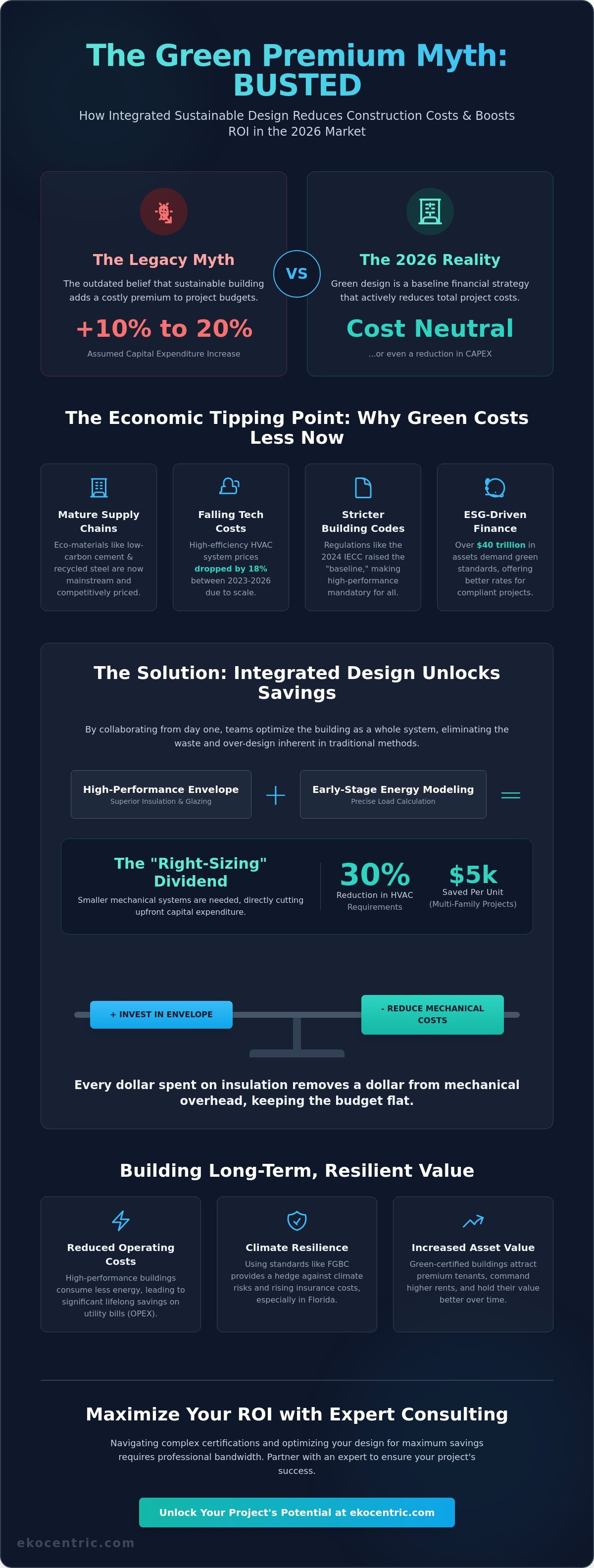
The "Green Premium" was once a valid concern for developers, often cited as a 5% to 12% increase in initial capital expenditure. By 2026, this concept has become a legacy myth. The construction industry no longer views sustainability as a luxury add-on or a checkbox for marketing. Instead, Green building principles have integrated into the standard delivery model. This shift happened because the industry reached a tipping point where the cost of high-performance components equalized with traditional materials. Developers are finding that reducing construction costs with green design isn't just possible; it's the most logical path forward.
To better understand how the financial landscape has shifted, watch this helpful video:
The Evolving Economics of Green Construction
In 2026, supply chains for eco-friendly materials like low-carbon cement and recycled steel are fully mature. Prices for high-efficiency HVAC systems dropped by 18% between 2023 and 2026 as production scaled to meet global demand. Stricter building codes, such as the 2024 International Energy Conservation Code (IECC), raised the "baseline" cost of all construction. This means a "standard" building now requires high-performance envelopes by law. The price gap has vanished. Simultaneously, ESG-driven financing now accounts for over $40 trillion in global assets. Developers who ignore green standards often face higher interest rates or limited capital access from institutional investors who demand climate resilience data before approving a loan.
CAPEX vs. OPEX: A Developer’s Perspective
Smart developers look beyond the initial Capital Expenditure (CAPEX) to the Operational Expenditure (OPEX). However, reducing construction costs with green design also offers immediate budget relief through "right-sizing" equipment. For example, a high-performance building envelope allows for a smaller, less expensive HVAC system. This can save $2,500 to $5,000 per unit in multi-family projects by reducing the tonnage required. Our team at Ekocentric helps clients manage these complexities through our specialized consulting services. This approach uses Value Engineering to cut waste rather than quality. It sets the stage for an Integrated Design process. In this model, every dollar spent on insulation or window quality removes a dollar from the mechanical overhead, keeping the total budget flat while increasing the asset's market value.
The Power of Integrated Design: Reducing Upfront CAPEX Through Optimization
Integrated design represents a fundamental shift from the traditional, siloed approach to construction. In a standard project, the architect finishes the drawings before handing them to the mechanical engineer, who then designs the HVAC system based on "worst-case" assumptions. This lack of communication leads to bloated budgets and oversized equipment. By bringing all stakeholders, including energy modelers and contractors, to the table on day one, you unlock the true potential of reducing construction costs with green design.
This collaborative framework allows the team to treat the building as a single, holistic system. When the envelope is optimized early, the mechanical requirements drop. Precise energy modeling replaces the 20% "safety factor" many engineers add to their calculations just to be safe. Eliminating this over-designing isn't just a sustainability win; it's a direct reduction in your capital expenditure (CAPEX).
Right-Sizing: The Secret to Immediate Savings
The primary financial benefit of a high-performance envelope is the ability to "right-size" mechanical systems. When you invest in superior insulation and high-performance glazing, you drastically lower the building’s peak cooling and heating loads. This allows for the installation of smaller, less expensive HVAC units and significantly reduced ductwork runs. The savings on equipment often offset the costs of the better materials.
Smaller Footprint: Reduced equipment sizes free up valuable square footage for leasable space or amenities.
Electrical Savings: Smaller motors and fans require less robust electrical service and smaller switchgear.
Material Reduction: Shorter duct runs and smaller pipes mean less raw material and lower labor costs during installation.
Consider a hypothetical 40,000 square foot commercial project. By improving the R-value of the walls and using solar-control glass, the required cooling capacity might drop from 100 tons to 70 tons. This 30% reduction in tonnage can save tens of thousands of dollars in equipment costs alone, not including the labor for smaller-scale distribution systems. "Right-sizing isn’t just about efficiency; it’s about reducing the literal weight and cost of your building’s mechanical heart."
Complexity Reduction in Building Systems
Passive design elements like strategic building orientation and external shading replace the need for expensive, active technological "fixes." If a building is oriented to minimize solar heat gain in the summer, you don't need a massive, complex chiller system to combat the heat. We've seen that simplifying the building's form can lead to more efficient, centralized plumbing layouts. Clustering wet rooms reduces the total linear feet of piping by 12% to 18%, cutting both material costs and the time required for plumbers to be on-site.
Developers who don't have the internal bandwidth to manage these complex, multi-disciplinary trade-offs often find that specialized sustainability management is the key to capturing these savings. By focusing on multi-functional building components, like thermal mass that doubles as a finished floor, you reduce the number of trades and layers in the assembly. This pragmatic approach to reducing construction costs with green design ensures that every dollar spent on the envelope returns two dollars in system savings.
Material Selection and Waste Mitigation: Streamlining the Construction Budget
Materials represent roughly 40% of a project's total budget. Choosing sustainable options isn't just about environmental ethics; it's a primary method for reducing construction costs with green design by minimizing the volume of "purchased waste" that ends up in a landfill. When developers prioritize "Design for Disassembly" (DfD) and modularity, they create buildings that function like assemblies rather than monolithic structures. This approach significantly lowers labor costs during both the initial build and future renovations because components are designed to fit together with precision and can be replaced without heavy demolition.
Localizing the supply chain also offers a buffer against the volatility of global markets. While global shipping costs fluctuated by over 200% between 2021 and 2023, local sustainable materials provided price stability. Using certification frameworks like LEED standardizes the procurement process. This creates a predictable framework that helps project managers avoid the expensive "one-off" purchasing decisions that often cause budget overruns.
Sustainable Materials: Cost-Neutral or Cost-Saving?
As of 2024, the price gap between recycled-content steel and virgin steel has narrowed to near parity. By 2026, industry analysts project that recycled steel and low-carbon concrete will become the cost-effective baseline due to increased domestic production capacity. Prefabricated green components, such as structural insulated panels (SIPs), can reduce on-site labor hours by 20% to 30%. This speed of assembly directly translates to lower carrying costs for the developer. Additionally, integrating natural lighting strategies can eliminate up to 15% of initial electrical infrastructure costs. By maximizing daylight, teams can install smaller electrical panels and fewer circuits, providing immediate savings during the rough-in phase.
Waste Management as a Profit Center
Construction and demolition waste accounts for approximately 30% of all solid waste in the U.S. Reducing this volume directly impacts the bottom line by lowering tipping fees and hauling expenses. Average landfill tipping fees reached $58 per ton in 2023 and continue to rise annually. On-site material reuse programs can divert up to 75% of waste from landfills, turning what was once a liability into a resource. For example, crushed concrete from a demolition can often be reused as on-site base fill, saving thousands in procurement and transportation fees. Utilizing LEED BD+C consulting allows developers to track these metrics with precision. This data-driven approach doesn't just satisfy certification requirements; it provides the transparency needed to monetize waste reduction and prove the financial efficacy of reducing construction costs with green design to stakeholders and investors.
On-site sorting: Decreases contamination and increases the resale value of scrap metal and wood.
Standardized dimensions: Designing to standard material sizes (e.g., 4x8 sheets) reduces off-cut waste by 10% or more.
Just-in-time delivery: Reduces the risk of material damage from weather or on-site accidents, preventing costly re-orders.
Building for Resilience: Mitigating Long-Term Financial Risk in Florida
Florida developers face a challenging financial trifecta: Category 5 hurricane risks, 100-plus degree heat waves, and an insurance market that spiked 102% between 2021 and 2024. Building for the status quo is a liability. Reducing construction costs with green design means more than just saving on monthly energy bills; it's about avoiding the "Correction Cost." This is the massive expense of retrofitting a building five years after completion because it wasn't hardened for 2026 climate realities. Building it right the first time is always cheaper than a post-storm rebuild or a mid-lifecycle HVAC overhaul.
The Florida Green Building Coalition (FGBC) Advantage
FGBC standards are specifically engineered for Florida’s unique climate. While national certifications often focus on heating for northern states, FGBC prioritizes high-performance building envelopes that manage 90% humidity levels and 150 mph wind loads. This localized certification reduces the cost of compliance because it aligns with Florida building codes rather than adding layers of irrelevant requirements. The criteria include:
Pest and Decay Resistance: Utilizing materials that withstand Florida’s subterranean termites and high moisture.
Disaster Mitigation: Enhanced roof-to-wall connections and impact-resistant openings.
Native Landscaping: Reducing irrigation infrastructure costs by using drought-tolerant species.
"Florida-Hardened" green buildings are highly marketable to local investors who understand that a resilient asset is a protected asset. It's a stamp of quality that proves the structure can handle the specific environmental stressors of the Gulf and Atlantic coasts.
Resilience and Insurance ROI
In the 2026 market, insurance costs can account for as much as 15% of a property's operating budget. Developers who ignore resilience are essentially building assets that may become uninsurable or prohibitively expensive to cover. Underwriters now require granular data on building durability before issuing a policy. A green certification serves as an official "proof of resilience" for these providers. Buildings designed with sealed roof decks and enhanced window flashing often secure lower premiums compared to standard code-minimum builds.
The "Resilience Premium" is a critical asset value driver where properties with documented hardening measures command higher appraisal values and lower risk ratings. Reducing construction costs with green design involves integrating these features during the initial build to lock in these long-term financial hedges. When you present an FGBC-certified project to a lender, you're presenting a lower-risk investment that's built to last in a volatile environment.
Ensure your next project is built to withstand the elements while protecting your bottom line. Explore Ekocentric’s sustainability management services to find the right certification path for your development.
Maximizing ROI with Expert Consulting: The Ekocentric Advantage
Hiring a green building consultant is often viewed as an added line item. However, for 2026 projects, it's a primary strategy for reducing construction costs with green design. When developers bring in experts during the pre-construction phase, they avoid the "green tax" caused by inefficient planning and reactive decision-making. Ekocentric acts as a pragmatic partner, ensuring that sustainability goals align with your bottom line rather than competing against it. We don't just check boxes; we find the most cost-effective path to high-performance results.
Reducing Management Complexity
Most Florida builders and developers don't have the internal bandwidth to manage the intricate sustainability side of a project. Between sourcing compliant materials and tracking field inspections, the administrative burden is heavy. Ekocentric provides a dedicated layer of management that offloads this complexity. This specialization is a safeguard against the cost of errors. A single missed certification requirement discovered during the final walk-through can lead to expensive last-minute retrofits or the total failure of a certification goal. By managing these details from the start, we protect your investment and your schedule. You can explore our full range of Green Rater and FGBC services to see how we simplify the process for your team.
The Tangible ROI of a LEED Green Rater
Architects are essential for design and code compliance, but a LEED Green Rater provides a different lens focused on performance and cost-optimization. Our experts identify specific opportunities for reducing construction costs with green design that design teams might overlook, such as rightsizing HVAC systems based on high-performance envelope data. This third-party verification is vital for more than just environmental ethics. It secures tangible financial benefits:
Increased asset value: Data from the Dodge Construction Network indicates that green buildings often command a 10% increase in asset value compared to traditional builds.
Financing advantages: Many lenders offer preferential rates or specialized terms for projects that meet LEED or ENERGY STAR standards.
Performance validation: Utilizing a HERS Rater ensures that the energy-efficient features you paid for are actually delivering the promised operational savings.
Ekocentric stays focused on the practical realities of the Florida market. We help you navigate the requirements of the Florida Green Building Coalition (FGBC) and other standards without over-complicating the build. Partner with Ekocentric to optimize your next green build and ensure your sustainability goals translate into measurable financial success.
Future-Proof Your Development Strategy for 2026
As we navigate the 2026 building landscape, it's clear that sustainable practices have shifted from optional upgrades to essential budget-saving tools. By prioritizing integrated design from day one, developers can effectively lower upfront CAPEX through systems optimization and reduced material waste. You don't have to choose between your bottom line and environmental stewardship. Reducing construction costs with green design is now the standard for high-performance projects that withstand Florida's unique climate challenges.
Managing these complex requirements requires deep expertise and significant time. Most development teams don't have the internal bandwidth to navigate the technicalities of LEED BD+C or FGBC certifications while keeping a project on schedule. Ekocentric provides that necessary layer of management. We bring a specialized focus to the Florida market, balancing your environmental goals with practical business realities to ensure your project remains resilient and profitable. Our pragmatic approach ensures you meet your targets without overextending your staff.
Optimize your construction budget with Ekocentric consulting to secure your project's future today. Let's build a more sustainable world together.
Frequently Asked Questions
Does reducing construction costs with green design require a higher initial investment?
Reducing construction costs with green design doesn't always require a higher initial investment. Integrated strategies allow teams to trade off expensive mechanical systems for better building envelopes, often reaching cost parity. Data from the 2023 World Green Building Trends report shows that 35% of developers achieved green projects with less than a 5% cost premium.
How does integrated design help lower my project’s CAPEX?
Integrated design lowers CAPEX by identifying system overlaps during the pre-construction phase. When architects and engineers collaborate early, they eliminate redundant components and reduce change orders by up to 20% according to AIA research. This proactive approach ensures every dollar spent contributes to both performance and budget goals.
What is the most cost-effective green building certification for Florida projects?
The Florida Green Building Coalition (FGBC) certification is typically the most cost-effective option for Florida-based developers. Since it focuses specifically on the state's unique climate and environmental challenges, the compliance path is more direct than national programs. It offers lower registration and certification fees while still meeting local regulatory requirements for sustainable development.
Can green design help reduce my building’s insurance premiums in Florida?
Green design significantly lowers insurance premiums in Florida by incorporating resilience features like impact-resistant glass and reinforced roof-to-wall connections. Buildings meeting the IBHS FORTIFIED Commercial standard can see substantial reductions in windstorm insurance rates. These structural enhancements protect the asset from tropical storms, making the property a lower risk for underwriters.
How does right-sizing HVAC systems impact construction costs?
Right-sizing HVAC systems reduces construction costs by preventing the installation of oversized, expensive equipment. Using precise Manual J and S calculations allows engineers to specify smaller units that cost less upfront and require smaller ductwork runs. This strategy can reduce mechanical equipment costs by 10% to 15% while improving indoor humidity control.
Why should I hire a LEED Green Rater if I already have an architect?
A LEED Green Rater provides the specialized technical oversight that most architects don't have the bandwidth to manage. They act as a pragmatic partner, ensuring every sustainability goal is documented and verified in the field. This third-party verification is essential for securing green financing and ensuring the building performs as designed.
Are sustainable building materials more expensive in 2026?
Sustainable building materials aren't a luxury expense in 2026. Global supply chain shifts have brought the cost of recycled steel and low-carbon concrete into line with traditional options. For example, many mass timber components are now 10% faster to install than reinforced concrete, saving developers significantly on labor and site management costs.
How does waste mitigation during construction improve my bottom line?
Waste mitigation improves your bottom line by slashing hauling fees and reducing material overages. Construction projects typically generate 3.9 pounds of waste per square foot, but a strict management plan can divert 75% of that from landfills. By recycling site debris and optimizing material orders, developers keep more capital in the project rather than paying for disposal.