Strategic Water Reduction: A Builder’s Guide to Efficiency and Certification
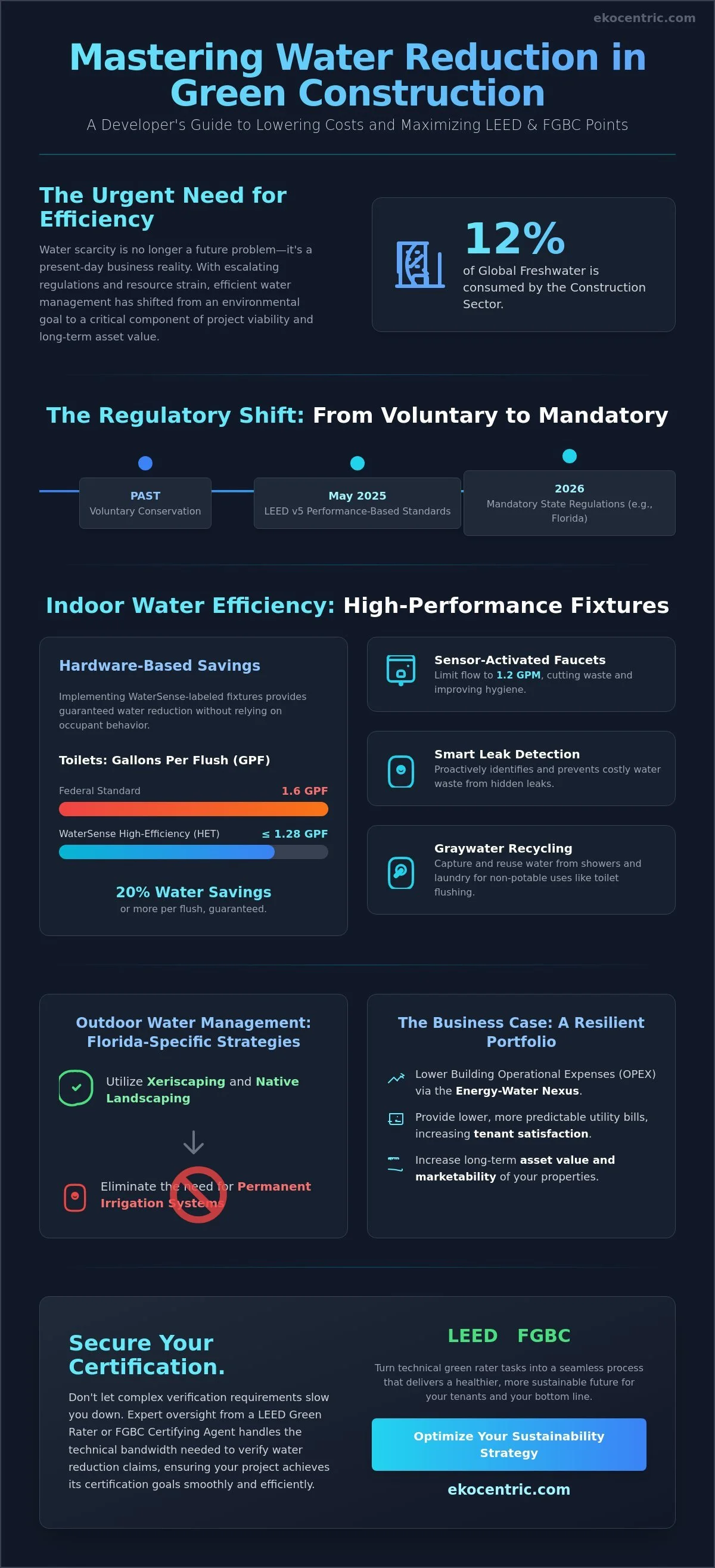
Did you know the global construction sector accounts for 12% of total freshwater consumption? In a state like Florida, where the Southwest Florida Water Management District recently extended "Extreme" water shortage restrictions through July 1, 2026, efficiency is no longer just an environmental goal; it's a business requirement. We understand that managing the technical side of green building can feel overwhelming, especially when you're trying to balance upfront costs with long-term performance. It’s a challenge to find the bandwidth to navigate complex certification requirements while keeping your project on schedule.
This guide will show you how to master water reduction strategies that lower operational costs and maximize your points for LEED and FGBC certifications. We'll break down the shift to performance-based standards in LEED v5, which opened for new projects in May 2025, and explain how specific choices like 1.28 GPF toilets or smart leak detection create marketable, resilient assets. You'll learn how to turn these technical green rater tasks into a seamless process that delivers a healthier, more sustainable future for your tenants and your bottom line.
Key Takeaways
Understand the transition from voluntary conservation to the mandatory 2026 regulatory environment and performance-based standards for new construction.
Learn how implementing WaterSense-labeled fixtures serves as a technical baseline for maximizing indoor efficiency credits in LEED and FGBC projects.
Discover Florida-specific xeriscaping and native landscaping techniques that eliminate the need for permanent irrigation systems to meet local standards.
See how expert oversight from a LEED Green Rater handles the technical bandwidth required to verify water reduction claims and secure certifications.
Gain insights into lowering utility overhead for future tenants while building a resilient, marketable portfolio of green-certified developments.
What is Water Reduction in Modern Green Construction?
Water reduction in modern green construction is the systematic decrease of potable water consumption achieved through advanced technology, intentional design, and rigorous site management. It isn't just about saving a few gallons; it's a fundamental shift in how we approach the 12% of global freshwater consumption currently attributed to the construction sector. By focusing on smart resource use from the pre-construction phase, builders can create structures that are both environmentally responsible and financially resilient.
In 2026, we've moved past the era of voluntary conservation. With the Florida Department of Environmental Protection (FDEP) rolling out stricter well and stormwater regulations as of March 15, 2026, and LEED v5 prioritizing performance-based data since May 2025, efficiency is now a core requirement for project viability. This regulatory pressure ensures that projects aren't just built to look green but are verified to perform efficiently over their entire lifecycle.
To better understand the distinction between efficiency and conservation, watch this helpful video:
Change video
Developers prioritize Water Efficiency to protect against rising impact fees and utility overhead. High-performance projects can reduce a commercial building's overall water usage by 20%, which directly increases the property's long-term asset value and marketability. By integrating these systems early, builders mitigate the risk of future water shortages, such as the Modified Phase III "Extreme" restrictions currently impacting Southwest Florida through July 2026.
The Energy-Water Nexus for Developers
The energy-water nexus is the interdependent relationship between water and energy production. When you reduce the volume of water moving through a building, you naturally lower the energy costs required for heating, treatment, and pumping. It takes a significant amount of electricity to move thousands of gallons of water through a multi-story development. By minimizing this demand, you lower building operational expenses (OPEX), which creates a more stable financial model and improves tenant satisfaction by providing lower, more predictable monthly utility bills.
Water Reduction vs. Water Conservation
It's vital to distinguish between these two concepts to ensure long-term project success. While "conservation" often relies on the unpredictable behavior of tenants, water reduction focuses on permanent, hardware-based solutions that guarantee results. By integrating low-flow fixtures, smart sensors, and high-efficiency toilets (HETs) that use 1.28 gallons per flush or less into the initial design, you create "passive" savings that don't require user intervention. For many builders who don't have the internal bandwidth to manage these technical details, our sustainability services provide the necessary management layer to ensure these systems are verified and perform as intended from day one.
Indoor Water Efficiency: High-Performance Fixtures and Systems
Achieving meaningful water reduction starts with the hardware inside the walls. By implementing products from the EPA WaterSense program as your project baseline, you ensure a minimum 20% improvement over standard models. This isn't just about labels; it's about verified performance. For example, WaterSense-labeled high-efficiency toilets (HETs) must use 1.28 gallons per flush (GPF) or less, a significant drop from the federal 1.6 GPF standard. In commercial settings, pairing these with ultra-low-flow urinals and touchless, sensor-activated faucets, which limit flow to 1.2 gallons per minute (GPM), drastically cuts daily consumption while improving facility hygiene.
For larger developments, graywater recycling offers a high-impact solution. By capturing and treating water from showers and laundry for reuse in toilet flushing, builders can close the loop on indoor usage. This strategy is particularly effective in multi-family projects where laundry volume is high. While these systems require upfront coordination, they provide a resilient hedge against future utility hikes and strengthen your application for LEED Water Efficiency credits. It's a pragmatic way to build long-term value into your assets.
Advanced Appliance Standards
Specifying ENERGY STAR and WaterSense certified appliances is a straightforward way to rack up points for NGBS and LEED certifications. Modern dishwashers and laundry units use significantly less water per cycle than their predecessors. Additionally, high-efficiency water heaters reduce "wait time" waste by delivering hot water faster to the tap. This prevents tenants from running the faucet for minutes, saving an average household more than 2,700 gallons of water annually. These choices ensure your project remains competitive in a market that increasingly values resource efficiency.
Leak Detection and Smart Monitoring
IoT-enabled flow monitors provide a critical layer of protection for new construction. These systems provide real-time data that helps builders verify performance during the commissioning phase, ensuring every fixture meets the design intent. Automated shut-off valves mitigate risk and lower insurance premiums by stopping leaks before they cause catastrophic damage. If you find your team lacks the internal bandwidth to manage these technical green rater tasks, partnering with an expert can streamline the verification process and ensure your project hits its sustainability targets.
Outdoor Water Management: Florida-Specific Strategies
Florida’s outdoor environment presents a unique paradox of high humidity and periodic "Extreme" water shortage restrictions, such as those implemented through July 1, 2026, in Southwest Florida. To achieve meaningful water reduction in this climate, builders must look beyond generic landscaping. Xeriscaping is a primary strategy here. It involves using native, drought-resistant plants that, once established, eliminate the need for permanent irrigation. This approach is a cornerstone of Florida-friendly landscaping, which is essential for meeting Florida Green Building Coalition (FGBC) certification standards.
Smart irrigation controllers are another vital tool. These systems use real-time weather data and soil moisture sensors to ensure water is only applied when absolutely necessary. For larger developments, installing rainwater harvesting and cistern systems allows you to collect high-volume runoff during the summer rainy season. This stored water can then be used for landscape maintenance during drier months. It drastically reduces the demand on municipal potable water supplies and protects your project from local watering restrictions.
Native Plants and Bio-Retention
Florida's climate requires specific plant choices that handle both intense drought and sudden, heavy rain. Using bio-swales and rain gardens helps manage stormwater runoff effectively. This ensures your project complies with the stricter FDEP requirements that went into effect on March 15, 2026. These features don't just manage water; they also reduce the "heat island" effect through strategic greenery. It creates a more comfortable environment for residents while protecting the local ecosystem from unfiltered runoff.
Reclaimed Water Integration
Navigating municipal reclaimed water lines is a pragmatic move for landscape and cooling tower use. Many Florida developments now connect to "purple-pipe" systems. These distribute treated non-potable water for non-human consumption. While the cost-benefit analysis varies by municipality, these systems offer a sustainable alternative that ensures compliance with local building codes. If your team doesn't have the internal bandwidth to manage these technical green rater tasks, we can help coordinate the integration of these systems into your site plan to ensure you capture every available certification point.
Water Reduction for LEED and FGBC Certifications
Certifications aren't just badges of honor; they're verified evidence of a building's long-term performance and market value. Under the LEED v5 framework, which became the mandatory standard for new projects after March 2026, water reduction serves as a primary pillar within the Water Efficiency (WE) category. To navigate this successfully, builders must distinguish between prerequisites and optimization credits. Prerequisites are the non-negotiable baselines required for any level of certification, while optimization credits allow you to earn the additional points necessary for Silver, Gold, or Platinum ratings.
Documentation is the bridge between an efficient design and a certified asset. You'll need to provide precise flow rates, fixture cutsheets, and manufacturer specifications to satisfy a green rater’s verification process. This technical overhead often requires a dedicated management layer to ensure that every choice made on the job site aligns with the final certification goals. By centralizing this data early, you avoid the common pitfall of missing points due to insufficient paperwork during the final audit.
LEED BD+C Water Credits
To qualify for LEED BD+C, every project must first achieve a 20% indoor water use reduction baseline. However, the real competitive advantage lies in hitting the higher optimization tiers. Projects that demonstrate a 30%, 40%, or 50% reduction through the high-performance fixtures and graywater systems we've discussed can secure significant points. Sub-metering is another critical component of the LEED strategy. The program rewards projects that install permanent meters for at least two water subsystems, such as irrigation or indoor plumbing. This focus on real-time data ensures the building remains efficient throughout its entire lifecycle.
FGBC and NGBS Water Standards
While LEED provides a global benchmark, the Florida Green Building Coalition (FGBC) rewards practices specifically tailored to our state’s unique environmental challenges. FGBC standards place heavy emphasis on low-volume irrigation and the protection of local aquifers, which is vital given the "Extreme" water shortages currently impacting Florida through July 2026. Similarly, National Green Building Standard (NGBS) verification treats water-efficient appliances as a core requirement for high-scoring projects. Managing these diverse requirements can be complex, but Ekocentric's services page shows how we handle the technical green rater tasks to ensure your credits are secured. If you want to maximize your project’s credentials without overextending your internal team, contact our experts to streamline your certification path today.
Optimizing Your Sustainability Strategy with Ekocentric
Many developers and builders don't have the bandwidth to manage the intricate technicalities of a sustainability program. Ekocentric provides that essential additional layer of management, ensuring your project moves smoothly from design intent to as-built performance. This oversight is critical because a gap often exists between what's on the blueprints and what's installed on-site. By managing the water reduction verification process, we ensure your investment in high-performance hardware actually delivers the expected utility savings and certification credits. Professional consulting is the most pragmatic way to secure certification success without overextending your internal team.
Our role involves more than just checking boxes; we act as your partner in navigating the evolving landscape of green building. Whether you're aiming for LEED v5 or local FGBC standards, having an expert to oversee the technical green rater tasks prevents costly errors and ensures every credit is maximized. This hands-on management approach protects your bottom line and guarantees that the building's operational reality matches your sustainability goals. It’s about creating a project that's as efficient in practice as it is on paper.
The Green Rater Advantage
Third-party verification is a non-negotiable requirement for LEED for Homes and multi-family residential projects. A LEED Green Rater provides the objective data needed to prove a building's efficiency. Our approach involves seamless onsite inspections and rigorous performance testing to verify that every fixture, from 1.28 GPF toilets to smart irrigation sensors, operates at peak efficiency. We take the burden of these technical green rater tasks off your project managers. This allows your team to focus on construction timelines while we handle the complex documentation and compliance details required by the USGBC.
Achieving Resilience in Florida Development
Positioning your project for success in a water-conscious market requires more than just meeting the bare minimum. Partnering with a firm that holds an unwavering dedication to Florida's sustainable future ensures your development is prepared for the regulatory shifts seen in March 2026. As utility rates rise and water shortages become more frequent, resilient buildings will command higher market value and tenant loyalty. We're genuinely passionate about creating healthier living spaces and protecting our state's vital water resources. We invite you to contact Ekocentric to start your certification journey and ensure your next project leads the way in Florida’s green building revolution.
Build for Resilience and Certification Success
Implementing a robust water reduction strategy is a critical step toward future-proofing your developments against the stricter 2026 FDEP regulations and rising utility overhead. By integrating 1.28 GPF toilets and drought-resistant xeriscaping now, you secure a 20% baseline efficiency that pays dividends in both certification points and property value. These choices aren't just technical requirements; they're investments in a more sustainable and resilient Florida. We've seen how permanent design changes outperform behavioral conservation, ensuring your project remains efficient for its entire lifecycle.
We understand that managing the technical side of green building can be complex. Ekocentric brings an unwavering dedication to your project, offering expert LEED Green Rater services and specialized knowledge in Florida Green Building Coalition standards. We act as that necessary management layer, ensuring your design intent translates into as-built performance without taxing your team's internal bandwidth. Ready to elevate your next project? Schedule a consultation for your LEED or FGBC project to ensure your sustainability goals are met with precision and passion. It's time to build a greener, more sustainable future for everyone.
Frequently Asked Questions
What is the difference between indoor and outdoor water reduction?
Indoor water reduction focuses on decreasing the volume of water used within the building envelope through high-performance fixtures and appliances. This typically involves installing hardware like 1.28 GPF toilets and 1.2 GPM faucets. Outdoor reduction targets the site's landscaping and irrigation systems. It relies on xeriscaping and smart controllers to manage runoff and eliminate the need for potable water in the landscape.
How many LEED points can I earn for water efficiency?
You can earn up to 11 points in the Water Efficiency (WE) category under the LEED v5 framework for New Construction projects. These points are distributed across subcategories including indoor use, outdoor use, and building-level metering. Achieving a 50% reduction in indoor usage can secure the maximum 6 points for that specific credit, significantly boosting your project's overall certification level.
Why is a LEED Green Rater necessary for water verification?
A LEED Green Rater provides the essential third-party verification required to prove that your as-built performance matches the original design intent. They conduct on-site inspections to verify that every installed fixture meets the specified flow rates. This objective oversight ensures that your water reduction claims are accurate and that the project remains eligible for final certification by the USGBC.
What are the best drought-resistant plants for Florida green buildings?
Native species like Saw Palmetto, Firebush, and Coontie are the most effective choices for Florida’s hot and humid climate. These plants are naturally adapted to local soil conditions and can survive the Modified Phase III "Extreme" water shortages seen through July 1, 2026. Using these species helps you meet FGBC standards by creating a landscape that thrives without permanent, high-volume irrigation systems.
Does water reduction significantly increase construction costs?
Implementing efficiency strategies typically adds less than 1% to total construction costs, and these expenses are often offset by lower municipal impact fees. Most WaterSense-labeled fixtures are priced competitively with standard models but deliver immediate operational savings. The long-term ROI is driven by a 20% reduction in utility overhead, which increases the property's asset value and appeals to eco-conscious tenants.
Can graywater systems be used in residential developments in Florida?
Yes, graywater systems are permitted in Florida residential developments provided they comply with the specific treatment and plumbing standards in the Florida Building Code. These systems capture water from showers and laundry for reuse in toilet flushing or subsurface irrigation. While they require separate piping, they're a powerful tool for achieving high-tier LEED credits in multi-family projects where laundry volume is high.
What is a WaterSense labeled product and why does it matter for LEED?
A WaterSense labeled product is a fixture or appliance certified by the EPA to be at least 20% more efficient than standard federal models. In LEED v5, using these products is a primary way to meet the mandatory indoor water reduction prerequisite. Every labeled item undergoes independent testing to ensure it maintains high performance and user satisfaction while using significantly less water.
How does smart irrigation help with FGBC certification?
Smart irrigation controllers help secure FGBC certification by automatically adjusting watering schedules based on real-time weather data and soil moisture levels. This technology prevents overwatering and ensures the site complies with Florida-friendly landscaping principles. These systems can reduce outdoor water use by as much as 30% compared to traditional timers, making them a pragmatic choice for builders in water-restricted regions.