FGBC Land Development Certification: The Developer’s Guide to Sustainable Florida Projects
In Florida’s increasingly crowded development landscape, simply meeting minimum building codes is a recipe for stagnation and regulatory friction. You likely recognize that navigating our state's specific environmental regulations requires more than just a standard checklist, especially when your team lacks the internal bandwidth to manage mountains of certification paperwork. Achieving FGBC land development certification transforms these regulatory hurdles into a competitive advantage by aligning your project with the Florida Green Building Coalition’s standards, a framework that has guided sustainable growth in the Sunshine State since 2000.
We understand that your goal is to build resilient communities that stand the test of time and market fluctuations. Sustainability is no longer optional. This guide reveals how the certification process streamlines permitting through "green" recognition and secures higher property valuations from the start. We'll walk you through the practical steps to enhance community appeal and ensure your project thrives in Florida’s unique ecosystem. By the end of this article, you'll have a clear roadmap to differentiate your developments while fulfilling an unwavering dedication to environmental stewardship.
Key Takeaways
Understand how FGBC land development certification provides a Florida-specific framework for site-wide sustainability that goes beyond individual building standards.
Learn to leverage green development pillars to mitigate environmental risks and attract high-value, eco-conscious tenants and buyers.
Discover the streamlined 6-step process for certification, including how to identify the most cost-efficient points during your initial project assessment.
See how partnering with expert consultants bridges the internal bandwidth gap to ensure your development maximizes its ROI and long-term resilience.
What is FGBC Land Development Certification?
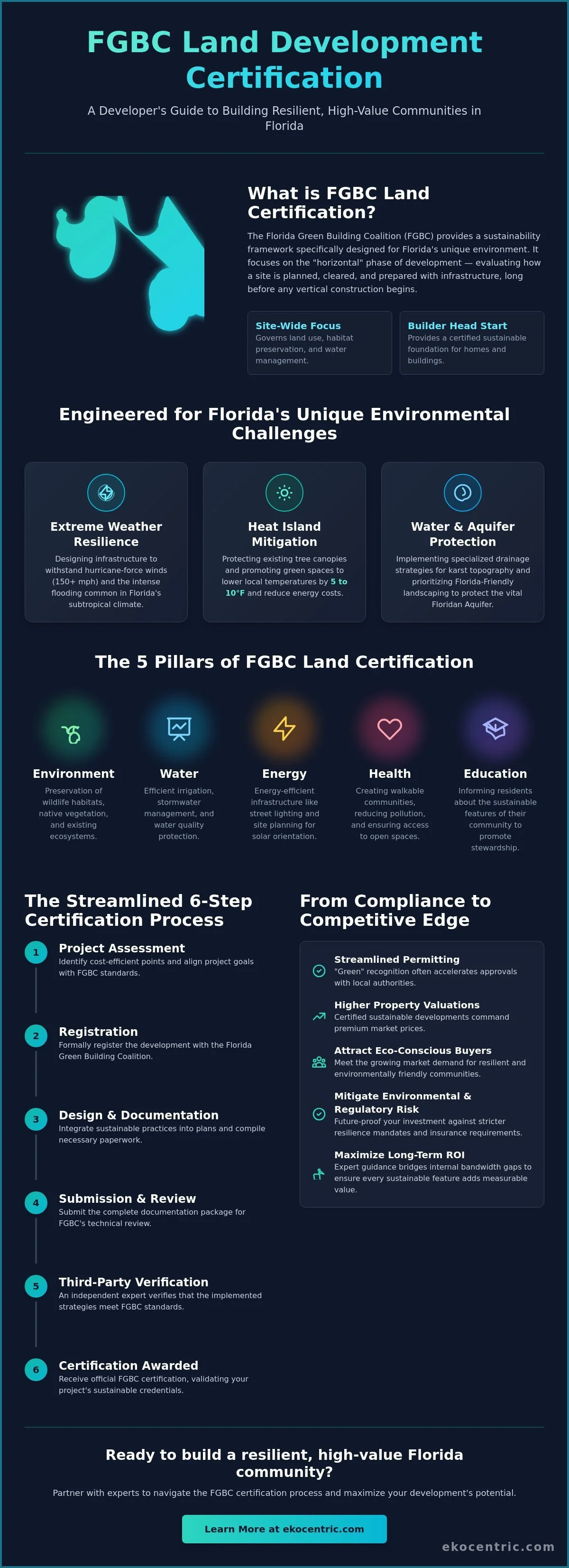
The FGBC land development certification serves as the primary sustainability framework designed specifically for the unique environmental and regulatory landscape of Florida. While many developers are familiar with building-specific ratings, this standard focuses on the "horizontal" phase of a project. It evaluates how a site is planned, cleared, and outfitted with infrastructure. The Florida Green Building Coalition (FGBC) created this program to ensure that Green building practices start at the soil level, protecting the state’s natural resources from the very beginning of the construction cycle.
Industry analysts point to 2026 as a critical deadline for developers to fully integrate these standards. With Florida's population projected to grow by over 300,000 residents annually through that year, the strain on local water tables and power grids is reaching a tipping point. Adopting the FGBC framework now isn't just about environmental stewardship; it's a pragmatic business move to ensure projects remain viable under increasingly strict state resilience mandates and shifting insurance requirements.
To better understand the practical application of these standards, watch this helpful video:
The Scope of Land vs. Building Certification
It’s vital to distinguish land certification from vertical building standards like FGBC Homes or High-Rise. Land certification governs site selection, wildlife habitat preservation, and stormwater management. It sets the stage for everything that follows. When a developer achieves this certification, they provide an automatic "head start" for builders who will eventually construct homes on those lots. This synergy often makes it easier to achieve LEED for Neighborhood Development status. If your team doesn't have the internal bandwidth to manage these complex requirements, exploring professional sustainability services can bridge that gap effectively.
Why Florida-Specific Standards Matter
Florida presents environmental challenges that national certifications don't always address with enough precision. Our state’s unique karst topography requires specialized drainage strategies to prevent sinkholes and groundwater contamination. We also deal with extreme heat and hurricane-force winds that can exceed 150 mph. The FGBC land development certification aligns with the Florida Building Code and regional water management district guidelines to solve these local problems. Key benefits include:
Water Conservation: Prioritizing Florida-Friendly landscaping that thrives without heavy irrigation, protecting the Floridan Aquifer.
Resilience: Designing infrastructure that survives the intense flooding and wind events common in the subtropics.
Ecosystem Protection: Maintaining existing tree canopies to reduce the "urban heat island" effect, which can lower local temperatures by 5 to 10 degrees.
By focusing on these regional specifics, the FGBC ensures that large-scale land planning respects the local ecosystem while providing long-term durability for future residents. This approach transforms a raw piece of land into a high-performing asset that is prepared for the environmental realities of the next several decades.
The Technical Framework: 5 Pillars of FGBC Land Certification
The FGBC land development certification operates on a weighted points system designed specifically for the state's unique climate and geology. Unlike national standards that might overlook Florida's high humidity or karst topography, this framework provides a localized roadmap for resilience. It categorizes projects based on their impact on the environment, water, energy, health, and resident education. This structure ensures that every acre developed contributes to a more sustainable future without sacrificing the project's bottom line.
Success within this ecosystem relies on rigorous third-party verification. This independent oversight confirms that a project's green claims are backed by measurable results, providing developers with the credibility needed to satisfy local planning boards and eco-conscious buyers. The widespread adoption of FGBC certification, which reached a milestone of 20,000 certified projects in 2021, proves its viability as a mainstream development tool. Because the system is flexible, developers can choose credits that align with their site's specific geography. A project in the Florida Keys will naturally prioritize different credits than one in the rolling hills of the Panhandle. This adaptability allows for the integration of smart growth principles, such as increased density and walkable layouts, into traditional Florida community designs.
Environmental Stewardship & Site Protection
True sustainability begins before the first shovel hits the ground. Developers earn points by preserving at least 25% of the existing native canopy and protecting local wildlife corridors. During the construction phase, strict soil management and erosion control plans are essential to prevent sediment from entering Florida's sensitive aquifers. Low-Impact Development (LID) in the context of Florida wetlands is an engineering and design strategy that manages stormwater runoff by mimicking natural hydrologic processes to ensure post-development water flow matches pre-development conditions. By prioritizing these ecosystems, projects maintain the natural beauty that drives property values higher over time.
Water Conservation & Energy Efficiency
Water is Florida's most precious resource, and the FGBC framework mandates its protection at the community level. This involves implementing the nine principles of Florida-Friendly Landscaping™, which reduce the need for supplemental irrigation and fertilizers. Many certified projects now utilize 100% reclaimed water for common areas and install advanced irrigation sensors to prevent waste. Energy strategies extend beyond individual homes to include the entire development infrastructure. Key requirements often include:
Installation of high-efficiency LED street lighting to reduce community energy loads.
Designing common areas and clubhouses to exceed Florida Energy Code by at least 15%.
Planning for solar-ready infrastructure in shared community spaces.
If your team doesn't have the internal bandwidth to track these complex technical requirements, we can provide the expert sustainability management needed to streamline your project's path to certification.
Strategic Benefits: Why Developers Certify Land
Securing the FGBC land development certification is a calculated business move that goes beyond environmental stewardship. It serves as a powerful tool for market differentiation. Eco-conscious buyers and corporate tenants are no longer looking for just a building; they want a community that reflects their values. By 2025, research suggests that 75 percent of the global workforce will be millennials who prioritize sustainability in their living and working spaces. This certification proves a project meets those demands through a third-party, Florida-specific lens.
Risk mitigation is another critical factor. Florida's climate shifts require infrastructure that can handle intense weather events. Certification ensures that site planning accounts for these realities from the start. It also streamlines the public hearing process. When a developer presents a project backed by the Florida Green Building Coalition, it signals a commitment to the local environment. This builds immediate rapport with skeptical community groups and planning boards.
Financial benefits extend to ESG (Environmental, Social, and Governance) reporting. Institutional lenders often offer better terms for projects with verified green credentials. They view these developments as lower-risk assets that are better prepared for future carbon regulations. It's a way to future-proof the investment while attracting high-quality capital that demands transparency and measurable impact.
Permitting and Regulatory Advantages
Many Florida municipalities now incentivize sustainable growth. Cities like Miami and Orlando have implemented green building ordinances that reward certified projects. Choosing to pursue FGBC land development certification can lead to expedited site plan reviews in these jurisdictions. This speed is crucial for maintaining project timelines and reducing carrying costs. Developers who find they don't have the bandwidth for the technical requirements often find that expert sustainability management helps bridge the gap between complex standards and local code compliance. This partnership builds long-term trust with planning departments.
Long-Term Resilience and Value
Sustainable design directly impacts the bottom line by lowering operational overhead. Using native vegetation and advanced xeriscaping can reduce irrigation costs by 50 percent or more compared to traditional turf-heavy landscapes. These savings are passed on to homeowners' associations and commercial tenants, increasing the site's long-term viability. A 2022 market analysis showed that green-certified communities often command a 5 to 10 percent price premium over traditional developments. Creating walkable, shaded environments doesn't just look good; it creates a healthier atmosphere that residents are willing to pay for. This verified status ensures the property retains its value as market standards evolve.
The 6-Step Certification Process for New Developments
The path to FGBC land development certification is a structured six-stage journey designed to verify that your project meets Florida's highest environmental standards. This process ensures that every environmental claim is backed by rigorous data and third-party verification, moving beyond simple "greenwashing" to provide tangible value. The certification lifecycle follows these essential steps:
Project Registration: You begin by officially registering the project with the Florida Green Building Coalition and selecting an accredited Certifying Agent to oversee the file.
Preliminary Assessment: Your team identifies "low-hanging fruit" for points, such as preserving 25% of existing native upland vegetation or opting for pervious paving in 15% of common areas.
Design Integration: This phase involves embedding FGBC requirements directly into site plans and engineering documents to ensure compliance is built-in, not bolted-on.
Construction Monitoring: The Certifying Agent conducts on-site inspections to verify that sustainable practices, like proper erosion control and habitat protection, are maintained during the build.
Final Submission: Once construction is complete, a full documentation package is submitted to the FGBC for a final, comprehensive review.
Post-Certification Marketing: After approval, you can leverage your official "Green" status to attract eco-conscious buyers and differentiate your project in a competitive market.
The Role of the FGBC Certifying Agent
An independent Certifying Agent is a mandatory requirement for this process. They don't just check boxes; they act as a technical bridge between your development team and the Florida Green Building Coalition. You should select an agent with specific expertise in Florida's unique ecosystems and climate challenges. Their role is to provide the professional authority needed to validate your project's performance, ensuring that your sustainability claims are both credible and measurable for future residents.
Managing Documentation and Timelines
Successful certification depends on integrating milestones into your standard project lifecycle. A common mistake is treating documentation as an afterthought. This often leads to missed opportunities for points that were easily achievable during the early grading or clearing phases. Securing FGBC land development certification relies on capturing evidence in real-time, rather than trying to reconstruct records months after a task is finished.
Effective developers use digital tracking tools to monitor compliance from day one. You can avoid delays by establishing a clear "documentation owner" on your team who works closely with the agent. This proactive management ensures that you capture every credit, from water-efficient landscaping to energy-efficient street lighting, without disrupting your build schedule or budget.
If you don't have the internal bandwidth to manage these complex requirements, we're here to help. Explore our expert management services to streamline your next sustainable project.
Maximizing ROI: Why Expert FGBC Consulting is Essential
Achieving FGBC land development certification isn't just about environmental stewardship; it's a strategic business move that requires precise execution. Most developers face a significant bandwidth gap. Internal teams are often stretched thin managing zoning, contractors, and site logistics, leaving little room for the rigorous documentation green standards demand. This is where professional consultants become indispensable partners. We handle the technical heavy lifting, allowing your team to focus on the core build.
Expert consultants optimize the points-to-cost ratio by identifying the most affordable ways to reach your certification goals. We don't just check boxes. We analyze every credit to find high-impact, low-cost solutions. For example, prioritizing native xeriscaping over complex irrigation systems often yields higher points for a lower initial investment. This strategic planning ensures compliance without compromising project timelines or budget constraints. Efficiency in this area is vital, as Florida projects can face daily carry costs that quickly erode profit margins if certification delays occur.
Consultants bridge the knowledge gap between site engineers and sustainability auditors.
We identify credits that overlap with existing municipal requirements to double-count efforts.
Early intervention prevents expensive retrofits or last-minute design changes.
Successful land certification creates a seamless transition to building-level success, such as FGBC Homes or LEED for New Construction.
Ekocentric’s Practical Approach to Sustainability
We provide the additional layer of management that busy developers need to stay competitive. Our team possesses deep expertise in the 2023 Florida Building Code and the specific nuances of FGBC standards. We act as a pragmatic partner, ensuring that every sustainable choice aligns with your project's financial realities. By integrating our knowledge into your workflow, we help you build resilient communities that stand out in the Florida market. You can explore our comprehensive green building services for more details on how we manage these complexities.
Getting Started with Your Green Development
The path to a successful project begins with an early-stage feasibility study. This audit determines which points are most attainable for your specific site and highlights potential roadblocks before they become costly issues. Beyond the technical data, we help you craft a sustainability narrative for stakeholders and investors. This narrative positions your project as a forward-thinking, future-proof asset that appeals to modern buyers and institutional lenders alike.
Don't leave your FGBC land development certification to chance. A proactive approach saves time, reduces stress, and maximizes your return on investment. Schedule a consultation with our team today to audit your next project and ensure your sustainability goals are both ambitious and achievable.
Leading the Way in Resilient Florida Development
Adopting the FGBC land development certification framework is more than a sustainability goal; it's a strategic move for developers who want to stay ahead of the Florida Building Code. By focusing on the 5 technical pillars, projects achieve measurable resilience against local environmental stressors. The Florida Green Building Coalition established these standards to ensure that new developments protect natural resources while providing long-term value to stakeholders. Since the 6-step certification process involves complex documentation and site assessments, having a dedicated partner ensures nothing falls through the cracks.
Many builders don't have the internal bandwidth to manage these detailed requirements alongside tight construction schedules. Ekocentric provides the Florida-based expertise needed to navigate both FGBC and LEED standards with precision. Our expert Certifying Agents bring a proven track record of managing sustainability for complex developments across the state. We handle the technical heavy lifting so you can focus on building. Let's work together to create a greener, more sustainable future for Florida's growing communities.
Partner with Ekocentric for your FGBC Land Development Certification
Frequently Asked Questions
What is the minimum project size for FGBC Land Development certification?
FGBC doesn't mandate a specific minimum acreage for land development certification. Whether you're developing a 5-acre infill site or a 5,000-acre master-planned community, the standards remain applicable. This flexibility allows developers of all scales to pursue sustainable goals and demonstrate environmental leadership within their specific market.
How much does FGBC Land Development certification typically cost?
The Florida Green Building Coalition publishes a transparent fee schedule for all projects. For instance, registration fees start at $400 for non-members and are reduced for active FGBC members. Certification fees are then calculated based on the total acreage of the development, though these costs don't include the professional consulting fees required to manage the documentation and verification process.
Can an existing development apply for FGBC certification retroactively?
You can't apply for certification retroactively once a project is finished. The program requires third-party verification of site preparation and construction phases that can't be documented after the work's complete. It's best to register your project during the early planning or design stages to ensure every credit is captured accurately and efficiently.
How does FGBC certification compare to LEED for Neighborhood Development?
FGBC land development certification focuses specifically on Florida's unique environment, while LEED for Neighborhood Development is a global standard. FGBC credits prioritize Florida-specific issues like karst topography, hurricane resilience, and subtropical water management. Choosing FGBC ensures your project addresses the exact ecological challenges found in the Sunshine State rather than generic national benchmarks.
What are the most common "Green" features in Florida land developments?
Florida developments frequently incorporate drought-tolerant xeriscaping and reclaimed water systems for irrigation. A majority of certified projects also utilize pervious pavement to manage stormwater runoff effectively. These features help developers meet the 200-point minimum required for the Bronze level of certification while protecting local Florida aquifers and sensitive ecosystems.
How long does the FGBC review process take for a final application?
The FGBC review process for a final application typically takes 30 to 45 days. This timeline depends on the completeness of your documentation and how quickly your project team responds to any requests for clarification. We recommend submitting your final package as soon as site construction is complete to avoid delays in marketing your certified status to potential buyers.
Does FGBC certification expire once the development is complete?
FGBC land development certification doesn't expire once the development phase is complete. It serves as a permanent designation for the infrastructure and site design of the community. While individual buildings within the development might pursue separate, recurring certifications, the land development status remains a fixed achievement for the life of the project.
Can I use FGBC certification to satisfy local Florida municipal requirements?
Yes, over 70 Florida local governments have adopted green building programs that recognize FGBC certification. Cities like Sarasota and Gainesville have historically offered expedited permitting or density bonuses for projects that achieve these standards. Check with your local planning department to see how an FGBC-certified project can streamline your approval process and provide a competitive advantage.