Sustainable Building Advisor Florida: Navigating LEED, FGBC, and Coastal Resilience
Imagine it is late Friday afternoon in Miami, and your development team is buried under 400 pages of LEED documentation while the 2024 coastal building code updates threaten your project schedule. Most developers recognize that high-level green certifications are now essential for securing institutional financing and attracting premium tenants. However, we also know that most teams don't have the internal bandwidth to manage every HERS rater and FGBC credit requirement. Working with an experienced sustainable building advisor South Florida allows you to offload this complexity so you can focus on your core construction goals.
We agree that your time is best spent on the building site, not chasing down green verifiers or filing paperwork. You'll discover how to master the nuances of LEED, FGBC, and NGBS while ensuring your property is built to withstand our unique tropical climate. This guide breaks down the certification process and reveals how resilient design can lead to a 15% reduction in long-term insurance premiums and energy costs.
Key Takeaways
Understand why South Florida’s unique climate-marked by high humidity and salt air-demands a specialized strategic partner to manage the certification lifecycle.
Compare the global prestige of LEED with the regional specificity of FGBC to determine which framework best aligns with your project’s environmental goals.
Learn how independent third-party verification from HERS Raters and NGBS Verifiers ensures the technical integrity and compliance of your sustainable development.
Discover how a sustainable building advisor South Florida developers trust can fortify building envelopes against heavy rainfall while optimizing energy storage for hurricane resilience.
Identify how to bridge the "bandwidth gap" in your team by integrating an additional layer of management dedicated to navigating complex green building standards.
Table of Contents
The Growing Need for a Sustainable Building Advisor in South Florida
Navigating LEED vs. FGBC: Which Certification is Right for Your Project?
Designing for the Florida Climate: Coastal Resilience and Efficiency
The Growing Need for a Sustainable Building Advisor in South Florida
Building in the Sunshine State has never been a one size fits all endeavor. A sustainable building advisor South Florida acts as a strategic partner who manages the entire certification lifecycle, from initial design charrettes to final onsite inspections. They bridge the gap between architectural vision and the technical requirements of green rating systems. In a region where 90% humidity and salt-laden air are daily realities, this role is about more than just checking boxes. It's about ensuring a structure survives the next century of environmental stress. An advisor doesn't just suggest green materials; they orchestrate the integration of energy models, moisture control strategies, and material sourcing to meet rigorous standards.
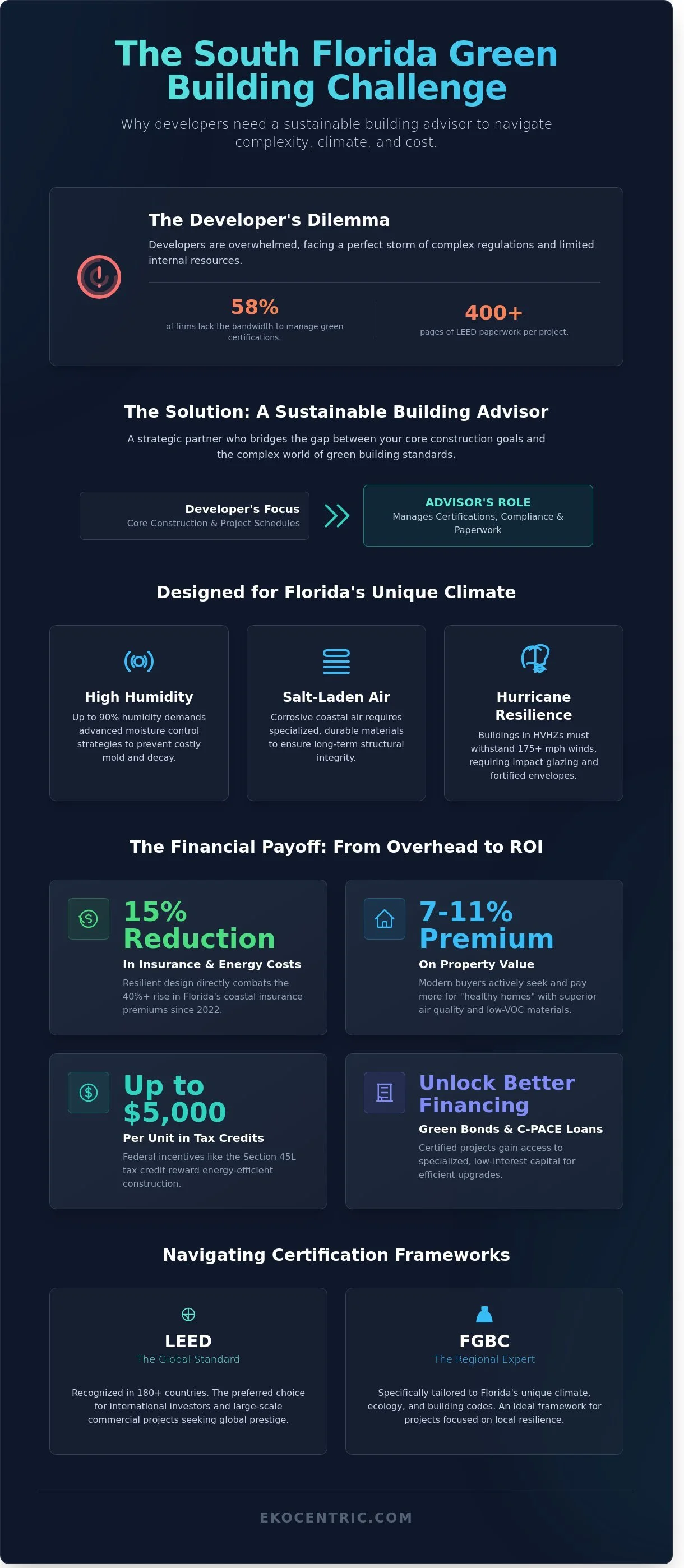
Developers often hit a wall when trying to manage these complex requirements in-house. A 2023 industry survey showed that 58% of mid-sized construction firms lack the internal bandwidth to track the evolving documentation needed for high-level certifications. This bandwidth problem often leads to missed deadlines or lost incentives. Hiring a sustainable building advisor South Florida provides that essential management layer. It allows builders to focus on the physical construction while the advisor handles the sustainability side, ensuring every credit is documented and every performance target is hit. This pragmatic partnership turns a complicated administrative burden into a streamlined path toward certification.
The 2026 landscape is shifting toward even stricter performance metrics. Recent updates to the Florida Building Code and new federal mandates mean that standard construction is no longer enough to stay competitive. The Inflation Reduction Act has solidified incentives like the Section 45L tax credit, which offers up to $5,000 per unit for energy-efficient homes that meet specific criteria. Financing models now heavily favor projects that can prove their performance through third-party verification. Without an expert to navigate these shifting regulations, developers risk building assets that are obsolete before they're even completed.
Beyond the Checklist: Sustainability as Resilience
In Miami and Fort Lauderdale, sustainability isn't a luxury; it's a survival strategy. High-velocity hurricane zones (HVHZ) require materials that can withstand 175 mph winds and flying debris. Green building practices in Florida prioritize high-impact glazing and moisture-managed envelopes that prevent mold growth in our punishing subtropical climate. These choices drive long-term property value by reducing insurance premiums, which have risen by over 40% in some Florida coastal markets since 2022. Sustainable building is the intersection of environmental stewardship and structural resilience.
The Business Case for Green Building in 2026
The financial argument for green certification has never been stronger for the South Florida market. Programs like the Leadership in Energy and Environmental Design (LEED) and the Florida Green Building Coalition (FGBC) unlock specialized financing such as Green Bonds and Commercial Property Assessed Clean Energy (C-PACE) loans. These tools provide low-interest capital specifically for energy-efficient upgrades. Modern buyers are actively seeking "healthy" homes that feature MERV-13 filtration and low-VOC materials, often paying a 7% to 11% premium for these features. Project management becomes seamless when an expert advisor handles the technical coordination, allowing the build team to deliver high-performance results without the usual administrative friction.
Navigating LEED vs. FGBC: Which Certification is Right for Your Project?
Choosing between LEED and FGBC isn't just about a plaque on the wall. It's a strategic decision that affects your project's lifecycle, marketability, and environmental impact. As an experienced sustainable building advisor South Florida developers rely on, I've seen how the right framework can streamline construction and maximize long-term ROI. While both certifications promote high-performance buildings, they serve different niches and offer distinct advantages depending on your specific site conditions and goals.
LEED (Leadership in Energy and Environmental Design) is the global gold standard, recognized in over 180 countries since its launch by the USGBC in 1993. For commercial developments, LEED for Building Design and Construction (BD+C) provides a comprehensive roadmap for energy, water, and waste reduction. It's often the preferred choice for international investors or corporations with global ESG mandates. However, the process for residential and multi-family projects requires a specialized touch. Unlike commercial projects that use a standard review process, residential LEED projects must employ a LEED Green Rater. This third-party verifier provides mandatory on-site inspections to ensure every sustainability claim is backed by physical evidence.
Many developers don't have the internal bandwidth to manage these complex requirements. Ekocentric services act as the essential bridge for LEED project management, handling the technical documentation and coordination that keeps a project on track for certification. This level of oversight ensures that the 20% to 30% energy savings typically targeted by LEED projects are actually realized. If your target audience includes national retailers or luxury residential buyers who value global prestige, LEED is your strongest asset.
The Florida Green Building Coalition (FGBC) Advantage
The Florida Green Building Coalition (FGBC) offers a regional alternative tailored specifically to our state's unique climate. Founded in 2000, FGBC focuses on challenges that national standards might overlook, such as extreme humidity, salt spray, and high-velocity hurricane zones. It places a heavy emphasis on water conservation and pest resistance, which are critical for South Florida's ecosystem. This regional focus aligns perfectly with state-level initiatives like the Resilient Florida Program, which works to protect our coastal communities from sea-level rise and storm surges.
The FGBC certification process is often more flexible and cost-effective for local developers. It follows a clear path from entitlement through final occupancy. Because it's built for Florida, the points system rewards strategies that make sense here, like using drought-tolerant native landscaping or high-efficiency cooling systems designed for 90-degree days. Local developers often prefer FGBC because it demonstrates a commitment to the local environment while remaining pragmatic about construction costs. In 2023, FGBC saw a significant uptick in certifications as builders recognized the value of "Florida-friendly" credentials.
If you're unsure which path fits your budget or timeline, a sustainable building advisor South Florida expert can help you weigh the pros and cons of each system. We've helped dozens of projects find the sweet spot between environmental stewardship and financial reality. If you're ready to define your project's green strategy, feel free to schedule a consultation to explore your options.
The Critical Role of Third-Party Verification and Rating
Trust in green building isn't just about good intentions; it's about verified results. A sustainable building advisor South Florida developers trust knows that consulting and verification are two different animals. Consulting sets the strategy while verification proves the work. Independent third-party raters provide the "seal of approval" that prevents greenwashing and ensures certification integrity. Without this separation of duties, projects risk losing credibility with investors, insurers, and future tenants. It's the difference between claiming a building is efficient and having the data to prove it.
The technical stack for a modern project often involves three distinct roles. ENERGY STAR Raters focus on the mechanical "guts" of the building. RESNET HERS Raters measure the overall energy output. NGBS Verifiers look at the holistic environmental footprint. A sustainable building advisor South Florida teams rely on acts as the central hub for these professionals. They manage the "bandwidth" issues that often plague developers, ensuring that raters are scheduled at the exact moments when walls are open or systems are accessible. This coordination prevents the 48-hour delays that can derail a tight construction schedule.
Proactive rating is also a shield against future regulations. The 2026 Florida Building Code is expected to introduce much stricter requirements for airtightness and thermal performance. By targeting high-level green ratings today, builders aren't just being eco-friendly. They're effectively "future-proofing" their assets against these mandatory shifts 24 months in advance. This foresight ensures that a project permitted today remains competitive and compliant when it hits the market in two years.
NGBS and ENERGY STAR: Targeted Efficiency
The National Green Building Standard (NGBS) provides a rigorous framework for high-performance residential construction. It covers everything from site design to indoor environmental quality. An ENERGY STAR Rater focuses heavily on the thermal envelope and HVAC systems. They perform duct leakage tests and blower door tests to confirm the building meets strict EPA guidelines. UF's leadership in sustainable design showcases how these standards scale from single-family homes to massive campus infrastructures, proving that third-party oversight is the gold standard for Florida's built environment.
These certifications are often more than just marketing tools. They're frequently prerequisites for federal and local housing grants. For instance, meeting ENERGY STAR Version 3.1 or higher is a common requirement for the 45L tax credit. This can provide up to $5,000 per unit in incentives for developers who hit the highest efficiency tiers. This financial upside makes the rater's fee a high-return investment rather than just another project cost.
HERS Rating: The Yardstick for Energy Performance
The HERS Index is the industry standard for measuring a home's energy performance. Think of it like a miles-per-gallon rating for a house. A score of 100 represents a standard new home built to 2006 codes, while a score of 0 represents a net-zero home. Most high-performance homes in South Florida aim for a score below 50, indicating they're 50% more efficient than a standard new build.
Plan Analysis: The rater models the building's energy use before a single nail is driven.
Pre-Drywall Inspection: This phase checks for proper insulation installation and air sealing.
Final Inspection: Blower door and duct leakage testing provide the final data points.
A lower HERS score directly correlates to higher energy savings and better building performance. This data gives builders a powerful marketing tool to show buyers exactly how much they'll save on monthly utilities. In a market where energy costs are rising, a HERS certificate is a tangible asset that increases property value and buyer confidence.
Designing for the Florida Climate: Coastal Resilience and Efficiency
South Florida presents a unique set of environmental demands that can overwhelm standard construction practices. High humidity, salt spray, and extreme wind events require a specialized approach to design. Retaining a sustainable building advisor South Florida ensures your project doesn't just meet the minimum 2023 Florida Building Code requirements but actually thrives in these conditions. We focus on the "Safe Harbor" challenge, which involves securing solar arrays and energy storage systems against 175 mph wind loads while maintaining peak efficiency. It's a delicate balance between maximizing renewable energy and ensuring the structural system remains intact during a Category 5 hurricane.
Coastal Resilience: Building to Last
Resilience is a core component of modern green building certifications. Integrating these strategies early can lead to a 15% reduction in annual insurance premiums for commercial developers. An advisor helps select materials that satisfy both LEED v4.1 resilience credits and the strict High Velocity Hurricane Zone (HVHZ) protocols found in Miami-Dade and Broward counties. We also implement smart building technology, such as wireless moisture sensors and structural strain gauges. These tools provide real-time data on building health, allowing owners to address minor envelope breaches before they become costly mold or structural issues.
Solar and Energy Storage in South Florida
Installing solar panels in a hurricane zone requires more than just a standard rack system. A holistic approach is mandatory. We don't just look at the roof; we look at the entire energy model. Integrating a Tesla Powerwall or similar lithium-ion storage system provides critical backup power and helps projects earn significant points under the "Optimize Energy Performance" LEED credit. Working with an experienced sustainable building advisor South Florida allows for precise energy modeling that predicts exactly how solar-plus-storage will reduce peak demand charges by up to 30% during the sweltering summer months.
Building envelope integrity serves as the first line of defense against our tropical environment. We prioritize products that withstand intense UV exposure and salt-induced corrosion. Common strategies include:
High-Performance Glazing: Using impact-rated, low-E glass that blocks 70% of solar heat gain while resisting debris.
Liquid-Applied Barriers: These provide a seamless air and water seal, preventing humidity from infiltrating wall cavities in ways traditional wraps can't.
Sustainable Material Selection: We specify 316-grade stainless steel fasteners and recycled-content composites that won't degrade in the salt air.
Water Management: In high-water-table regions like Fort Lauderdale, we implement permeable paving and bioswales that can manage a 5-inch rainfall event in a single hour, reducing site runoff by 80%.
Our mission is to help you build structures that are as tough as they are efficient. We understand that developers don't always have the internal bandwidth to manage these complex sustainability goals. Ekocentric provides that necessary layer of expert management to ensure your project reaches its full potential. By focusing on site-specific data and proven technologies, we turn environmental challenges into long-term assets for your portfolio.
Ready to protect your investment with professional oversight? Contact us for sustainable construction consulting tailored to the Florida coast.
Partnering with Ekocentric: Your Sustainable Building Ally
Choosing a sustainable building advisor South Florida developers can rely on involves finding a partner who understands the bottom line as well as the carbon footprint. At Ekocentric, we bridge the gap between high-level environmental goals and the day-to-day realities of a busy construction site. Most development teams don't have the internal bandwidth to track every LEED credit or verify every HERS rating requirement. We provide that essential, additional layer of management. We ensure your project meets rigorous standards without derailing your timeline or budget. Our approach combines professional authority with a mission-driven passion for environmental stewardship.
Our expertise is grounded in technical precision and local experience. We hold active certifications as LEED Green Raters and FGBC Designated Professionals, offering comprehensive coverage across the state of Florida. In 2023, the market demand for resilient, energy-efficient housing in the Southeast rose by 15 percent. This shift makes green certifications more than just a badge of honor; they're vital financial assets. We help you navigate these complexities by providing:
LEED for Homes Green Rater services to ensure international quality standards.
FGBC (Florida Green Building Coalition) consulting tailored to our unique tropical climate.
ENERGY STAR for Homes verification to lower long-term operational costs.
HERS Rater inspections that provide a clear metric for energy performance.
We believe in creating healthier, more resilient living spaces that stand the test of time. By revolutionizing how we build today, we protect the Florida landscape for tomorrow. Our team acts as a pragmatic partner, ensuring that your commitment to sustainability translates into a tangible, high-performing asset.
Tailored Consulting for Developers and Architects
We don't just hand you a checklist and walk away. We integrate directly into your existing project team to streamline the certification process from the very first meeting. Our team works alongside your architects to identify the most cost-effective ways to hit sustainability targets. This unwavering dedication to client success ensures your project isn't just compliant; it's a market leader. We invite you to explore our full range of services to see how we support multifamily and residential builds with expert precision.
The Path Forward: Start Your Green Project Today
The journey toward a certified build starts with a project feasibility analysis. We examine your site, your budget, and your specific goals to determine which certifications offer the highest ROI. Engaging a sustainable building advisor South Florida during the pre-design phase is a strategic move. Data shows that early involvement can save up to 10 percent in total construction costs by avoiding expensive late-stage retrofits and design changes. We help you make informed decisions that maximize both environmental impact and financial performance. It's time to build a more resilient future. Contact Ekocentric to schedule your sustainable building consultation and begin your next project with confidence.
Secure Your Project’s Legacy Through Resilient Design
South Florida's construction landscape is shifting rapidly. Balancing rigorous LEED requirements with Florida Green Building Coalition (FGBC) standards requires more than just a simple checklist. It demands a deep, technical understanding of coastal resilience and long term energy efficiency. Most developers don't have the internal bandwidth to manage these complex certifications while meeting strict 2024 construction deadlines. This complexity makes choosing the right sustainable building advisor South Florida a critical business decision for your next residential or commercial development.
Ekocentric provides the professional authority and pragmatic solutions you need to succeed. As a Certified LEED Green Rater and FGBC expert, we bring a proven track record of helping South Florida developers navigate third party verification with precision. We've dedicated our work to ensuring projects aren't just compliant; they're built to withstand the unique environmental pressures of our coastal region. You can rely on our expertise to handle the sustainability management so you can focus on the build. Partner with Ekocentric for your LEED or FGBC Certification today. Let's work together to nurture a greener, more resilient future for our community.
Frequently Asked Questions
What exactly does a sustainable building advisor do in South Florida?
A sustainable building advisor South Florida expert manages the entire green certification lifecycle, from initial design review to final submission. We act as a project manager for sustainability, ensuring developers meet specific Florida Green Building Coalition (FGBC) or LEED standards without losing project momentum. Our role includes performing technical energy modeling and coordinating with contractors to verify that high-performance materials are installed correctly during construction.
How much does LEED certification cost for a project in Miami?
LEED registration fees for a standard project in Miami start at $1,500 for USGBC members. Certification fees generally range from $0.06 to $0.10 per square foot, depending on the project's size and complexity. Beyond these fixed costs, developers should budget 1% to 3% of total construction costs for green upgrades. These investments typically provide a full return through energy savings within 5 to 7 years.
Is FGBC certification better than LEED for a Florida-based developer?
FGBC is often the superior choice for Florida developers because it focuses specifically on the state's unique climate, such as high humidity and hurricane resilience. While LEED offers global prestige, FGBC certification costs are typically 25% lower and the criteria are tailored to Florida’s specific ecosystem. Over 12 regional lenders and municipal density programs in Miami specifically recognize FGBC as a primary compliance pathway for developers.
What is the difference between a LEED Green Rater and a HERS Rater?
A HERS Rater focuses strictly on energy performance by calculating a building's Home Energy Rating System index through blower door and duct leakage tests. A LEED Green Rater has a broader scope, verifying all aspects of the LEED for Homes program, including indoor air quality, site sustainability, and material sourcing. You'll need a HERS score to achieve LEED certification, so these roles often work in tandem on a single project.
Can an existing building in South Florida be retrofitted for green certification?
Existing structures can achieve certification through the LEED Operations and Maintenance (O+M) rating system or the FGBC Existing Building standard. Retrofitting a 20,000 square foot office building in Fort Lauderdale can reduce energy consumption by 30% through HVAC upgrades and lighting controls. We help owners identify the most cost-effective retrofits that qualify for utility rebates and federal tax deductions under Section 179D of the tax code.
How does sustainable building impact insurance premiums in hurricane zones?
Sustainable buildings designed to FGBC or LEED standards often qualify for insurance premium discounts of 5% to 15% in South Florida. These certifications require enhanced wind resistance and moisture protection measures that exceed the base 2023 Florida Building Code requirements. By implementing impact-rated glazing and fortified roof systems, owners reduce the risk profile of the asset, which insurers reward with lower annual rates and better terms.
What are the 2026 tax incentives for green construction in Florida?
The 45L New Energy Efficient Home Credit provides up to $5,000 per unit for homes that meet ENERGY STAR or Zero Energy Ready Home standards through 2032. For commercial projects, the 179D tax deduction offers up to $5.36 per square foot in 2026 for buildings that achieve a 50% reduction in energy usage. Our sustainable building advisor South Florida team tracks these specific thresholds to ensure your project captures every available dollar.
How long does the green certification process typically take?
The green certification process typically follows the construction timeline, lasting between 12 and 24 months from design to final award. Initial registration takes 2 weeks, while the final review by the GBCI or FGBC usually requires 60 to 90 days after construction is complete. We manage this timeline by conducting mid-construction audits to prevent delays during the final verification phase, ensuring you get your certificate as quickly as possible.