ENERGY STAR Certification Requirements 2026: The Definitive Guide for Builders and Developers
The biggest risk to your project's profitability isn't the market or materials; it's the mountain of evolving compliance paperwork set for 2026. We understand the pressure. You're trying to decipher the new NextGen standards, manage the documentation for the core program, and do it all while the critical July 1, 2026, deadline for the 45L tax credit is rapidly approaching. Many builders and developers simply don't have the bandwidth to manage this on top of everything else.
That's why we built this definitive guide. Our goal is to give you absolute clarity and a strategic advantage by mastering the complete ENERGY STAR certification requirements 2026. We'll help you transform these complex mandates from a source of stress into a powerful tool for profitability and market differentiation. Inside, we will break down the precise technical thresholds for both traditional and NextGen certifications, outline a streamlined path to securing your financial incentives, and ensure every project meets the highest benchmarks of sustainable, energy-efficient construction.
Key Takeaways
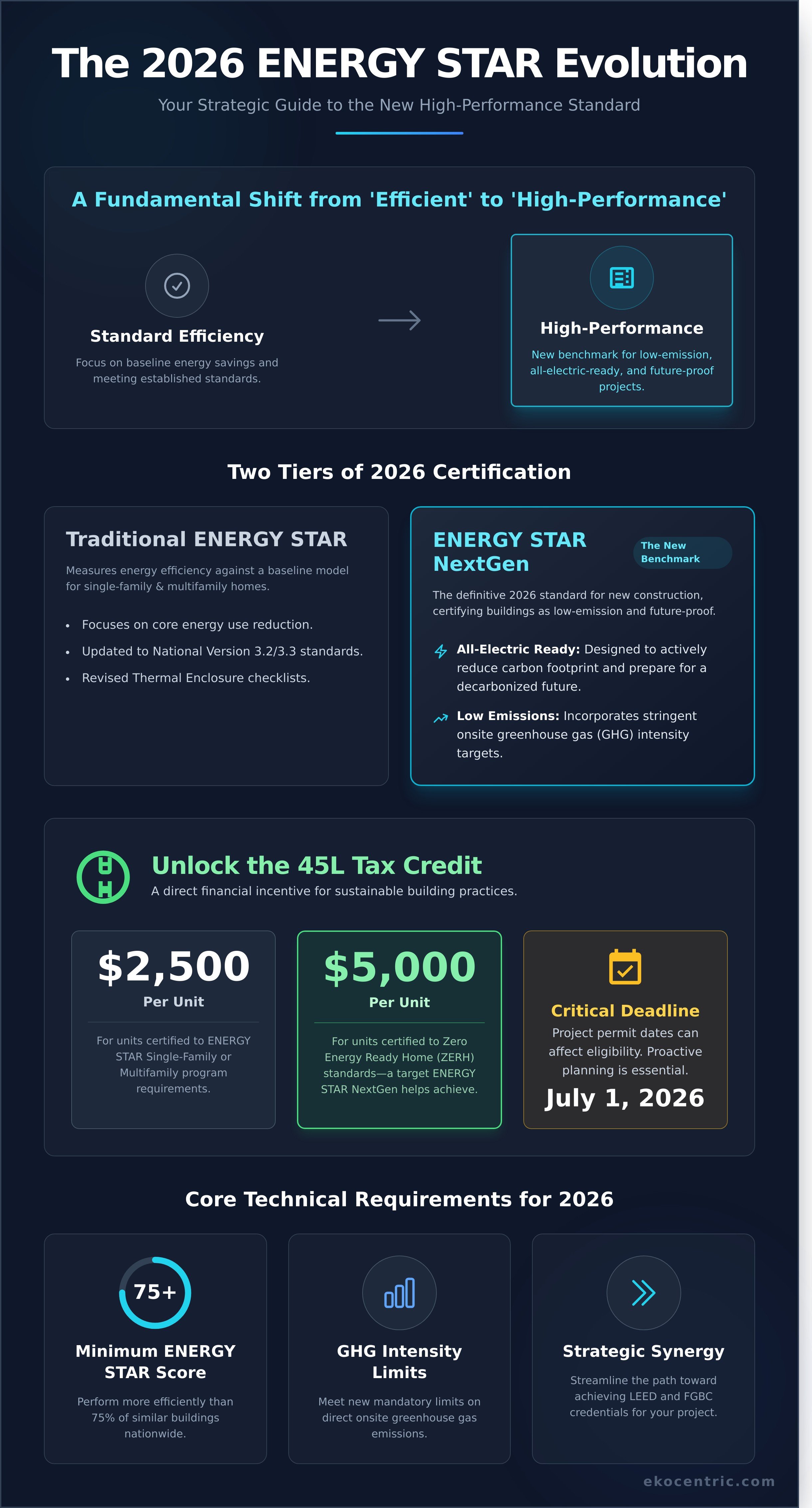
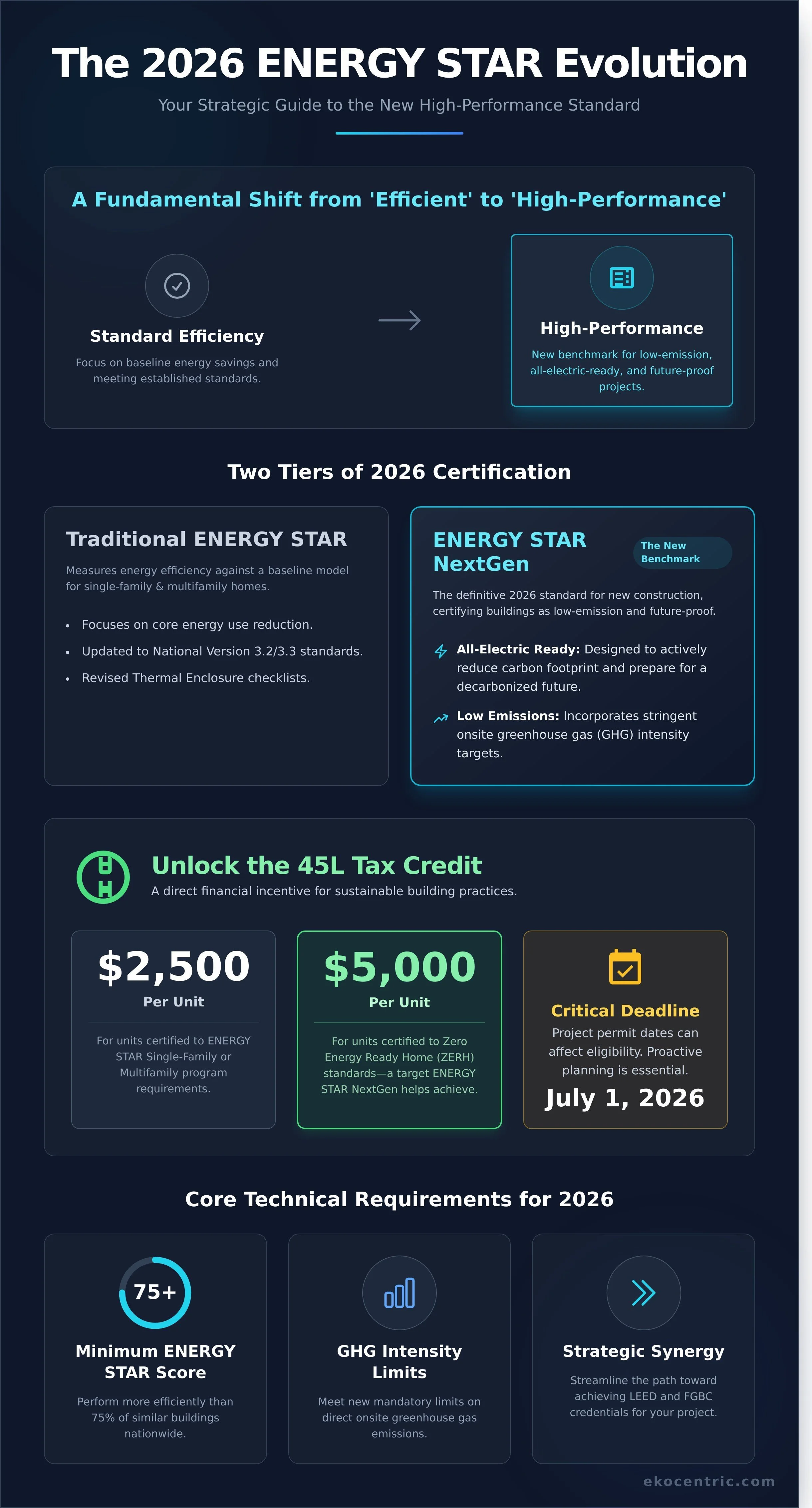
Understand how the 2026 standards shift from basic efficiency to a high-performance model, with ENERGY STAR NextGen setting the new benchmark for future-proof projects.
Navigate the updated ENERGY STAR certification requirements 2026, including the mandatory ENERGY STAR Score of 75 and new onsite greenhouse gas intensity limits, to ensure compliance.
Learn the key changes in the National Version 3.2/3.3 standards and updated Thermal Enclosure checklists to streamline certification for single-family and multifamily homes.
Discover how to strategically leverage ENERGY STAR certification to simplify the path toward achieving LEED and Florida Green Building Coalition (FGBC) credentials for your project.
Table of Contents
Technical Requirements for ENERGY STAR Certification in 2026
Residential Nuances: Single-Family and Multifamily Standards
The Strategic Synergy: Integrating ENERGY STAR with LEED and FGBC
The 2026 ENERGY STAR Landscape: Beyond Basic Efficiency
The year 2026 marks a fundamental turning point for the building industry. The familiar blue ENERGY STAR label, a symbol of energy efficiency for over three decades, is evolving. We're moving beyond simply using less energy; the new mandate is a decisive shift from 'efficient' to 'high-performance.' This evolution reflects a market-wide demand for buildings that are not only cost-effective to operate but are also resilient, healthy, and aligned with decarbonization goals. Understanding the updated ENERGY STAR certification requirements 2026 is no longer just about compliance. It’s about securing a competitive advantage in a market that increasingly rewards genuine sustainability. The program has come a long way, and reviewing the history of the ENERGY STAR program reveals a consistent pattern of raising the bar to meet new environmental and economic challenges.
This pivot is driven by powerful financial and regulatory forces. Federal incentives, particularly those updated in the Inflation Reduction Act of 2022, are now directly tied to these higher standards. Simultaneously, state and local building codes are rapidly integrating advanced energy and emissions targets, making 2026 a critical year for code alignment. For builders, developers, and architects, this means the definition of a "premium building" has changed. The return on investment (ROI) is no longer calculated solely on utility savings. It now includes substantial tax credits, increased asset valuation, and enhanced appeal to a growing demographic of environmentally conscious buyers and tenants. A 2023 Zillow analysis confirmed that homes with listings mentioning EV charging and drought-resistant features sold for 3.5% more, demonstrating a clear market premium for sustainable assets.
ENERGY STAR NextGen vs. Traditional Certification
The most significant change is the introduction of ENERGY STAR NextGen as the new benchmark. Unlike traditional certification, which primarily measures energy efficiency against a baseline, NextGen incorporates stringent emissions targets and electrification readiness. This means designs must actively reduce their carbon footprint and be equipped for an all-electric future. It's precisely this forward-looking approach that makes NextGen the preferred tier for institutional investors who view non-electrified, higher-emission buildings as a long-term liability. ENERGY STAR NextGen is the definitive 2026 standard for new construction, certifying buildings that are not just energy-efficient but also low-emission and all-electric-ready.
The 45L Tax Credit and the July 2026 Deadline
Meeting the new ENERGY STAR certification requirements 2026 directly unlocks one of the most valuable financial tools available: the 45L Tax Credit. This federal incentive provides a direct financial reward for sustainable building practices.
$2,500 Per Unit: Awarded for homes and dwelling units certified to ENERGY STAR Single-Family or Multifamily New Construction program requirements.
$5,000 Per Unit: Awarded for units certified to the Department of Energy’s Zero Energy Ready Home (ZERH) program standards, a target that ENERGY STAR NextGen certification helps projects achieve.
A critical deadline is approaching. The current version of the 45L credit applies to homes and units "acquired" by a developer or homeowner before January 1, 2033. However, nuances in project timelines and permitting, especially for projects with permits issued before July 1, 2026, can affect eligibility. Proactive planning is essential. To satisfy IRS requirements and claim the credit, you must maintain meticulous records, including the signed Form 8908, a declaration from a third-party certifier, and the specific energy modeling software reports used to verify compliance.
Technical Requirements for ENERGY STAR Certification in 2026
The landscape for high-performance buildings is evolving. By 2026, achieving the coveted blue ENERGY STAR label will demand more than just efficient design; it will require proven, data-backed operational excellence. The updated criteria move beyond simple energy consumption to a more holistic view of performance, integrating emissions and renewable energy as core pillars of certification. For developers and architects, this signals a clear shift: performance data is now the ultimate measure of success.
Meeting the ENERGY STAR certification requirements 2026 hinges on three non-negotiable technical benchmarks. First, your building must achieve a minimum ENERGY STAR score of 75 on the EPA's 1 to 100 scale. This isn't an arbitrary number; it certifies that your building performs more efficiently than 75% of similar buildings nationwide. Second, new direct emissions targets introduce onsite greenhouse gas intensity (GHGi) limits, holding properties accountable for their direct carbon footprint. Finally, buildings must demonstrate a significant commitment to clean energy through one of two pathways:
Procuring at least 30% of the building's total energy from renewable sources.
Sourcing 100% of the building's total electricity from certified renewable sources.
This rigorous, multi-faceted approach is precisely why ENERGY STAR certification is becoming a foundational prerequisite for other green building standards. You can't achieve top-tier LEED certification in 2026 without first proving your operational efficiency through ENERGY STAR. It's the essential first step on the path to verified sustainability.
Commercial Building Performance Criteria
For the 18 eligible commercial property types, from offices to K-12 schools, benchmarking in Portfolio Manager remains central. However, the data integrity standards for 2026 are stricter. All energy, water, and emissions data submitted must be verified by a licensed Professional Engineer (PE), eliminating ambiguity and ensuring accuracy. Specific property types face unique metrics, such as Power Usage Effectiveness (PUE) for data centers and weather-normalized energy use intensity (EUI) for hospitals and warehouses.
The Role of Real-Time Energy Monitoring
Relying on last month's utility bill is no longer a viable strategy. The 2026 standards implicitly demand proactive energy management, which requires real-time data. Automating data uploads to Portfolio Manager via API connections prevents the manual errors that can jeopardize certification. More importantly, this continuous monitoring helps identify the operational drift and equipment inefficiencies that, according to the U.S. Department of Energy, account for up to 30% of the energy waste in a typical commercial building.
Successfully navigating these technical demands requires unwavering dedication and specialized expertise. Many development teams don't have the bandwidth to manage the granular data tracking and verification processes involved. Ekocentric can provide that essential layer of sustainability management, transforming complex requirements into an achievable roadmap for your project's success.
DownloadFeedback & RecreateDelete
Residential Nuances: Single-Family and Multifamily Standards
The path to high-performance residential building is becoming more defined. For builders and developers, understanding the granular details of the updated ENERGY STAR certification requirements 2026 is not just about compliance; it's about delivering the superior quality, comfort, and resilience that today's homebuyers demand. The transition to the National Version 3.2 program represents a significant step forward, moving beyond basic code to a holistic, performance-verified standard.
This evolution sharpens the focus on the building envelope and its integrated systems. Success hinges on meticulous execution and verification across four critical areas:
Thermal Enclosure System: The 2026 updates place an unprecedented emphasis on the quality of installation, not just material specs. Raters will use the updated Rater checklists to verify a continuous air barrier and thermal alignment. This means no gaps in insulation, especially at challenging junctions like rim joists and corners, ensuring the home’s R-value on paper matches its real-world performance.
HVAC Commissioning: System performance is no longer assumed. A new, stringent total duct leakage standard of 6 to 8 CFM per 100 sq. ft. of conditioned floor area (depending on duct location) is now a mandatory verification. Additionally, ventilation systems must be tested to confirm they meet ASHRAE 62.2 airflow standards, guaranteeing healthier indoor air for occupants.
Water Management System: To build homes that last, we must build them to stay dry. The updated requirements mandate a comprehensive approach to water management, verified against a detailed checklist. This includes ensuring proper flashing at all roof-to-wall intersections, window and door openings, and foundation damp-proofing to prevent moisture intrusion that leads to mold and structural decay.
Florida-Specific Compliance: Climate Zones 1 and 2
In Florida's hot, humid climate (IECC Climate Zones 1A and 2A), meeting ENERGY STAR standards requires a specialized strategy. The intense solar gain and high humidity demand more than just standard insulation. The 8th Edition (2023) of the Florida Building Code sets a baseline, but ENERGY STAR pushes further, requiring R-8 insulated ductwork in unconditioned attics and meticulous air sealing to prevent humid air from infiltrating the building envelope and causing condensation. It’s a crucial step toward building true resilience.
Multifamily New Construction (MFNC) Version 1.2
The updated MFNC program refines the certification pathways for mid-rise and high-rise projects. A primary challenge is accurately modeling and balancing common area energy consumption (hallway lighting, fitness centers, pools) with the efficiency of individual dwelling units. A common pitfall is failing to account for thermal bridging in steel or concrete structures, an issue that can derail a project’s energy model late in the process. Proactive planning with a HERS Rater is essential to navigate these complexities successfully.
The Strategic Synergy: Integrating ENERGY STAR with LEED and FGBC
Achieving ENERGY STAR certification isn't an isolated goal; it’s a strategic cornerstone that unlocks higher-level green building achievements and significant financial value. For developers, builders, and architects, viewing ENERGY STAR as a foundational layer rather than a final destination streamlines complex certification processes, reduces redundant work, and amplifies a project's marketability. This integrated approach transforms a compliance task into a powerful asset.
The synergy is most apparent with leading green building programs. For projects pursuing LEED for Homes certification, ENERGY STAR isn't just an advantage, it's a mandatory prerequisite. This requirement makes it the non-negotiable first step on the path to LEED. Similarly, the Florida Green Building Coalition (FGBC) standard heavily rewards energy performance, and achieving ENERGY STAR certification directly contributes a substantial number of points in FGBC's Energy category, simplifying the path to certification. By aligning inspections and documentation from the start, you avoid the costly problem of 'double-work' and create a seamless verification process across multiple standards.
LEED Green Rater and ENERGY STAR Alignment
The technical overlap between these programs is where true efficiency gains are made. The Home Energy Rating System (HERS) Index, the core metric for ENERGY STAR certification, is the very same performance benchmark used to award points in the LEED for Homes Energy & Atmosphere (EA) category. This means the energy modeling, blower door tests, and duct leakage assessments performed for ENERGY STAR directly satisfy key LEED requirements. Hiring a dual-certified professional who is both a LEED Green Rater and an ENERGY STAR Rater saves invaluable time and coordination costs. They can conduct a single, integrated site visit to collect data for all programs simultaneously. Explore how integrated green rating solutions can eliminate these project bottlenecks.
ESG Reporting and Institutional Value
Beyond the construction site, certification data delivers immense value for institutional investors and stakeholders. The verifiable energy performance metrics from ENERGY STAR provide the exact data needed for Environmental, Social, and Governance (ESG) reporting frameworks like the Global Real Estate Sustainability Benchmark (GRESB). This transparency is no longer a "nice-to-have"; it's a critical factor in attracting capital.
This verified performance directly unlocks access to 'Green Financing.' Lenders view certified properties as lower-risk, higher-value assets. Programs like Fannie Mae’s Green Rewards offer interest rate reductions of up to 0.10% for properties that achieve recognized green certifications. Building to the robust ENERGY STAR certification requirements 2026 future-proofs your asset, ensuring it remains competitive, resilient, and appealing to a market that increasingly demands proven sustainability. It's a clear strategy for long-term value creation.
Don't let your team's bandwidth limit your project's potential. A single expert can manage the sustainability side of your project, harmonizing these certifications to maximize efficiency and ROI. To leverage this strategic advantage, contact Ekocentric to manage your integrated certification process.
Implementation Strategy: Working with an ENERGY STAR Rater
Meeting the rigorous ENERGY STAR certification requirements 2026 isn't just about using the right materials; it’s about executing a verified, four-step process with an expert partner. A qualified ENERGY STAR Rater doesn't just inspect your work. They integrate into your project timeline, providing critical oversight from design to delivery. This collaborative approach is the most effective way to guarantee compliance, avoid costly rework, and deliver a high-performance home on schedule.
The path to certification follows a clear, sequential process:
Step 1: Early-Stage Design Review. Before the first shovel hits the ground, your Rater should conduct a comprehensive review of your plans. This crucial step identifies potential performance gaps in the building envelope, HVAC design, and window specifications. Catching a thermal bridging issue or an undersized HVAC system on paper saves thousands compared to fixing it in the field.
Step 2: Pre-Drywall Inspections. This is the moment of truth for your building's core energy performance. Your Rater will visually verify that insulation is installed to Grade I standards without compression or gaps and that the air barrier is continuous and properly sealed at all seams, joints, and penetrations. This inspection is non-negotiable; you can't see what’s behind the walls once they're closed up.
Step 3: Final Performance Testing. After construction is complete, your Rater performs diagnostic tests to quantify the home's performance. The Blower Door test depressurizes the house to measure total air leakage (ACH50), while the Duct Blaster test measures the airtightness of your HVAC ductwork. These tests provide the hard data that proves the home meets ENERGY STAR’s stringent airtightness and efficiency targets.
Step 4: Submission and Verification. Once the home passes all inspections and performance tests, your Rater compiles the complete documentation package. This includes checklists, photos, and test results, which are then submitted to an EPA-recognized Home Certification Organization (HCO) for final verification and issuance of the ENERGY STAR certificate.
Selecting the Right Rater for Your Bandwidth
Many developers and builders don't have the internal bandwidth to manage the sustainability side of a project. That’s why you need more than a "box-checker"; you need a strategic partner who provides an additional layer of management. A true partner proactively coordinates with trade contractors, troubleshoots issues on-site, and possesses deep expertise in Florida-specific building codes, ensuring your project meets every requirement without slowing you down.
Avoiding Common Certification Delays
Navigating the updated ENERGY STAR certification requirements 2026 means anticipating common points of failure. Based on current trends, the top three reasons projects are projected to fail final verification are:
Exceeding Air Leakage Thresholds: Failing the Blower Door test due to poor air sealing around recessed lighting, attic hatches, and exterior wall penetrations.
High Duct Leakage: Failing the Duct Blaster test, often caused by disconnected or poorly sealed ductwork in unconditioned attics or crawlspaces.
Incomplete Documentation: Missing or incorrect paperwork, especially for the HVAC design and commissioning reports, which are under increased scrutiny.
To prevent these issues, we advise creating a "Green File" for each project. This binder or digital folder holds all checklists, inspection photos, and product submittals, ensuring a seamless transition from construction to final certification. Don't let preventable delays jeopardize your project's timeline and budget. Contact Ekocentric to secure your 2026 certification timeline.
Navigate the Future of Energy Efficiency with Confidence
The building landscape is shifting. The upcoming standards aren't just an update; they represent a fundamental move towards integrated, high-performance construction. Success means looking beyond individual components to embrace a holistic strategy that synergizes with frameworks like LEED and FGBC. Navigating the new ENERGY STAR certification requirements 2026 demands this proactive, comprehensive approach, and it’s the new benchmark for market leadership.
We know that many developers and builders don't have the internal bandwidth to manage these increasingly complex sustainability goals. That’s where we step in. With a proven track record of managing developer bandwidth, our team of expert LEED Green Raters and specialists in the Florida Green Building Coalition (FGBC) provides that crucial layer of management. We handle the details so you can focus on building.
Don't let the 2026 updates become a hurdle. Let's turn them into your competitive advantage. Schedule your 2026 ENERGY STAR project consultation with Ekocentric today and let's build a more resilient and sustainable future together.
Frequently Asked Questions About ENERGY STAR in 2026
What is the minimum ENERGY STAR score required for certification in 2026?
The minimum ENERGY STAR score required for certification remains 75. This score signifies that a building performs better than 75% of similar buildings across the nation. While the score itself isn't changing, the EPA's underlying data models are periodically updated to reflect market improvements. This means achieving a 75 requires progressively better energy performance, making continuous efficiency efforts a crucial part of maintaining certification.
How does ENERGY STAR NextGen differ from the standard certification?
ENERGY STAR NextGen certification adds specific requirements for on-site renewable energy and electric vehicle (EV) charging infrastructure. It's a higher, forward-looking tier designed to recognize the top 5% of energy-efficient new homes and apartments. Unlike the standard certification, which focuses purely on energy efficiency, NextGen mandates the inclusion of features that prepare buildings for a fully decarbonized future. It’s about building for tomorrow, not just for today.
Can I still claim the 45L tax credit if my project is completed after July 2026?
Yes, you can still claim the 45L tax credit for projects completed after July 2026, provided they meet the prevailing ENERGY STAR program requirements. The Inflation Reduction Act of 2022 extended this valuable tax credit through 2032. The key is that your project must be certified under the specific ENERGY STAR Residential New Construction program version that is active at the time your project is completed and placed in service.
Is ENERGY STAR certification mandatory for LEED projects?
No, ENERGY STAR certification isn't strictly mandatory for all LEED projects, but it is the most direct way to meet the "Energy and Atmosphere" (EA) prerequisite for minimum energy performance. To achieve any level of LEED certification, a project must first demonstrate this baseline efficiency. Earning an ENERGY STAR score of 75 or higher is the primary pathway to fulfill this requirement, making it a foundational step for nearly all teams pursuing LEED.
What building types are eligible for ENERGY STAR certification in 2026?
A wide range of commercial buildings are eligible to pursue ENERGY STAR certification requirements 2026, including over 20 types like offices, K-12 schools, and multifamily housing. The EPA continuously expands its Portfolio Manager tool to cover more sectors. Beyond common types like hotels and warehouses, specialized facilities such as hospitals, data centers, and senior care communities are also eligible. The main qualifier is whether your building can be accurately benchmarked against a national peer group.
How much does it cost to hire an ENERGY STAR Rater for a multifamily project?
The cost to hire an ENERGY STAR Rater for a multifamily project typically ranges from $200 to $500 per unit. This price can vary based on project complexity, size, and location. For a 100-unit building, total Rater fees might fall between $20,000 and $50,000. These fees cover essential verification services like design review, diagnostic testing such as blower door tests, and the final inspection required for certification.
What are the specific renewable energy requirements for the NextGen tier?
The ENERGY STAR NextGen tier requires homes and apartments to have on-site solar PV systems and be designed for future solar and battery storage expansion. The standard also mandates all-electric equipment for heating, cooling, and cooking, eliminating on-site fossil fuel use. In addition, it requires the installation of at least one Level 2 EV charging port, ensuring the building is not just efficient but also fully prepared for a clean energy grid.
How often do I need to re-certify my commercial building for ENERGY STAR?
You must re-certify your commercial building for ENERGY STAR annually to maintain the certification. The certification is valid for one year and is based on 12 consecutive months of verified energy data. To keep the blue label, you must submit a new application each year, signed by a licensed professional. This annual process ensures the building's operational performance continues to meet the high standards of the EPA's program.