EPA Indoor AirPlus and Green Building: The Essential Guide for 2026
In 2026, building an airtight, energy-efficient home without a rigorous ventilation strategy isn't just a technical oversight; it's a liability for your brand. The EPA reports that indoor air can be 2 to 5 times more polluted than outdoor air, a statistic that carries immense weight when 90% of our lives are spent inside. You likely agree that managing these health risks while juggling LEED or NGBS requirements often feels like a constant battle for bandwidth. It's frustrating to track technical documentation when your primary focus is project delivery and construction quality. We've designed this guide to explore the EPA Indoor AirPlus program and its crucial role within Green Building standards, simplifying your workflow and protecting your clients. You'll discover how the Indoor AirPlus program acts as the foundational health pillar for elite certifications, ensuring your builds are as healthy as they are efficient. This roadmap will help you streamline verification and boost the marketability of your residential units by providing the specific health data that modern buyers demand.
Key Takeaways
Understand how EPA Indoor AirPlus builds upon ENERGY STAR® requirements to provide a comprehensive shield against radon, mold, and harmful VOCs.
Explore the technical pillars of moisture control and soil gas barriers that ensure long-term structural resilience and healthier living environments.
Learn how to create article about EPA Indoor Air Quality Plus and where it fits in with Green Building standards like LEED for Homes v4.1 and NGBS.
Navigate the critical third-party rater and verification workflow to ensure your project successfully passes both pre-drywall and final inspections.
Discover the business advantages of Indoor AirPlus, from increased property appraisal values to powerful marketing tools for health-conscious buyers.
Table of Contents
The Technical Pillars: How Indoor AirPlus Enhances Building Resilience
The Integration Map: Where IAQ+ Fits with LEED, NGBS, and FGBC
Implementation Strategy: Navigating the Rater and Verification Process
The Business Case: ROI and Marketability of Healthy Buildings
What is the EPA Indoor AirPlus Program in 2026?
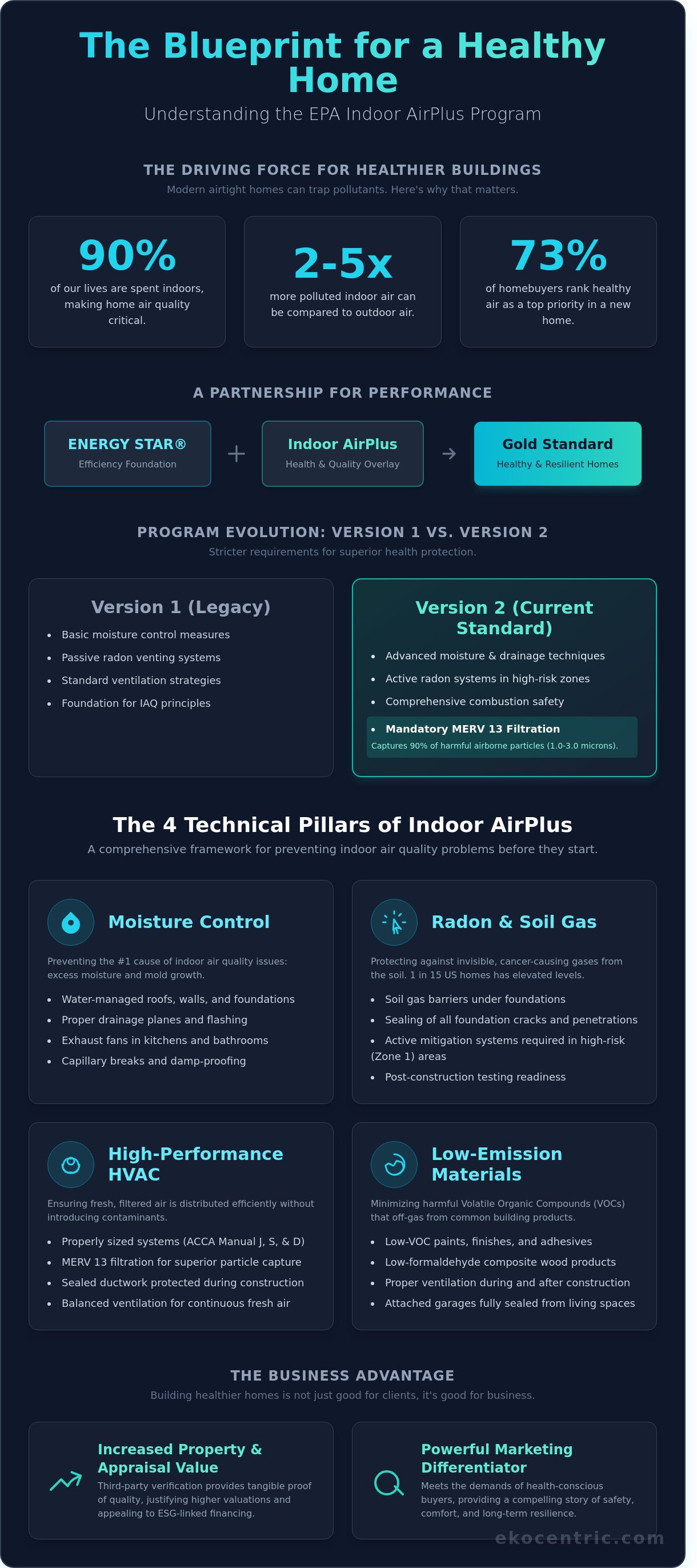
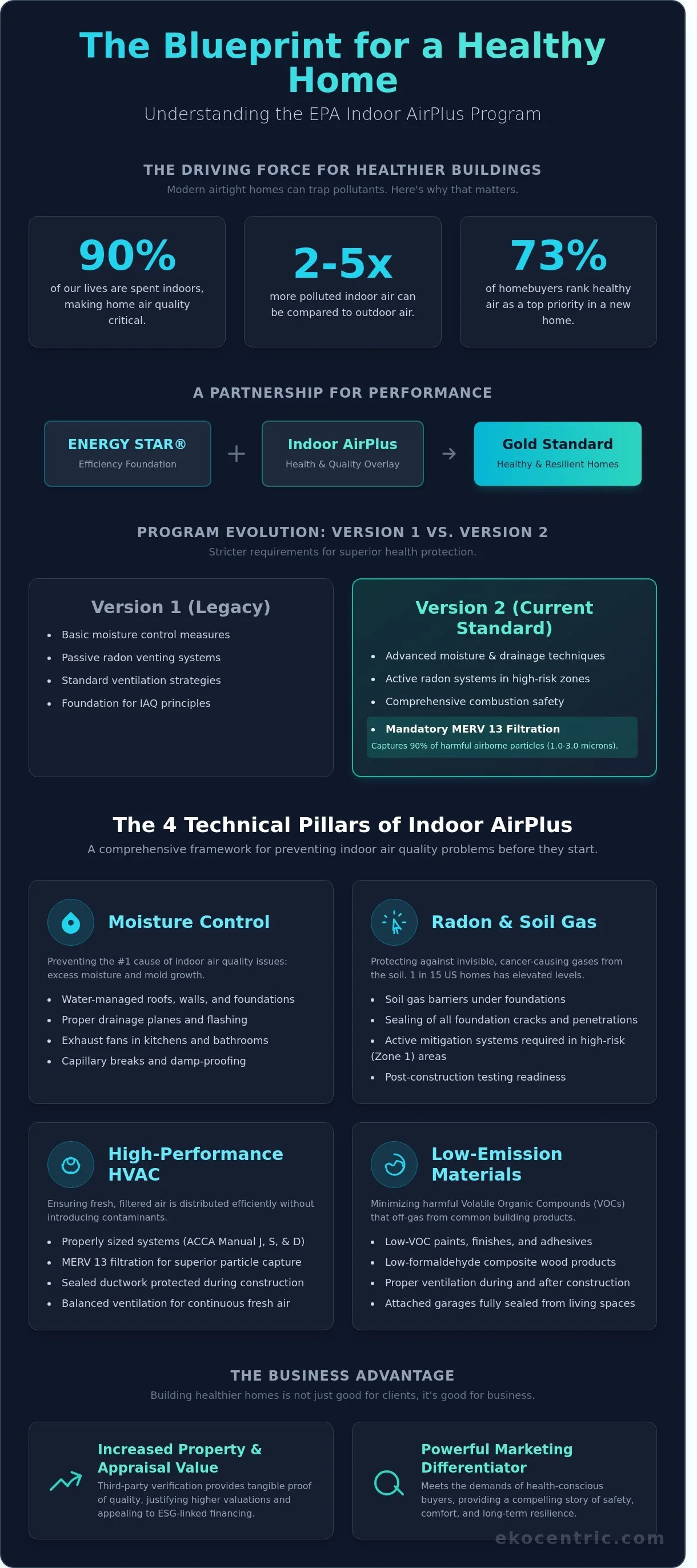
The EPA Indoor AirPlus program is a voluntary partnership that acts as a rigorous health overlay for residential construction. It isn't a standalone certification; it builds directly upon the Energy Star Residential New Construction program. This means a home must first meet strict energy efficiency standards before it can even qualify for the Indoor AirPlus label. By 2026, this dual-certification approach has become the gold standard for builders who want to create article about EPA Indoor Air Quality Plus and where it fits in with Green Building. The program's core mission is to protect occupants from harmful pollutants. It requires a comprehensive set of construction practices that minimize exposure to radon, moisture, combustion gases, and volatile organic compounds (VOCs).
Modern homes are built tighter than ever to prevent energy loss. While this is great for utility bills, it creates a "thermos effect" that can trap contaminants inside. Effective Indoor air quality (IAQ) management is the only way to ensure these high-performance envelopes don't compromise occupant health. The 2026 landscape demands this balance. Builders are now navigating a market where 73% of homebuyers rank healthy air as a top priority when choosing a new home. This shift makes Indoor AirPlus an essential tool for any developer committed to environmental stewardship and long-term resilience.
The Evolution to Indoor AirPlus Version 2
The shift to Version 2 marks a pivotal moment in green building history. While Version 1 focused on basic moisture control and radon venting, Version 2 introduces much stricter requirements for mechanical ventilation and filtration. Specifically, it mandates MERV 13 filtration for all forced-air systems. This is a crucial upgrade; MERV 13 filters are capable of capturing 90% of particles between 1.0 and 3.0 microns. For projects in 2026, these benchmarks are often tied to financial incentives. Developers using these standards can more easily qualify for ESG-linked financing or the $5,000 45L federal tax credit. It's a pragmatic solution that aligns health-focused construction with the bottom line.
Why IAQ is the New Frontier of Green Building
The "90% Rule" is the driving force behind the IAQ movement. Statistics from the EPA consistently show that Americans spend 90% of their lives indoors. This makes the home the primary environment for health. In the past, "green building" was synonymous with solar panels and insulation. Today, the focus has shifted toward a "health-first" philosophy. If a home is airtight but lacks proper IAQ+ protocols, it risks becoming a source of respiratory issues. We're no longer just building for energy savings; we're building for human longevity.
Ekocentric LLC understands that many builders don't have the bandwidth to manage these complex sustainability goals alone. We see IAQ as the natural evolution of the industry. It's about revolutionizing how we think about shelter. Our unwavering dedication to these standards helps partners navigate the transition from "energy-only" to "health-first" development. By integrating Indoor AirPlus, builders provide a tangible promise of safety and quality that resonates with today's conscious consumers. It's a mission-driven approach that ensures a greener and more sustainable future for every occupant.
The Technical Pillars: How Indoor AirPlus Enhances Building Resilience
If you want to create article about EPA Indoor Air Quality Plus and where it fits in with Green Building, you must first understand the rigorous technical requirements that separate it from standard codes. This program isn't just a list of suggestions; it's a comprehensive set of construction specifications that build upon the ENERGY STAR platform. By addressing the root causes of poor air quality, these pillars ensure that a structure remains durable and healthy for decades. The framework focuses on preventing problems before they occur, which is a core tenet of sustainable development.
Radon mitigation serves as a primary example of this proactive approach. In the EPA Indoor AirPlus Program, builders in high-risk Zone 1 areas must install active soil gas barriers and specialized venting systems. Since 1 in 15 homes in the United States has elevated radon levels above 4.0 pCi/L, these barriers are essential for long-term safety. Similarly, HVAC optimization goes beyond simple thermostat settings. Systems must be "right-sized" using ACCA Manual J, S, and D calculations. This prevents the short-cycling that leads to 60% higher humidity levels and premature equipment failure. During construction, ductwork must be sealed with plastic to prevent the 20% efficiency loss often caused by construction dust and debris infiltration.
Moisture Management in Humid Climates
Florida builders face unique challenges with annual rainfall often exceeding 50 inches and constant coastal salt spray. Indoor AirPlus requirements provide a 30-item moisture control checklist that acts as a shield for the building envelope. This includes mandatory flashing at all window and door penetrations, which prevents the water intrusion responsible for 90% of structural wood rot. By implementing capillary breaks like 6-mil polyethylene sheeting under slabs, builders stop ground moisture from migrating into the living space. These strategies don't just prevent mold; they extend the building's life cycle by 15 or 20 years, directly supporting the goals of any green building certification.
Source Control and Material Selection
The chemistry of a home is defined by what you put into it. Indoor AirPlus mandates the use of low-emitting materials to reduce the off-gassing of volatile organic compounds (VOCs). This includes using composite wood products that meet the CARB Phase 2 or TSCA Title VI standards for formaldehyde emissions, keeping levels below 0.05 parts per million. For developers seeking higher certifications, documenting these materials is a critical step in our LEED Green Rater services. Using formaldehyde-free cabinetry and "Clean Air" finishes ensures that the indoor environment remains stable even as the building ages.
Managing these technical details can feel overwhelming for teams already stretched thin. Many developers find they don't have the internal bandwidth to track every material submittal or verify every flashing detail on site. If you're looking to streamline this process while ensuring your project meets the highest standards of health and efficiency, partnering with a specialized consultant can provide the oversight needed to bridge the gap between design intent and finished reality. This technical rigor ensures that your green building isn't just sustainable on paper, but resilient and healthy for every occupant who walks through the door.
DownloadFeedback & RecreateDelete
The Integration Map: Where IAQ+ Fits with LEED, NGBS, and FGBC
Many builders and developers lack the internal bandwidth to manage multiple, overlapping certification tracks. They often view indoor air quality as a separate silo from energy efficiency. This is a mistake that leads to redundant paperwork and inflated consulting fees. When we create article about EPA Indoor Air Quality Plus and where it fits in with Green Building, the primary takeaway is the efficiency of the "bundled" approach. IAQ+ acts as a bridge. It connects the technical requirements of Energy Star with the broader health goals of comprehensive green building frameworks.
IAQ+ and the LEED BD+C Framework
In the LEED for Homes v4.1 system, the EPA Indoor AirPlus Program isn't just an optional add-on; it's a foundational requirement for specific pathways. It serves as a direct prerequisite for the "Minimum Indoor Air Quality Performance" credit. By adopting the IAQ+ specifications, project teams satisfy the LEED moisture management and radon mitigation mandates without having to invent a new internal process. This alignment provides a path of least resistance for architects. Using a unified documentation strategy for both labels typically saves a project team 10 to 15 hours of administrative work. It ensures that the technical data collected by the HERS Rater flows seamlessly into the LEED online portal.
National Green Building Standard (NGBS) Synergy
NGBS projects find a natural, pragmatic ally in this EPA label. The NGBS 2020 and 2024 versions award significant points in the "Indoor Environmental Quality" category for homes that achieve the IAQ+ certification. For developers aiming for "Gold" or "Emerald" status, these points are often the difference between a high-tier rating and a standard one. Understanding how to create article about EPA Indoor Air Quality Plus and where it fits in with Green Building requires looking at the technical overlaps between these major third-party verifications. Multi-family developers frequently default to this dual-label because it streamlines the onsite verification process. A single inspection cycle can verify both Energy Star and IAQ+ metrics. This integrated approach reduces total project verification costs by approximately 20% compared to pursuing disparate health and energy goals separately.
For Florida-based projects, the Florida Green Building Coalition (FGBC) offers specific credits for EPA-labeled homes. The FGBC 2023 standards reward the rigorous moisture management protocols found in the IAQ+ checklist. This is vital in the Southeast, where buildings must withstand 50+ inches of annual rainfall and high humidity. Bundling these certifications isn't just a marketing win; it's a strategy for long-term resilience. It protects the building envelope while securing the "healthier" living space that 85% of modern homebuyers now prioritize. Efficiency is the core of our mission at Ekocentric. We believe that by mapping these requirements early in the design phase, builders don't just "check a box." They create a superior product that's backed by the most respected names in the industry.
LEED v4.1: IAQ+ serves as a prerequisite for moisture control and radon mitigation.
NGBS: Direct point contributions toward Gold and Emerald tiers in the IEQ category.
FGBC: Provides a streamlined path for Florida-specific resilience and health credits.
Cost Savings: Bundled inspections can reduce verification overhead by up to 20%.
Implementation Strategy: Navigating the Rater and Verification Process
Achieving certification isn't a task you can tackle at the finish line. It requires a dedicated partnership with a HERS Rater from the design phase through the final walk-through. This third-party expert acts as the bridge between EPA standards and on-site execution. When developers look to create article about EPA Indoor Air Quality Plus and where it fits in with Green Building, they often find that the rater's presence is the single most important factor in preventing costly rework. They provide the objective verification that lenders and savvy homeowners now demand.
The Rater's Checklist for Builders
The Indoor AirPlus Verification Checklist is a rigorous document that demands attention long before the first shovel hits the dirt. Builders must schedule two primary site visits: the pre-drywall inspection and the final inspection. During the pre-drywall phase, the rater examines moisture control systems, framing for proper drainage, and the sealing of the building envelope. If a builder misses this window and hangs drywall before the rater arrives, the project cannot be certified. It's a binary requirement; there are no retroactive approvals for hidden components.
Coordination between trades is where most projects succeed or fail. HVAC contractors must provide specific calculations for ventilation rates, while insulation teams need to ensure their work doesn't obstruct airflow paths. Documentation is equally vital. You'll need a robust "paper trail" for every material used. This includes certificates showing that all composite wood products meet TSCA Title VI standards and that all paints, carpets, and finishes are low-VOC. Keeping these records organized in a digital project hub prevents the 11th-hour scramble that often delays closing dates.
Managing the Sustainability Side of Your Project
The reality of modern construction is that most developers don't have the internal bandwidth to manage every nuance of a green certification. Hiring specialized building consultants early in the process prevents mid-build corrections that can cost upwards of $10,000 in labor and material waste. These consultants act as an extension of your management team, ensuring that every subcontractor understands their specific role in the IAQ+ workflow. This is the primary way to create article about EPA Indoor Air Quality Plus and where it fits in with Green Building while ensuring the project remains profitable and on schedule.
Beyond air quality, professional verification is the key to unlocking significant financial rewards. For instance, the Section 45L tax credit provides up to $2,500 per unit for homes meeting ENERGY STAR and Indoor AirPlus requirements. If your project reaches the DOE Zero Energy Ready Home standard, that credit can jump to $5,000. We've seen projects lose these incentives simply because of a missing radon fan or an undocumented sealant. A pragmatic approach balances construction speed with certification rigor, ensuring you don't sacrifice long-term incentives for short-term convenience.
Ready to streamline your next green build? Partner with Ekocentric for expert sustainability management and ensure your project meets every certification milestone without the stress.
The Business Case: ROI and Marketability of Healthy Buildings
Investing in superior indoor air quality (IAQ) is no longer a niche preference; it's a financial imperative for the modern developer. Data from a 2024 real estate market analysis indicates that homes with health-focused certifications command a 7% to 11% price premium over conventional builds. Buyers are increasingly aware that the air they breathe impacts their cognitive function and long-term wellness. When you create article about EPA Indoor Air Quality Plus and where it fits in with Green Building, you're essentially mapping out a blueprint for higher appraisal values and faster absorption rates. These labels act as a third-party verification of quality that resonates with 85% of homebuyers who now rank "healthy home features" as a top priority.
Beyond the initial sale, Indoor AirPlus protects the developer's bottom line by drastically reducing long-term liability. Mold remediation and air quality claims cost the construction industry millions of dollars annually in litigation and repairs. By following the EPA's rigorous, standardized protocols for moisture control and radon resistance, builders create a documented "defensive shield." These protocols ensure that every home is built to withstand the environmental stressors that typically lead to structural damage or tenant health complaints. It's a pragmatic approach that replaces guesswork with verified performance.
Market Differentiation for Developers
The Indoor AirPlus logo signals an unwavering dedication to tenant wellness that sets a project apart in a crowded marketplace. By 2026, the Wellness Real Estate sector is projected to reach a global valuation of $585 billion, driven by a demographic that views health as the ultimate luxury. Developers who create article about EPA Indoor Air Quality Plus and where it fits in with Green Building strategies can effectively capture this niche. Certified "Healthy Homes" don't just sell faster; they foster brand loyalty. Buyers recognize the EPA label as a gold standard, ensuring their living space is free from the volatile organic compounds (VOCs) and allergens found in standard construction.
Partnering for a Sustainable Future
Many builders and developers simply don't have the internal bandwidth to manage the complex documentation required for high-level certifications. Ekocentric provides that essential additional layer of management, ensuring your project meets every EPA requirement without slowing down your timeline. We understand Florida's unique climate challenges, from extreme humidity to specific local building codes. Our mission is to bridge the gap between ambitious sustainability goals and the practical realities of the job site. We act as your expert advocate, revolutionizing the way you build by making resilience and health a standard feature of every project.
Our team at Ekocentric is ready to help you navigate the nuances of the Indoor AirPlus program. We bring a blend of technical expertise as HERS Raters and a genuine passion for environmental stewardship to every partnership. We don't just check boxes; we help you build a legacy of health and efficiency. To see how we can streamline your next project and maximize your ROI, Explore our full suite of certification services to start your next green build. Let's work together to nurture a more sustainable future for Florida's communities.
Future-Proof Your Projects for 2026 and Beyond
Adopting the EPA Indoor AirPlus Version 2 standards isn't just a compliance step; it's a strategic move for the 2026 market. By 2026, building resilience will rely on the technical pillars of moisture control and low-VOC materials that define this program. Integrating these requirements with LEED v5 or FGBC 2024 standards creates a streamlined path to certification. Research shows that healthy buildings can command a 7% to 11% premium in rental rates. When you create article about EPA Indoor Air Quality Plus and where it fits in with Green Building, it's clear that air quality is now the cornerstone of sustainable development. We know most builders don't have the bandwidth to manage these complex layers alone. Our team provides expert LEED Green Rater verification and specialized FGBC Florida expertise to handle the heavy lifting for you. Partner with Ekocentric to streamline your EPA Indoor AirPlus and LEED certifications. We're here to help you build a healthier, more profitable future with confidence.
Frequently Asked Questions
Is EPA Indoor airPLUS mandatory for LEED certification?
No, EPA Indoor airPLUS isn't mandatory for LEED certification, but it's a strategic pathway for earning credits. In LEED v4.1 Residential, meeting these requirements can contribute significantly to the Indoor Environmental Quality category. We recommend this path because it simplifies the verification process. It ensures your project meets 100% of the rigorous health standards required for a high-performing green building.
What is the difference between Energy Star and Indoor AirPlus?
ENERGY STAR focuses on energy efficiency and thermal performance, while Indoor AirPlus adds over 60 additional requirements specifically for air quality. You can't have one without the other; ENERGY STAR certification is a prerequisite. This partnership ensures your home is both efficient and healthy. Integrating EPA Indoor Air Quality Plus and where it fits in with Green Building standards provides a comprehensive solution for moisture control and radon mitigation.
How much does Indoor AirPlus certification cost for a new home?
Most builders see incremental construction costs between $200 and $500 per home to meet these standards. This figure excludes the HERS Rater verification fee, which typically ranges from $300 to $600 depending on the project's complexity. Investing this small percentage of the total build cost provides a 100% return in buyer confidence. It's a pragmatic choice for developers who want to differentiate their properties in a competitive market.
Can an existing home be Indoor AirPlus certified?
No, the current Indoor airPLUS program is exclusively for new construction or homes undergoing a gut renovation. Because many requirements involve structural elements like sub-slab radon barriers and moisture flashing, they're impossible to verify in a finished existing home. For older properties, we recommend following the EPA's Healthy Indoor Environment Protocols for Home Renovations. This ensures you still improve air quality even without the formal label.
What are the ventilation requirements for Indoor AirPlus Version 2?
Indoor airPLUS Version 2 requires mechanical ventilation systems to meet the ASHRAE 62.2-2010 standard or a more recent version. This involves installing whole-house fans or ERV/HRV systems that provide a specific CFM based on floor area and bedroom count. These systems must be field-tested by a certified professional. Proper ventilation prevents the buildup of VOCs and ensures a continuous supply of fresh, filtered air for the occupants.
Does Indoor AirPlus help with Florida Green Building Coalition (FGBC) points?
Yes, Indoor airPLUS certification directly supports your Florida Green Building Coalition (FGBC) goals by fulfilling multiple criteria in the Health category. In the FGBC Homes Standard v3.1, implementing these air quality measures can earn your project 10 or more credits. We help builders leverage this overlap to streamline their certification process. It's an efficient way to boost your score while creating a more resilient home for Florida's humid climate.
Who can verify an Indoor AirPlus home?
Only a certified HERS Rater or an accredited third-party verifier can certify a home under this program. These professionals must complete a specific EPA training module and be affiliated with a Home Energy Rating Provider. Our team at Ekocentric provides this expertise, managing the 100% inspection rate required for the label. We act as your pragmatic partner, ensuring every checklist item is documented correctly during the construction process.
What happens if a home fails the radon or moisture inspection?
If a home fails an inspection, the builder must remediate the specific issue before the Rater can issue the final certification. For example, if a radon test exceeds 4 pCi/L, you'll need to activate the passive mitigation system with a fan. If moisture is detected in the wall cavity, the source must be sealed and dried. Certification isn't granted until 100% of the EPA's rigorous technical specifications are met.