LEED Consultant for Custom Home Builders: Navigating Certification in 2026
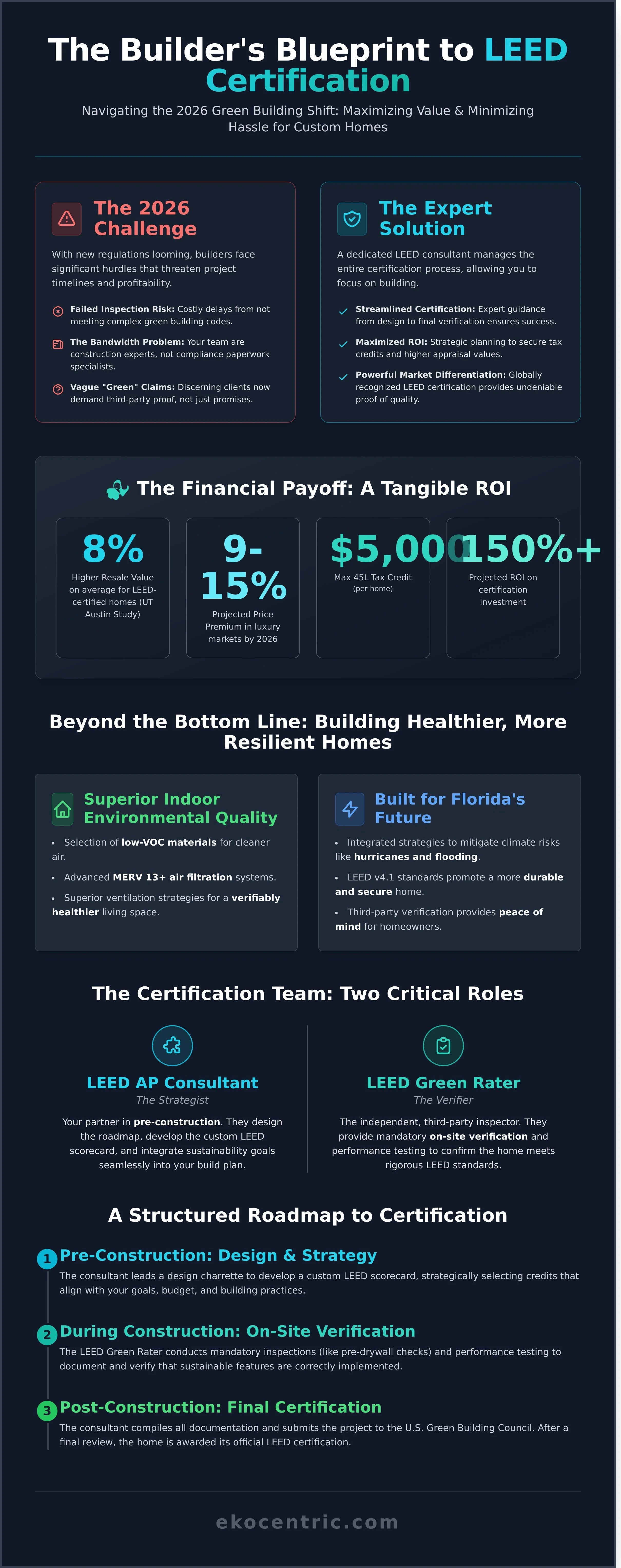
According to a 2017 study from the University of Texas at Austin, LEED-certified homes can command an 8% higher resale value. You're already dedicated to building exceptional, high-quality homes; the real challenge isn't the craftsmanship, it's the complex verification and mountain of paperwork that drain your internal bandwidth. With the 2026 green building regulations fast approaching, the fear of a failed inspection causing costly project delays is a genuine concern for even the most experienced builders.
This is where a dedicated expert becomes essential. By partnering with a specialized LEED consultant for custom home builders, you can offload the complexities of certification and focus entirely on what you do best: construction. This article breaks down how a consultant manages the entire process, from initial design to final Green Rater verification, to secure a streamlined certification. You'll discover how this partnership not only prevents delays but also maximizes your property's appraisal value and powerful market differentiation.
Key Takeaways
Learn why third-party validation is becoming non-negotiable in 2026 and how it separates genuinely sustainable homes from simple "green-built" claims.
Clarify the distinct roles of the LEED AP (Consultant) and the LEED Green Rater (Verifier) to ensure your project has the right expertise for successful certification.
A LEED consultant for custom home builders helps you evaluate whether the international prestige of LEED or the climate-specific criteria of FGBC is the better fit for your Florida project.
See how a structured collaboration process, starting with a design charrette, can integrate sustainability goals without disrupting your construction workflow.
Table of Contents
The Value of a LEED Consultant for Custom Home Builders in 2026
LEED vs. FGBC: Choosing the Right Standard for Florida Builders
Why Ekocentric is the Strategic Partner for Florida's Custom Builders
The Value of a LEED Consultant for Custom Home Builders in 2026
In the competitive landscape of 2026, the term "green-built" has lost its edge. Discerning clients in the Florida luxury market now demand proof, not promises. This is where a specialized consultant becomes essential. A LEED consultant provides the rigorous technical oversight and manages the complex third-party verification process required to achieve certification under the U.S. Green Building Council's (USGBC) globally recognized Leadership in Energy and Environmental Design (LEED) framework. They are the strategic partner who translates sustainability goals into a certified, high-performance reality.
This short video provides a clear overview of the LEED for Homes program and its core principles:
Change video
The market has fundamentally shifted. By 2026, industry analysts predict that homes with verified green certifications in markets like Naples and Miami will command a 9% to 15% price premium over non-certified counterparts. This move toward validation creates a significant challenge for even the most elite building teams. You are experts at construction, not compliance. The meticulous documentation, energy modeling, and performance testing required for LEED certification create a 'Bandwidth Problem' that distracts your team from its core mission. A dedicated LEED consultant for custom home builders solves this by managing the entire sustainability side of the project, ensuring a seamless process from design to final certification.
Financial ROI and Tax Incentives for 2026
Partnering with a LEED consultant directly impacts your bottom line. They are experts at navigating the financial incentives that make high-performance homes profitable. This includes maximizing the 45L tax credits, which, under the Inflation Reduction Act of 2022, offer up to $5,000 per home for builders meeting specific ENERGY STAR or Zero Energy Ready Home criteria. Certification also strengthens appraisal values and unlocks access to Energy Efficient Mortgages (EEMs), making your homes more attractive to a wider pool of qualified buyers. In 2026, the average return on investment for achieving LEED certification on a custom home is projected to be over 150% when factoring in tax credits, energy savings over ten years, and increased resale value.
Beyond Energy: Health and Resilience
The value of LEED extends far beyond utility savings. In the luxury residential sector, Indoor Environmental Quality (IEQ) is now a primary driver of client demand. A LEED consultant guides the selection of low-VOC materials, advanced MERV 13+ air filtration, and superior ventilation systems to create a verifiably healthier living space. More critically for Florida, LEED v4.1 standards build for resilience. They integrate strategies to mitigate climate risks like hurricanes and flooding, resulting in a more durable and secure home. This third-party verification gives homeowners what they truly want: the peace of mind that their investment is not only efficient and healthy but built to last.
The Role of the LEED Green Rater and BD+C Consultant
For custom home builders new to LEED, the project team structure can seem confusing. Two roles are absolutely essential, yet distinct: the LEED AP Consultant and the LEED Green Rater. Think of them as the project's architect and inspector. The LEED AP Consultant is your strategist, designing the roadmap to certification from day one. The LEED Green Rater is the independent, third-party verifier who confirms the home was built to the plan and meets the rigorous standards of the program.
A seasoned LEED consultant for custom home builders orchestrates the entire process, starting long before the first shovel hits the ground. During pre-construction, we work with your design team to develop a custom LEED scorecard. This isn't about chasing every possible point; it's a strategic exercise to identify the credits that offer the most value, align with your project goals, and integrate seamlessly with your existing building practices. This initial strategy sets the budget, timeline, and specifications for the entire build.
Once construction begins, the LEED Green Rater takes the field. Their job is to provide on-site verification through mandatory inspections and performance testing. This includes a pre-drywall inspection to verify framing, insulation, and air sealing details, followed by final testing which includes:
Blower Door Test: Measures the home's airtightness to quantify air leakage, a key factor in energy efficiency.
Duct Blaster Test: Checks for leaks in the HVAC ductwork to ensure conditioned air reaches its intended destination.
Thermal Bypass Checklist: A comprehensive visual inspection based on ENERGY STAR for Homes Version 3 guidelines to prevent energy loss.
Mandatory Requirements vs. Optional Credits
The LEED v4.1 BD+C: Homes framework is built on a foundation of non-negotiable prerequisites and a flexible menu of optional credits. Your consultant’s first job is to ensure all prerequisites, like Minimum Energy Performance and Construction Activity Pollution Prevention, are integrated into the project plan. From there, we strategically select credits that play to your strengths. If you already specify ENERGY STAR appliances and WaterSense fixtures, we leverage those decisions for points, maximizing your return on existing quality standards. The process begins with a HERS Rater establishing an energy performance baseline, a critical step for achieving the energy prerequisites and credits.
Documentation and Quality Control
LEED certification requires meticulous documentation. Every sustainable material and system must be tracked and submitted through the LEED Online portal. This is a significant administrative task that many builders don't have the bandwidth to manage. A dedicated consultant ensures that subcontractor submittals, from low-VOC paint data sheets to FSC-certified lumber invoices, are collected, verified, and correctly uploaded. This rigorous process is what guarantees the real-world performance and benefits of LEED-certified homes. Ekocentric provides that 'additional layer of management,' transforming a complex documentation challenge into a streamlined workflow for your team. Our integrated services ensure your project stays on track without overwhelming your internal resources.
LEED vs. FGBC: Choosing the Right Standard for Florida Builders
For Florida builders, the green certification landscape presents a critical choice: the global prestige of LEED or the regional precision of the Florida Green Building Coalition (FGBC). This decision isn't just about a plaque on the wall; it directly impacts a project's design, budget, and market appeal. Making the right call requires a deep understanding of each standard's unique strengths, and it’s a core strategic function of a skilled LEED consultant for custom home builders.
LEED, or Leadership in Energy and Environmental Design, is the internationally recognized benchmark for green building. Developed by the U.S. Green Building Council (USGBC), its brand carries significant weight, particularly with luxury homebuyers relocating from out-of-state who associate LEED with premium quality and performance. However, its broad framework can sometimes miss the nuances of Florida’s demanding climate.
This is where FGBC shines. Created by and for Floridians, its criteria are laser-focused on our state's specific challenges:
Humidity and Moisture Control: FGBC provides specific credits for enhanced dehumidification systems and mold-resistant materials, directly addressing the state's average 75% annual humidity.
Hurricane Resilience: The standard goes beyond basic building codes, offering points for superior impact-rated windows, advanced roof tie-down systems, and durable siding designed to withstand hurricane-force winds.
Water Conservation: FGBC emphasizes native, drought-tolerant landscaping (Florida-Friendly Landscaping™), a critical strategy for a state with seasonal water restrictions.
From a practical standpoint, the differences are stark. A typical LEED for Homes certification for a custom build can involve registration and certification fees exceeding $2,500, accompanied by a rigorous documentation process. FGBC certification is often more accessible, with fees generally under $1,500 and a checklist-based system that feels more intuitive to local construction teams. For luxury clients in markets like Palm Beach or Miami, the LEED brand can contribute to a higher resale value, but for projects targeting local buyers, the FGBC certification often provides more tangible, climate-relevant selling points.
When to Pursue Dual Certification
You don't always have to choose. For high-end coastal projects, pursuing both LEED and FGBC certification offers a powerful combination of global prestige and local resilience. Many requirements, such as using low-VOC paints and installing ENERGY STAR appliances, overlap between the two programs. This synergy allows builders to capture local utility rebates tied to FGBC standards while leveraging the powerful LEED brand for national marketing, creating the ultimate value proposition for discerning buyers.
Integrating National Green Building Standards (NGBS)
A third path, the National Green Building Standard (NGBS), offers a streamlined alternative perfect for custom builders focused on production efficiency. While LEED requires a Green Rater for intensive, multi-stage verification, the NGBS process is often seen as more straightforward and builder-friendly. If a project's goals or budget changes mid-construction, an experienced LEED consultant for custom home builders can help pivot from a complex LEED target to NGBS, ensuring the home still earns a credible third-party certification without derailing timelines.
A Step-by-Step Roadmap for Builder-Consultant Collaboration
Achieving LEED certification isn't a final-hour task; it's a meticulously planned journey that begins long before the first foundation is poured. A successful partnership with a LEED consultant for custom home builders is built on a structured, phased approach that integrates sustainability into every stage of construction. This roadmap prevents costly rework, streamlines documentation, and ensures the final home performs as designed. The process transforms a complex set of requirements into a manageable, predictable workflow.
Here are the five critical phases of collaboration:
Phase 1: Discovery and Goal Setting. This initial stage is anchored by the LEED Charrette, a collaborative workshop involving the builder, architect, homeowner, and LEED consultant. This is the single most important meeting of the project. It’s where the vision is aligned with a tangible LEED scorecard, preventing mid-stream design changes that can inflate budgets by over 10%.
The LEED Charrette: Aligning the Team
During the charrette, the team sets the target certification level (e.g., Silver, Gold) and defines key responsibilities. For instance, is the site superintendent responsible for tracking construction waste diversion tickets, or will the project manager handle material sourcing documentation? Clarifying these roles early on prevents critical points from being lost due to administrative oversight. This alignment ensures everyone is working toward the same sustainable goals from day one.
Phase 2: Design Integration. Your consultant moves from strategy to specifics, meticulously reviewing architectural, mechanical, and electrical plans. They cross-reference every detail against the LEED v4.1 Residential checklist, identifying opportunities for points and flagging potential compliance issues. This review might pinpoint a window specification that doesn't meet the U-factor requirements for a specific credit or suggest an HVAC design that improves energy performance by 15%, directly contributing to EA (Energy & Atmosphere) points.
Phase 3: On-site Verification. As construction begins, the project’s LEED Green Rater becomes a crucial set of eyes on-site. Their primary focus is the pre-drywall inspection, a mandatory step where they verify the integrity of the home’s thermal envelope. This isn't a simple walkthrough; it's a detailed audit.
Field Inspections and Performance Testing
The Green Rater uses the Thermal Enclosure System Rater Checklist to verify dozens of items, from proper air sealing at plate lines to ensuring insulation achieves a Grade 1 installation with no gaps or compression. Common pitfalls that jeopardize points include unsealed attic hatches, recessed lighting cans that aren't ICAT (Insulation Contact Air Tight) rated, and improperly flashed windows. Ekocentric's specialized services bridge the gap between design intent and field execution, providing the expert oversight needed to catch these issues before they get buried behind drywall.
Phase 4: Final Performance Testing. Once the home is complete, it's time to measure its performance. The Green Rater conducts two key diagnostic tests. A blower door test depressurizes the house to quantify air leakage, with a target often set below 3.0 air changes per hour at 50 Pascals (ACH50). A duct leakage test measures the integrity of the HVAC system, ensuring conditioned air isn't lost to unconditioned spaces like attics or crawlspaces.
Phase 5: Certification Award and Marketing. With successful tests and all documentation compiled, your LEED consultant for custom home builders submits the complete package to the Green Business Certification Inc. (GBCI) for review. Upon approval, you receive the official LEED certification. This isn't just a plaque; it's a powerful marketing tool that validates the home's quality, health, and efficiency, giving you a distinct advantage in a competitive market. Ensure your project passes every inspection with confidence. Partner with Ekocentric for expert on-site verification and testing.
Why Ekocentric is the Strategic Partner for Florida's Custom Builders
Choosing a partner for green building certification isn't just about checking a box. It’s about finding an expert who understands the unique pressures of custom home building in Florida. We get it. You're managing tight schedules, complex budgets, and demanding client expectations. Ekocentric was built to integrate seamlessly into your process, providing pragmatic, actionable guidance that respects your construction realities while delivering certified, high-performance homes.
Our expertise isn't theoretical; it's forged in the Florida sun. We have a deep, practical understanding of both LEED and the Florida Green Building Coalition (FGBC) standards and how they apply within the framework of the Florida Building Code, 8th Edition (2023). Unlike national firms that apply a one-size-fits-all approach, we account for Florida’s specific challenges, from managing extreme humidity loads for superior indoor air quality to designing for resilience in hurricane-prone regions. We speak your language and operate on your timeline.
Managing multiple verifiers is a drain on your most valuable resource: time. We eliminate that inefficiency by serving as your single point of contact for all green building and energy rating needs. As your LEED consultant for custom home builders, we also provide a full suite of verification services, ensuring a cohesive and streamlined path to certification. Our integrated services include:
LEED BD+C: Homes Consulting and Administration
Florida Green Building Coalition (FGBC) Certifying Agent
ENERGY STAR for Homes Verification
Certified HERS Rater Services
This comprehensive approach means less administrative burden for you and a more holistic, cost-effective strategy for your project.
Your Partner in Sustainable Resilience
We aren't just verifiers; we are advocates for your project's success. We leverage our founder's unwavering passion for sustainability to help you craft a powerful narrative of quality and resilience that resonates with discerning homebuyers. Think of us as your dedicated sustainability department, managing the details of green certification so you can focus on building exceptional homes. Ready to see how we can streamline your next project? View our full range of rater and consulting services.
Securing the Future of Custom Home Building
Building a certified home today is about future-proofing your client’s most significant asset. With Florida residential electricity prices rising over 20% in the past three years and stricter energy codes on the horizon, efficiency is a market necessity. By partnering with an expert LEED consultant for custom home builders, you're not just earning a plaque; you're building a legacy of environmental stewardship and delivering homes of enduring value that stand apart from the competition.
Don't leave your project’s green certification to chance. Partner with an expert who understands your business as well as the environment. Let's build a more resilient Florida, one certified custom home at a time.
Secure Your 2026 Success with a Pragmatic LEED Partner
Building a high-performance custom home in 2026 is no longer just about quality construction; it's about verified, sustainable value. The journey to certification, whether through LEED or FGBC, is a strategic business decision that demands expert guidance. Choosing the right LEED consultant for custom home builders is the critical first step that protects your timeline, maximizes your ROI, and ensures you capitalize on financial incentives like the 2026 45L Tax Credit.
You don't need more on your plate. You need a dedicated partner to manage the sustainability side of your project. At Ekocentric, our unwavering dedication is backed by credentials as a Certified LEED Green Rater and an FGBC Designated Evaluator. We provide the pragmatic, hands-on support that frees you to do what you do best: build extraordinary homes. Let's work together to create healthier living spaces and a more resilient future.
Ready to transform your green building goals into a seamless reality? Schedule your LEED project consultation with Ekocentric today.
Frequently Asked Questions
What is the difference between a LEED AP and a LEED Green Rater?
A LEED AP is your project's guide, while a LEED Green Rater is the official verifier. The LEED AP (Accredited Professional) acts as your consultant, helping the design and build team navigate the certification process, select credits, and manage documentation. The Green Rater is an independent, third-party inspector who conducts the mandatory on-site inspections and performance tests (like blower door tests) required by the Green Business Certification Inc. (GBCI) to confirm the home meets LEED standards.
How much does a LEED consultant cost for a custom home project?
A LEED consultant's fee for a custom home typically ranges from $5,000 to $15,000. This cost depends directly on the home's square footage, the complexity of the design, and the target certification level (e.g., Gold or Platinum). This fee covers project management, documentation, and strategy. It generally doesn't include separate costs like the USGBC registration fee (around $300), the certification fee (around $500), or the mandatory fees for the LEED Green Rater's inspections.
Is LEED certification still relevant for custom homes in 2026?
Yes, LEED certification is more relevant than ever for high-performance custom homes. With over 60% of millennial homebuyers prioritizing sustainability, a LEED plaque provides trusted third-party verification of a home's quality and efficiency. It helps homes meet increasingly stringent local energy codes and can increase a property's resale value by an average of 8%, according to a 2021 study by the University of Texas at Austin. It's a clear differentiator in a competitive market.
Can a custom home builder achieve LEED without a consultant?
While technically possible, pursuing LEED without a consultant is a significant risk for builders. The LEED v4.1 documentation process is rigorous, often requiring hundreds of pages of detailed evidence and calculations. Misinterpreting a single prerequisite can jeopardize the entire certification. An experienced LEED consultant for custom home builders streamlines this process, prevents costly errors, and ensures your project's sustainability goals are achieved efficiently, saving your team valuable time and resources.
How long does the LEED certification process take for a single-family home?
The LEED certification process aligns with your construction timeline, typically spanning 12 to 24 months from initial design to final plaque. The consultant engages during the design phase to integrate LEED goals. Documentation and verification occur throughout construction. After the final inspection, the submission review by the Green Business Certification Inc. (GBCI) takes approximately 20 to 25 business days. Planning for LEED early is the key to a smooth and predictable timeline.
What are the most common LEED credits for custom builds in Florida?
For Florida's climate, builders often target credits that address heat and water usage. Three of the most common credits include SS Credit: Heat Island Reduction, achieved by using roofing materials with a high Solar Reflectance Index (SRI) of 33 or more. Another is WE Credit: Outdoor Water Use Reduction, earned by installing drought-tolerant, native landscaping. Finally, many projects earn points under EA Credit: Annual Energy Use, by using high-efficiency, 16+ SEER HVAC systems and open-cell spray foam insulation.
Does LEED certification qualify for the 45L tax credit in 2026?
No, LEED certification on its own does not automatically qualify a home for the 45L tax credit. To claim the credit, which can be up to $5,000 per home, the property must be certified under the ENERGY STAR Residential New Construction program or the DOE Zero Energy Ready Home program. While LEED projects often meet or exceed these energy standards, the home must secure the specific ENERGY STAR or ZERH certification to be eligible for the 45L tax incentive.
What happens if a project fails a LEED Green Rater inspection?
Failing an inspection doesn't mean the project fails certification. The LEED Green Rater will provide a detailed report identifying the specific items that didn't meet the required standards, such as inadequate air sealing or insulation gaps. Your build team is then given an opportunity to perform corrective work to fix these deficiencies. Once the issues are resolved, a re-inspection is scheduled to verify compliance. A proactive consultant helps prevent these issues from happening in the first place.