Marketing a LEED Certified Property: The Strategic Guide for Developers and Builders
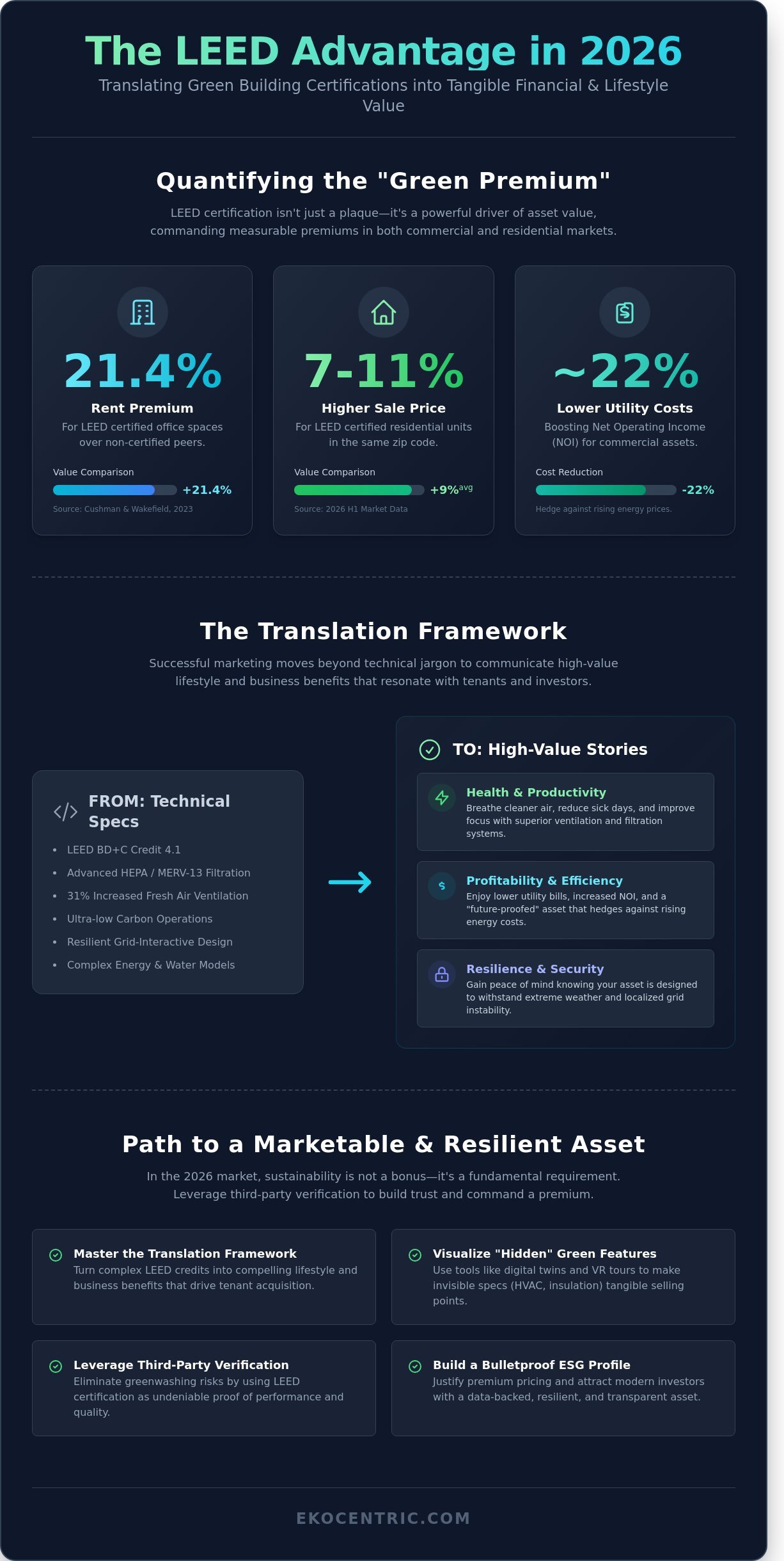
A 2023 study by Cushman & Wakefield reveals that LEED certified office spaces command a 21.4% rent premium over their non-certified peers. Yet, many builders find that a silver or gold plaque on the wall doesn't automatically translate into a signed lease. You likely already know that sustainability is a powerful differentiator. However, you might lack the internal bandwidth to turn complex energy models and water-use data into a compelling lifestyle narrative. It's frustrating when your unwavering dedication to green building feels trapped behind technical jargon that prospects don't understand.
This guide will teach you the art of marketing a LEED certified property by translating technical credits into high-value stories that drive tenant acquisition. We'll show you how to justify premium pricing while building a bulletproof ESG profile that resonates with modern investors. You'll learn how to bridge the gap between engineering excellence and emotional appeal to ensure your project's environmental resilience becomes its greatest financial asset. We are going to move beyond the technical data to create a vision of healthier, more efficient living that your market can't ignore.
Key Takeaways
Discover why the 2026 real estate market has shifted from viewing sustainability as a bonus to a fundamental requirement for savvy stakeholders.
Master the "Translation Framework" for marketing a LEED certified property by turning complex technical credits into high-value lifestyle and business benefits.
Learn to use innovative tools like digital twins and VR tours to visualize "hidden" green features, turning invisible HVAC and insulation specs into tangible selling points.
Protect your asset's reputation and value by leveraging third-party verification to eliminate the legal and financial risks associated with greenwashing.
Understand how professional consulting creates synergy between LEED, NGBS, and FGBC certifications to streamline your path toward a more resilient and marketable asset.
Table of Contents
Beyond the Plaque: Why Marketing a LEED Certified Property is Different in 2026
Translating LEED BD+C and Residential Credits into Compelling Narratives
Avoiding Greenwashing: Verification as the Ultimate Marketing Tool
Scaling Impact: How Professional Consulting Enhances Marketability
Beyond the Plaque: Why Marketing a LEED Certified Property is Different in 2026
Marketing a LEED certified property in 2026 requires more than just hanging a silver or gold plaque in the lobby. It's the strategic communication of verified environmental performance to every stakeholder, from institutional investors to individual tenants. By 2026, the real estate market has moved past "green-as-a-bonus" thinking. Sustainable features are now a baseline requirement for Class A office space and luxury residential developments. Many developers face a "Value Gap" where properties with high-level certifications fail to command a premium. This usually happens because the messaging focuses on technical specs rather than tangible human benefits. If you don't translate kilowatts saved into dollars earned or health improved, you're leaving money on the table.
Trust is the primary currency in the 2026 market. Skeptical consumers and savvy investors demand proof to avoid the "greenwashing" traps of previous years. This is where Leadership in Energy and Environmental Design (LEED) provides the necessary third-party verification. It bridges the gap between a developer's claims and actual, measurable performance. Effective marketing a LEED certified property means using this verification to build an airtight case for the building's long-term viability and operational excellence. At Ekocentric, we've seen that builders who lack the bandwidth to manage this narrative often lose out to competitors who lead with data-backed transparency.
The Evolution of LEED in the Commercial and Residential Sector
LEED v5 has fundamentally changed the conversation by 2026. This latest version prioritizes ultra-low carbon operations and social equity, moving beyond simple energy efficiency. The post-pandemic demand for "healthy buildings" is no longer a niche preference; it's a permanent market shift. Buyers now look for specific metrics, such as a 31% increase in fresh air ventilation or advanced HEPA filtration systems. Resilience is the new priority. In 2026, owners want to know their assets can withstand extreme weather events and localized grid instability. Marketing must highlight how a building's design protects the occupant's safety and the investor's capital during climate-related disruptions.
Quantifying the "Green Premium" for Investors and Tenants
Data from the first half of 2026 shows that LEED certified residential units sell for 7% to 11% more than non-certified peers in the same zip code. For commercial developers, the impact on the bottom line is even more direct. Energy-efficient systems typically boost Net Operating Income (NOI) by lowering annual utility costs by an average of 22%. This efficiency acts as a hedge against rising energy prices and municipal carbon penalties. When marketing a LEED certified property, you must present these figures as a central part of the investment thesis. The Green Premium is the measurable increase in asset value attributed to sustainable certifications. Investors view these buildings as "future-proofed" assets that will maintain their value as stricter environmental regulations become the law of the land.
By focusing on these pragmatic business benefits, you transform a sustainability certification from a construction cost into a powerful revenue driver. The goal is to show that a greener building isn't just better for the planet; it's a more profitable, lower-risk, and higher-performing asset for everyone involved.
Translating LEED BD+C and Residential Credits into Compelling Narratives
Developers often get trapped in the technical weeds of LEED BD+C (Building Design and Construction) scorecards. While a LEED Gold plaque is a badge of honor, the average tenant or buyer doesn't find "Credit 4.1" inherently valuable. Successful marketing a LEED certified property requires a "Translation Framework" that converts technical specifications into tangible business or lifestyle benefits. You must move the conversation from "points earned" to "value gained." This transition is vital because LEED certification financial benefits extend far beyond simple utility savings; they impact tenant retention, occupancy rates, and overall asset valuation.
The most effective marketing strategies focus on three core pillars: health, cost-efficiency, and location. By 2026, market data suggests that Indoor Environmental Quality (IEQ) will surpass energy savings as the primary driver for high-end residential and Class A office leases. Buyers are no longer just looking for a building that's "less bad" for the planet; they want a building that's actively "better" for their bodies. If you're feeling overwhelmed by the technical documentation required to prove these benefits, our team can help you streamline your LEED management to focus on these high-value narratives.
From "Low-VOC" to "Breathe Easier": The Health Narrative
The LEED IEQ category is a goldmine for human-centric storytelling. Instead of listing "Low-VOC paints and adhesives," tell families they're moving into a home where the air is filtered 4 times more effectively than a standard code-built house. Use data from your LEED Green Rater to back these claims. For office tenants, connect superior air filtration to the bottom line. Research from the Harvard COGfx study shows that doubling ventilation rates can lead to an 8% increase in employee productivity, which translates to roughly $6,500 per person per year in added value. You're not selling a HVAC system; you're selling a cognitive performance upgrade and 30% fewer sick days for the staff.
Energy Performance: Marketing the "Lower Monthly Cost"
For residential projects, the HERS Index is your most powerful sales tool. A HERS score of 50 means the home is 50% more efficient than a standard new build. Translate this into a specific dollar amount. If energy modeling predicts $1,500 in annual utility savings, lead with that number in your brochures. For commercial properties, energy modeling provides a 95% accurate forecast of operational expenditures, giving investors the certainty they crave. Integrating solar arrays or a Tesla Powerwall into the narrative shifts the story from "saving money" to "energy independence." It's about resilience. In the event of a grid failure, a LEED certified home with battery storage keeps the lights on and the food cold while the rest of the neighborhood goes dark.
The "Location and Transportation" (LT) credits also offer significant marketing leverage for urban developments. Rather than mentioning "density points," highlight the "5-minute walk to the Metro" or the "90+ Walk Score." According to 2023 AAA data, the average cost of owning a car is now over $12,000 per year. By leveraging LT credits, you're helping buyers eliminate a major liability from their balance sheet. By focusing on these specific credits, marketing a LEED certified property becomes an exercise in selling a better, more resilient way of life.
Multi-Channel Strategies for Promoting Sustainable Assets
Marketing a LEED certified property effectively requires moving beyond the simple placement of a silver or gold plaque in the entryway. Success in 2026 depends on an active strategy that translates technical achievements into tangible human benefits. Physical signage shouldn't just decorate; it must educate. Instead of a static logo, use infographics that explain how your low-flow fixtures save 30,000 gallons of water annually or how your MERV 13 filtration system provides 40% cleaner air than standard ventilation. This approach turns a building's walls into a narrative of health and efficiency.
Digital twins and VR tours offer a solution to the "hidden feature" problem. Most of what makes a building sustainable, like high-performance R-30 insulation or complex HVAC energy recovery wheels, stays tucked away behind drywall. By using Matterport or similar 3D scanning tech, you can peel back these layers for prospective tenants. A virtual walkthrough that highlights the energy-efficient building envelope builds a level of trust that static photos can't match. It transforms abstract certifications into a visible commitment to quality.
Your social media strategy should document the construction journey rather than just the finished product. Sharing a time-lapse of the solar array installation from August 2023 or a video of the team sorting 75% of construction waste for recycling creates an authentic "green" pedigree. This transparency resonates with the 82% of institutional investors who now prioritize ESG metrics. It proves that your LEED status isn't just a badge; it's a core component of the project's DNA.
Leasing and sales teams must be equipped to answer technical questions without hesitation. If a prospect asks about the HERS Index or how the building's resilience features lower insurance premiums, the staff needs precise data. This level of expertise is vital because research on green building marketing shows that LEED serves as a powerful signal of superior management and asset quality. When your team speaks the language of sustainability, they reinforce the property's premium positioning and justify higher rental rates.
Digital Marketing and ESG Reporting
Integrate your LEED score directly into GRESB and other investor-facing reports to streamline capital raising. As of 2025, over 2,000 real estate entities used these benchmarks to prove their portfolio's value. On your property website, optimize for high-intent keywords like "sustainable living" and "green building" to capture organic traffic. Don't forget to provide a downloadable "Sustainability Fact Sheet." This 2-page PDF should summarize energy savings, carbon footprint reductions, and wellness features, giving brokers a ready-made tool to close deals.
The Power of Experiential Marketing
Host "behind-the-walls" tours during the final stages of construction to show off the building's guts. These events allow architects and developers to explain the engineering passion behind the project. Once the building is occupied, use interactive lobby displays to show real-time energy and water savings. A 2021 pilot program in Seattle showed that tenants are 15% more likely to renew leases when they see live data proving the building's performance. Finally, partner with local eco-conscious brands for launch events to align your property with a broader lifestyle of environmental stewardship.
Avoiding Greenwashing: Verification as the Ultimate Marketing Tool
Greenwashing is moving from a marketing faux pas to a high-stakes legal liability. By 2026, the Federal Trade Commission (FTC) and international regulators will enforce stricter penalties for vague environmental claims, with fines in some jurisdictions reaching 4% of annual turnover. For developers, this means the era of "trust me" is over. Marketing a LEED certified property requires a transition from aspirational adjectives to verified data points. If your marketing materials claim a building is green but lack the USGBC seal, you risk reputational damage and potential litigation.
Savvy investors and tenants no longer accept self-certified checklists. They want to see the LEED plaque and the underlying performance metrics. Maintaining this narrative post-occupancy is vital. You should use the official LEED branding according to USGBC guidelines, ensuring you distinguish between "Certified," "Silver," "Gold," and "Platinum" levels. Misrepresenting a LEED-registered building as already "Certified" is a common trap that triggers legal scrutiny. Accuracy is your best defense against skeptics.
Proof Over Promises: The Role of Third-Party Data
Marketing a LEED certified property becomes significantly easier when you treat the LEED Green Rater reports as "proof of performance" documents. These reports provide a 100 percent objective audit of the building's systems. You can include summaries of these reports in investor packets to justify higher per-square-foot asking prices. To maintain this value, consider annual performance recertification. This ensures the building operates at peak efficiency long after the ribbon-cutting ceremony. You can partner with Ekocentric’s consulting services to manage this data collection and ensure your marketing claims remain bulletproof.
Addressing the "Florida Factor": Resilience as Marketing
In Florida, sustainability is inseparable from resilience. With average relative humidity levels often exceeding 70%, moisture control is a primary concern for tenants. You can market LEED BD+C (Building Design and Construction) credits specifically related to building envelope commissioning to prove your property is resistant to mold and structural decay. This technical proof is a powerful selling point for luxury residential and Class A office spaces where air quality is a top priority.
The synergy between the Florida Green Building Coalition (FGBC) and LEED standards provides a dual layer of protection that resonates with insurance providers. Highlighting "Hardened Building" features, such as impact-resistant glass and reinforced roof-to-wall connections, allows you to craft a narrative around lower insurance premiums. Data from the insurance industry suggests that buildings with these verified resilience features can see premium reductions of 15% to 25% compared to non-certified structures. This financial incentive is often the final push a prospective buyer needs to close the deal.
Ready to verify your building's performance and maximize your ROI?
Contact the experts at Ekocentric to start your LEED certification journey today.
Scaling Impact: How Professional Consulting Enhances Marketability
Marketing a LEED certified property effectively requires a shift in perspective. You shouldn't view sustainability consultants as mere technical advisors who disappear once the HERS Rater finishes their final inspection. Instead, these experts are your most potent marketing allies. When you involve consultants in the marketing phase, you bridge the gap between complex engineering and the lifestyle benefits that drive tenant decisions. This collaboration ensures that the "green" features of your building aren't just hidden behind drywall but are front and center in your sales narrative.
The synergy between LEED, NGBS, and Florida Green Building Coalition (FGBC) certifications provides a layered story of resilience and efficiency. In Florida's unique climate, an FGBC certification speaks directly to local environmental challenges, while LEED offers global prestige. Combining these frameworks allows developers to capture a wider audience. However, managing the rigorous documentation for multiple certifications is a massive undertaking. Data from industry experts suggests that developers often spend over 200 hours on sustainability paperwork alone. Ekocentric helps builders manage this bandwidth by providing a dedicated layer of management. We handle the administrative complexities, ensuring your project stays on track for its targets while you focus on the core business of construction and leasing.
Positioning your brand as a leader in environmental stewardship is a long-term play for ROI. Properties with high-level green certifications can command rents up to 31% higher than non-certified buildings, according to 2023 market analysis. By leveraging professional consulting, you aren't just buying a certificate; you're investing in a verified brand identity that resonates with the 73% of modern renters who prioritize wellness and sustainability in their living spaces.
The Consultant as a Marketing Asset
Expertise adds immediate credibility to your promotional efforts. Including direct quotes from LEED Green Raters in your press releases or brochures transforms technical data into authoritative claims. Consultants help you identify the most marketable credits for your specific demographic. For instance, if your target market is young families, we highlight "Indoor Air Quality" and "Non-Toxic Materials" rather than just energy percentages. We also streamline the certification timeline, ensuring your marketing team has verified data and HERS scores at least 60 days before your launch date to meet crucial advertising deadlines.
Next Steps: Launching Your LEED Marketing Campaign
To begin, conduct a Sustainability Audit of your current marketing materials. Ensure every claim is backed by the specific LEED or ENERGY STAR credits your project earned. Transition from vague terms like "eco-friendly" to concrete data, such as "25% lower utility costs compared to local averages." It's vital to set measurable KPIs for your green marketing efforts, such as tracking lead conversion rates for units specifically marketed as "high-performance." This data-driven approach proves the value of your investment. To ensure your next project reaches its full potential, partner with Ekocentric to verify and elevate your sustainability goals from the blueprint to the final sale.
Turn Sustainable Design Into Your Strongest Competitive Advantage
The real estate market in 2026 demands more than just a certificate on the wall. Successful developers now translate LEED BD+C and residential credits into human-centric stories that drive a 10% to 30% premium in lease rates according to recent sector data. By prioritizing rigorous third-party verification, you eliminate the risks of greenwashing while building lasting trust with savvy investors and tenants. Effective marketing a LEED certified property requires a precise blend of technical accuracy and emotional resonance that speaks directly to today’s eco-conscious buyers.
Many builders don't have the internal bandwidth to bridge the gap between complex design requirements and final ROI. As Florida-based experts in LEED and FGBC standards, Ekocentric provides the specialized LEED Green Rater services residential developers need to scale their impact. We're passionate about ensuring your sustainable vision translates into a high-performing, marketable asset that stands the test of time. Our team brings years of field experience to every project, ensuring your certification process is seamless and profitable.
Let Ekocentric manage your LEED certification and boost your property’s marketability.
We're ready to help you build a healthier, more resilient, and more profitable future for your community.
Frequently Asked Questions
Does LEED certification actually increase property value in 2026?
Yes, LEED certification continues to drive higher asset valuations. Data from 2024 market reports shows that LEED-certified buildings command a 4% to 11% rental premium over non-certified assets. By 2026, this value gap will likely widen as 75% of institutional investors now require ESG disclosures, making certified properties more liquid and easier to finance through green bonds.
How do I explain LEED BD+C to a tenant who isn’t an expert?
You should explain LEED Building Design and Construction (BD+C) as a third-party verified "birth certificate" for the structure. It proves the building was designed from the ground up to be 20% more efficient than standard code. Tell them it's a guarantee that their office or home was built to provide better air quality and lower bills without them having to do any extra work.
What is the best way to use the LEED logo in marketing materials?
The most effective strategy is to follow the USGBC Trademark Policy by using the specific "LEED Certified" logo only after the final award is granted. Place the logo prominently on the first page of your offering memorandum. This immediate visual cue signals high-performance standards to the 70% of corporate tenants who now have internal mandates to occupy sustainable spaces.
Can I market a property as "green" before the final LEED certification is issued?
You can market a project as "LEED Registered" or "Targeting LEED Silver" while construction is still in progress. This level of transparency is essential when marketing a LEED certified property to remain compliant with the FTC Green Guides. Providing a copy of the preliminary LEED scorecard to prospective buyers builds trust and proves you're on track to meet your sustainability goals.
How does LEED for Homes marketing differ from commercial LEED marketing?
Residential marketing focuses on personal benefits like the $400 average annual utility savings and 15% better indoor air quality for families. Commercial marketing prioritizes the business case, emphasizing a 2% increase in employee productivity and lower operational expenses. While homeowners care about comfort, commercial tenants look for how the certification helps them meet their global carbon reduction targets by 2030.
What are the risks of greenwashing in real estate marketing?
The primary risk is a legal challenge or fine from the FTC for making deceptive environmental claims. Using vague terms like "eco-friendly" without a HERS Index or LEED scorecard can lead to a 30% drop in brand trust among Gen Z and Millennial buyers. It's much safer to use verified data points and third-party certifications to back up every claim you make in your brochures.
How do I market the energy savings of a LEED building effectively?
Use the ASHRAE 90.1 baseline to show the exact 30% reduction in kilowatt hours your building achieves compared to the local average. Don't just list technical specs; translate those numbers into a concrete dollar amount per square foot. When a tenant sees they'll save $2,500 a month on overhead, the value of the LEED certification becomes a practical business advantage they can't ignore.
Is it worth marketing Florida Green Building Coalition (FGBC) certification alongside LEED?
It's definitely worth it because FGBC focuses on Florida's specific environmental challenges like high humidity and hurricane resilience. While LEED provides international prestige, FGBC proves the building is 100% optimized for the local climate. Marketing both shows you've addressed global sustainability and local durability, which can help lower insurance premiums by 5% to 10% in high-risk zones.