The Ultimate FGBC Certification Checklist: A Guide for Florida Builders
Building a high-performance home in Florida without a precise roadmap is like flying into a hurricane without a radar. You're bound to hit a wall. Most Florida builders recognize that sustainable construction is now a necessity for long-term resilience and securing state-specific incentives. However, the sheer volume of technical documentation required by the Florida Green Building Coalition can quickly exhaust your team's bandwidth. Managing a project while tracking every credit on the FGBC certification checklist often feels like a second full-time job.
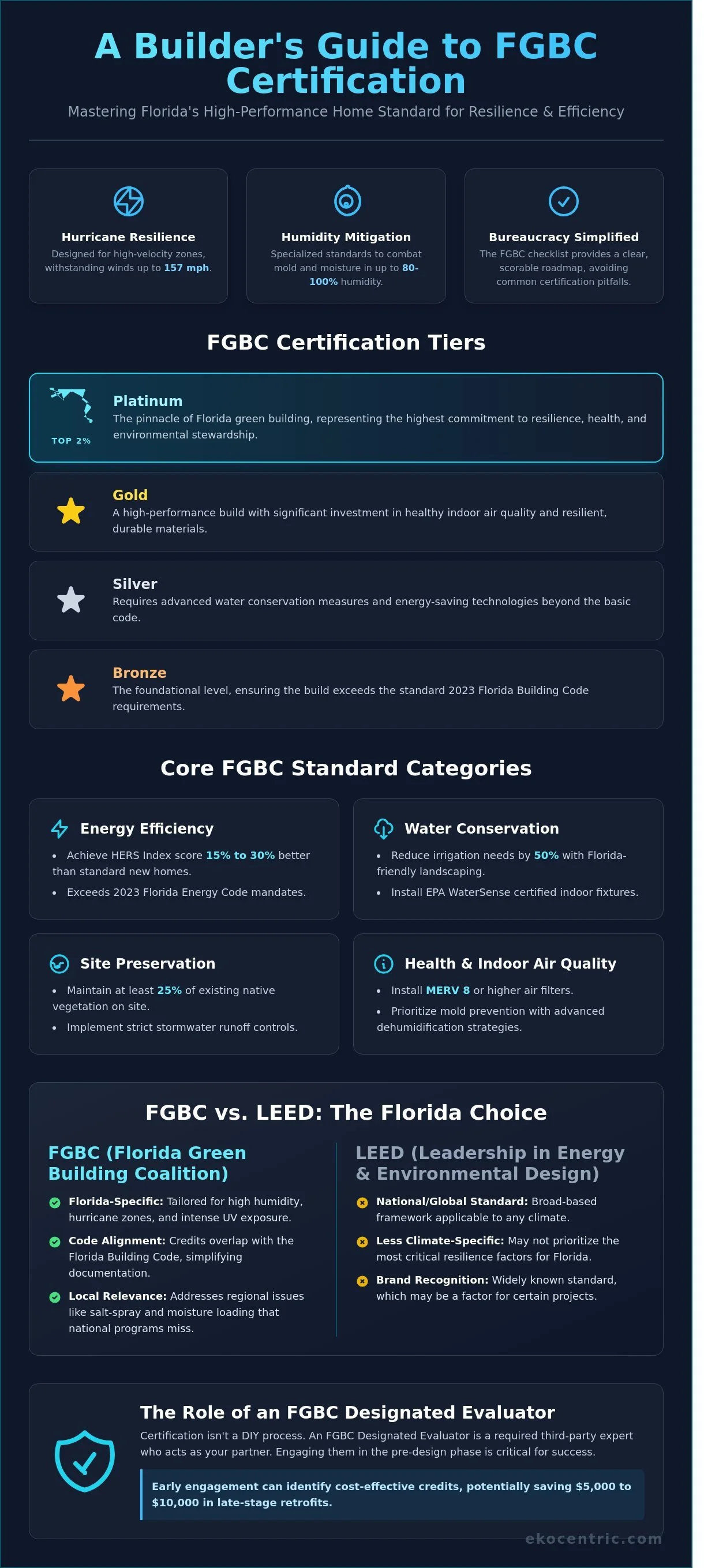
We believe that creating homes capable of withstanding 157 mph winds and 80% humidity shouldn't be a bureaucratic nightmare. This guide simplifies the process by breaking down the checklist into actionable steps tailored for our unique climate. You'll learn how to streamline your documentation, avoid the common errors that cost builders their desired certification level, and unlock the specific financing benefits that reward your commitment to a greener, more resilient future.
Key Takeaways
Understand how the FGBC framework serves as a specialized roadmap for achieving energy efficiency and disaster resilience in Florida’s unique climate.
Navigate the core requirements of the FGBC certification checklist to implement high-impact HERS Index improvements and water conservation strategies.
Evaluate the cost considerations and local relevance of FGBC versus LEED to determine the most strategic certification path for your project goals.
Learn a practical, step-by-step management approach to seamlessly integrate green standards into your architectural and MEP design phases.
Discover how expert consulting solves the "bandwidth" challenge by managing complex certification details so your team can focus on construction.
Table of Contents
What is the FGBC Certification Checklist?
The FGBC certification checklist is the primary tool used to measure a building's environmental impact within the unique context of the Sunshine State. Developed by the Florida Green Building Coalition since its inception in 2000, this framework isn't just a list of suggestions. It's a rigorous, points-based roadmap designed to address the specific challenges of Florida's climate, from 100% humidity levels to high-velocity hurricane zones. While national standards provide a broad overview, this state-specific checklist ensures that a home or commercial building is truly "Florida-fit."
Choosing a local standard over a national one often leads to better long-term performance. National programs frequently overlook the intense salt-spray and moisture-loading issues prevalent in coastal regions. By following the FGBC certification checklist, developers can target specific credits that improve disaster resilience and energy efficiency simultaneously. This practical impact is visible in master-planned developments like Fish Hawk, which gained recognition as a Florida Green Building Coalition 'green' community by adhering to these stringent sustainable guidelines.
The checklist organizes sustainability into four distinct tiers based on the total points earned during construction and verification. Each level represents a deeper commitment to the environment and structural longevity:
Bronze: The foundational level, ensuring the build exceeds standard 2023 Florida Building Code requirements.
Silver: A step up that requires more advanced water conservation and energy-saving technologies.
Gold: Represents a high-performance build with significant investments in healthy indoor air quality and resilient materials.
Platinum: The pinnacle of Florida green building, achieved by only the top 2% of certified projects.
Why Florida Builders Prioritize FGBC
Florida builders prioritize this framework because it aligns seamlessly with the state's regulatory environment. Many of the credits in the checklist overlap with mandatory requirements in the 2023 Florida Building Code, which simplifies the documentation process for busy teams. Beyond compliance, the focus on high-humidity mitigation is a major business driver. Builders who implement the advanced dehumidification and 130 mph wind-rated assemblies suggested by the checklist can market their homes as safer and more durable than the competition. For the end-user, this translates to utility bills that are often 25% lower than non-certified homes, providing a clear return on investment that residents can see every month.
The Role of an FGBC Designated Evaluator
You can't self-certify a project; the integrity of the system depends on a third-party expert known as an FGBC Designated Evaluator. This professional doesn't just check boxes at the end of the project. They act as a pragmatic partner, verifying field conditions through on-site inspections and technical testing. It's vital to engage an evaluator during the pre-design phase. Early involvement can help a project team identify the most cost-effective points to pursue, potentially saving $5,000 to $10,000 in expensive late-stage retrofits. The evaluator ensures that every requirement of the FGBC certification checklist is met with documented proof, providing the professional authority needed to secure the final certification seal.
Core Categories of the FGBC Green Home Standard
The Florida Green Building Coalition (FGBC) standard provides a rigorous framework specifically tailored to Florida’s unique climate. Unlike national programs, this standard addresses the high humidity, intense UV exposure, and hurricane risks inherent to the Sunshine State. Achieving certification requires a balanced approach across five critical categories that transform a standard build into a high-performance asset. Using a comprehensive FGBC certification checklist ensures that every technical requirement is met from the design phase through final inspection.
Energy Efficiency: Builders must go beyond the 2023 Florida Energy Code. We typically aim for a HERS Index score that represents a 15% to 30% improvement over a standard new home.
Water Conservation: This involves a dual strategy of Florida-friendly landscaping to reduce irrigation by 50% and installing EPA WaterSense indoor fixtures.
Site Preservation: Protecting local ecosystems means maintaining at least 25% of existing native vegetation and implementing strict stormwater runoff controls to prevent silt from entering local waterways.
Health and Indoor Air Quality: In our humid climate, mold prevention is paramount. This includes installing MERV 8 or higher filters and ensuring all paints and adhesives meet Low-VOC standards, such as SCAQMD Rule 1113.
Disaster Mitigation: Hardening the structure against 160 mph wind zones and potential flooding is a core requirement for Florida resilience.
Energy and Water: The Heavy Hitters
Energy and water categories often carry the most weight because they provide the most immediate ROI for homeowners. To earn maximum points, your FGBC certification checklist should prioritize HVAC systems with a minimum 14.3 SEER2 rating, which became the regional standard in January 2023. We also advocate for solar readiness; installing conduit from the attic to the electrical panel allows for future PV integration without costly retrofits. Reclaimed water systems for irrigation and xeriscaping with drought-tolerant plants like Saw Palmetto can nearly eliminate the need for potable water outdoors.
Materials and Disaster Resilience
Florida’s environment is brutal on building materials. We focus on products that offer longevity and resistance to moisture. Sustainable material selection isn't just about recycled content; it's about choosing finishes that won't degrade under intense UV radiation. Disaster resilience is equally vital. Points are awarded for impact-resistant windows and reinforced roof-to-wall connections that exceed base code requirements. During the build, we implement waste management strategies to divert at least 50% of construction debris from landfills, turning potential waste into a resource for other projects.
Success in these categories requires early planning and a deep understanding of how various systems interact. If you're looking to optimize your project's performance, we can help you implement sustainable building strategies that align with your budget and timeline. Our team ensures that these core categories are integrated seamlessly, helping you achieve a higher certification level while creating a more resilient home for the future.
FGBC vs. LEED: Selecting the Right Path for Your Project
Choosing between LEED and FGBC isn't about finding a "better" standard. It's about identifying which framework aligns with your project's specific geography and financial goals. LEED offers global prestige that attracts international investors and corporate tenants. However, the Florida Green Building Coalition (FGBC) provides a localized approach that addresses the unique environmental stressors of the Sunshine State. While LEED is a broad brush, the FGBC certification checklist acts as a precision tool for Florida's subtropical climate.
Financial realities often drive the final decision. LEED registration and certification fees for a mid-sized commercial project can exceed $5,000, excluding the high cost of specialized LEED AP consultants. In contrast, FGBC registration fees typically stay below $600 for residential projects and are significantly lower for commercial builds than their national counterparts. Construction premiums also vary. LEED often requires specific materials that may need to be shipped from across the country to meet "regional priority" credits. FGBC emphasizes local sourcing, which can reduce logistics costs by 12% to 15% on large-scale developments.
State-specific incentives also tip the scales. Florida Statute 212.08 and various local ordinances often provide property tax abatements or expedited permitting for green-certified buildings. In many Florida jurisdictions, an FGBC designation carries the same weight as LEED for these "fast-track" programs. Some developers now pursue dual-certification. They use LEED to satisfy institutional lenders and FGBC to ensure the building survives Florida's humidity and hurricane seasons. This strategy maximizes marketability, appealing to both global ESG funds and local buyers who prioritize resilience.
When to Choose FGBC Over LEED
FGBC is the superior choice for projects dealing with Florida's specific geological risks. If your site sits on karst topography, which affects roughly 80% of the state's land, FGBC offers targeted credits for sinkhole prevention and aquifer protection that LEED lacks. Smaller residential builders often find LEED for Homes cost-prohibitive due to the rigid documentation requirements. FGBC allows for more flexibility, letting builders use traditional Florida construction methods while still achieving high-performance results in energy and water conservation.
Strategic Consulting for Certification Selection
Deciding on a path requires more than a cursory glance at a spreadsheet. Ekocentric services help developers analyze the ROI of each standard by comparing point-attainability against current building plans. We've found that many builders don't have the bandwidth to track the 100+ variables in a typical FGBC certification checklist while managing a construction schedule. Our team identifies the "low-hanging fruit" credits that offer the highest impact for the lowest cost. For multi-family developments, we often recommend a hybrid approach. This involves using high-level LEED principles for the building envelope while utilizing FGBC's rigorous water-efficiency standards to combat Florida's rising utility rates.
Our goal is to ensure your project isn't just "green" on paper, but resilient and profitable in the long term. Whether you're aiming for the national spotlight or local leadership, we provide the expert management needed to cross the finish line.
Implementing the Checklist: A Step-by-Step Management Guide
Successful green building isn't an accident; it's the result of a disciplined management approach that begins long before the first shovel hits the dirt. To maximize your score, you must treat the FGBC certification checklist as a living document rather than a final exam. This proactive strategy ensures that sustainability goals remain integrated into the project's DNA, preventing costly retrofits or missed point opportunities later in the cycle.
The pre-design phase is where you set the trajectory. Don't just aim for the minimum 75 points required for Bronze certification. Aim for a 10% buffer to account for unforeseen field changes. During this stage, we identify "easy-win" points. These often include Florida-friendly landscaping or the installation of high-efficiency plumbing fixtures that meet the 2023 Florida Building Code requirements while exceeding FGBC standards. Identifying these low-hanging fruits early allows the budget to stay lean while the point total grows.
Once you move into the design phase, the checklist requirements must appear directly on the architectural and MEP (Mechanical, Electrical, and Plumbing) drawings. If a SEER2 rating of 16 or higher is required for a specific credit, it needs to be in the equipment schedule. Vague notes lead to non-compliance. We've seen projects lose certification tiers because the specified insulation didn't match the energy model used during the schematic design. Clear, annotated drawings act as the primary communication tool for the entire build team.
Construction requires a shift toward field education. Subcontractors often rely on traditional methods that might conflict with green standards. A 15-minute toolbox talk regarding low-VOC adhesives or proper duct sealing can be the difference between earning a point and losing it. Finally, verification is about the paper trail. You'll need dated photos of the building envelope, invoices for sustainable materials, and spec sheets for every ENERGY STAR appliance. Collecting these in real-time prevents the "documentation scramble" that occurs at the end of a 12-month build.
Avoiding Common Documentation Pitfalls
Missing paperwork is the primary reason projects fail to reach their target certification level. Data shows that approximately 12% of attempted points are rejected during the final audit because of insufficient evidence. We solve this by implementing a centralized "Green Folder" accessible to all stakeholders. Using digital tools like Procore or FieldWire allows your team to upload photos directly to the FGBC certification checklist from the job site. This real-time tracking ensures that no critical installation, like slab insulation or moisture barriers, goes unrecorded before being covered up.
The Value of Early-Stage Consulting
Waiting until the framing stage to consult with a specialist is a mistake that often leads to "fatal flaws." For instance, poor solar orientation on a site plan can negatively impact your HERS rating by 5 to 10 points before you've even broken ground. We use energy modeling during the schematic phase to optimize the building's performance. By creating a clear "Responsibility Matrix," we assign every checklist item to a specific professional, whether it's the architect, MEP engineer, or site supervisor. This clarity eliminates the "I thought they were doing it" excuse that plagues complex projects.
Ready to streamline your next green project? Partner with Ekocentric for expert FGBC management and ensure your certification stays on track.
Partnering with Ekocentric for FGBC Success
Our unwavering dedication to Florida’s sustainable future stems from a belief that every structure built today should protect the environment of tomorrow. We don't just provide advice; we act as a strategic bridge between high-level sustainability goals and the practical realities of a construction site. Since our inception, we've remained focused on the idea that green building is a necessity for the state's long-term resilience. This mission drives us to go beyond basic consulting to become true advocates for your project's success.
One of the biggest hurdles for developers is the bandwidth problem. Research indicates that approximately 60% of green building projects face administrative delays due to complex documentation requirements. Most construction teams are already stretched thin managing subcontractors, materials, and timelines. They often lack the internal resources to meticulously track every credit required by the Florida Green Building Coalition. Ekocentric solves this by taking full ownership of your FGBC certification checklist. We manage the data, coordinate the inspections, and compile the evidence, allowing your team to stay focused on what they do best: building quality structures.
Our team brings a unique advantage by maintaining deep expertise in both LEED and FGBC standards. While LEED offers a global perspective, FGBC is tailored specifically to Florida’s unique climate, including its high humidity and hurricane risks. We understand how to align these two frameworks so you don't waste effort on redundant tasks. Whether you are aiming for a single certification or a dual-rated project, we ensure that every design choice serves multiple purposes, maximizing your points while minimizing extra costs.
Our Pragmatic Approach to Green Building
We don't believe in checking boxes just for the sake of a plaque. Our approach is rooted in finding the most cost-effective path to high performance. As certified HERS Raters and ENERGY STAR partners, we use technical modeling to identify where your budget will have the most impact. For instance, upgrading to a high-efficiency HVAC system might reduce long-term energy costs by 20% while securing critical points on your FGBC certification checklist. We focus on tangible results that create healthier, more resilient Florida communities capable of withstanding the 150 mph winds and extreme heat common in our region.
Ready to Certify Your Next Project?
The long-term value of an FGBC-certified building is undeniable. Data from Florida real estate markets suggests that certified green homes can command price premiums of 5% to 8% compared to conventional builds. Beyond the financial ROI, these projects offer superior indoor air quality and lower utility bills for occupants. If you're ready to elevate your next development, we invite you to explore our full range of consulting services.
Every successful project begins with a clear roadmap. We start by conducting a thorough project assessment and a checklist gap analysis to see where you stand today. This process identifies easy wins and potential roadblocks before they become expensive change orders. Don't leave your certification to chance. Schedule a consultation with our team today to review your project goals and ensure a smooth path to certification.
Build a Resilient Florida Future Today
Navigating the Florida Green Building Coalition's standards requires more than a passing interest in sustainability. It demands a precise understanding of the 7 core categories tailored for our state's unique environment. You've seen how the right documentation streamlines your workflow while distinguishing your project from standard builds. Whether you're comparing these local benchmarks against LEED requirements or scaling for high-volume residential developments, the goal remains the same: creating energy-efficient, resilient structures.
We know most Florida builders don't have the internal bandwidth to track every technical detail while managing a job site. As a Florida Green Building Coalition Designated Evaluator with expertise in LEED, NGBS, and ENERGY STAR, Ekocentric provides the professional oversight you need to succeed. Our mission centers on Florida's long-term resilience, ensuring every home we evaluate meets the highest standards of durability and health. Don't let administrative complexity stall your progress toward a greener future. Let Ekocentric manage your FGBC certification checklist today. We're ready to turn your sustainable vision into a tangible, certified reality.
Frequently Asked Questions
How many points are required for FGBC Bronze certification?
You must earn a minimum of 200 points to achieve FGBC Bronze certification for a single-family residential project. This baseline score ensures that the building meets fundamental sustainability standards across categories like energy efficiency, water conservation, and site preservation. Higher designations require more points; Silver starts at 240, Gold at 280, and Platinum at 320. Reaching the 200 point threshold demonstrates a clear commitment to protecting Florida's natural environment.
Is the FGBC certification mandatory for new construction in Florida?
FGBC certification isn't a statewide legal requirement for all new construction, but it's often mandatory for projects receiving local government incentives or specific grants. For instance, some Florida municipalities require green certification for any developer seeking a 15% density bonus or expedited permitting. Even when it isn't mandated by law, using the FGBC certification checklist helps builders qualify for the federal 45L tax credit, which offers up to $5,000 per energy-efficient dwelling unit.
How does the FGBC checklist differ for high-rise vs. single-family homes?
The high-rise checklist focuses on shared mechanical systems and vertical transportation, while the single-family version emphasizes individual building envelopes and lot-specific landscaping. In a high-rise project, 20% of the possible points might come from centralized HVAC efficiency and sub-metering for individual units. Single-family homes earn significant points through HERS Index scores and the use of native Florida plants on 80% of the landscaped area. These distinct pathways ensure every project type receives a tailored strategy.
What is the average cost of an FGBC certification for a developer?
A developer can expect to pay between $1,500 and $4,500 per project for the total certification process, which includes registration fees and third-party verification. For a standard residential home, the FGBC registration fee is currently $150 for members and $350 for non-members. While professional consulting adds to the initial budget, it typically identifies 10% to 15% in construction waste savings. These upfront costs are pragmatic investments that increase the long-term market value of the property.
Can I use ENERGY STAR appliances to earn points on the FGBC checklist?
You can earn up to 4 points on the FGBC certification checklist by installing ENERGY STAR certified appliances throughout the home. Each qualifying appliance, such as a refrigerator, dishwasher, or clothes washer, typically contributes 1 point toward your total sustainability score. Using these high-performance models reduces annual utility costs for residents by an average of $450. It's a simple, effective way to boost your score while meeting the modern buyer's demand for energy-efficient living spaces.
How long does the final FGBC verification process take after construction?
The final verification process typically takes between 30 and 45 days once the completed application is submitted to the Florida Green Building Coalition. This timeline accounts for the detailed audit of your construction documents and the final on-site inspection by a designated evaluator. We recommend submitting all final paperwork within 14 days of receiving your Certificate of Occupancy to prevent unnecessary delays. Staying organized throughout the build ensures this final phase moves quickly and efficiently.
What happens if my project fails to meet the checklist requirements during the final audit?
If a project fails to meet the required points during the final audit, the developer has 30 days to implement corrective actions or provide additional documentation. If the point total still falls short of the intended tier, the project might be downgraded to a lower level, such as moving from Silver to Bronze. Our team prevents this by performing a pre-audit at 90% construction completion. This proactive management ensures every requirement is verified before the official submission occurs.