The Strategic Role of an NGBS Verifier: A Guide for Developers in 2026
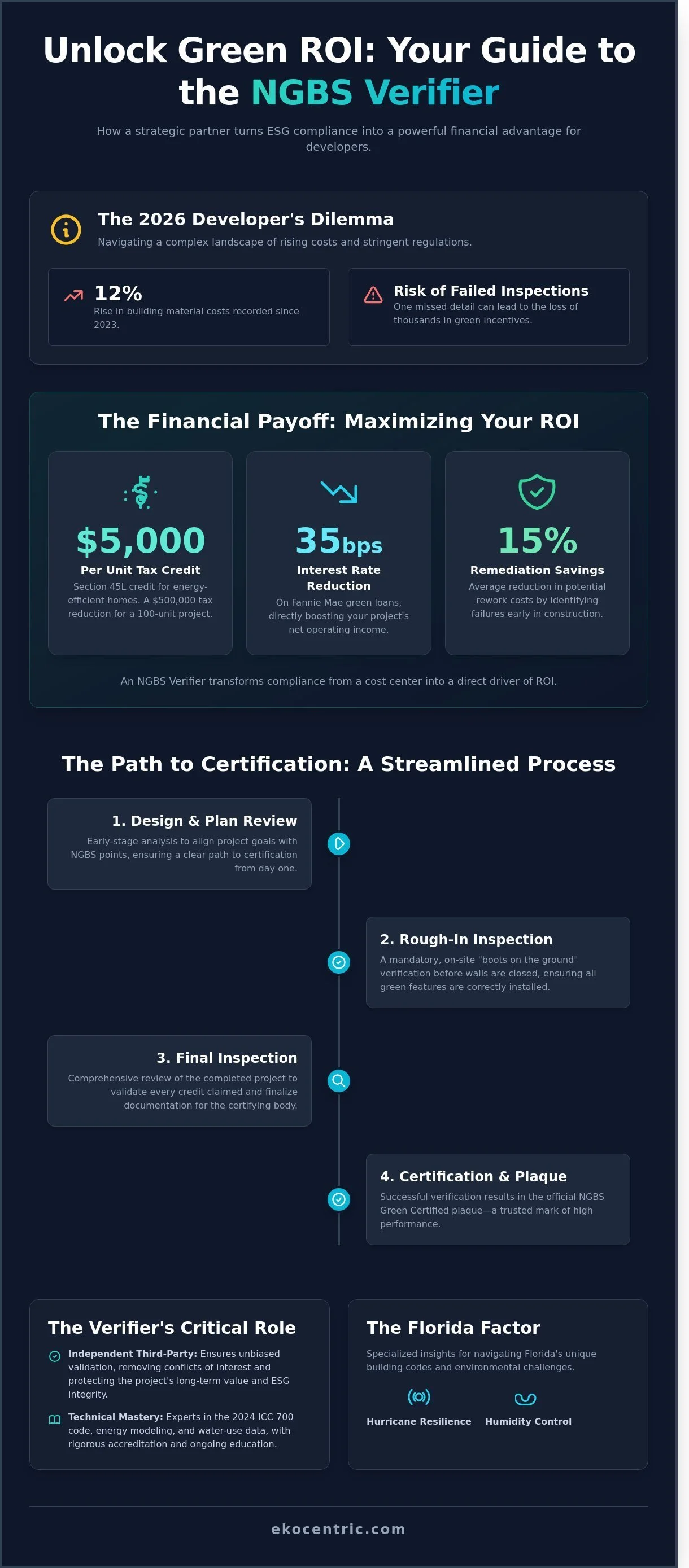
What if your path to a 35 basis point interest rate reduction on a Fannie Mae loan isn't found in a spreadsheet, but in the expertise of a single consultant? Most developers in 2026 feel the weight of tightening ESG requirements and the 12% rise in building material costs recorded since 2023. You likely don't have the internal bandwidth to track every technical change in the National Green Building Standard or manage the mountain of documentation required for federal tax credits. It's a common frustration to fear that one missed detail during construction could lead to a failed final inspection and the loss of thousands in green incentives. Partnering with a qualified NGBS Verifier ensures your project stays on track from the first shovel in the ground.
We believe that building a resilient future should be a rewarding investment, not a regulatory burden. This guide shows how an NGBS Verifier acts as your strategic partner to unlock lucrative financing incentives, ensure total compliance, and maximize the ROI of your sustainable projects. We'll explore the specific ways these experts streamline your certification process to deliver high-performing, marketable buildings that stand out in a competitive market.
Key Takeaways
Learn how to maximize your project’s ROI by unlocking green financing incentives and high-value tax credits through strategic certification.
Discover how a qualified NGBS Verifier serves as a pragmatic partner, managing complex documentation and ensuring your project meets rigorous third-party standards.
Master the step-by-step verification process, from early-stage design reviews to the final plaque, to ensure seamless compliance and point allocation.
Gain specialized insights into navigating Florida’s unique building codes and environmental challenges, such as humidity control and hurricane resilience.
Understand how to select a partner with the industry bandwidth to handle the sustainability side of your project, allowing your team to stay focused on delivery.
What is an NGBS Verifier and Why is Third-Party Oversight Essential?
An NGBS Verifier is an accredited, independent professional who serves as the primary point of contact between a construction project and Home Innovation Research Labs. This role is built on a foundation of technical mastery and objectivity. Unlike other programs where a developer might submit their own data, the National Green Building Standard requires a third party to validate every credit claimed. This ensures that the certification remains a trusted benchmark for high-performance homes. Since its inception, the standard has evolved to meet modern challenges, and the verifier is the person responsible for ensuring those standards are met on every job site through rigorous, documented evidence.
The verifier's presence on-site is a requirement, not a suggestion. They perform two critical inspections: the rough-in inspection before walls are closed and the final inspection upon completion. This process eliminates the risks associated with self-certification. It provides developers with a reliable "boots on the ground" partner who ensures that 100% of the mandatory green features are correctly installed. This level of detail is why the program is recognized by major financial institutions and government agencies across the country. To better understand how these professionals use digital tools to track project progress, watch this helpful video:
Change video
Accreditation and Technical Expertise
Becoming an NGBS Verifier requires passing a rigorous four-part exam and maintaining ongoing continuing education through Home Innovation Research Labs. These professionals don't just understand general sustainability; they're experts in the 2024 ICC 700 code cycle that dictates 2026 building practices. Whether you're developing a 300-unit multifamily complex or a single-family subdivision, you need a verifier with specific expertise in that building type. They must interpret complex energy models and water-use data to ensure compliance. This specialized knowledge allows them to identify potential failures early, saving developers an average of 15% in potential remediation costs during the construction phase.
The Independence Factor: Ensuring Certification Integrity
Third-party oversight is the gold standard for green building because it removes bias from the equation. This independence is essential for developers looking to tap into green bonds or federal financing programs. For instance, the FHA's Mortgage Insurance Premium (MIP) reduction program requires a certified NGBS Verifier to sign off on the project's sustainability goals to secure lower interest rates. These verifiers operate under strict conflict-of-interest rules, ensuring they don't have a financial stake in the construction company or the materials used. This unbiased bridge between the builder and the certifying body protects the project's long-term value and ensures that ESG (Environmental, Social, and Governance) reporting remains accurate and defensible for stakeholders.
The Business Case: How an NGBS Verifier Drives ROI
By 2026, the intersection of environmental stewardship and fiscal responsibility has become the standard for successful multi-family and residential development. Hiring an NGBS Verifier isn't just a compliance step; it's a strategic move to capture significant capital that's otherwise left on the table. Developers often find that the cost of third-party verification is offset multiple times over by the immediate tax credits and long-term financing benefits available to certified projects.
Accessing Green Financing and Incentives
The most immediate impact on a project's bottom line comes from federal incentives and preferential lending. The Section 45L tax credit now offers up to $5,000 per unit for homes and apartments that meet specific energy-efficient benchmarks. For a 100-unit development, this represents a $500,000 direct reduction in tax liability. To secure these funds, rigorous documentation is required, which is where your verifier becomes indispensable. They ensure the project adheres to the ICC 700 National Green Building Standard, providing the third-party oversight that federal agencies demand.
Beyond tax credits, Fannie Mae and Freddie Mac continue to offer "Green Rewards" and "Green Bonds" programs in 2026. These programs typically provide a 15-basis point reduction in interest rates for certified buildings. On a $25 million loan, a 0.15% reduction saves roughly $37,500 in interest annually. Your verifier's early involvement prevents "point chasing," a common mistake where developers scramble to add expensive features at the end of construction to meet a certification level. Instead, a NGBS Verifier helps integrate these requirements into the initial design, keeping costs low and ESG scores high for institutional investors who now prioritize sustainable assets.
Risk Mitigation and Quality Control
Construction defects are a primary source of long-term liability and unexpected costs. An NGBS Verifier acts as an extra set of expert eyes during critical phases of construction. They perform mandatory thermal bypass inspections and insulation grading that general contractors might overlook. Statistics show that buildings with verified envelopes can reduce energy loss by as much as 20%, which directly impacts the building's operational expenses and the owner's long-term maintenance budget.
Thermal Bypass Checks: Identifying air leaks before drywall is installed prevents future moisture issues and mold growth.
Envelope Optimization: Proper sealing reduces the load on HVAC systems, potentially allowing for smaller, less expensive equipment.
Liability Reduction: A "certified" label serves as documented proof that the building was constructed to high-performance standards, providing a robust defense against future claims of negligence or poor construction.
The market also rewards this transparency. Data from 2025 indicates that certified green buildings achieve lease-up rates 15% to 20% faster than conventional builds. Tenants are increasingly willing to pay a "green premium" of 5% to 8% for units that promise lower utility bills and superior indoor air quality. If you find your team doesn't have the internal bandwidth to manage these complex requirements, bringing in a dedicated partner ensures these financial opportunities don't slip through the cracks. This proactive approach transforms sustainability from a line-item expense into a powerful engine for project ROI.
The NGBS Verification Process: From Design to Final Plaque
Achieving NGBS certification isn't a post-construction afterthought. It's a rigorous, five-step technical journey that demands precision from the first architectural sketch. Your NGBS Verifier acts as the primary gatekeeper, ensuring every sustainable goal translates from a digital blueprint into a high-performance physical asset. This process follows a specific sequence designed by Home Innovation Research Labs to ensure third-party oversight at every critical milestone.
Step 1: Early Design Review: The verifier analyzes plans to set a point allocation strategy.
Step 2: Project Registration: Formalizing the project with Home Innovation Research Labs to lock in the 2026 standard versions.
Step 3: Rough-In Inspections: A pre-drywall site visit to verify "hidden" elements like air sealing and insulation.
Step 4: Final Inspection and Testing: Comprehensive performance diagnostics, including blower door and duct leakage testing.
Step 5: Final Submission: The verifier uploads all evidence for a final review and the issuance of the green certificate.
Phase 1: Strategic Planning and Design Review
Success begins months before groundbreak. During this phase, we analyze architectural and MEP plans to identify the most cost-effective path to Silver, Gold, or Emerald levels. We create a customized Green Scoring Sheet. This document serves as the project's roadmap, aligning your budget with the mandatory requirements of the 2026 NGBS standard. We look for "low-hanging fruit" in site design and resource efficiency that can net 15 to 20 points without increasing the hard cost per square foot. Because the 2026 standard introduces stricter energy baselines, early modeling is vital to avoid expensive mid-construction changes.
A qualified NGBS Verifier must possess deep technical knowledge of building science. If you're interested in the rigorous training required for this role, you can learn how to Become an NGBS Green Verifier through the Home Innovation Research Labs accreditation program. This expertise allows the verifier to spot design flaws, such as thermal bridging or inadequate ventilation paths, that would otherwise disqualify a building from certification during the final testing phase.
Phase 2: Field Verification and Performance Testing
Field verification turns the scoring sheet into reality. The rough-in inspection is the most critical site visit. We examine the building envelope before the drywall hides the work. We're looking for Grade 1 insulation installation. This means zero gaps, compression, or voids in the fiberglass or mineral wool batts. We also verify that air sealing at top plates and window headers meets the 100% mandatory compliance threshold. If we find a gap, it's fixed on the spot. This proactive management prevents failures during the "moment of truth" at the end of the project.
The final inspection includes the blower door test. This diagnostic tool depressurizes the building to measure air leakage. For 2026 compliance, many climate zones require a leakage rate below 3.0 ACH50. We also perform duct blast testing to ensure HVAC systems aren't losing more than 4% of their conditioned air to unconditioned spaces. Throughout this phase, your verifier manages the documentation trail. We collect photos, manufacturer spec sheets, and purchase orders for every green feature. This evidence is compiled into a final verification report. Once Home Innovation Research Labs reviews this data, the project receives its official certification and the final plaque, signaling to the market that your building is truly resilient and energy efficient.
The Florida Factor: NGBS Verification in a Tropical Climate
Building in Florida requires more than just meeting the 2023 Florida Building Code, 8th Edition. It demands a strategy that accounts for 100-degree heat indexes and 90% humidity. A knowledgeable NGBS Verifier acts as a technical bridge, ensuring that mandatory coastal requirements also count toward your green certification. Many developers miss out on easy points because they don't realize that standard High-Velocity Hurricane Zone (HVHZ) features often satisfy NGBS resilience criteria. Our role is to identify those overlaps early in the design phase to maximize your ROI.
The intersection of state code and national standards can be tricky. While Florida's energy code is already 25% more stringent than many other states, NGBS provides a framework to push beyond basic compliance. We help you leverage local necessities like salt-spray resistant finishes and advanced stormwater management into a nationally recognized rating. This creates a tangible asset for investors who prioritize ESG (Environmental, Social, and Governance) metrics in the 2026 market.
Resilience and Storm Readiness
Florida’s strict requirements for impact-resistant glazing and reinforced roofing systems are a natural fit for NGBS Chapter 12. By documenting these features, developers can earn up to 15 points toward the "Resilience" badge. In a 2024 analysis of multi-family assets in Miami, buildings with NGBS Resilience designations saw an average 7% reduction in property insurance premiums compared to non-certified baseline structures. Your NGBS Verifier ensures that every dollar spent on storm shutters or reinforced masonry is properly credited during the inspection phase.
Moisture Management and Indoor Air Quality
Hot-humid climates like ours make mold prevention a top priority. NGBS requires specific moisture management practices, such as Grade 1 insulation installation and proper flashing around window openings. We focus heavily on AC sizing. If your HVAC system is oversized, it won't run long enough to dehumidify the air. This leads to "clammy" units and potential microbial growth. By strictly following Manual J, S, and D protocols, developers can hit 2026 energy targets while keeping indoor relative humidity below 60%.
Successful Florida projects share three common traits:
Precision HVAC Sizing: Using Manual S to select equipment that handles the latent load without short-cycling.
Enhanced Building Envelopes: Utilizing liquid-applied weather barriers to prevent salt air intrusion.
Local Expertise: Partnering with a verifier who knows the difference between a standard build and a coastal-resilient one.
The financial stakes are high. A mold outbreak in a 200-unit complex can cost over $20,000 in remediation and lost rent per unit. We prevent these issues by verifying the building envelope's integrity before the drywall goes up. It's about protecting your investment while creating a healthier living space for residents. We understand that most developers don't have the internal bandwidth to manage these microscopic details. That's why we provide the oversight needed to ensure your project stays on track for certification.
If you're ready to turn Florida's climate challenges into a competitive advantage for your next project, partner with our expert NGBS verification team today.
Selecting the Right Partner: Why Experience Matters
Choosing an NGBS Verifier is a strategic decision that impacts a project's financial viability and construction timeline. In 2026, the technical requirements for the ICC 700 National Green Building Standard have evolved, making the distinction between a novice and an expert more pronounced. You need a partner who understands the nuances of your specific asset class. A 300 unit multifamily complex in an urban core presents vastly different compliance challenges than a suburban mixed-use development with retail on the ground floor. We've seen projects where inexperienced oversight led to a 10% increase in material costs because the verifier didn't understand the trade-offs available within the point system.
The documentation burden is often the biggest hurdle for project teams. Internal data from late 2025 suggests that developers who manage their own green building paperwork spend approximately 60 hours more per project phase than those who outsource the management. Most builders don't have the internal bandwidth to track every photo, specification sheet, and subcontractor affidavit required for final certification. An experienced NGBS Verifier acts as an additional layer of management, handling the heavy lifting of documentation so your site supers can focus on the build. This pragmatic approach ensures that certification remains a benefit rather than a bureaucratic bottleneck.
Questions to Ask Your Potential NGBS Verifier
How often do you communicate with Home Innovation Research Labs to clarify ambiguous credit requirements?
Can you provide a specific example where you helped a client save at least 5% on construction costs through alternative compliance paths?
What is your protocol for critical path field inspections to ensure site delays never occur?
Do you have a direct relationship with local code officials to help align green goals with municipal requirements?
Efficiency increases when you consolidate your technical needs. Ekocentric integrates NGBS verification with LEED and ENERGY STAR Rater services to create a "one-stop-shop" for developers. This eliminates the friction of managing multiple consultants who might provide conflicting advice. When one firm handles the HERS rating, the blower door testing, and the green building certification, the data flow is seamless. In a 2025 case study, this integrated model reduced soft costs for a Florida developer by 18% compared to using separate vendors for each service.
The Ekocentric Approach: More Than Just an Inspection
Our mission focuses on nurturing a greener future through pragmatic, expert consulting. We don't just point out failures; we provide solutions that keep your project moving. For builders who lack the internal resources to oversee complex sustainability goals, we provide that essential management layer. Our team understands that for a building to be truly sustainable, it must also be economically viable for the developer. We invite you to learn more about our full suite of green building services to see how we can support your next project.
We bring unwavering dedication to every site visit and plan review. By 2026, 75% of new multifamily developments will require some form of green certification to qualify for competitive financing. Having a seasoned professional on your side ensures you meet these requirements without overextending your budget. We're advocates for your success and the planet's health, proving that high performance buildings are achievable for every developer.
Future-Proof Your 2026 Development Strategy
The landscape for developers in 2026 demands more than just standard construction. It requires a commitment to high-performance standards that protect both the environment and your bottom line. Integrating an NGBS Verifier into your project team from the design phase ensures your building meets the rigorous criteria for National Green Building Standard certification. This third-party oversight doesn't just check boxes; it helps capture the 7% premium in asset value often seen in certified green multifamily properties. For projects in Florida's unique climate, meeting the 2023 Florida Building Code while ensuring 155 mph wind resilience is a massive undertaking. Most developers don't have the internal bandwidth to manage these complex sustainability goals alone.
Ekocentric brings specialized expertise as an accredited NGBS Green Verifier, LEED Green Rater, and ENERGY STAR Rater to navigate these requirements. We focus on the technical details so you can focus on building. Our team understands the intersection of tropical resilience and energy efficiency. Partner with Ekocentric for your next NGBS project to ensure your project exceeds industry benchmarks. Let's work together to create a healthier, more sustainable future for your next development.
Frequently Asked Questions
How much does an NGBS Verifier cost for a typical project?
An NGBS Verifier typically costs between $1,500 and $5,000 for a single-family home. For multifamily developments, fees usually range from $150 to $400 per unit. These costs vary based on project complexity and the total number of required site visits. Budgeting 0.5% of your construction cost for third-party verification ensures you meet all sustainability milestones without financial surprises.
Can an NGBS Verifier also perform LEED Green Rater services?
Yes, an NGBS Verifier can also serve as a LEED Green Rater if they hold the necessary dual credentials from GBCI and Home Innovation Research Labs. At Ekocentric, we often combine these roles to streamline the process for developers. This dual-path approach can reduce your administrative workload by 25% because one expert handles all documentation. It's a pragmatic way to ensure your project meets multiple high-performance standards simultaneously.
What is the difference between an NGBS Verifier and a HERS Rater?
The primary difference is that a verifier evaluates the entire building's sustainability, while a HERS Rater focuses solely on energy efficiency. The HERS Index is a numerical score where 0 represents a net-zero home. While every green project includes energy testing, the verifier also checks for site development, water conservation, and indoor environmental quality. In 2024, nearly 90% of certified projects use both roles to meet compliance.
How early in the project should I hire an NGBS Verifier?
You should hire an NGBS Verifier during the pre-design phase, at least 4 months before you pull permits. Early collaboration allows us to identify the most cost-effective points in the 2020 NGBS Green Scoring Tool. Developers who engage a verifier during schematic design save an average of $2,000 per unit by avoiding expensive retrofits. It's about building a solid foundation for your green goals before construction starts.
What happens if my project fails an NGBS field inspection?
If your project fails a field inspection, you must correct the identified deficiencies before the verifier can sign off on that stage. The verifier provides a detailed report within 24 hours of the site visit. You'll then schedule a re-inspection to confirm the 100% compliance required by Home Innovation Research Labs. Quick action prevents construction delays and ensures your project stays on track for final certification.
Does NGBS certification expire, and is re-verification required?
NGBS certification for new construction does not expire. Once your building receives its certificate from Home Innovation Research Labs, that designation stays with the property for its entire lifespan. If you're pursuing the Green Property Management certification, you'll need to re-verify every 3 years. This ensures the building's operational performance continues to meet the 2020 standards for energy and water efficiency.
Can an NGBS Verifier help me qualify for the 45L Tax Credit?
The 45L Tax credits are expiring in June 2026 so are not available for new projects.. This third-party documentation is the essential evidence you need for your tax filings.
Is NGBS certification recognized by the Florida Green Building Coalition (FGBC)?
The Florida Green Building Coalition and NGBS are separate entities, but they share many of the same sustainability goals. While FGBC is specific to Florida's unique climate, NGBS is a national standard recognized by HUD and Fannie Mae. Many Florida builders use both to maximize their marketability. Choosing a national standard ensures your project meets rigorous criteria that 75% of institutional investors now demand for their portfolios.