Sustainable Design Consulting Services: A Builder’s Guide to 2026 Standards
Could a single documentation oversight in your LEED application cost your firm 15% in projected asset value by 2026? You already know that most builders simply don't have the bandwidth to manage the sustainability side of a project while maintaining tight construction schedules. Juggling the 100+ technical data points required for high level certifications makes integrated sustainable design consulting services an essential partner for your bottom line. It's frustrating to watch a project's timeline slip because of complex green building workflows or the risk of a technical audit failure.
We understand these pressures. Our mission is to transform these hurdles into streamlined successes through a pragmatic, expert led approach to technical verification. You'll learn exactly how to ensure your buildings are genuinely resilient and energy efficient without draining your internal resources. This guide provides a clear roadmap for mastering 2026 standards, ensuring your next development achieves its LEED Gold or Platinum goals while you stay focused on the build itself.
Key Takeaways
Learn how to bridge the "bandwidth gap" by integrating expert management into your sustainability workflows to ensure seamless project execution.
Compare the global recognition of LEED against the regional advantages of FGBC and NGBS to choose the most effective certification for your 2026 development.
Discover why technical field verification by a LEED Green Rater is critical for turning high-level design concepts into verified, high-performance buildings.
Master Florida-specific resilience strategies that address unique environmental challenges like humidity and hurricane risks more effectively than generic national standards.
Understand how professional sustainable design consulting services provide the pragmatic oversight needed to achieve ambitious green building goals without overextending your internal team.
Defining Sustainable Design Consulting Services in 2026
By January 2026, the construction industry has moved past the era of voluntary environmentalism. Sustainable design consulting services now function as a technical bridge between high-level architectural concepts and the rigorous performance requirements of modern building codes. These services integrate environmental science with construction management to ensure every square foot of a project contributes to a lower carbon footprint. It isn't just about picking low-VOC paints anymore; it's about engineering systems that achieve net-zero readiness.
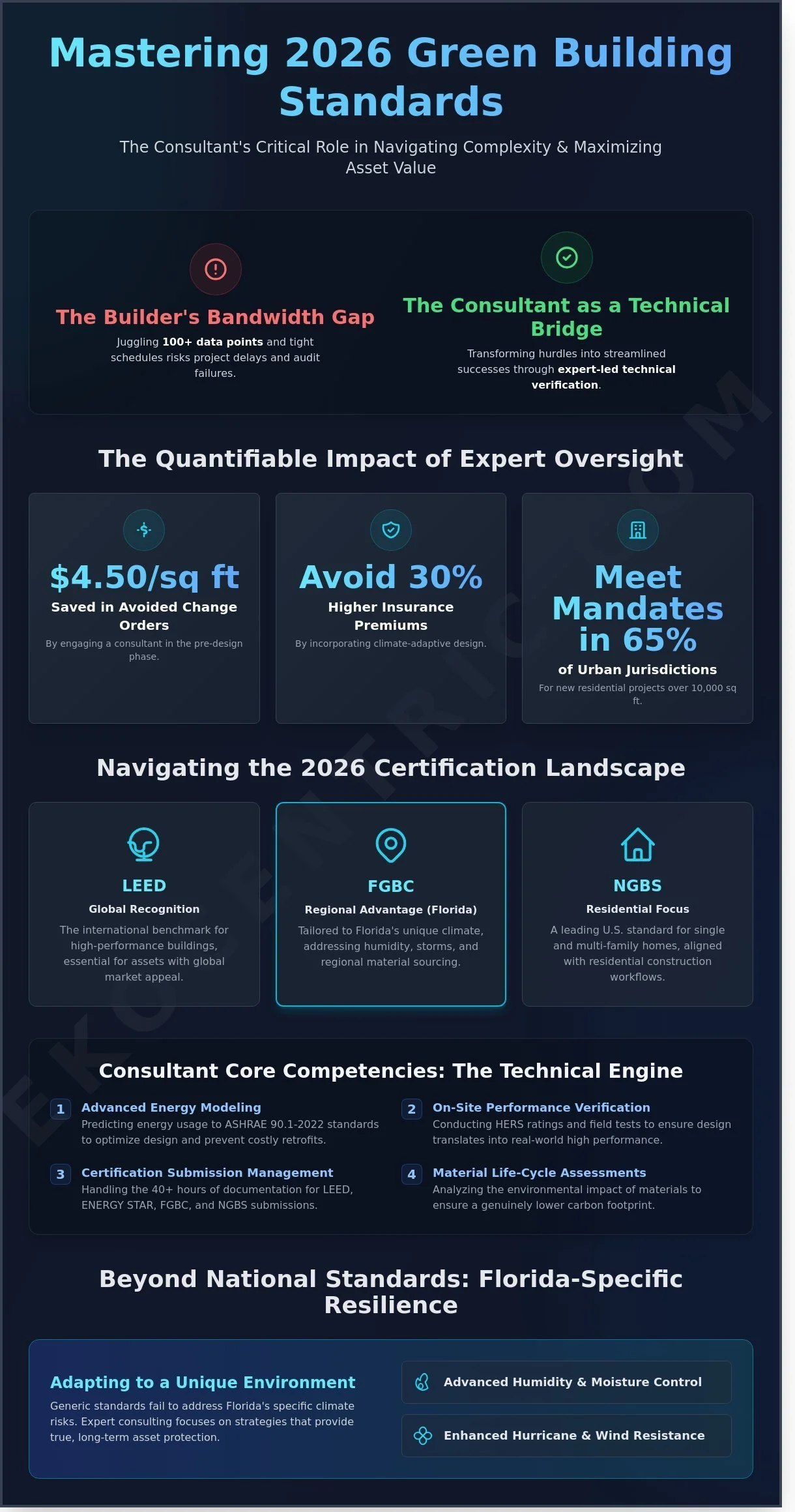
The core of this work centers on Green building principles that reduce carbon footprints while increasing asset value. Most developers face a significant bandwidth gap when trying to manage these requirements internally. Tracking 150 unique data points for a LEED Gold certification or managing the 40+ hours of documentation required for FGBC credits isn't feasible for a standard project manager. Ekocentric provides that vital layer of external management, allowing builders to focus on construction while we handle the complex sustainability workflows.
To better understand the principles behind these services, watch this helpful overview:
It's vital to distinguish between what an architect does and what a sustainability consultant provides. An architect focuses on the spatial, aesthetic, and structural integrity of a building. In contrast, a firm like Ekocentric manages the specific certification frameworks and performance metrics that architects often don't have the specialized training to oversee. By 2026, 65% of urban jurisdictions have mandated high-performance metrics for all new residential projects over 10,000 square feet. We ensure these projects don't just look good; they perform to the exact standards required by law and lenders.
The Evolving Role of the Sustainability Consultant
In 2026, the consultant is a project-critical risk manager. We don't just check boxes at the end of a build. We enter the project during the pre-design phase to prevent costly retrofits. Research from early 2025 shows that involving a consultant before the first shovel hits the ground can save a developer $4.50 per square foot in avoided change orders. We act as the primary liaison between the owner, the design team, and certifying bodies like the USGBC or the Florida Green Building Coalition.
Core Competencies of a Sustainable Design Firm
A modern firm must possess deep technical proficiency in energy modeling and performance testing. We use advanced software to predict energy usage before construction begins. Our team navigates complex, multi-tier certification frameworks that change almost annually. Beyond the math, we bring project management capabilities specifically tailored to green building documentation. We handle the "heavy lifting" of data collection, which includes:
Detailed energy modeling using ASHRAE 90.1-2022 standards.
On-site performance verification and HERS rating.
Managing the submission process for ENERGY STAR and LEED certifications.
Coordination of material life-cycle assessments.
The shift in 2026 is toward mandatory resilience. Developers now face 30% higher insurance premiums if they don't incorporate climate-adaptive design. Sustainable design consulting services provide the roadmap to navigate these financial and regulatory pressures, ensuring your project is built to last in a changing environment.
Navigating the Certification Landscape: LEED, FGBC, and NGBS
Choosing the right certification isn't just about a plaque on the wall; it's a strategic business decision that dictates the long-term viability of an asset. By 2026, the complexity of building codes and the rise of ESG reporting requirements have made sustainable design consulting services indispensable for developers. A consultant's role is to bridge the gap between architectural vision and technical compliance, ensuring that every dollar spent on green features translates into measurable equity.
LEED BD+C: The Global Gold Standard
LEED BD+C is the premier framework for holistically sustainable commercial and residential buildings. For developers targeting institutional investors or Fortune 500 tenants, this framework remains the most recognized benchmark. It's not just about energy; it's about the entire lifecycle of the project. A 2024 study by Dodge Construction Network found that LEED-certified buildings command 30% higher lease rates compared to non-certified peers in the same submarkets. Achieving LEED certification requires a rigorous approach to site selection, water efficiency, and indoor environmental quality. Our experts manage the heavy documentation load, allowing your team to focus on construction timelines while we secure your building's prestige in the global market.
Florida Green Building Coalition (FGBC) vs. NGBS
Florida-based projects often benefit from the regional specificity of the FGBC. Unlike national programs, FGBC standards are specifically tailored to Florida’s unique climate, focusing heavily on hurricane resilience and high-humidity moisture management. This regional focus often makes it a more practical choice for developers who want to address local environmental risks without the overhead of global frameworks. It's a pragmatic path that resonates with local appraisers and insurance providers who understand Florida's specific challenges.
The National Green Building Standard (NGBS) provides a different advantage, particularly for high-performance residential developments. It's the only green building rating system for residential construction that is ANSI-approved. NGBS Green Verification is often the preferred path for multi-family developers because its scoring system is finely tuned to the realities of residential density and occupant behavior. Data from 2025 indicates that NGBS Gold-certified multi-family assets see a 4% to 7% increase in appraisal value over standard builds. This certification focuses on six key areas:
Lot Design and Development
Resource Efficiency
Energy Efficiency
Water Efficiency
Indoor Environmental Quality
Building Operation and Maintenance
Determining the "best fit" requires a deep dive into your project’s specific goals and budget. A consultant analyzes your target demographic and financing requirements to recommend the path of least resistance and highest reward. If you're building a luxury high-rise in Miami, the global prestige of LEED might be the priority. For a workforce housing project in Orlando, the cost-effectiveness and residential focus of NGBS could be the better play. If you're unsure which path maximizes your ROI, our team can analyze your site specifics to find the right balance between cost and performance. We look at the 15% to 20% energy savings potential of each framework to ensure your operational expenses remain low for decades. This level of sustainable design consulting services ensures that your project isn't just green, but also financially resilient.
Beyond Design: The Critical Role of Technical Verification and Rating
A high-performance blueprint is just a promise until it's verified on the construction site. Expert sustainable design consulting services don't stop at the drawing board. They extend into the field to ensure every R-value and airtightness target is actually met. It's common for developers to wonder why a third-party rater is necessary when they've already hired a talented architect. The reality is that architects and raters have different, complementary roles. An architect manages the complex web of zoning, aesthetics, and structural integrity. They often don't have the bandwidth to spend hours on-site testing duct leakage or verifying every insulation batt's installation. This is where the rater steps in as a pragmatic partner. They act as the developer's eyes and ears, catching small errors before they become expensive structural failures. By 2026, the complexity of building envelopes has increased to the point where specialized verification is the only way to guarantee a high-performing asset.
LEED Green Rater Services: Ensuring Compliance
For any residential project aiming for LEED certification, a Green Rater is a non-negotiable partner. They provide the mandatory field verification required by the U.S. Green Building Council. Their work begins early with a mid-construction thermal bypass inspection. During this phase, they identify air leakage paths and insulation voids that could lead to a 20% drop in thermal efficiency if ignored. The final inspection involves blower door testing and duct leakage assessments to confirm the home meets rigorous standards. This hands-on oversight is what prevents the scenario where a project is denied certification after construction is complete. Utilizing professional Green building rating and certification systems ensures that every sustainability claim is backed by data, not just intent. This technical layer of management allows developers to focus on their core business while the rater secures the project's green credentials.
Energy Performance Ratings: HERS and ENERGY STAR
The Home Energy Rating System (HERS) Index serves as the most respected yardstick for energy efficiency in the United States. A lower HERS score translates directly to higher marketability and long-term value. For example, a home with a HERS score of 45 is 55% more efficient than a standard new build based on the 2006 IECC. This numerical clarity allows developers to provide tangible proof of value to prospective residents. Beyond the HERS Index, ENERGY STAR Rater services are essential for meeting local energy performance benchmarks that are becoming stricter in 2026. These ratings don't just measure consumption; they are a proxy for building resilience. A well-rated home maintains its internal temperature longer during power outages and resists moisture damage more effectively. This synergy between energy ratings and durability is a cornerstone of modern sustainable design consulting services. It transforms a simple building into a resilient structure that stands the test of time while protecting the planet and improving the health of its occupants.
Regional Resilience: Sustainable Design Consulting in Florida
Florida presents an environmental challenge unlike any other state. Developers working along the 1,350 miles of coastline face persistent salt air, intense UV radiation, and humidity levels that frequently top 85%. Standard green building frameworks often fail to account for these localized stressors. This is where specialized sustainable design consulting services become essential. Our team utilizes these sustainable design consulting services to bridge the gap between basic compliance and high-performance asset protection. We prioritize the Florida Green Building Coalition (FGBC) certifications because they're built for our specific geography. Unlike generic national standards, FGBC requirements align with the 2023 Florida Building Code to ensure every project is both efficient and legally compliant within local jurisdictions.
Designing for the Florida Climate
Heat mitigation is a core priority in the sub-tropical zone. In 2024, several Florida cities saw over 100 days with heat indices above 100 degrees, placing immense strain on traditional cooling systems. We help developers optimize HVAC systems using advanced energy modeling to prevent the "oversizing" trap common in residential construction. Large units often cycle too quickly, which leaves excessive moisture in the air and invites mold growth. By focusing on the building envelope, specifically using R-20 wall insulation and high-performance vapor barriers, we've seen projects reduce cooling demand by 30%. Local water conservation is another pillar; FGBC standards prioritize native landscaping to protect the Floridan Aquifer, which supplies nearly 90% of our drinking water. This pragmatic approach ensures that "green" features actually perform in a swamp-adjacent environment.
Resilience and Disaster Preparedness
By 2026, the industry has realized that a building that can't survive a hurricane isn't sustainable. Resilience is the ultimate form of environmental stewardship because it prevents the massive waste associated with post-storm reconstruction. We integrate disaster-ready features that also boost energy performance. For example, impact-resistant glass protects against Category 5 winds, which can exceed 157 mph, while Low-E coatings significantly lower solar heat gain. Sustainable design in Florida must prioritize structural resilience to maintain environmental certification. This ensures that the carbon footprint of the building materials is protected for a 50 to 100-year lifecycle. Builders who ignore these factors often face rising insurance premiums, which hit record highs in 2025 across the peninsula.
Key Florida-Specific Design Features:
High-Impact Glazing: Rated for ASTM E1886 to withstand wind-borne debris and prevent pressure equalization failures.
Moisture Management: Semi-permeable membranes and non-vented attics with spray foam to prevent "wall rot" in high-humidity zones.
Elevated Mechanicals: Placing HVAC and electrical components at least 2 feet above the 100-year base flood elevation.
Cool Roofing: Materials with a Solar Reflectance Index (SRI) above 78 to combat the heat island effect and lower attic temperatures.
Salt-Tolerant Materials: Utilizing 316-grade stainless steel or specialized composite materials for exterior hardware to prevent premature corrosion.
Don't leave your project's longevity to chance; partner with us for resilient and sustainable design consulting tailored to the Florida market.
Partnering for Success: How Ekocentric Bridges the Bandwidth Gap
Most developers and builders operate with lean teams where every hour is accounted for. Managing the intricate requirements of green building certifications often feels like an impossible addition to an already full plate. Ekocentric functions as your pragmatic partner, stepping in to manage the sustainability side of the build so your team can focus on core construction milestones. We understand that you don't always have the internal bandwidth to track every evolving energy code or certification update. Our role is to provide that missing layer of management, ensuring your project meets its environmental goals without stalling your timeline.
Our approach is driven by a unique blend of mission-driven passion and sharp business acumen. The founder’s unwavering dedication to environmental stewardship isn't just about "doing good"; it's about building better. We view sustainable design consulting services as a tool for creating high-performance assets that stand out in a crowded market. We've seen projects that treat sustainability as a last-minute regulatory burden, and they almost always face higher costs. By contrast, our process starts with an initial consultation to align project goals early, followed by rigorous design reviews and field inspections, and concluding with final certification. This structured flow ensures that every green goal is met with precision.
Builders who view sustainability as a competitive advantage rather than a hurdle are the ones winning in 2026. A green-certified building isn't just a plaque on the wall; it's a signal to investors and tenants that the property is resilient and forward-thinking. We help you translate complex technical requirements into tangible market value.
Our Comprehensive Service Suite
Success in green building requires a unified strategy rather than a fragmented approach. Ekocentric provides LEED Green Rater services and FGBC consulting, allowing developers to consolidate their verification needs under one roof. When you use a single partner for HERS, ENERGY STAR, and LEED verification, you eliminate the communication gaps that lead to errors. In a 2024 analysis of multifamily projects, those using a unified consulting partner saw a 12% reduction in certification-related delays. Our expertise saves you time by anticipating requirements before they become bottlenecks. We don't just point out problems; we provide the technical solutions needed to keep the project moving toward its final rating.
The Future of Sustainable Development
Building for 2026 requires a partner who looks beyond current minimum standards. As energy costs fluctuate and tenant expectations for indoor air quality rise, high-performance buildings offer a superior long-term ROI. Research from 2025 indicates that certified green buildings maintain 7% higher occupancy rates compared to traditional builds in the same zip code. This financial resilience is why we focus on durable, energy-efficient solutions that provide value long after initial construction is complete. You need a partner who understands the technical lexicon of the industry while remaining accessible and results-oriented. The goal is to create spaces that are healthier for occupants and more profitable for owners. To start your journey toward a higher-performing portfolio, schedule your project consultation with Ekocentric today. Our team is ready to help you navigate the complexities of sustainable design consulting services with confidence and clarity.
Future-Proof Your Portfolio for 2026 Standards
The 2026 building landscape requires more than a simple checklist. It demands a strategic integration of LEED, FGBC, and NGBS frameworks to ensure long-term resilience. Builders often find they don't have the internal bandwidth to manage these complex certifications while keeping 100% of their focus on construction timelines. This is exactly where professional sustainable design consulting services become a critical asset for your development team. We bridge the gap between ambitious green goals and field-verified performance.
Ekocentric brings a pragmatic approach to every project, combining technical expertise in HERS ratings with our founder's unwavering dedication to environmental stewardship. We handle the heavy lifting of technical verification and rating so you can focus on building. By 2026, high-performance resilience won't be an optional upgrade for Florida projects; it'll be the baseline for market viability and structural longevity. You deserve a partner who understands the nuances of the Florida Green Building Coalition and National Green Building Standard as well as you know your own blueprints.
Ready to elevate your next development? Partner with Ekocentric to streamline your next green building project and build a legacy that lasts for generations.
Frequently Asked Questions
What exactly does a sustainable design consultant do?
A sustainable design consultant acts as your project's environmental project manager, overseeing the integration of eco-friendly strategies from pre-design through post-construction. We provide the technical bandwidth that many developers lack, managing every detail of the certification process to ensure your building meets its performance targets. By coordinating between architects and contractors, our sustainable design consulting services transform complex requirements into actionable construction steps.
How does LEED BD+C differ from LEED for Homes?
LEED Building Design and Construction (BD+C) focuses on commercial, institutional, and high-rise residential projects over 8 stories. In contrast, LEED for Homes is specifically tailored for single-family residences and low-rise multifamily buildings between 1 and 6 stories. This distinction ensures that the rating system's credits align with the specific mechanical systems and structural requirements of each building type.
Why is a LEED Green Rater required for my residential project?
A LEED Green Rater is mandatory for all LEED for Homes projects because they provide essential third-party verification of the project's green features. They perform on-site inspections and performance testing, such as blower door tests, to confirm the building actually meets the USGBC's rigorous standards. Without this verified data, your project can't achieve final certification or prove its actual energy performance to investors.
What are the benefits of FGBC certification for Florida builders?
FGBC certification offers Florida builders a localized framework that addresses the state's unique climate challenges, such as high humidity and hurricane-force winds. Since its inception in 2000, the Florida Green Building Coalition has helped developers create homes that are 30% more energy-efficient than standard code. These projects often see increased marketability and higher resale values because they're built for long-term resilience in a tropical environment.
How much do sustainable design consulting services typically cost?
Sustainable design consulting services generally cost between 0.5% and 2% of the total construction budget, depending on project complexity. For a standard multifamily project, fees might range from $15,000 to $60,000. While this represents an upfront investment, it's often offset by long-term operational savings and the increased asset value associated with high-performance building certifications.
Can a consultant help us achieve multiple certifications simultaneously?
We frequently manage concurrent certifications like LEED and FGBC by identifying overlapping requirements to streamline documentation. This "cross-walking" approach reduces administrative work by roughly 40% since many energy-efficiency and water-conservation credits apply to both programs. It's a pragmatic way to maximize your project's market recognition without doubling the consulting workload.
When is the best time to hire a building consultant for a new project?
You should hire a consultant during the pre-design or schematic phase to ensure sustainability goals are baked into the initial blueprints. Engaging an expert before the first 10% of the design is complete prevents costly retrofits and ensures your site orientation and envelope specs are optimized. Early involvement allows us to identify the most cost-effective path to certification before any major construction contracts are signed.
What is the difference between a HERS Rater and an ENERGY STAR Rater?
A HERS Rater calculates a building's Home Energy Rating System index, where a score of 0 represents a net-zero home. An ENERGY STAR Rater uses that HERS data to verify the building meets the EPA's specific program requirements for efficiency and durability. While a HERS Rater provides the numerical score, the ENERGY STAR certification confirms the project has met a comprehensive set of national performance benchmarks.