A Developer's Guide to the LEED Certification Process
Does the path to LEED certification feel like a maze of complex paperwork, potential budget overruns, and high-stakes decisions? For many, the ambition to create a truly sustainable, high-performing building can feel overshadowed by the perceived bureaucracy. We understand that navigating the LEED certification process for developers can seem intimidating, but it doesn't have to be. Achieving this globally recognized standard is a powerful testament to your commitment to a greener future, and with the right guidance, it is an entirely achievable goal.
This comprehensive guide is designed to be your pragmatic partner, transforming that complexity into clarity. We will break down the entire journey into clear, manageable phases, providing a step-by-step roadmap from project conception to final certification. You will learn to identify key milestones, anticipate decision points, and accurately budget your time and resources. Consider this your blueprint for pursuing LEED certification with confidence, ensuring your vision for an energy-efficient, resilient building becomes a celebrated reality.
Key Takeaways
Key Takeaways
Establish clear sustainability goals upfront to align your project with core business objectives and ensure a smooth certification journey from the start.
Learn to navigate the critical transition from official GBCI registration and design documentation to successful on-site implementation and verification.
Mastering the four key stages of the LEED certification process for developers transforms a complex requirement into a manageable pathway to success.
Gain a competitive edge by accurately forecasting the full scope of LEED costs and timelines, moving beyond simple fees to understand the total investment.
Table of Contents
Phase 2: Project Registration and Design Phase Documentation
Phase 3: Construction, On-Site Verification, and Performance Tracking
Phase 1: Strategy and Goal-Setting Before You Begin
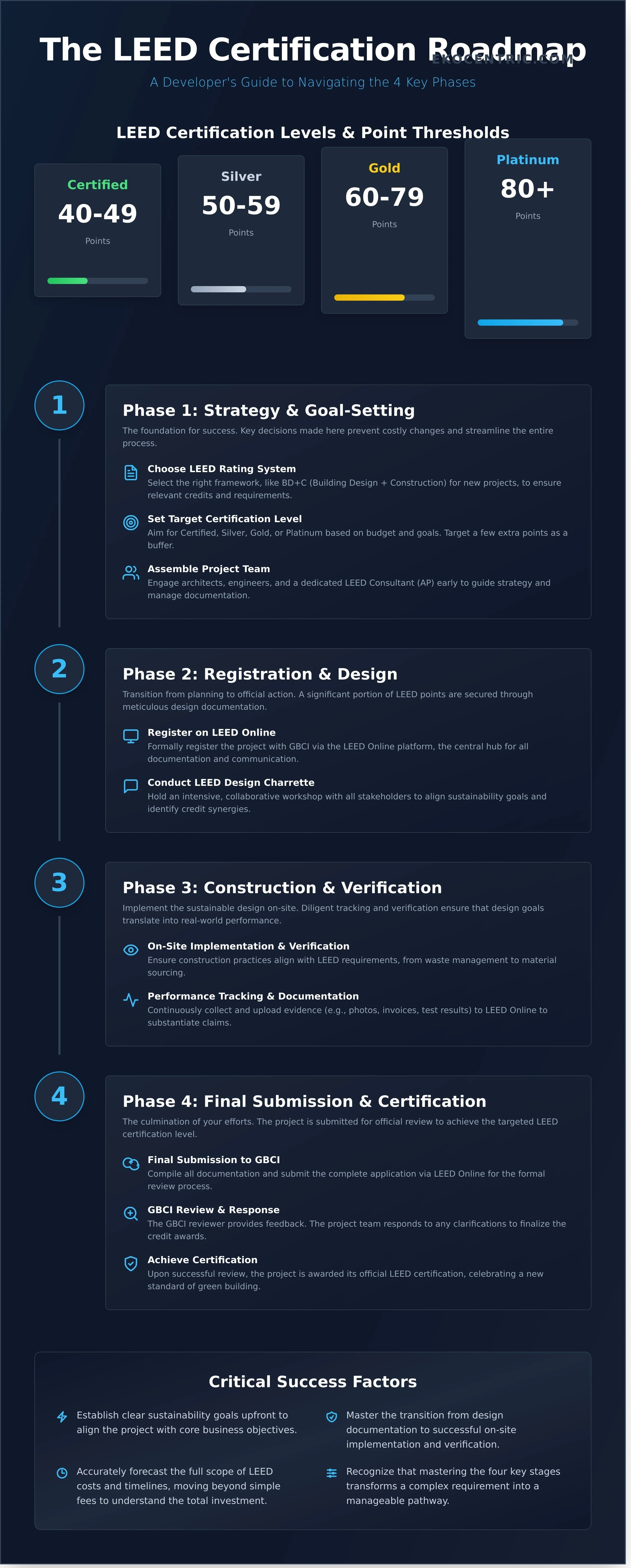
The success of the LEED certification process for developers is determined long before the first shovel hits the ground. This initial strategy phase is the most critical for a smooth journey toward achieving your green building goals. Making key decisions here-from choosing the right rating system to setting a target certification level-prevents costly changes and streamlines documentation later in the project. Proper planning doesn’t just earn points; it builds a solid foundation that aligns your sustainability vision with your business objectives.
To visualize how these initial steps come together, this overview provides a helpful introduction:
Change video
Choosing the Right LEED Rating System for Your Project
The Leadership in Energy and Environmental Design (LEED) framework is not a one-size-fits-all solution. It offers several rating systems tailored to different project types. For developers, the most common system is LEED BD+C (Building Design and Construction), which applies to new construction and major renovations. Within BD+C, there are further adaptations for specific uses like Core and Shell, Schools, Retail, and Hospitality. Matching your project scope to the correct rating system is a foundational step that ensures the requirements and credits are relevant to your building.
Setting a Target Certification Level (Certified, Silver, Gold, Platinum)
LEED certification is awarded based on a points system across various credit categories. Your target level-whether Certified (40-49 points), Silver (50-59), Gold (60-79), or Platinum (80+)-should be driven by a combination of your budget, market demands, and corporate sustainability goals. We strongly recommend conducting a preliminary LEED scorecard or feasibility study to identify achievable credits. A pragmatic strategy is to aim for a few points above your target threshold to create a buffer against unforeseen challenges during design and construction.
Assembling Your LEED Project Team
Achieving LEED certification is a collaborative effort requiring input from the owner, architect, engineers, and contractor. However, the most vital role is often the dedicated LEED consultant or Accredited Professional (AP). Many developers lack the internal bandwidth to manage the complexities of the LEED certification process for developers. Bringing a consultant on board at the very beginning is the single most effective step you can take. They guide credit strategy, manage the extensive documentation required, and ensure the entire team is aligned and accountable. Let our experts guide your project strategy.
Phase 2: Project Registration and Design Phase Documentation
With a clear strategy in place, this phase marks the transition from planning to official action. Here, you formally commit to your sustainability goals and lay the foundational groundwork for earning credits. The design stage is where a significant portion of your LEED points are secured, making meticulous documentation not just a best practice, but an absolute necessity for a smooth and successful LEED certification process for developers.
Registering Your Project on LEED Online
The first official step is registering your project with the Green Business Certification Inc. (GBCI). This is done through LEED Online, the digital platform that will serve as the central hub for all your documentation and team communication. The process involves creating an account, providing key project details (like gross floor area, project type, and chosen rating system), and paying the registration fee. This formal step, guided by the standards of the U.S. Green Building Council (USGBC), signals your unwavering commitment. It is crucial to assign specific roles to team members within the platform to streamline accountability.
The LEED Design Charrette and Integrated Design
An integrated design process begins with a charrette-an intensive, collaborative workshop that aligns all stakeholders, including architects, engineers, and the developer. This meeting is foundational for establishing shared sustainability goals and identifying synergies between different LEED credits. Key topics often include:
Optimizing the building orientation for passive solar design.
Evaluating water-efficient landscaping and fixture options.
Setting targets for energy performance through early energy modeling.
Discussing sustainable material sourcing and waste diversion strategies.
This pragmatic approach ensures every team member is working toward the same green building objectives from day one.
Documenting Design-Phase Credits
During the design phase, your team will generate the evidence needed to achieve specific credits across categories like Sustainable Sites (SS), Water Efficiency (WE), and Energy and Atmosphere (EA). For example, earning a credit for reduced parking footprint requires site plans showing the provided capacity, while optimizing energy performance requires detailed energy simulation reports. This documentation-a mix of drawings, calculations, product specifications, and narratives-is meticulously compiled and uploaded to LEED Online. A dedicated LEED consultant manages this critical task, ensuring every piece of evidence is accurate and correctly formatted to prevent costly delays during the official review.
Phase 3: Construction, On-Site Verification, and Performance Tracking
With a certified design in hand, this phase transitions your sustainable vision from paper to reality. The construction stage is where meticulous execution and rigorous documentation become paramount. Success here hinges on seamless coordination between the design team, general contractor, and subcontractors to ensure every sustainable strategy is implemented correctly. This is a critical part of the LEED certification process for developers, turning planned performance into tangible results.
Implementing and Tracking Construction-Phase Credits
This stage is about action and evidence. Your construction team must actively implement the strategies defined in the design phase and, just as importantly, track them. Key activities include diverting construction waste from landfills, sourcing materials with high recycled content, and prioritizing products with low-VOC (Volatile Organic Compound) content to ensure superior indoor air quality. Meticulous record-keeping is non-negotiable. Your team must collect and organize:
Material receipts and manufacturer cut sheets
Waste diversion tickets from hauling companies
Chain-of-custody documentation for certified wood (FSC)
Proof of purchase for regional materials
The Role of On-Site Inspections and Verification
LEED standards demand proof, not just promises. Many credits require on-site, third-party verification to confirm compliance. This can involve visual inspections, such as confirming proper insulation installation, or performance testing, like building envelope commissioning (blower door tests) and post-construction air quality testing. For projects pursuing LEED for Homes, a certified LEED Green Rater plays a mandatory role, conducting inspections and tests throughout construction to verify that all prerequisites and targeted credits are met.
Managing Submittals and Documentation
As construction progresses, a mountain of documentation is generated. The key is to manage it proactively, not retroactively. We recommend using your target LEED scorecard as a master checklist, collecting submittals from trades as they complete their work. This organized evidence must then be uploaded to LEED Online to demonstrate credit achievement. This continuous documentation is the backbone of a successful submission in the LEED certification process for developers. Overwhelmed by documentation? We manage the details for you.
Phase 4: Final Submission, GBCI Review, and Certification
This is the final stage where your unwavering dedication to sustainable construction is formally assessed. After months or even years of meticulous planning, design, and construction, your project team will compile and submit all required documentation for a comprehensive third-party review. This phase transforms your green building goals into a recognized, certified achievement.
Preparing and Submitting Your Application
Before submission, your team must decide on a review strategy. You can opt for a split review, where design-phase credits are submitted and reviewed before construction is complete, or a combined review, where all documentation is submitted at once. A split review can provide early assurance that your design is on track, which is often beneficial for financing and marketing. The project administrator then performs a final quality check on all documentation before officially submitting the application and paying the required fees via LEED Online.
Navigating the GBCI Review Process
Once submitted, your project enters the formal review stage, managed by the Green Business Certification Inc. (GBCI). This is a critical part of the LEED certification process for developers where precision is key. A GBCI reviewer will analyze your documentation, a process that typically takes 20-25 business days for the preliminary review. You will then receive comments that may:
Anticipate and award a credit as submitted.
Request clarification or additional information for a credit.
Deny a credit if documentation is insufficient.
Your team will have a set period to respond to any clarifications, providing the necessary evidence to secure your targeted credits. After your responses are submitted, the project enters a final review before a decision is issued.
Receiving Your Certification and Next Steps
Upon a successful final review, you will receive the official notification of your project’s LEED certification level: Certified, Silver, Gold, or Platinum. This is a landmark achievement worth celebrating. The USGBC will send your official certificate, a LEED plaque to display proudly on your building, and other promotional materials. It's crucial to leverage this success in your marketing efforts to highlight your commitment to sustainability and building healthier communities. Some rating systems also require ongoing performance data sharing to maintain transparency and contribute to the evolution of green building standards. Navigating these final steps efficiently ensures you can maximize the value of your hard-earned certification. For expert guidance on managing this entire process, from submission to promotion, visit us at ekocentric.com.
Understanding the Costs and Timeline of LEED Certification
A successful project hinges on realistic planning. For developers navigating the path to green building, a clear-eyed view of the investment-both in time and capital-is essential. Budgeting for LEED involves more than just USGBC fees; it requires a comprehensive financial strategy that accounts for every stage of the project. Similarly, the timeline is not an obstacle but a parallel track that, with expert guidance, integrates seamlessly into your existing construction schedule.
Breaking Down the Hard Costs (Fees)
The most direct costs in the LEED certification process for developers are the fees paid to the U.S. Green Building Council (USGBC) and Green Business Certification Inc. (GBCI). These are predictable and can be budgeted for with precision.
Registration Fee: A flat fee paid upfront to register your project with LEED Online.
Certification Fee: This is the most significant fee and is calculated based on your project's square footage and the specific LEED rating system being used.
Other Potential Costs: These can include fees for appeals, credit interpretation requests (CIRs), or expedited reviews.
It's important to note that USGBC members receive significant discounts on these fees. For the most current and detailed fee structure, we always recommend consulting the official USGBC fees page.
Understanding the Soft Costs and Potential Premiums
Soft costs are the variable expenses related to the expertise and analysis required for certification. This includes consultant fees, commissioning (Cx) agent services, and specialized analysis like energy modeling. While sometimes viewed as a "green premium," these costs are more accurately an investment in performance, efficiency, and a streamlined process. An integrated design approach, where sustainability goals are established from day one, significantly minimizes premiums on materials or systems. A dedicated LEED consultant doesn't just manage paperwork; they provide the strategic oversight to make smart, cost-effective decisions that align with your project’s goals.
Establishing a Realistic Project Timeline
A common misconception is that LEED certification significantly extends project timelines. In reality, the LEED certification process for developers is designed to run concurrently with your design and construction phases. Early and consistent planning is the key to staying on schedule. The primary addition to the timeline occurs after construction is complete, during the GBCI review periods. A typical new construction project timeline might look like this:
Design Phase: LEED goal-setting, charrettes, and credit documentation begin.
Construction Phase: Ongoing documentation, tracking of materials, and site management.
Post-Construction: Final documentation is submitted for GBCI review (approx. 20-25 business days).
Final Review: After responding to GBCI comments, a final review is conducted (approx. 12-15 business days) before certification is awarded.
With a pragmatic partner guiding you, these steps become a predictable part of your project's successful journey toward a greener future. The experts at Ekocentric have the bandwidth and experience to manage this entire process, ensuring your project stays on track and on budget.
Your Partner in Navigating the Path to LEED Certification
The journey to achieving LEED status is a structured, multi-phase endeavor that transforms a project from a simple blueprint into a high-performance, sustainable asset. As we've explored, success hinges on strategic goal-setting from the outset and diligent documentation through every stage. Mastering the LEED certification process for developers isn’t just about compliance; it’s about creating healthier, more resilient buildings that deliver long-term value for occupants and the planet.
We understand that navigating these complexities requires dedicated expertise that many development teams simply don't have the bandwidth for. At Ekocentric, we provide pragmatic guidance tailored to developers and builders. With specialized expertise in LEED BD+C and LEED for Homes, plus certified LEED Green Rater services, we integrate seamlessly with your team to manage the process efficiently and ensure your project goals are met.
Ready to bring your sustainable vision to life without the administrative burden? Schedule a consultation to discuss your LEED project goals. Let's build a greener and more sustainable future, together.
Frequently Asked Questions
What is the difference between USGBC and GBCI?
The U.S. Green Building Council (USGBC) is the visionary non-profit organization that develops and maintains the LEED green building rating systems. Think of them as the architects of the framework, setting the standards for sustainable design. Green Business Certification Inc. (GBCI) is a separate entity that manages the third-party verification and certification process. GBCI handles project reviews and awards the final certification, ensuring integrity and rigor in the process.
Can a building fail its LEED certification review?
Yes, a project can be denied LEED certification if it fails to meet all mandatory prerequisites or does not accumulate enough points for the "Certified" level. However, the process is designed to prevent this. The preliminary and final review stages provide project teams with critical feedback and an opportunity to submit clarifications or corrections. Working with an experienced consultant significantly minimizes the risk of denial and ensures a smoother path to success.
How long is a LEED certification valid for?
For new construction projects certified under systems like LEED Building Design + Construction (BD+C), the certification is valid for the building's lifetime and does not expire. It is a permanent recognition of its sustainable design. For existing buildings certified under LEED Operations + Maintenance (O+M), however, recertification is required every three years. This ensures the building maintains its high-performance operations and continues to meet rigorous sustainability benchmarks over time.
What is a LEED AP, and do I need one on my team?
A LEED Accredited Professional (AP) is an individual who has demonstrated advanced knowledge of a specific LEED rating system by passing a rigorous GBCI exam. While not technically mandatory to have one on your project, it is highly recommended. A LEED AP provides invaluable expertise, streamlines the complex documentation process, mitigates risks, and can even earn the project an additional point toward its certification goal, making them a crucial asset.
Is it possible to get LEED certification for an existing building?
Absolutely. The LEED for Operations + Maintenance (O+M) rating system is specifically designed for existing buildings to improve their sustainability. This framework focuses on measurable performance in key areas like energy and water consumption, waste management, and indoor environmental quality. Pursuing LEED O+M allows owners to benchmark performance, reduce operating costs, and enhance asset value, demonstrating an unwavering commitment to a healthier, more efficient built environment.
What are the biggest challenges developers face in the LEED process?
Developers often face two primary challenges: intensive documentation management and complex team coordination. The LEED certification process for developers requires meticulous tracking of data from architects, engineers, and contractors, which can overwhelm teams lacking dedicated bandwidth. Additionally, accurately budgeting for sustainable strategies and defining their long-term ROI requires specialized expertise to ensure that green building goals align seamlessly with the project’s financial objectives from the outset.