
Troubleshooting Your HERS Index Score: A Developer’s Guide to Lowering Energy Ratings

A perfect design model on a computer screen doesn't guarantee a passing grade when the HERS Rater arrives on site for the final blower door test. You've likely invested significant resources into your LEED or FGBC certifications, so seeing a HERS score jump by 10 points at the finish line feels like a major setback. Since the 2023 RESNET Trends Report shows the national average HERS index at 47, hitting your specific target requires precision. If you're currently troubleshooting a low HERS rating, you know that even small gaps in the thermal envelope can derail your entire energy strategy.
We understand that your reputation as a builder relies on delivering high-performance, resilient homes that meet strict energy codes. This article provides the expert insight you need to identify and fix the hidden performance gaps that inflate your ratings. We'll walk through a systematic audit of your building envelope, HVAC ductwork, and insulation installs to ensure your final numbers reflect your commitment to environmental stewardship. You'll learn how to bridge the gap between design and reality, turning unexpected rating spikes into predictable, sustainable successes.
Key Takeaways
Identify the primary energy performance gaps in HVAC efficiency, building envelope integrity, and water heating that often lead to higher-than-expected ratings.
Master the process of troubleshooting a low HERS rating by auditing software inputs against actual "as-built" conditions to catch common modeling errors.
Learn how to implement mid-build "pre-drywall" inspections and preliminary duct testing to remediate thermal bypass issues before they are sealed behind finishes.
Discover the strategic benefits of partnering with a HERS Rater during the design phase to align your project with LEED and FGBC certification standards.
Bridge the gap between design intent and field execution to ensure your residential developments deliver the high-performance results your brand promises.
Understanding the HERS Index: Why Your Score Isn’t Hitting the Target
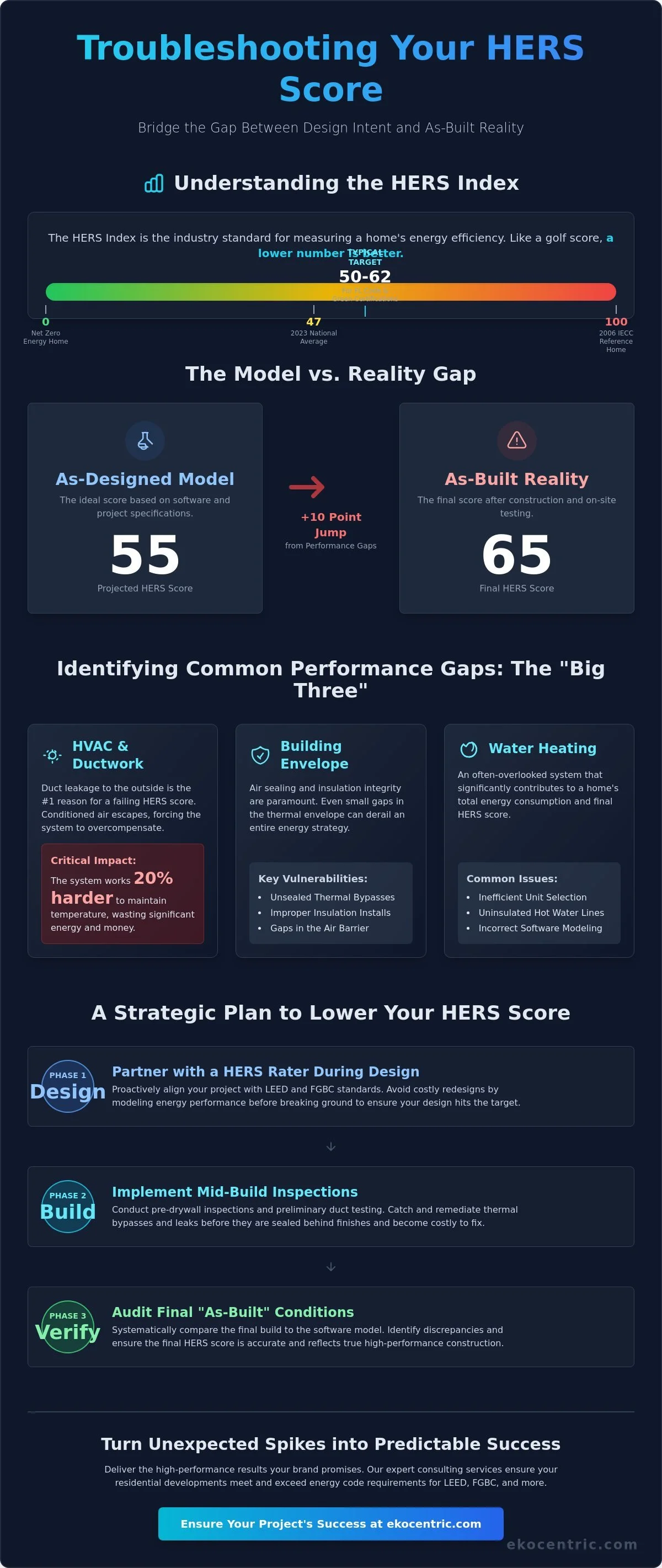
The Home Energy Rating System (HERS) serves as the definitive yardstick for residential energy performance. Unlike most metrics where high numbers indicate success, the HERS Index operates like a golf score; the lower your number, the better the home performs. A score of 100 represents the HERS Reference Home, which is based on the 2006 International Energy Conservation Code (IECC). If your project returns a score of 70, it is 30% more efficient than that 2006 baseline. When a developer is troubleshooting a low HERS rating, they are usually investigating why their "as-built" reality is falling short of the "as-designed" energy model.
Discrepancies in these ratings create immediate friction with Florida’s stringent building codes and specialized green certification programs. Whether you are pursuing FGBC (Florida Green Building Coalition) status or LEED for Homes, every point represents a hurdle or a victory for project compliance. At Ekocentric, we understand that developers don't always have the bandwidth to manage these technical nuances, which is why professional consulting services are vital for maintaining project timelines and performance goals.
To better understand how these scores impact your build, watch this helpful video:
The Math Behind the Rating
Each point on the index reflects a 1% shift in energy consumption. While the 2006 IECC serves as the baseline of 100, modern 2026 standards are pushing the industry toward much more aggressive targets. Troubleshooting a low HERS rating often involves analyzing the volume-to-surface-area ratio of the structure. Larger homes often find it easier to achieve a lower HERS score because their increased interior volume balances out the heat loss through the building envelope. This creates a paradox where a 5,000 square foot luxury home might score "better" than a 1,200 square foot cottage, even if the larger home consumes more total kilowatt-hours annually.
Common HERS Rating Goals for Developers
Most modern developers in Florida aim for scores between 50 and 62 to satisfy R406 code requirements and market demand. Hitting a score of 0 is the gold standard for Net Zero projects, requiring a heavy investment in both high-performance envelopes and renewable energy systems. Certification thresholds for LEED or FGBC often require specific sub-70 targets to qualify for silver, gold, or platinum tiers. These goals aren't just about meeting a mandate. Homes with lower HERS ratings command higher property valuations in the Florida market. Buyers prioritize resilience and lower monthly utility overhead, making a low HERS score a powerful marketing asset for any new development.
Identifying the Performance Gaps: HVAC, Insulation, and Air Sealing
When developers face a score that doesn't meet their targets, the culprit usually lies within the "Big Three": HVAC efficiency, the building envelope, and water heating systems. Troubleshooting a low HERS rating requires a surgical approach to these interconnected systems. The HERS Index serves as the industry standard for a home's energy efficiency, and even a 5% deviation in mechanical performance can spike a rating. In Florida, where humidity levels often exceed 60% and solar heat gain is constant, these gaps are magnified. Minor mechanical oversights, such as a poorly calibrated thermostat or a single unsealed thermal bypass in the attic, lead to major score inflation. These bypasses act as hidden chimneys, sucking conditioned air out of the living space and forcing systems to work overtime.
HVAC and Ductwork Deficiencies
Duct leakage to the outside remains the most frequent reason for a failing HERS score. When conditioned air escapes into unconditioned spaces like attics or crawlspaces, the system works 20% harder to maintain setpoints. Troubleshooting a low HERS rating often leads back to the duct system's integrity. Sizing also plays a critical role. An oversized AC unit cools the air too quickly without removing moisture, leading to high humidity and poor efficiency ratings. Since the January 1, 2023 transition to SEER2 standards, builders must ensure equipment meets the minimum 14.3 SEER2 requirement in the Southeast. Utilizing high-efficiency heat pumps can often drop a score by 5 to 8 points compared to traditional split systems, providing a pragmatic path to compliance.
The Building Envelope and Infiltration
Air changes per hour (ACH) measured during a blower door test reveal how much air leaks through the shell. While Florida building code allows up to 7 ACH, a HERS-competitive home typically requires 3 ACH or lower to see significant score improvements. Glass selection is equally vital. In southern climates, a Solar Heat Gain Coefficient (SHGC) of 0.25 or lower is necessary to block radiant heat from entering the home. Insulation quality is the final piece of the envelope puzzle. A Grade III installation, characterized by gaps, compression, and rounded corners, can penalize a score by several points. Achieving Grade I status requires 100% surface contact and zero voids. Our team often helps builders bridge the gap between design and execution through our sustainability management services. These details determine whether a building performs as designed or becomes an energy liability.
The Model vs. Reality Audit: Troubleshooting Software Discrepancies
The "As-Designed" model serves as a blueprint for success, yet the "As-Built" rating often reveals a different story. Discrepancies between these two stages are the primary culprits when a project fails to meet its energy targets. When you're troubleshooting a low HERS rating, your first step is a rigorous side-by-side audit of the energy model against the actual physical construction. If the field data doesn't match the design specifications exactly, the software won't reflect the building's true performance.
Energy modeling software like Ekotrope or REM/Rate relies on precise inputs. If a rater lacks specific documentation for an insulation R-value or a window U-factor, the software often reverts to "default" values. These defaults typically align with the 2006 International Energy Conservation Code (IECC) standards, which are far less efficient than modern requirements. Using a default value instead of actual product data can penalize your score by 5 to 12 points, making the difference between a passing grade and a failure.
Verifying Input Accuracy
Small errors in software entry lead to significant rating inflation. Developers should review the following specific data points with their rater:
Orientation and Shading: Check if the model accounts for the true cardinal direction and nearby structures. In sun-drenched regions, shading from an adjacent building can reduce solar heat gain by 15% to 25%, which lowers cooling loads in the model.
Lighting and Appliances: Verify that every permanent fixture is logged as a high-efficiency LED. Ensure ENERGY STAR units are documented by model number to avoid the software assuming standard, inefficient consumption rates.
Water Heater Specs: The difference between a standard electric tank and a heat pump water heater is massive. A unit with a 3.75 Uniform Energy Factor (UEF) will drastically outperform a standard 0.92 UEF tank in the final calculation.
The Rater-Builder Communication Gap
The most frequent cause of a poor rating isn't a failure of technology, but a breakdown in communication. Many developers and builders don't have the bandwidth to manage every technical detail of the sustainability side of a project. This gap leads to missing invoices or spec sheets, forcing the rater to use those conservative, "worst-case" software defaults.
For multi-family developments, the role of a LEED Green Rater is vital. They provide an extra layer of management to verify performance across complex building systems and ensure that field data matches the high-performance design. To avoid these common pitfalls, you can learn more about professional rater services that prioritize accurate, data-driven modeling. Getting the documentation right from the start ensures your HERS score reflects your commitment to a greener and more sustainable future.
Tactical Remediation: How to Lower Your HERS Score Mid-Construction
The mid-construction phase represents a critical window for troubleshooting a low HERS rating before the building envelope is finalized. Once the drywall is installed, your ability to address systemic energy leaks drops significantly. A pre-drywall inspection allows our team to identify air sealing gaps in the building shell that would otherwise remain hidden. During this walkthrough, we focus on the continuity of the air barrier and the alignment of insulation against the air barrier to prevent thermal bypassing.
Performing a preliminary duct blaster test before closing up the ceilings is a high-impact move. If the test reveals leakage higher than 4 CFM per 100 square feet of conditioned floor area, you can seal connections and plenums with mastic while they are still accessible. If your projected score is still lagging, upgrading your mechanical package is an effective pivot. Swapping a standard 14.3 SEER2 unit for a variable-speed HVAC system can often salvage a score by 3 to 5 points. Additionally, optimizing the water delivery system by shortening pipe runs or adding R-4 insulation to hot water lines reduces distribution losses and improves the overall index.
For homes struggling with high cooling loads, moving the thermal boundary to the roofline is a proven solution. Applying open-cell spray foam to the underside of the roof deck brings the attic into the conditioned space. This tactic eliminates the massive temperature swings in the attic, protecting the HVAC equipment and ductwork from 130-degree environments.
Site-Specific Fixes for Florida Homes
Florida projects require a specialized approach to manage solar gain and humidity. Adding a radiant barrier to the roof decking can block up to 97 percent of radiant heat transfer, which is vital during our high-heat months. We also recommend optimizing porch overhangs or adding exterior shading to lower the impact of the Solar Heat Gain Coefficient (SHGC) on west-facing glass. To prevent the air conditioner from over-cycling, which wastes energy and hurts your HERS score, ensure the system includes dedicated dehumidification to maintain indoor comfort without over-cooling.
Advanced Air Sealing Techniques
Effective air sealing goes beyond simple caulking. You must focus on high-leakage areas like top plates, recessed light housings, and plumbing penetrations through the subfloor. For developers seeking precision, automated sealing technologies like AeroBarrier can seal a structure to levels below 1.0 ACH50 in a single afternoon. ACH50 measures the number of times the total air volume in a home is replaced per hour when the building is pressurized to 50 Pascals. Reducing this number is the most cost-effective way to ensure a low HERS score and a resilient home.
We understand that many developers don't have the bandwidth to manage these technical details alone. Let us provide the expert oversight your project needs. Explore our HERS rating and consulting services
Strategic Performance Partnering: The Role of a HERS Rater
Engaging a HERS Rater at the tail end of a project is a common mistake that leads to avoidable delays. When a rater is brought in only for the final inspection, troubleshooting a low HERS rating becomes a costly hurdle that can stall your certificate of occupancy. A strategic partnership begins during the design phase. By reviewing blueprints and energy models before construction starts, we identify potential failures in the thermal envelope or HVAC specifications that would otherwise go unnoticed until it's too late to fix them affordably.
This early involvement creates a powerful synergy between HERS ratings and broader certifications like LEED or the Florida Green Building Coalition (FGBC). These frameworks rely on accurate energy data to validate their high-performance claims. At Ekocentric, we understand that many developers don't have the internal bandwidth to manage the intricate documentation and field verification required for these programs. We act as your dedicated sustainability arm, handling the technical heavy lifting so your team stays focused on the build.
Integrated Consulting for Better Outcomes
Shifting your focus from simple code compliance to high-level performance is a significant brand differentiator. Buyers in the 2024 market increasingly prioritize efficiency and indoor air quality. Third-party verification doesn't just improve your score; it reduces developer liability by providing documented proof that the home performs as promised. Our team ensures that every component, from insulation installation to duct sealing, meets rigorous standards. You can explore our comprehensive consulting services to see how we integrate these checks into your existing workflow. Proactive modeling and site visits ensure that troubleshooting a low HERS rating isn't something you have to worry about during the final walkthrough.
The Future of Energy Ratings
The industry is moving rapidly toward the Energy Rating Index (ERI) as a primary metric in building codes. This shift reflects a global move toward carbon-neutral standards. Building for 2026 and beyond requires a focus on resilience. Homes must be able to withstand fluctuating energy costs and more extreme weather patterns while maintaining comfort. This isn't just about environmental stewardship. It's a pragmatic business strategy. High-performance buildings see fewer warranty claims and higher resale values. Sustainability is no longer just a badge to wear on a marketing brochure. It's a fundamental requirement for long-term financial success in the modern real estate market. Partnering with an expert rater ensures your projects remain relevant, compliant, and profitable as standards continue to evolve.
Build Better with Precision Energy Management
Success in sustainable development depends on closing the gap between your initial energy model and the final field inspection. Troubleshooting a low HERS rating often reveals that small discrepancies in HVAC duct sealing or insulation alignment are the primary culprits behind high scores. Addressing these performance gaps mid-construction ensures your project stays on track for essential certifications without the need for expensive retrofits after the drywall is up. It's about moving beyond the software and focusing on the tactical reality of the job site.
Our team brings a proven track record with LEED for Homes and BD+C projects to every site we visit. As Certified RESNET HERS Raters with deep expertise in Florida-specific FGBC standards, we provide the technical oversight many developers lack the internal bandwidth to manage. We focus on pragmatic solutions that turn energy challenges into measurable results for your building's resilience and efficiency. We've helped numerous partners navigate complex requirements to achieve superior building performance.
Ready to optimize your next project? Partner with Ekocentric for Expert HERS Rating and LEED Services to ensure your builds meet the highest industry standards. We're here to help you lead the way toward a greener, more sustainable future.
Frequently Asked Questions
Why is my HERS score higher than the design model predicted?
Your HERS score often exceeds the design model due to performance gaps during the construction phase. While the design assumes Grade I insulation, a rater might find Grade III installation with significant voids. According to RESNET standards, small gaps in the thermal envelope can increase a score by 3 to 5 points. Troubleshooting a low HERS rating starts with verifying that the field team matched the exact specifications of the original energy model.
Can I lower my HERS score after the house is finished?
You can lower your score after completion, though options are more limited than during the framing stage. Upgrading to LED lighting or ENERGY STAR certified appliances can reduce a score by 2 to 3 points. If the blower door results were higher than expected, applying aerosol-based duct sealing can often improve the rating by 1 to 2 points without opening finished walls or ceilings.
How much does a 10-point drop in a HERS score actually save in energy costs?
A 10-point drop in a HERS score typically correlates to a 10% reduction in the home's annual energy consumption. For a standard 2,000 square foot home, this improvement translates to approximately $150 to $250 in annual utility savings based on 2023 national average electricity rates. These savings provide a tangible ROI for buyers and enhance the long-term resilience of the property for future generations.
What is the most cost-effective way to lower a HERS rating in Florida?
Optimizing the cooling system and building envelope is the most cost-effective strategy in Florida's humid climate. Switching from a SEER2 14.3 unit to a SEER2 16 unit can drop a score by 4 to 6 points. Using windows with a Solar Heat Gain Coefficient (SHGC) below 0.23 prevents heat transfer, which is vital for troubleshooting a low HERS rating while maintaining a comfortable indoor environment.
Does a larger house automatically get a better HERS score?
Larger houses don't automatically receive better scores because the HERS Index is a relative scale compared to a Reference Home of the same size. However, larger homes often have a lower surface-area-to-volume ratio, which can make it easier to achieve a lower score than a small cottage. A 4,000 square foot home might reach a HERS 50 more easily than a 1,200 square foot unit using identical building materials.
How does the Florida Green Building Coalition (FGBC) use HERS ratings?
The Florida Green Building Coalition uses the HERS Index as the primary metric for its Energy category. Projects must achieve a maximum HERS score of 70 to qualify for Bronze certification under the 2023 Version 4.0 standards. Lower scores earn additional points, helping developers reach Silver or Gold tiers by demonstrating an unwavering dedication to superior energy performance and sustainable construction practices throughout the state.
Is a blower door test mandatory for a HERS rating?
A blower door test is a mandatory requirement for every confirmed HERS rating according to RESNET standards. This test measures the air exchange rate of the building envelope at 50 Pascals of pressure. Without this verified data point, a Rater can't generate a final HERS certificate. It ensures the home meets the air leakage requirements specified in the 2020 Florida Building Code, Energy Conservation, for all new residential projects.
What happens if my project fails to meet the target HERS score for LEED?
If a project misses its target HERS score, it may lose points in the LEED for Homes Energy and Atmosphere category. This shortfall can drop the certification level from Gold to Silver. Developers must then implement rapid remediation, such as upgrading to higher-efficiency water heaters. Our team acts as a pragmatic partner, identifying the specific 1 or 2 point adjustments needed to restore compliance before the final submission deadline.