
2026 Florida Building Code R407: Energy Compliance Guide
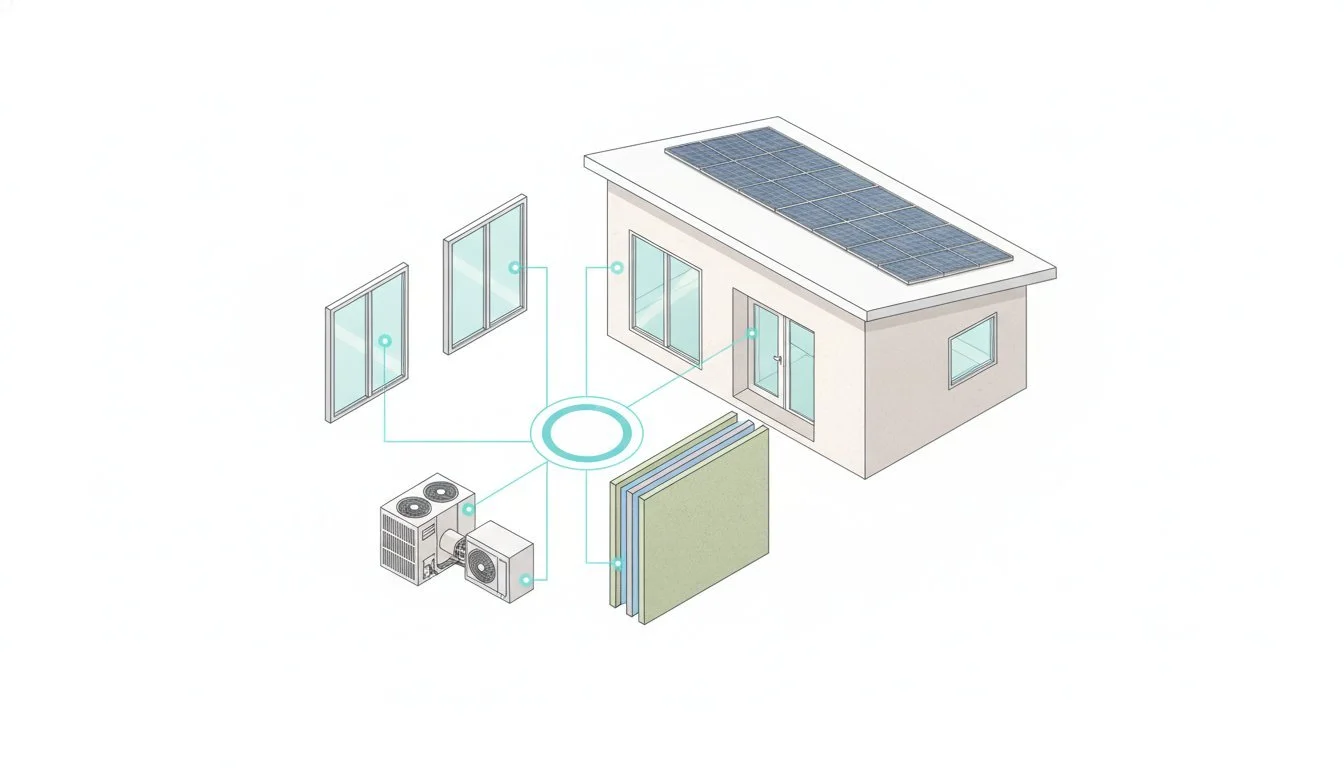
What if the most rigid path to building compliance actually offered the greatest flexibility for your next high-performance project? Developers often view energy mandates as a bottleneck for architectural creativity, but the 9th Edition of the Florida Building Code introduces a shift that changes the calculation. You might be asking, what is the R407 section of the 2026 Florida Building Code? It's a mandatory credit-based system for the prescriptive path that requires projects to earn at least 10 efficiency credits from a diverse menu of options. While it adds a layer of complexity for permits submitted on or after December 31, 2026, it also provides a structured way to balance envelope improvements with mechanical upgrades without over-engineering the entire structure.
We know that balancing strict efficiency mandates with aesthetic design goals feels like a constant struggle, especially when navigating the transition to new standards. This guide from Ekocentric will help you master the technical nuances of Section R407 to optimize building performance and secure better certification outcomes. We'll explore how these requirements integrate with LEED and NGBS standards, compare the prescriptive path to the R405 Simulated Performance Alternative, and provide a framework for choosing the most cost-effective compliance strategy for your projects in Florida.
Key Takeaways
Understand the answer to "What is the R407 section of the 2026 Florida Building Code?" by exploring the new mandatory 10-credit efficiency menu required for all prescriptive compliance paths.
Compare the strategic differences between the prescriptive, simulated performance, and Energy Rating Index paths to select the most cost-effective compliance strategy for your project.
Learn how to leverage compliance data from the 9th Edition code to streamline your pursuit of higher-tier certifications like LEED Green Rater or NGBS verification.
Identify how the reduction in allowable performance e-Ratios and new mandatory field testing requirements will impact your building envelope and mechanical design decisions.
Discover how partnering with technical experts can help you avoid over-engineering while ensuring your projects in the Southeast and across the US meet the December 31, 2026, deadline.
Table of Contents
Understanding Section R407: The Simulated Performance Alternative
Navigating the 2026 Code: How Ekocentric Optimizes Your Project
Understanding Section R407: The Simulated Performance Alternative
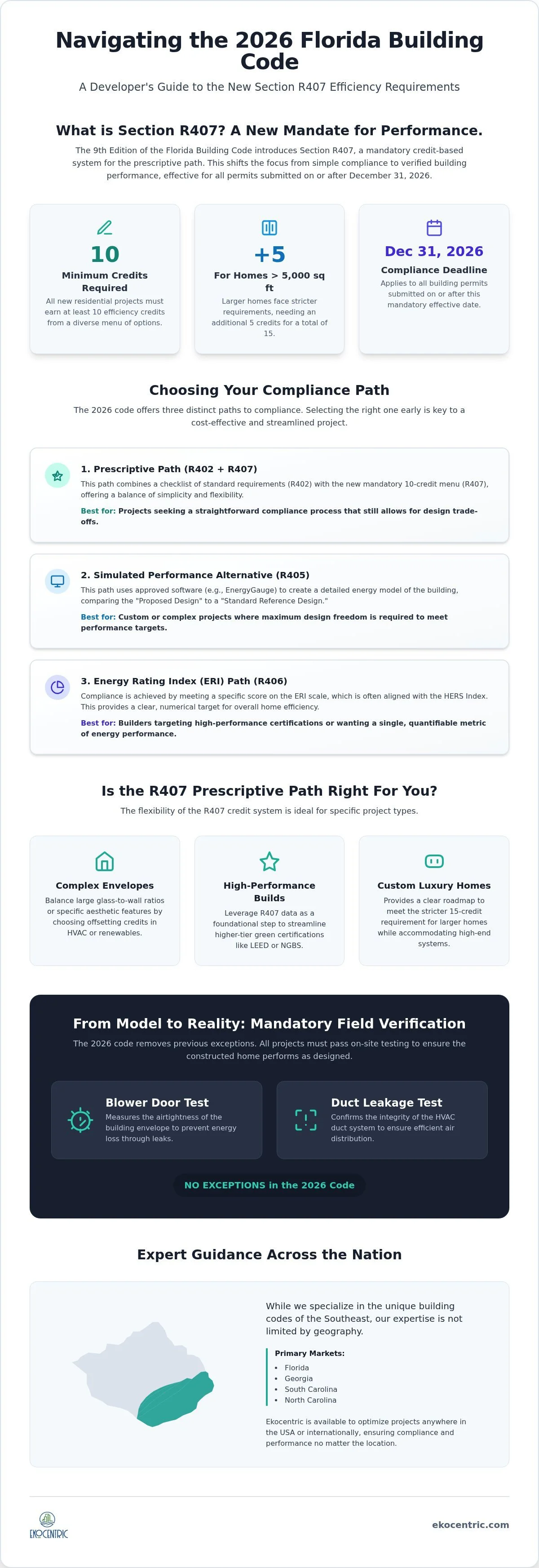
The transition to the 9th Edition of the Florida Building Code, which becomes mandatory for permits submitted on or after December 31, 2026, marks a significant shift in energy conservation strategy. While previous cycles offered simpler distinctions, the 2026 code introduces a more nuanced framework. You might be asking, what is the R407 section of the 2026 Florida Building Code? Technically, R407 is the "Additional Efficiency Requirements" section. It's a mandatory credit-based system designed to ensure that even projects following the prescriptive path achieve high-performance outcomes. This section isn't just a hurdle; it's a tool for flexibility that allows builders to choose their own path toward environmental stewardship.
The Logic of Performance-Based Compliance
In the 2026 code cycle, the prescriptive path (R402) now requires projects to earn at least 10 credits from a menu of efficiency measures. If your home exceeds 5,000 square feet, that requirement jumps by an additional 5 credits. This credit system allows for strategic trade-offs. For example, if your design requires a specific building envelope feature that isn't traditionally efficient, you can offset that by selecting higher-efficiency HVAC systems or renewable energy options from the R407 menu. While the R405 Simulated Performance Alternative still uses computer modeling to compare a "Proposed Design" against a "Standard Reference Design," the R407 credits provide a structured way to hit performance targets without the full complexity of a total building simulation. It's about ensuring the constructed home actually performs as intended, which is why we focus on performance optimization rather than just checking boxes.
Who Should Use the R407 Path?
The R407 credit framework is ideal for developers and architects who want the simplicity of the prescriptive path but need the flexibility to accommodate modern design trends. It's particularly useful for:
Projects with complex envelopes: If your design features large glass-to-wall ratios or high SHGC requirements, the R407 menu lets you balance those choices with other efficiency credits.
High-performance builds: Developers aiming for LEED BD+C or NGBS certifications can use R407 data as a baseline for more advanced green building verifications.
Custom luxury homes: Since larger homes face stricter credit requirements, the R407 path provides a clear roadmap for integrating high-efficiency mechanical systems and lighting.
We've seen that choosing the right path early prevents costly over-engineering later. Whether you're building in the Southeast or managing a project elsewhere in the US, understanding how these credits interact with your overall design is the key to a seamless permit process and a superior living space.
The Modeling Mechanism: How R407 Compliance is Calculated
Calculating energy compliance for the 9th Edition requires more than a simple checklist. It demands a technical validation of your design's environmental impact through precise modeling. When professionals ask, what is the R407 section of the 2026 Florida Building Code? they're often looking for the specific methodology used to prove a building meets the new 10-credit efficiency threshold. This process relies on software validated by the Florida Building Commission, such as EnergyGauge or REM/Rate. These tools process variables like thermal envelope performance, mechanical system efficiency, and lighting requirements to generate a "Proposed vs. Reference" report. This document is the primary evidence building officials review to grant a permit.
Field verification is the final, non-negotiable step in this mechanism. The 2026 code removes previous exceptions for duct leakage testing, meaning every project must now undergo rigorous Blower Door and Duct testing. This ensures the theoretical model matches the actual construction, protecting the long-term resource efficiency of the home. By confirming that the building envelope is tight and the HVAC distribution is sealed, we bridge the gap between design intent and real-world performance.
Approved Software and Compliance Reports
For permits submitted after the December 31, 2026, deadline, using the correct software version is critical. The 9th Edition is based on the 2024 IECC, so your reporting must reflect these updated baselines. Building officials look for Form R407-2026, which details how your project earns its mandatory 10 credits. Ensuring total consistency between your architectural plans and this energy report prevents costly delays. If you're unsure which path fits your project, our performance optimization services can help you navigate these technical requirements across Florida, Georgia, and the Carolinas.
The Role of the Energy Consultant
A certified RESNET HERS Rater is your most valuable partner in this process. By involving a consultant during the design phase, you can model different credit combinations to find the most cost-effective path. This proactive approach identifies potential failures before they become expensive field corrections. There's also a powerful synergy between R407 modeling and ENERGY STAR Rater services. Since the data sets overlap, we can often leverage your code compliance modeling to streamline higher-level green certifications. This integrated strategy works whether your project is in the Southeast or anywhere else in the US.
R407 vs. R402 vs. R406: Choosing the Right Compliance Path
Selecting a compliance path isn't just a legal necessity; it's a strategic business decision that affects your project's bottom line and design integrity. When developers ask, what is the R407 section of the 2026 Florida Building Code? they're usually trying to determine if the performance path offers a better return on investment than the prescriptive or ERI alternatives. The 9th Edition offers three primary routes, each with distinct advantages depending on your building's complexity and your sustainability goals. Choosing the wrong one can lead to over-engineered assemblies that drive up construction costs without a proportional increase in value.
R402 represents the prescriptive path, which functions as a rigid baseline for simple structures. R406, the Energy Rating Index (ERI) path, relies on a HERS score to prove compliance. In contrast, R407 provides the maximum flexibility for custom builds by using total building performance modeling. This path is often the most cost-effective choice for modern architecture because it allows for high-performance trade-offs that the other paths simply don't permit.
Prescriptive Limitations (Section R402)
The prescriptive path is essentially a "pass/fail" checklist. While this might seem easier for small-scale residential projects, it often leads builders into the "insulation trap." This happens when the code requires R-values so high that they become cost-prohibitive or physically impossible to install within standard wall cavities. High-end architecture frequently fails R402 because of fenestration limits; the prescriptive path strictly regulates the amount of glass you can use. If your design features expansive views or unique window placements, the rigid requirements of R402 will likely stall your permit process or force unwanted design changes.
The Performance Advantage (Section R407)
The performance path allows you to trade off lower insulation levels for high-efficiency mechanical systems or superior window ratings. This is where creative architectural features like vaulted ceilings and floor-to-ceiling glass become viable. By modeling the entire building's energy use, we can prove that a home with more glass but a high-efficiency HVAC system meets the new 0.85 e-Ratio target. For multi-family projects, R407 often beats the R406 ERI path by allowing for more nuanced modeling of shared walls and centralized systems. Whether you're building in the Southeast or managing a national portfolio, our performance optimization services ensure you select the path that protects both your design vision and your budget.
Leveraging R407 for Green Building Certifications
Building to code shouldn't be the final goal for a visionary developer. Instead, it serves as the essential foundation for achieving prestigious environmental certifications. When we define what is the R407 section of the 2026 Florida Building Code, we're describing a robust data set that directly supports LEED, NGBS, and other leading green building program outcomes. By using an integrated design process, we can leverage the mandatory energy modeling required for R407 to satisfy the rigorous documentation needs of these higher-tier green building programs. This approach turns a regulatory requirement into a strategic asset.
The synergy between state-level mandates and national standards is where project efficiency truly shines. For projects in Florida, Georgia, and the Carolinas, the data generated for the 9th Edition compliance report often accounts for a significant portion of the evidence needed for a LEED Green Rater. This streamlined approach reduces administrative overhead and ensures that your sustainability goals are baked into the project from the very first model. It's a pragmatic way to prove your commitment to environmental stewardship while maintaining a focus on business realities.
Connecting Code to LEED and NGBS
The R407 performance model provides a clear pathway for earning points in the LEED BD+C Energy & Atmosphere category. Because the 2026 code is based on the 2024 IECC, the baseline for compliance is already quite high. This means a project that successfully navigates R407 is often just a few strategic upgrades away from a Silver or Gold LEED rating. Similarly, our NGBS Green Verifiers utilize these performance reports to validate credits in the Energy Efficiency chapter of the National Green Building Standard. For state-specific projects, aligning these models with leading regional green building requirements ensures your building is recognized for its localized performance. Explore our LEED Green Rater services to see how we bridge this gap.
Optimizing Building Performance Beyond Code
We believe that code minimum is the floor, not the ceiling. While R407 ensures a building is legally compliant, it's the beginning of a conversation about long-term resource efficiency. Using the R407 model, we can project operational costs over the building's lifecycle, providing owners with tangible proof of their investment's value. This modeling also integrates seamlessly with ENERGY STAR requirements. By aligning your R407 workflow with ENERGY STAR Partner standards, you create a high-quality living space that stands out in the market. Whether you're working in the Southeast or anywhere else in the US, our role is to turn these technical requirements into a competitive advantage for your brand.
Ready to move beyond basic compliance? Consult with our NGBS Green Verifiers to optimize your next project.
Navigating the 2026 Code: How Ekocentric Optimizes Your Project
The 9th Edition of the Florida Building Code represents a significant leap toward a more sustainable future, but it also introduces new operational hurdles for project leads. Understanding what is the R407 section of the 2026 Florida Building Code is only the first step. The real challenge lies in integrating these mandatory efficiency credits into a cohesive design that remains cost-effective. At Ekocentric, we don't just provide a compliance report; we act as a pragmatic partner. By combining our background as licensed Florida Building Contractors with technical energy modeling expertise, we ensure your project achieves its environmental goals without the burden of over-engineering.
Our approach focuses on cause and effect. We analyze how a specific insulation choice or HVAC system impacts your overall credit count under Section R407. This allows you to make informed decisions that protect your design aesthetics while meeting the strict December 31, 2026, deadline. While our roots and deep expertise are firmly planted in the Southeast, serving Florida, Georgia, North Carolina, and South Carolina, our team is available to support projects anywhere in the USA or internationally. We bridge the gap between complex energy modeling and practical construction realities.
Comprehensive Certification Support
We specialize in managing the intersection of building codes and high-tier green standards. Whether you need a LEED Green Rater or an NGBS Green Verifier, we provide the technical validation required for success. Our dual perspective as contractors and consultants means we understand the realities of the job site as well as the nuances of the modeling software. This ensures that the credits earned in the energy model are actually achievable during the construction phase. View our full range of sustainability consulting services to see how we can streamline your path to certification.
Next Steps for Your 2026 Project
When you ask, what is the R407 section of the 2026 Florida Building Code? the answer depends heavily on your specific project type and size. Timing is everything when navigating these 2026 code changes. We recommend engaging our team during the initial design charrette phase. This early collaboration allows us to model various R407 credit combinations before the first permit application is even drafted. It's the most efficient way to ensure your project is ready for the new performance e-Ratio requirements and mandatory field testing. Proactive modeling prevents the need for expensive mid-construction changes that can derail a budget.
Don't let technical modeling become a bottleneck for your next development. Contact Ekocentric today for a project performance audit. Let us handle the complexities of energy compliance while you focus on building exceptional, high-quality living spaces.
Securing Your Project’s Future Under the 9th Edition
Mastering the transition to the 2026 code cycle is about more than avoiding permit delays; it's an opportunity to elevate your building's performance and market value. By understanding what is the R407 section of the 2026 Florida Building Code?, you gain a flexible credit-based framework that balances architectural vision with resource efficiency. These technical requirements shouldn't be viewed as obstacles but as the foundation for higher-tier green building outcomes that resonate with modern owners and developers. Proactive modeling ensures that your design choices remain cost-effective while meeting the mandatory performance targets.
As a Licensed Florida Certified Building Contractor, NGBS Green Verifier, and RESNET HERS Rater, Ekocentric is dedicated to simplifying this complex landscape. We provide the expert technical modeling and field verification needed to ensure your projects in Florida, Georgia, and the Carolinas, or anywhere across the US and beyond, succeed. Don't let new mandates disrupt your workflow or lead to over-engineering. Partner with Ekocentric for Expert R407 Compliance and Green Certification to turn regulatory hurdles into a strategic advantage. The path to a high-performance future is clear and achievable with the right expertise by your side.
Frequently Asked Questions
What is the primary difference between Section R402 and R407 in the Florida Building Code?
Section R402 is the traditional prescriptive path, which follows a rigid checklist of requirements for insulation and windows. In the 2026 code, R407 is a new mandatory addition for prescriptive projects, requiring them to earn 10 credits from a menu of efficiency measures. This differs from the R405 path, which is the Simulated Performance Alternative. While R402 and R407 focus on specific component upgrades, R405 uses total building modeling to compare your design against a reference home.
Does Section R407 require a blower door test for compliance?
Yes, on-site testing is mandatory for all residential projects under the 9th Edition. The 2026 code removes previous exceptions for duct leakage testing and reinforces the requirement for blower door testing to verify the building envelope's integrity. These tests ensure that the efficiency modeled during the design phase is actually achieved in the field. Our team provides these essential testing services to confirm your project meets every technical requirement for permits submitted after December 31, 2026.
Can I use R407 for multi-family residential projects in Florida?
You can certainly use this path for multi-family residential projects that fall under the Florida Building Code, Residential. Whether you're building a single-family home or a multi-unit development, the 10-credit requirement applies to any project following the prescriptive path. For larger multi-family buildings, we often recommend comparing this to the R405 or R406 paths to determine which provides the best balance between construction costs and design flexibility. We serve multi-family developers across the Southeast and NATIONALLY.
What software is approved for 2026 Florida Building Code R407 modeling?
The Florida Building Commission approves specific software tools for energy modeling, including EnergyGauge and REM/Rate. For the 2026 cycle, it's vital to use versions updated for the 9th Edition, which is based on the 2024 IECC. These tools must accurately calculate the 10-credit requirement for R407 or the 0.85 e-Ratio for performance paths. We handle the technical modeling using these approved tools to ensure your permit submittal is accurate and compliant with the latest statewide construction standards.
How does Section R407 impact the cost of a new home build?
What is the R407 section of the 2026 Florida Building Code? It's a credit-based system that can actually help manage construction costs by providing design flexibility. Instead of being forced into expensive insulation upgrades, you can choose more affordable credits from a diverse menu, such as high-efficiency lighting or HVAC systems. This allows for a more balanced budget while still achieving the mandatory performance levels required for permits. Strategic credit selection prevents over-engineering and protects your project's bottom line.
Is a HERS rating required if I choose the R407 compliance path?
A HERS rating is not strictly mandatory if you follow the R407 prescriptive credit path, as that's the foundation of the R406 ERI path. However, engaging a certified RESNET HERS Rater is highly recommended for any compliance route. A rater provides the technical expertise needed to model your project accurately and identify the most cost-effective efficiency credits. Their involvement ensures your building meets the 2026 standards while simplifying the path to higher certifications like LEED or NGBS.
What happens if my building fails the R407 performance model during construction?
If the initial model fails to meet the performance targets or the 10-credit threshold, we work with you to adjust the design variables. This might include upgrading HVAC efficiency, improving window SHGC ratings, or increasing insulation in specific areas. The goal is to find a compliant combination before you break ground. Early-stage modeling prevents expensive field corrections and ensures the final construction meets all mandatory 2026 code requirements without unexpected delays or costly reconstruction efforts.
How does the R407 section relate to Florida Green Building Coalition (FGBC) certification?
Section R407 data provides the essential baseline for Florida Green Building Coalition (FGBC) certification. Since the 2026 code requires a high level of efficiency, the data captured for your code compliance report satisfies many of the energy credits needed for FGBC. We use this integrated data to streamline the certification process for our clients. This ensures that your building doesn't just meet the legal minimum but also achieves recognized sustainability excellence in the Florida market and beyond.