
Guide to Florida Building Code Duct Testing: R405-R408
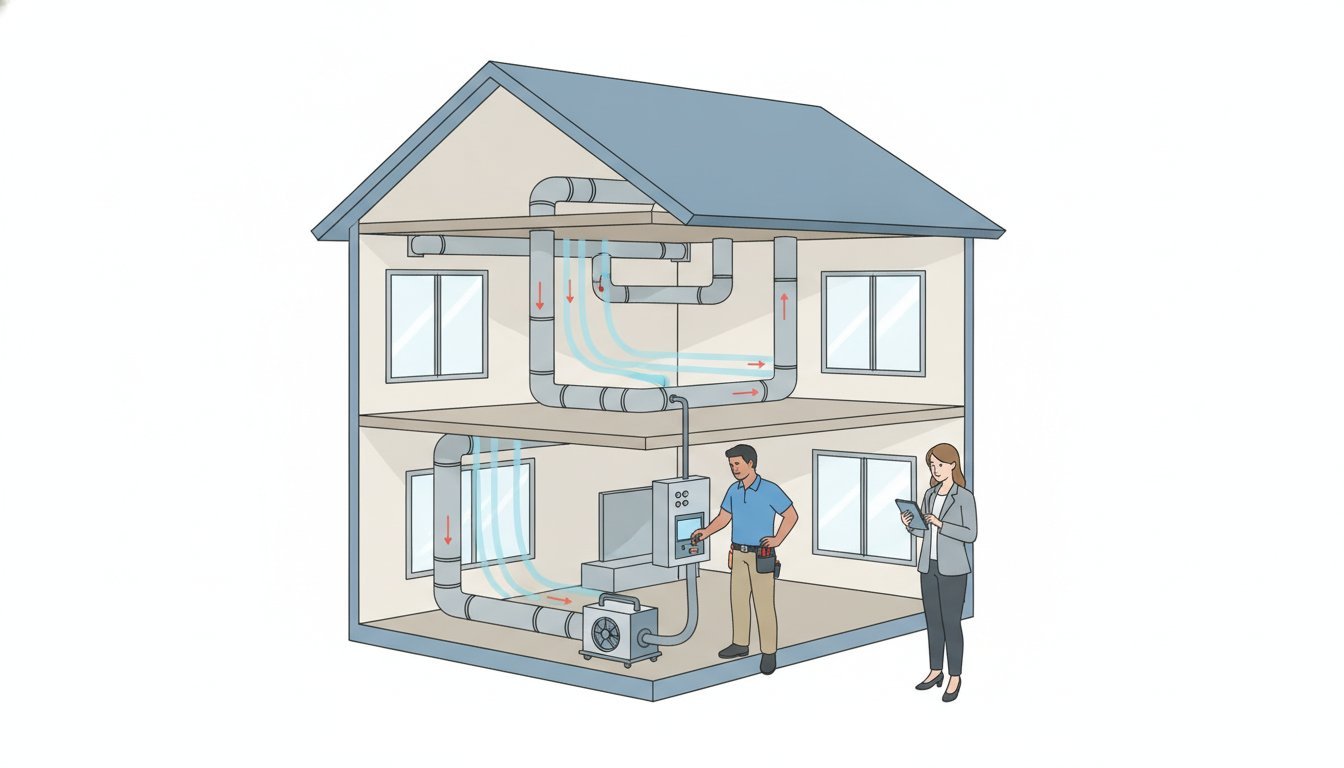
The 9th Edition of the Florida Building Code transforms duct testing from a technical hurdle into a mandatory cornerstone of residential energy performance. You may be asking what is duct testing and Florida Building Code and R405 R407 R408 compliance as you face the new 0.85 e-Ratio requirement and unexpected costs on projects that were previously exempt. We know it's difficult to balance energy credits to meet these stricter standards while keeping your project on schedule. Whether you're developing in Florida, Georgia, or the Carolinas, these shifting mandates require a pragmatic approach to stay ahead of the curve.
Our mission at Ekocentric is to turn these regulatory challenges into opportunities for superior building performance. This guide will help you master the complexities of the latest code cycle and learn how new mandates impact your next residential project. Whether you're working in the Southeast or anywhere across the country, we'll provide the technical roadmap you need. We'll preview the specific triggers for R405 versus R407, explain the nuances of R408, and show you how to achieve compliance without delays. By the end of this article, you'll have the expertise to optimize your projects for higher certification levels while maintaining practical business efficiency.
Key Takeaways
Understand how the 9th Edition Florida Building Code shifts duct testing from a technical hurdle to a mandatory performance metric for all residential projects.
Identify what is Duct Testing and Florida Building Code and R405 R407 R408 requirements to effectively choose between Simulated Performance and Tropical Zone compliance paths.
Prepare for the December 31, 2026, deadline by learning how project vesting rules and the new 0.85 e-Ratio impact your development timeline.
Discover how to integrate mandatory testing into higher-tier certifications like LEED BD+C and NGBS to move beyond code minimums toward high-performance results.
Leverage specialized expertise available across the Southeast and nationwide to ensure seamless code compliance and optimized building energy efficiency.
Table of Contents
What is Duct Testing and Why is it Essential for Compliance?
Duct leakage testing is a diagnostic procedure used to measure the airtightness of an HVAC distribution system. It's a critical step for any builder committed to environmental stewardship and operational excellence. When professionals ask what is Duct Testing and Florida Building Code and R405 R407 R408, they're often seeking a way to quantify how much conditioned air is being wasted. Leaky ducts don't just inflate utility bills; they compromise indoor air quality by drawing dust and allergens from unconditioned spaces into the living areas. By ensuring a sealed system, you protect both the building's longevity and the health of its occupants.
We quantify these leaks using CFM25, which stands for Cubic Feet per Minute at 25 Pascals of pressure. This standard metric allows us to provide a clear picture of system integrity. For projects in Florida, Georgia, and the Carolinas, the code makes a vital distinction between Total Leakage and Leakage to Outdoors. While total leakage measures every gap in the system, leakage to outdoors specifically tracks air lost to the exterior environment. Mastering these technical nuances is essential for navigating the performance paths of the 9th Edition and avoiding project delays.
The Role of the Energy Auditor and HERS Rater
Reliable performance data depends on independent, third-party verification. As a RESNET HERS Rater, our role is to provide an objective assessment that links duct integrity directly to the home's HERS Index. A tighter duct system leads to a better score, which increases the market value and comfort of the property. We don't view this as a hurdle. Instead, we see it as a pragmatic partnership. Ekocentric integrates these results into our specialized consulting services to help you reach higher certification goals like LEED Green Rater verification or NGBS compliance. This expertise is vital for those clarifying what is Duct Testing and Florida Building Code and R405 R407 R408 for their project teams.
Testing Methods: Rough-In vs. Post-Construction
Strategic timing can save your project from significant costs. We advocate for rough-in testing, which occurs before the drywall is hung. This proactive approach identifies leaks while the HVAC components are still exposed and easy to seal. It's a pragmatic solution that prevents the frustration of failing a final inspection. While rough-in testing is a best practice, a post-construction test is required for the Certificate of Occupancy. Our team utilizes advanced duct blasters and digital pressure gauges to ensure your project meets the specific leakage limits defined by the Florida Building Code, whether you're building in the Southeast or anywhere across the country.
The 2026 Florida Building Code: Navigating the 9th Edition
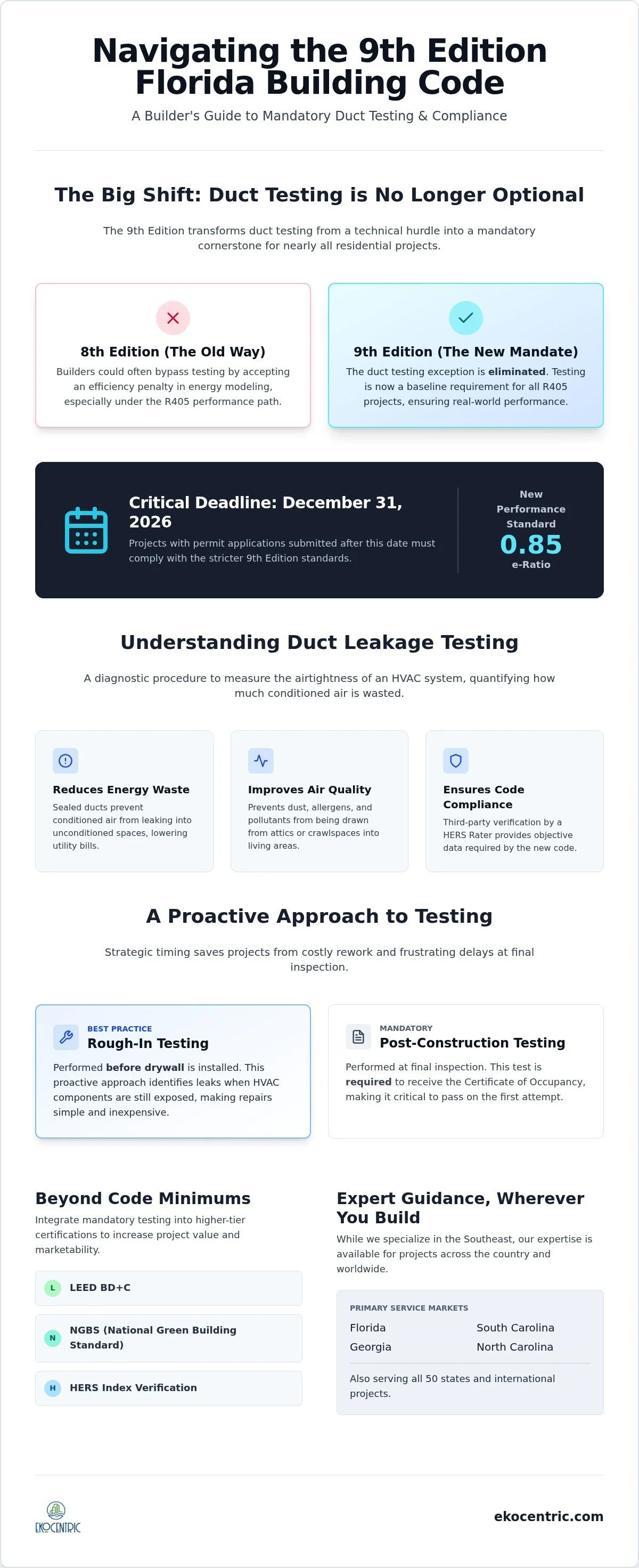
The regulatory landscape for residential construction is entering a transformative phase with the arrival of the 9th Edition Florida Building Code (Energy Conservation). This update represents a significant commitment to resource efficiency and environmental stewardship. The critical deadline is December 31, 2026. Projects that submit permit applications before this date are typically vested under the current 8th Edition, but any project permitted after this cutoff must meet the more rigorous 9th Edition standards. When developers evaluate what is Duct Testing and Florida Building Code and R405 R407 R408 compliance, they must recognize that the new code eliminates many of the performance trade-offs found in previous iterations.
Florida's updated code aligns more closely with the 2024 International Energy Conservation Code (IECC) standards. This shift is not just about meeting a checklist; it's about creating high-quality living spaces that stand the test of time. One of the most impactful changes is the removal of the duct testing exception for R405 performance-path projects. In the past, builders could sometimes bypass testing by accepting a specific efficiency penalty in their energy modeling. Under the 9th Edition, this option is gone. Testing is now a baseline requirement for almost every residential project, ensuring that the theoretical efficiency of a design matches its real-world performance.
Mandatory Testing Requirements for New Construction
The 9th Edition makes it clear that duct testing is no longer optional for R405 projects. Every system must be verified unless the entire duct distribution system is located within the thermal envelope. Even in those rare cases, builders are finding that mandatory mechanical ventilation testing is becoming the new norm. Our team helps developers streamline these technical requirements to ensure every project remains on track and fully compliant with the latest mandates.
Impact on Builders in Georgia and the Carolinas
While the Florida Building Code sets a high bar, builders in Georgia, South Carolina, and North Carolina are seeing similar trajectories in their own state energy codes. Multi-state developers face the challenge of managing varying standards across borders. We advocate for a standardized HVAC quality control process that meets the strictest requirements of the 9th Edition regardless of the project's location. This pragmatic approach reduces operational confusion and ensures a consistent level of building excellence. Whether you are working in the Southeast or managing a national portfolio, we provide the regional expertise and specialized consulting needed to navigate these evolving energy standards successfully.
Decoding Compliance Paths: R405, R407, and R408
Achieving compliance in the 9th Edition requires more than a simple checklist. While the prescriptive path under R402 offers a straightforward route, its rigid requirements often stifle architectural innovation and increase material costs. This is why most developers in Florida, Georgia, and the Carolinas opt for performance-based paths. To move forward, you need to understand what is Duct Testing and Florida Building Code and R405 R407 R408 compliance in the context of your specific site. These sections represent a hierarchy of performance that allows for flexibility while demanding higher levels of environmental stewardship.
The R407 Tropical Zone Compliance Path is a specialized option for projects located in specific geographic areas, such as the Florida Keys or other designated tropical regions. It rewards designs that prioritize natural ventilation and solar heat gain reduction. However, for the majority of residential projects, the choice lies between the prescriptive path and the R405 performance alternative. As building standards tighten, the prescriptive route is becoming less practical for modern, high-performance homes that feature expansive glass or complex footprints.
R405: The e-Ratio Challenge
The Simulated Performance Alternative, or R405, uses energy modeling to compare your design against a standard reference home. The most significant change in the 2026 code is the drop in the required e-Ratio from 0.95 down to 0.85. This 10% tightening is a bold step toward resource efficiency. It means your building must perform 15% better than the baseline code home. Duct testing is a non-negotiable factor in this calculation. High duct leakage can easily tank your e-Ratio score, forcing you to invest in more expensive upgrades like high-performance windows or additional insulation to compensate for the lost efficiency.
R408: Picking Your Efficiency Credits
Section R408 introduces Additional Efficiency Package Options. This is a separate requirement that sits alongside your chosen compliance path. Builders must select specific credits to demonstrate they've gone beyond the baseline. The 2026 options typically include:
Enhanced HVAC Performance: Installing equipment with higher SEER2 or HSPF2 ratings.
Reduced Energy Use in Service Water Heating: Utilizing heat pump water heaters or high-efficiency gas systems.
Enhanced Envelope Performance: Improving insulation levels or reducing air infiltration.
Your duct testing results directly influence your ability to claim these credits. A system with minimal leakage makes it much easier to hit the performance targets required for the HVAC or envelope packages. Strategically selecting these credits is the best way to minimize construction costs while still achieving a high-performance result. We help our partners navigate what is Duct Testing and Florida Building Code and R405 R407 R408 requirements to ensure they choose the path that offers the best balance of cost and performance.
Preparing Projects for the 0.85 e-Ratio Standard
The transition to the 0.85 e-Ratio represents a significant step toward resource efficiency and high-performance building. This 10% tightening from the previous 0.95 standard means that your residential projects must be designed with a holistic view of energy consumption. Success starts with preliminary energy modeling during the design phase. By simulating performance early, you can identify the most cost-effective path to compliance before a single nail is driven. As you evaluate what is Duct Testing and Florida Building Code and R405 R407 R408 for your next project, remember that success depends on the synergy between the building envelope and mechanical systems.
Optimizing fenestration is a critical lever in this process. The U-factor and Solar Heat Gain Coefficient (SHGC) of your windows directly impact your R405 scores. When combined with tight ductwork and a sealed envelope, these components create a high-performance system that exceeds baseline code. HVAC commissioning is equally vital; systems must be precisely sized for the tighter building shell to avoid short-cycling and humidity issues. This integrated approach ensures that your projects in Florida, Georgia, and the Carolinas are not just compliant, but are leaders in environmental stewardship.
Advanced Envelope and Duct Sealing Strategies
To reach the 0.85 threshold, many developers are moving toward aerosolized duct sealing for high-performance builds. This technology identifies and seals microscopic gaps from the inside out, providing a level of airtightness that traditional mastic often misses. Integrating duct design into the conditioned space is another pragmatic solution that drastically reduces thermal loss. We help developers across the country plan for these thresholds early, ensuring that the design intent translates into measurable field results. Schedule a consultation for our duct testing and energy modeling services to ensure your project meets the 0.85 e-Ratio threshold without late-stage surprises.
Managing Subcontractor Accountability
Technical specifications only matter if they are executed correctly on the job site. We recommend setting specific duct leakage targets directly in HVAC contracts to establish clear expectations from the start. Training site supervisors on the new 9th Edition requirements is also essential for maintaining quality control. Using rough-in tests as a mandatory milestone allows you to catch and correct leaks before they are buried behind drywall. This proactive management style reduces risk and ensures that your project achieves its performance goals. Whether you are building in the Southeast or managing a national portfolio, these accountability measures are the foundation of a successful, high-performance project.
The Value of Sustainable Consulting with Ekocentric
Duct testing shouldn't be viewed as a final box to check before occupancy. Instead, it serves as a foundational diagnostic tool for builders who want to move beyond code minimum and toward true market leadership. While many firms offer simple testing services, Ekocentric approaches these technical requirements through the lens of performance optimization and environmental stewardship. We understand the pressure of balancing tighter energy standards with construction budgets. Our team bridges the gap between technical contracting and real estate value, ensuring that every CFM of air saved translates into a better living space and a stronger brand for our clients.
The business case for performance optimization is clear. High-performance homes command higher resale values and offer superior comfort, which reduces warranty claims and enhances buyer satisfaction. By mastering what is Duct Testing and Florida Building Code and R405 R407 R408, you aren't just avoiding project delays; you are investing in the longevity of your portfolio. We help you use this technical data to tell a compelling story about your commitment to quality and resource efficiency. This approach turns a regulatory requirement into a tangible asset for your development team.
Leveraging FGBC and LEED Certifications
Data gathered during mandatory duct testing is an asset, not just a compliance record. We help you explore our LEED and FGBC services to see how this information earns points toward prestigious certifications. For example, a low duct leakage result is essential for Florida Green Building Coalition (FGBC) credits and is a primary focus for a LEED Green Rater during HVAC verification. These certifications provide a recognizable mark of quality that distinguishes your projects in a competitive market. We ensure your technical performance data supports your broader sustainability goals.
Nationwide Sustainability Support for Developers
Our expertise isn't limited to one region. While we maintain a deep focus on the specific codes of Florida, Georgia, and the Carolinas, Ekocentric provides comprehensive support across the United States and internationally. A holistic consultant is far more valuable than a simple tester because we look at the entire building system. We identify how a single change in duct design can impact your overall energy model and certification eligibility. If you're looking for more than a pass or fail result, contact us for a comprehensive project review. We're dedicated to helping you achieve your environmental goals through pragmatic, business-oriented solutions that work for your specific operational realities.
Mastering the Future of Residential Performance
The 9th Edition of the Florida Building Code represents a significant shift toward higher building standards and environmental stewardship. By eliminating previous testing exceptions and tightening the e-Ratio to 0.85, the code ensures that theoretical energy savings become a reality. Understanding what is Duct Testing and Florida Building Code and R405 R407 R408 is no longer just a technical requirement; it's a strategic advantage for developers seeking to build high-quality, efficient homes that stand the test of time.
Success in this new landscape requires a partner who understands the intersection of construction and sustainability. Ekocentric is a Licensed Florida Certified Building Contractor, NGBS Green Verifier, and ENERGY STAR Partner. We provide the specialized expertise needed to navigate these complexities across the Southeast and nationwide. Whether you're optimizing a single project or a multi-state portfolio, we bridge the gap between technical compliance and tangible real estate value.
Don't let the December 31, 2026, deadline disrupt your development timeline. Schedule your 2026 Code Compliance Consultation with Ekocentric today to ensure your next project leads the way in performance and efficiency. We're here to help you turn these regulatory challenges into lasting success.
Frequently Asked Questions
What is the new e-Ratio requirement in the 2026 Florida Building Code?
The 2026 Florida Building Code requires a maximum e-Ratio of 0.85 for the R405 Simulated Performance Alternative. This change represents a 10% reduction from the previous 0.95 standard, meaning the proposed home must be significantly more efficient than the baseline reference home. Achieving this target requires careful coordination between insulation levels, high-performance windows, and airtight duct systems to ensure the building meets these stricter resource efficiency goals.
Is duct testing mandatory for all new homes in Florida starting in 2026?
Yes, duct testing is mandatory for almost all new residential projects under the 9th Edition. This update removes previous performance path exceptions that allowed builders to bypass testing by accepting an efficiency penalty in their modeling. It's essential to understand what is Duct Testing and Florida Building Code and R405 R407 R408 to ensure your project stays on schedule for the December 31, 2026, implementation date and avoids costly delays.
Can I avoid duct testing if my ducts are entirely inside the thermal envelope?
While the code traditionally allowed exceptions for ducts located entirely within the thermal envelope, the 9th Edition narrows these options. Even when ducts are inside, builders often still face mandatory testing requirements for mechanical ventilation systems or for specific certifications like LEED and ENERGY STAR. We recommend testing all systems to verify performance and ensure that the HVAC distribution is delivering the high-quality indoor air occupants expect in modern homes.
What is the difference between R405 and R407 compliance paths?
R405 is the Simulated Performance Alternative used for the vast majority of residential builds, while R407 is the Tropical Zone Compliance Path. R407 is restricted to specific tropical geographic regions and focuses heavily on natural ventilation and solar heat gain reduction. Most developers choose the R405 path because energy modeling provides the design flexibility needed for modern architecture while requiring a clear 0.85 e-Ratio to demonstrate compliance.
How does duct leakage affect my HERS Index score?
Duct leakage has a direct and substantial impact on your HERS Index score. High leakage rates force the HVAC system to work harder, which increases energy consumption and raises the home's HERS score. Lowering this score through professional testing and sealing makes the property more valuable and energy-efficient. It also serves as a fundamental step toward achieving higher-level green building certifications such as NGBS Green Verification or LEED BD+C.
Does the 2026 code require testing for mechanical ventilation systems?
The 2026 code cycle introduces stricter mandates for mechanical ventilation testing to ensure proper indoor air quality. It's no longer enough to simply install a ventilation system; you must verify that it provides the specific airflow rates required by code. This requirement is a response to increasingly airtight building envelopes. It ensures that mechanical systems are actually delivering the fresh air needed to maintain a healthy and comfortable living environment for residents.
What happens if my project fails the duct leakage test?
If a project fails a duct leakage test, the builder must locate and seal the leaks before a retest can occur. This is why we strongly advocate for rough-in testing, as it's much easier to fix issues before the drywall is hung. Failure at the final inspection stage can lead to significant project delays and increased labor costs. Our team provides the expert guidance your subcontractors need to meet these targets successfully.
How do I choose the right R408 efficiency credits for my build?
Choosing the right R408 efficiency credits depends on your project's specific design and budget constraints. You must select from a menu of options, including enhanced HVAC performance, high-efficiency water heating, or improved envelope airtightness. We analyze your energy model to identify which credits offer the most cost-effective path to compliance. This strategic selection helps you achieve high-performance results while maintaining your commitment to environmental stewardship and resource efficiency across your portfolio.