Why Design Charrettes Are Vital for Green Certification

Design Charettes for Green Building
What if the most expensive mistake on your next project isn't a construction error, but a meeting you never held? For many developers across Florida, Georgia, and the Carolinas, the realization that they've missed easy certification credits often comes too late, leading to costly design overhauls and misaligned teams. You likely already know that waiting until the construction phase to fix sustainability goals is a recipe for budget bloat. It's frustrating to see architects and MEP engineers work in silos, only to find out their plans don't meet the rigorous standards of LEED v5 or the 2025 NGBS.
Understanding Why is a Design Charette such an important step in Green Building Certification. is the key to moving from reactive troubleshooting to proactive leadership. By facilitating a structured, collaborative workshop at the project's inception, you can secure vital certification points and identify technical constraints before they become expensive problems. This article explores how a well-executed charrette aligns your team for success, reduces construction costs, and provides a definitive roadmap for achieving your sustainability targets across the USA and beyond. We'll show you how to transform a simple brainstorm into a powerful risk-management tool that ensures environmental stewardship and project profitability go hand in hand.
Key Takeaways
Learn how front-loading critical decisions during a charrette reduces construction costs by identifying constraints before they become expensive field changes.
Understand Why is a Design Charette such an important step in Green Building Certification. by exploring its role in securing vital credits for LEED v5 and the 2025 NGBS.
Discover the collaborative framework that aligns architects and MEP engineers, ensuring your project meets technical performance standards from the very first day.
Gain a clear roadmap for navigating complex green building requirements in Florida, Georgia, and the Carolinas, as well as projects across the USA.
See how partnering with a technical rater early in the design phase ensures your sustainability goals are achievable and prevents "points chasing" later in the project.
Table of Contents
What is a Design Charrette in the Context of Green Building?
How Design Charrettes Earn Points for Green Building Certifications
Planning and Executing an Effective Green Building Charrette
What is a Design Charrette in the Context of Green Building?
A design charrette isn't just a creative brainstorming session; it's a technical, intensive workshop held at the very beginning of a project's life cycle. A design charrette is the collaborative engine for green building certification that synchronizes technical expertise with environmental goals at the earliest stage of development. What is a Design Charrette? Historically, the term refers to an intense period of design or planning. In the context of modern construction, it serves as the official kickoff where sustainability goals move from abstract ideas to concrete project requirements. This shift is vital for projects in high-growth regions like Florida, Georgia, and the Carolinas, where environmental regulations and climate challenges demand early precision. Understanding Why is a Design Charette such an important step in Green Building Certification. begins with recognizing that sustainability can't be "bolted on" at the end of a project; it must be woven into its DNA from day one.
The Integrated Design Process (IDP) Explained
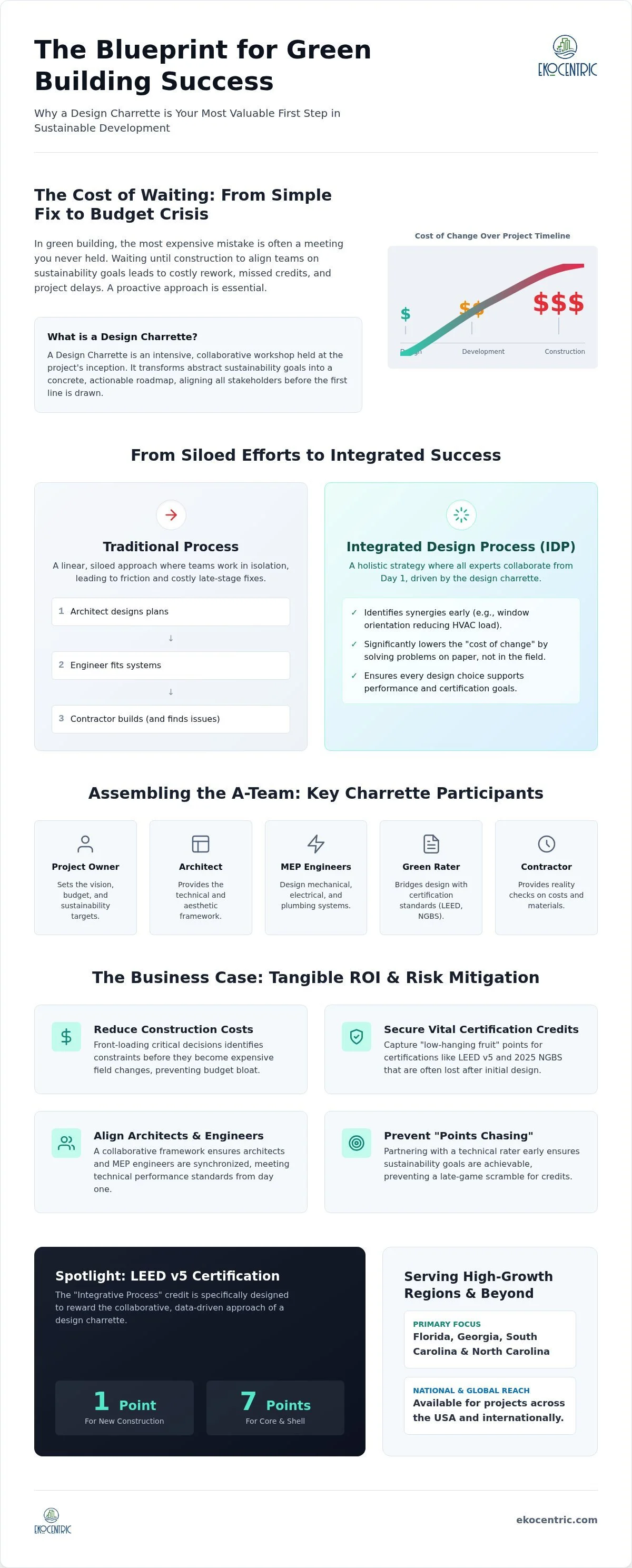
Traditional design follows a linear path. The architect draws the plans, the engineers design systems to fit those plans, and the contractor attempts to build the result. This siloed approach often leads to missed opportunities and team friction. The Integrated Design Process (IDP) replaces this outdated model with a holistic strategy. By using the charrette to integrate every discipline early, project teams can identify synergies, such as how specific window orientations reduce the cooling load on HVAC systems. This integration significantly lowers the "cost of change." Identifying a constraint during a workshop costs nothing to fix, whereas finding it during construction results in expensive change orders. A specialized sustainability consultant facilitates this integration, ensuring that every design choice supports the project's ultimate performance goals.
Key Participants in a Successful Charrette
Success depends on having the right experts in the room at the same time. The owner sets the overarching vision and budget, while the architect and MEP engineers provide the technical framework. Crucially, the Green Rater or consultant acts as the technical bridge, ensuring that the proposed strategies actually meet the rigorous standards of LEED BD+C, NGBS, or FGBC. Including a general contractor provides a real-world reality check on material costs and labor availability. This collective expertise explains Why is a Design Charette such an important step in Green Building Certification. because it transforms a fragmented team into a unified force. For those looking to implement these strategies, our professional consulting services help facilitate these workshops for projects across the USA and internationally, ensuring every participant is aligned for certification success.
How Design Charrettes Earn Points for Green Building Certifications
Certification points are the currency of sustainable development. They aren't simply awarded for good intentions; they require rigorous documentation and proof of performance. A structured design charrette allows project teams to capture "low-hanging fruit" credits that often disappear once the schematic design is finalized. By identifying these opportunities early, you can secure higher certification tiers without the premium costs associated with late-stage adjustments. This technical precision is a primary reason Why is a Design Charette such an important step in Green Building Certification. It transforms abstract sustainability goals into a checklist of achievable, high-value credits.
LEED v5 and Integrative Process Requirements
In the current LEED v5 framework, the "Integrative Process, Planning, and Assessments (IP)" category is a dedicated pillar of certification success. The Integrative Design Process (IPc1) credit specifically rewards early collaborative efforts. For New Construction projects, this credit is worth 1 point, while Core and Shell projects can earn up to 7 points. To qualify, teams must conduct preliminary energy and water-related systems analyses before the completion of the schematic design. This isn't just a meeting; it's a data-driven exercise. You must document how the charrette findings influenced the final Basis of Design (BOD) and the project's functional requirements. A Green Rater verifies these analyses to ensure the project remains on track for its target rating from day one.
NGBS and FGBC Certification Advantages
The ICC 700-2025 National Green Building Standard (NGBS) places significant emphasis on the "Project Management" category, which rewards early planning and team alignment. Conducting a charrette helps front-load the NGBS Green Verification process, which prevents expensive surprises during site visits. For projects in Florida, the Florida Green Building Coalition (FGBC) standards require specific attention to regional climate challenges like hurricane mitigation and high-humidity moisture control. Florida's High-Performance Green Building Act even mandates that state-funded buildings over $2 million achieve LEED Silver or a comparable FGBC rating. Using a charrette to align these requirements with ENERGY STAR and RESNET HERS rating goals is essential for compliance. Engaging a qualified green rater during this phase ensures your goals aren't just aspirational but are grounded in verifiable data across the USA and beyond.
The charrette also serves as a risk-mitigation tool for regional requirements in Georgia, South Carolina, and North Carolina. By analyzing site-specific constraints during the workshop, teams can select the most cost-effective path toward certification. This proactive approach ensures that every credit pursued is both technically viable and aligned with the owner's long-term operational budget.
The Business Case: ROI and Risk Mitigation
Every developer knows that the ability to influence a project's performance is highest at the beginning, while the cost of making changes is lowest. This concept, often called the MacLeamy Curve, is the financial foundation of sustainable development. Shifting critical decisions to the pre-design phase isn't just a best practice; it's a technical risk-management tool. This proactive approach is a primary reason Why is a Design Charette such an important step in Green Building Certification. It prevents "points chasing," a common and expensive mistake where teams try to add green features late in construction to hit a certification threshold. A well-facilitated $5,000 design charrette can easily prevent $50,000 in construction rework by catching system conflicts before they ever reach the field.
Reducing Operational and Embodied Carbon
Early workshops allow teams to prioritize passive design strategies that yield massive returns without increasing the capital budget. For instance, optimizing building orientation and the thermal envelope can significantly reduce long-term energy costs by lowering the cooling load on HVAC systems. In high-heat regions like Florida, Georgia, and the Carolinas, these early wins are essential for long-term profitability. We also use the charrette to address embodied carbon by selecting high-performance materials before the supply chain is locked in. This ensures that environmental stewardship remains a core project value rather than a late-stage financial burden. Our consulting services help bridge this gap, ensuring that every design choice is both technically viable and budget-conscious.
Streamlining the Certification Timeline
Time is a critical variable in real estate. A charrette eliminates the inefficient back-and-forth between the design team and certification bodies like the USGBC or Home Innovation Research Labs. By establishing a clear roadmap during the workshop, the team creates a Basis of Design that already satisfies the rigorous requirements of LEED v5 or the 2025 NGBS. This early alignment leads to faster approvals and a smoother verification process. Whether your project is in the Southeast or anywhere else in the USA, a structured timeline managed by an expert rater ensures you reach the finish line without technical friction. This efficiency doesn't just save money; it builds confidence with investors and stakeholders who demand measurable results.
Planning and Executing an Effective Green Building Charrette
A successful charrette requires more than just a room full of experts; it demands meticulous preparation and a structured agenda. The process begins with pre-charrette research, where the team gathers critical site data, utility information, and local code requirements. This data forms the technical foundation for every decision made during the workshop. In regions like Florida, Georgia, and the Carolinas, understanding local coastal regulations or humidity-related building codes is essential for a viable design. This level of preparation illustrates Why is a Design Charette such an important step in Green Building Certification. It ensures that the workshop is spent solving problems rather than looking for data. Without this groundwork, the session risks becoming a series of vague presentations rather than a technical engine for certification success.
Preparing the Project Team
Every participant should arrive with a clear understanding of the project's baseline. We provide the team with a comprehensive "Sustainability Brief" well before the meeting. This document outlines the initial project vision and sets expectations for collaborative problem-solving. Success depends on moving away from individual presentations and toward an integrated dialogue. A neutral facilitator, often a specialized sustainability consultant, is vital to this dynamic. They ensure that no single discipline dominates the conversation and that the owner's goals remain the central focus. This collaborative environment allows the team to identify synergies that a traditional design process would likely miss.
Setting Measurable Goals
The workshop must move from abstract visioning to concrete, measurable targets. During the session, we define Energy Use Intensity (EUI) targets and water consumption goals that align with the desired certification level, whether it's Silver, Gold, or Platinum. Identifying which LEED or NGBS credits are "must-haves" versus "maybes" allows the team to prioritize their efforts effectively. We also create a responsibility matrix that assigns specific documentation tasks to team members. This clarity is another reason Why is a Design Charette such an important step in Green Building Certification. It establishes accountability from day one. If you're ready to align your team for success, our expert facilitation services provide the technical roadmap needed for projects across the USA and internationally.
The final output of the workshop is the Charrette Report and an updated Project Checklist. These deliverables summarize the decisions made, the goals set, and the specific path toward certification. This report serves as a living document that guides the design team through the schematic and development phases. It ensures that the integrated strategies identified during the workshop are actually implemented in the final construction documents, protecting the project's sustainability integrity and the owner's investment.
Partnering with Ekocentric for Certification Success
Ekocentric facilitates charrettes that bridge the gap between visionary design and strict technical compliance. We leverage our dual expertise as licensed building contractors and real estate professionals to provide a grounded, pragmatic perspective. This ensures that the sustainability goals set during the workshop are both buildable and financially viable. Our team maintains a high-intensity focus on performance optimization, serving as a national resource with deep roots in the Florida, Georgia, South Carolina, and North Carolina markets. Having a LEED Green Rater or NGBS Verifier in the room at this stage is your most valuable asset. We identify technical hurdles that could derail your certification long before they become site-level problems.
A Green Rater doesn't just listen; they provide the technical "gut check" that keeps the design team grounded. When an architect proposes a high-performance envelope, we're there to explain how that choice impacts the HERS index or the ENERGY STAR Version 3.2 requirements. This real-time feedback loop is exactly Why is a Design Charette such an important step in Green Building Certification. It prevents the team from pursuing credits that are technically impossible or prohibitively expensive for your specific site. Our role is to ensure the path to certification is as smooth and predictable as possible.
Expert Consulting for National and State-Specific Standards
Navigating the technical nuances of LEED BD+C, FGBC, and NGBS requires more than just a checklist. It requires a partner who understands how building systems interact in the real world. We guide project leads through the latest energy codes and performance standards, including the 2025 NGBS and LEED v5 decarbonization requirements. This technical oversight is another reason Why is a Design Charette such an important step in Green Building Certification. It allows us to verify that energy and water analyses are accurate before they're baked into the schematic design. Explore our full range of green building services to see how we support projects across the USA and internationally.
A Mission-Driven Approach to Building Performance
We take a mission-driven approach to building performance. Our goal is to move beyond simply "checking boxes" to create spaces that are genuinely high-performing, healthy, and resource-efficient. With professional credentials as an ENERGY STAR Partner, NGBS Green Verifier, and RESNET HERS Rater, we provide comprehensive support that spans from the initial charrette to final blower door and duct testing. We understand the business reality of needing specific credentials to qualify for financing or to meet state-funded requirements like Florida’s High-Performance Green Building Act. By acting as your technical rater during the charrette, we ensure your sustainability outcomes are both achievable and verifiable. Contact Ekocentric today to schedule your project’s design charrette and secure your path to sustainability success.
Securing Your Project’s Sustainable Future
A design charrette transforms a fragmented design process into a unified, high-performance strategy. By front-loading critical decisions, you don't just earn points; you eliminate the technical friction that leads to budget overruns and construction delays. This workshop is the definitive answer to Why is a Design Charette such an important step in Green Building Certification. because it ensures every sustainability goal is technically grounded and financially viable from day one. Whether you're developing in Florida, Georgia, the Carolinas, or anywhere across the USA, early alignment is your greatest asset for long-term project success.
As a Licensed Florida Certified Building Contractor, National Green Building Standard Green NGBS Verifier, and expert LEED Green Rater, Ekocentric provides the technical oversight needed to bridge the gap between architectural vision and compliance. We're dedicated to helping you create spaces that thrive. Partner with Ekocentric for your next LEED or NGBS project to secure a clear roadmap for your certification goals. Let's work together to build a more resilient and environmentally conscious future.
Frequently Asked Questions
Is a design charrette required for LEED certification?
A design charrette isn't strictly mandatory for every LEED project, but it's essential for earning the "Integrative Process" credit. In LEED v5, this credit is worth 1 point for New Construction and up to 7 points for Core and Shell projects. Beyond the points, this workshop is the primary mechanism for aligning your team with decarbonization and quality of life goals. It provides the technical foundation for all subsequent design decisions.
What is the difference between a design charrette and a standard project meeting?
Standard meetings typically focus on administrative updates or single-discipline issues. In contrast, a charrette is an intensive, multi-disciplinary workshop designed to break down silos. It's Why is a Design Charette such an important step in Green Building Certification. because it forces architects, MEP engineers, and owners to solve system conflicts simultaneously. This collaborative environment identifies synergies, like window placement and HVAC sizing, that standard meetings often overlook.
How long does a typical green building charrette last?
A typical charrette lasts between four and eight hours, depending on the project's scale and complexity. For smaller residential developments, a half-day session might suffice to set sustainability targets. Larger commercial or multi-family projects often require a full-day intensive to work through energy modeling data and water-related systems analysis. The goal is to reach a consensus on the project's technical roadmap before the schematic design phase concludes.
Who should lead or facilitate the design charrette?
A neutral facilitator, such as a specialized sustainability consultant or Green Rater, should lead the session. This ensures that no single discipline, like architecture or engineering, dominates the conversation. At Ekocentric, we use our dual expertise in technical building contracting and real estate to guide these workshops. We keep the focus on performance optimization and ensure that the owner's certification goals remain the project's top priority throughout the discussion.
At what stage of the project should the charrette take place?
The charrette must take place during the pre-design or early schematic design phase. Holding the workshop early allows the team to influence the building's orientation and envelope without incurring the high costs of late-stage redesign. This timing is critical for capturing "low-hanging fruit" credits in LEED or NGBS. Moving these decisions earlier in the timeline reduces the cost of change and ensures that sustainability is integrated into the project's core.
How does a charrette help with National Green Building Standard (NGBS) verification?
A charrette front-loads the NGBS Green Verification process by aligning the project team with the ICC 700-2025 standards. It directly addresses the "Project Management" category, which rewards early planning and documentation. By identifying must-have credits during the workshop, developers can avoid expensive surprises during final site inspections. This proactive planning is Why is a Design Charette such an important step in Green Building Certification. for builders in Florida, Georgia, and the Carolinas.
Can a charrette be conducted virtually for national projects?
Yes, charrettes are frequently conducted virtually to accommodate national and international project teams. Virtual workshops use collaborative digital whiteboards and breakout rooms to maintain the intensity of an in-person session. This format allows experts from across the USA to participate without the time and expense of travel. Ekocentric facilitates these virtual sessions to provide seamless consulting support for developers and architects, regardless of their project's physical location.
What are the most common outcomes of a successful design charrette?
The primary outcomes include a finalized Basis of Design (BOD), a responsibility matrix, and a technical certification checklist. The team also establishes clear Energy Use Intensity (EUI) and water consumption targets. These deliverables provide a definitive roadmap for the design and construction phases. This structured output ensures every team member knows their role in achieving certification, which reduces technical friction and keeps the project on schedule and within budget.