What is a HERS Rating and What is it Used For? A 2026 Guide

As of May 2026, over 5 million homes across the United States have received a HERS Rating, representing a massive shift toward data-driven building performance. For many developers and architects, however, the technical specifics remain a source of confusion. You might be asking: What is a HERS Rating and what is it used for? While it's easy to view these scores as just another administrative hurdle, they actually provide a clear roadmap for achieving superior energy efficiency and long-term value.
We understand that the complexity of green building certifications can feel like a moving target, especially with the 2026 updates to ENERGY STAR and DOE programs. You need reliable third-party verification that translates into tangible results for your clients. In this guide, we'll clarify how the HERS Index measures energy performance and why it's a critical tool for modern professionals. You'll discover how these ratings integrate with LEED or FGBC certifications and how finding the right rater can streamline your workflow. Whether your project is in Florida, Georgia, the Carolinas, or anywhere else in the world, mastering this metric is the first step toward a more sustainable future.
Key Takeaways
Understand exactly what is a HERS Rating and what is it used for by exploring how the RESNET index serves as the industry standard for energy performance.
Learn how the rating process integrates into your design phase through plan analysis and onsite inspections to ensure compliance with 2026 building codes.
Discover how HERS scores act as the foundational requirement for achieving prestigious certifications like LEED, NGBS, and Florida Green Building Coalition status.
Recognize the market value of a low HERS score, which serves as a powerful tool for developers to attract buyers and reduce long-term operational liability.
Identify why partnering with a specialized consultancy provides the technical expertise needed for projects across Florida, the Carolinas, Georgia, and international locations.
Table of Contents
What is a HERS Rating? Defining the Industry Standard
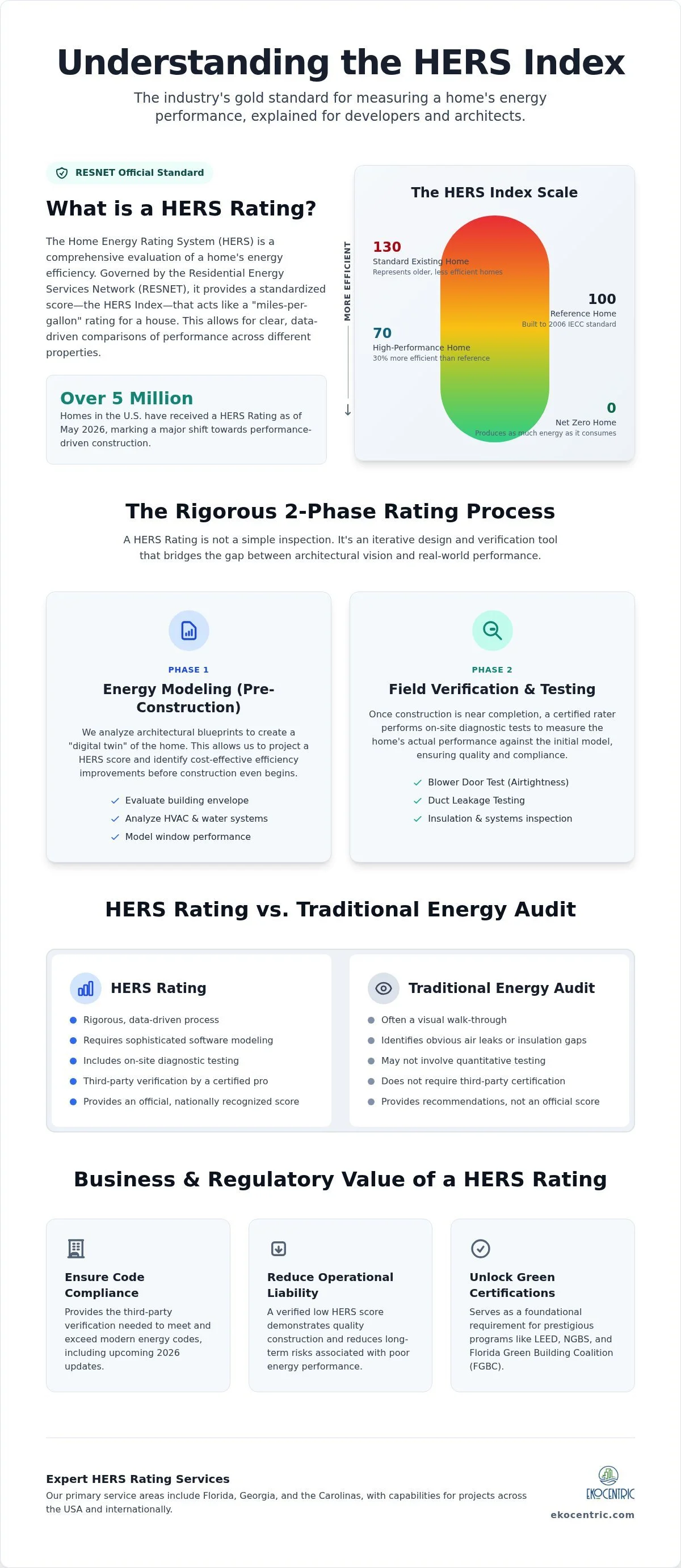
The Home Energy Rating System (HERS) is the gold standard for measuring a building's energy efficiency. If you've been asking "What is a HERS Rating and what is it used for?", it's helpful to view it as a comprehensive evaluation of a home's thermal performance. This system is governed by the Residential Energy Services Network (RESNET), a non-profit organization that ensures every rating follows strict national standards for accuracy and consistency. Essentially, the HERS Index is the "miles-per-gallon" rating for homes, providing a clear comparison of efficiency across different properties. This standardized House Energy Rating has become a vital requirement for developers pursuing green building certifications like LEED or the National Green Building Standard.
The 100-Point Scale Explained
The HERS Index operates on a linear scale where a score of 100 represents a home built to the 2006 International Energy Conservation Code (IECC) specifications. Because it's a performance-based index, a lower score indicates a more efficient building. For example, a home with a HERS score of 70 is 30% more energy-efficient than the baseline home. Achieving a score of 0 signifies a "Net Zero" home, which produces as much energy as it consumes over a year. In contrast, standard existing homes that haven't undergone efficiency upgrades often score 130 or higher, highlighting the massive performance gap that modern construction can bridge.
HERS vs. Traditional Energy Audits
Many people confuse a HERS rating with a standard energy audit, but the two serve very different purposes. While a traditional audit is often a visual walk-through intended to identify air leaks or insulation gaps, a HERS rating is a rigorous, data-driven process. It relies on sophisticated software modeling to predict energy use based on architectural plans and onsite testing, such as blower door and duct leakage tests. This process requires third-party verification from a certified professional to ensure the results are unbiased and reliable. At Ekocentric, our RESNET HERS Rater services provide the technical precision required to meet strict building codes and voluntary green standards. This level of detail is essential for developers in Florida, Georgia, and the Carolinas who need more than just a checklist. They need a verified performance roadmap that stands up to regulatory scrutiny and adds real value to the project.
How the HERS Index Works: The Rating Process
The rating process isn't a single event but a collaborative journey that begins long before the first shovel hits the dirt. To fully grasp what is a HERS Rating and what is it used for, developers should view it as an iterative design tool. By involving a rater early, architects can refine their plans to ensure the final structure meets specific performance goals without the need for expensive mid-project corrections. This two-phase approach ensures that the theoretical design actually matches the finished building's performance, providing a reliable bridge between vision and reality. We view every project as an opportunity to push the boundaries of what's possible in sustainable design through this rigorous verification.
Phase 1: The Energy Modeling (Pre-Construction)
During this stage, we analyze architectural blueprints to create a digital twin of the proposed home. This energy modeling software allows us to project a pre-construction HERS score by evaluating specific variables like the building envelope's thermal resistance and the efficiency ratings of proposed HVAC systems. We also examine insulation specs, window orientations, and solar heat gain coefficients. Identifying these efficiency improvements early is the most cost-effective way to boost a building's performance. It's much easier to specify a higher-efficiency heat pump on a drawing than it is to replace one after it's been installed.
Phase 2: Field Verification and Testing
Once construction is nearly complete, the rater returns for onsite verification. This isn't just a visual check; it's a series of diagnostic tests that measure the home's actual airtightness and duct efficiency. The Blower Door Test is a critical component here. We use a powerful fan to depressurize the house, which allows us to quantify air leakage through the building envelope. Similarly, duct leakage testing ensures that the HVAC system isn't losing conditioned air into unconditioned spaces like attics or crawlspaces. We also perform final inspections of insulation quality, window seals, and water heating systems. These rigorous field tests confirm that the home was built to the standards set during the modeling phase.
Our team provides this detailed oversight for projects across Florida, Georgia, and the Carolinas, as well as national and international projects. If you're looking to optimize your next project's efficiency, consider partnering with us for professional HERS rater support to streamline your certification process and ensure your building reaches its full performance potential.
What is a HERS Rating Used For? Business and Regulatory Value
For professional developers and architects, the answer to "What is a HERS Rating and what is it used for?" extends far beyond a simple energy score. It's a versatile strategic tool used for building code compliance, securing prestigious green certifications, and creating a distinct market advantage. In a project environment where energy performance is scrutinized by both regulators and savvy investors, the HERS Index provides the objective, third-party verification necessary to prove a building's worth. It transforms efficiency from a vague concept into a tangible business asset that enhances the property's overall valuation.
Synergy with LEED and Green Certifications
The data gathered during a HERS rating is a critical feed for LEED for Homes and LEED BD+C requirements. We often serve as both the LEED Green Rater and the HERS Rater on a project, which eliminates redundant testing and streamlines the certification timeline. This integration is vital for high-level sustainability goals, as HERS provides the specific, quantifiable data required to earn significant energy performance points. Beyond LEED, these ratings are essential for Florida Green Building Coalition (FGBC) certification. We provide comprehensive certification consulting to help developers manage these complex requirements and achieve National Green Building Standard (NGBS) verification. If you're aiming for the ENERGY STAR label, a HERS rating is a mandatory foundational component.
Building Code Compliance in the Southeast
Meeting increasingly stringent energy codes in Florida, Georgia, and the Carolinas is often more efficient through the HERS performance pathway than through rigid prescriptive paths. This approach offers architects greater design flexibility, allowing for performance trade-offs that can reduce construction costs without sacrificing the building's integrity. Our background as a licensed Florida Certified Building Contractor means we approach these ratings with a deep understanding of construction logistics and developer business realities. While we have deep roots in the Southeast, our consultancy manages projects across the entire United States and is available for international assignments. Choosing the HERS pathway for code compliance doesn't just satisfy an inspector; it ensures the long-term resource efficiency of the finished structure. This dedication to quality helps developers reduce potential liability related to building performance while delivering a superior product to the market.
what is a HERS Rating?
The ROI of a HERS Rating for Developers and Architects
While the technical process is rigorous, the true value of a HERS rating lies in its return on investment. Professionals often ask: What is a HERS Rating and what is it used for? In a business context, it's a risk mitigation tool that reduces long-term liability by ensuring a building performs as intended. By catching construction defects during the testing phase, you avoid costly post-occupancy repairs and maintenance headaches. This proactive approach ensures that the architect's vision translates into a high-performing asset that attracts discerning buyers and tenants who prioritize resource efficiency.
Marketing and Real Estate Differentiation
In the 2026 real estate market, "greenwashing" no longer works because buyers demand proof. A low HERS score provides that evidence, acting as a verified performance label that sets your project apart. These scores now frequently appear in MLS listings across Florida, Georgia, and the Carolinas, driving increased interest from energy-conscious investors. Our team brings a unique perspective here. Because we're licensed Realtors in FL, NC, and SC, we understand exactly how to leverage these ratings to maximize market value. Verified performance isn't just a badge; it's a competitive advantage that justifies premium pricing and accelerates sales cycles.
Optimizing Building Performance
Operational efficiency is a primary concern for modern building owners. A HERS rating identifies specific areas where design can be optimized to lower utility costs and improve occupant comfort. During our field inspections, we often uncover issues like misaligned insulation or unsealed bypasses that would otherwise go unnoticed. Correcting these defects early preserves the building's integrity and ensures it meets the high standards set during the design phase. As licensed Florida Certified Building Contractors, we bridge the gap between architectural theory and practical job-site reality. If you're ready to enhance your project's marketability and performance, partner with Ekocentric for expert HERS rating services today.
Implementing HERS Ratings: Partnering for Success
Successful project leads recognize that a HERS rating is most effective when treated as a strategic partnership rather than a final inspection checkbox. While a standalone rater might provide a score, a specialized B2B consultancy offers the technical foresight to prevent performance failures before they occur. When considering what is a HERS Rating and what is it used for, it's vital to view it as a collaborative framework for excellence. Early integration ensures that every design choice aligns with your efficiency goals, protecting your budget from mid-construction surprises. We're dedicated to helping you translate these technical requirements into a superior finished product that stands as a testament to environmental stewardship.
Choosing the Right Rater
The complexity of modern building standards requires a partner with diverse credentials. You should prioritize firms that hold multiple certifications, including RESNET HERS Rater, LEED Green Rater, and NGBS Verifier designations. This breadth of expertise allows for a more holistic approach to building science. Regional knowledge is equally indispensable. Our team understands the specific nuances of building codes across Florida, Georgia, and the Carolinas. Because we maintain licensing as Florida Certified Building Contractors and Realtors in FL, NC, and SC, we provide a pragmatic perspective that spans construction logistics and market valuation. Our reach isn't limited by borders; we serve clients across the entire United States and manage international projects with the same commitment to precision.
Next Steps for Your Project
To maximize the impact of your rating, you should schedule a comprehensive plan review before your architectural drawings are finalized. This allows us to identify low-cost, high-impact efficiency improvements that are easily integrated into the design. Once construction begins, we work alongside your team to schedule field testing at critical milestones. This ensures that insulation and air sealing meet the standards required for ENERGY STAR or FGBC certification. By leveraging our expertise throughout the construction timeline, you can confidently navigate the certification process and deliver a building that exceeds expectations. If you're ready to elevate your next development, contact Ekocentric for HERS Indexing and sustainability consulting to begin your performance roadmap.
Building for the Future: Your Next Steps in High Performance
Mastering the HERS Index is no longer optional for professionals who want to lead the market in 2026. By now, you should have a clear answer to the question: What is a HERS Rating and what is it used for? It's the technical foundation that allows you to prove building quality, satisfy stringent Southeast energy codes, and achieve elite certifications like LEED or FGBC. Integrating these ratings into your design phase doesn't just lower utility costs; it safeguards your reputation and increases the long-term value of your projects.
Our team provides the expert oversight needed to navigate these complex requirements. We bring the authority of a Licensed Florida Certified Building Contractor, NGBS Green Verifier, and LEED Green Rater to every project. Whether your development is based in Florida, Georgia, the Carolinas, or an international location, we're ready to serve as your pragmatic partner. High-performance construction is an achievable solution to today's environmental challenges when you have the right data in hand.
Optimize your building performance with Ekocentric HERS Rater services and ensure your next project reaches its full potential. We're here to help you build better, more resilient spaces for the future.
Frequently Asked Questions
How long does a HERS rating take to complete?
A HERS rating occurs in two distinct stages. The initial energy modeling phase typically requires three to five business days once architectural plans are submitted. Field inspections, including the blower door and duct leakage tests, generally take two to four hours per unit depending on building complexity. Coordinating these milestones early in your construction schedule ensures that certification doesn't delay your final certificate of occupancy or project handover.
Is a HERS rating required by law for new construction?
While not a federal mandate, HERS ratings are increasingly required by state and local building codes as a performance-based compliance pathway. In regions like Florida and the Carolinas, many developers choose this route over prescriptive codes because it offers greater design flexibility. Understanding what is a HERS Rating and what is it used for helps architects meet stringent 2026 energy standards while optimizing construction costs and ensuring regulatory approval.
What is the difference between a HERS Index and a HERS Carbon Index?
The standard HERS Index focuses on energy consumption, while the HERS Carbon Index specifically quantifies a building's greenhouse gas emissions. This newer metric is vital for developers targeting Net Zero status or meeting specific ESG reporting requirements. As the industry shifts toward electrification, measuring carbon impact alongside energy efficiency provides a more comprehensive view of a property's environmental stewardship and long-term sustainability goals.
Can an existing home get a HERS rating, or is it only for new builds?
Existing homes can absolutely receive a HERS rating. This is a powerful tool for large-scale renovation projects or for owners looking to verify the impact of energy retrofits. A rating provides a clear baseline, allowing you to identify exactly where efficiency is lost and how to prioritize improvements. For developers upgrading multi-family assets, a HERS score offers verified proof of quality that justifies higher resale or rental values.
How much does a HERS rating typically cost for a multi-family project?
The investment for a multi-family HERS rating varies based on the total unit count, building height, and specific certification goals like LEED or NGBS. Developers should consider the complexity of the HVAC systems and building envelope as primary cost drivers. Working with a specialized consultancy allows you to bundle these ratings with other green building services, which often streamlines the overall verification budget for large-scale projects without sacrificing technical accuracy.
Does a HERS rating expire, or is it permanent for the building?
A HERS rating is a permanent record of a home's performance at the time of testing. It doesn't technically expire, but it represents a snapshot of the building's efficiency under the specific code version active during the rating. If you make significant structural changes or upgrade mechanical systems, a new rating is necessary to reflect the improved performance. In the 2026 market, buyers prioritize the most current data to ensure compliance.
Can I use a HERS rating to qualify for LEED points?
A HERS rating is a foundational requirement for earning energy and atmosphere points in LEED for Homes and LEED BD+C. The data collected by your rater directly feeds into the LEED documentation process, simplifying the path to certification. When we serve as your LEED Green Rater, we utilize HERS modeling to quantify energy savings, ensuring your project meets the rigorous performance thresholds required for Silver, Gold, or Platinum status.