Florida Non-Profit Green Building Certification Guide
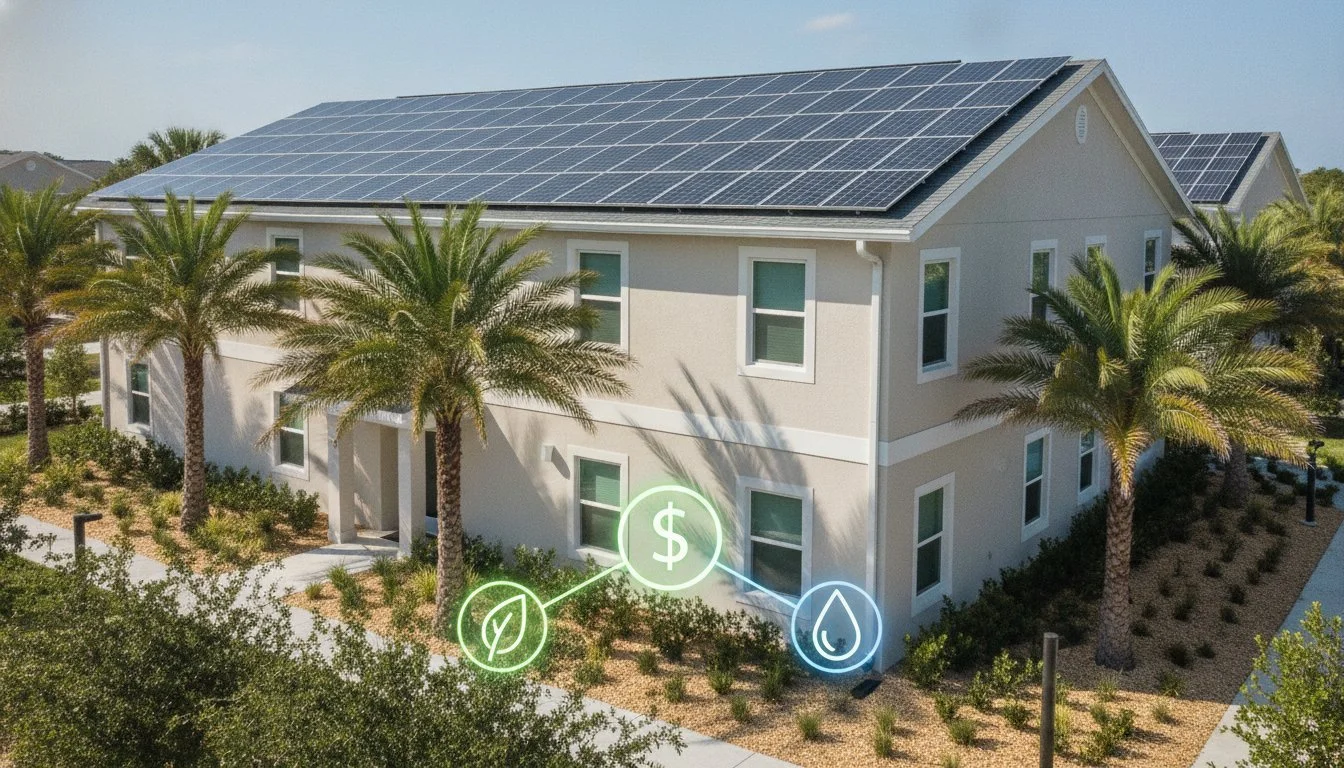
What if the overhead currently draining your operational budget was actually your greatest untapped asset for securing new donor trust? For many mission-driven leaders, green building certification for non-profit organizations in Florida feels like a luxury reserved for massive capital campaigns. However, with the 9th Edition of the Florida Building Code set to implement stricter energy standards by December 2026, these credentials are no longer optional. They're strategic fiscal tools that transform high-performance building standards into transparent, donor-ready proof of your commitment to stewardship.
We recognize that your team is likely already stretched thin. The prospect of managing complex LEED or FGBC paperwork shouldn't be the hurdle that stops you from achieving long-term sustainability. This guide will show you how to leverage specialized certifications to lower monthly expenses and build facilities that withstand the unique pressures of Florida, Georgia, South Carolina, and North Carolina. We'll explore the specific benefits of LEED v5, the regional advantages of the Florida Green Building Coalition, and how a pragmatic approach to building performance across the U.S. and internationally ensures your mission remains resilient for decades to come.
Key Takeaways
Learn how achieving green building certification for non-profit organizations in Florida transforms facility overhead into a transparent asset that boosts donor trust and mission alignment.
Compare the global prestige of LEED with the Florida-specific resilience of FGBC to determine which certification pathway best serves your organization’s long-term goals.
Discover the financial roadmap for transitioning from high upfront costs to significant lifecycle savings through energy-efficient systems and resource optimization.
Understand the phased approach to certification, from setting sustainability goals during pre-design to final verification for projects across the Southeast and internationally.
See how specialized consulting acts as the "internal capacity" your non-profit needs to manage complex technical documentation without draining your program funds.
Table of Contents
Navigating Green Building Certifications for Florida Non-Profits
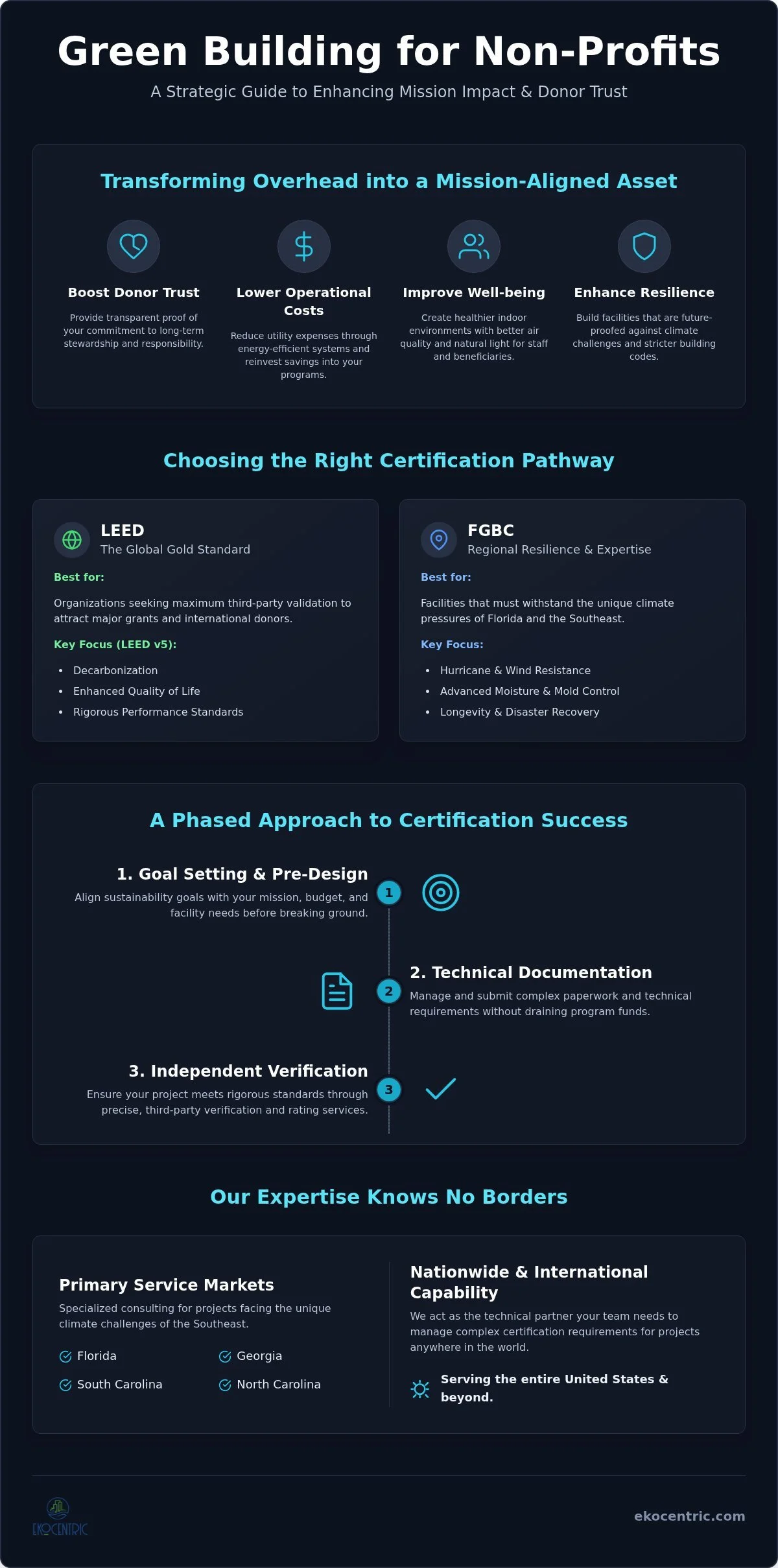
For a mission-driven organization, building green isn't just about the environment; it’s about responsible stewardship of every dollar donated. Green building certification for non-profit organizations in Florida provides a structured framework to verify that a facility operates at peak efficiency. These green building certification systems offer a roadmap for leaders who want to reduce utility costs and reinvest those savings directly into their programs. By achieving these standards, you transform your facility from a monthly expense into a high-performance asset that validates your commitment to donors.
Why Sustainability Aligns with Your Mission
Your physical space is a living testament to your values. When a non-profit invests in high-performance design, it directly supports community well-being and social equity. Environmental health is inseparable from the health of the people you serve. Research indicates that healthy indoor environments, characterized by superior air quality and natural light, significantly improve the cognitive function and emotional health of both staff and beneficiaries. It's a pragmatic way to ensure your facility serves as a safe, inspiring sanctuary for the people you help every day.
Florida-Specific Climate Challenges for Facility Managers
In the Southeast, sustainability must include resilience. Florida’s climate presents unique hurdles like intense humidity, urban heat islands, and the constant threat of severe storms. Many standard green guides overlook the fact that a building isn't truly sustainable if it can't survive a Category 4 hurricane or the relentless power of salt air. True green building certification for non-profit organizations in Florida requires a focus on longevity and disaster recovery.
We help organizations implement strategies that protect their long-term assets:
Integrating wind-load criteria that align with the 9th Edition of the Florida Building Code.
Deploying advanced moisture control systems to prevent mold in high-humidity zones.
Implementing water conservation measures that protect our sensitive aquifers while lowering utility bills.
The year 2026 marks a pivotal shift for the industry. With the transition to LEED v5 and the implementation of stricter state building codes on December 31, 2026, non-profits must act now to future-proof their investments. Whether you are pursuing global prestige through LEED or the Florida-specific standards of the FGBC, choosing the right path is essential. While our primary focus is the Southeast, including Georgia, South Carolina, and North Carolina, we provide specialized consulting services for projects across the entire United States and internationally. We act as the technical partner your team needs to manage complex certification requirements, ensuring your facility remains a durable, mission-aligned asset for decades.
Comparing LEED, FGBC, and NGBS for Non-Profit Facilities
Choosing the right green building certification for non-profit organizations in Florida involves balancing global recognition with local operational realities. Every organization has different priorities, whether it's attracting international donors or minimizing local utility spikes. Selecting the wrong framework can lead to unnecessary administrative costs. Conversely, the right choice acts as a catalyst for your mission by lowering overhead and proving your commitment to stewardship.
LEED BD+C: The Gold Standard for Global Recognition
The Leadership in Energy and Environmental Design (LEED) system is the most recognized name in sustainability. For large-scale institutional projects, LEED Building Design and Construction (BD+C) provides a rigorous hierarchy of performance standards. With the ratification of LEED v5 on March 28, 2025, the focus has shifted heavily toward decarbonization and quality of life. This version is ideal for non-profits seeking maximum third-party validation to boost major grant applications. Our LEED Green Rater services ensure your project meets these high-intensity standards through precise, independent verification.
Florida Green Building Coalition (FGBC): Regional Expertise
While LEED offers prestige, the Florida Green Building Coalition (FGBC) focuses on the specific environmental stressors of the Sunshine State. It’s often more cost-effective for community-focused organizations because it streamlines the administrative burden. FGBC standards prioritize drought-tolerant landscaping and moisture control, which are vital for Florida's sensitive aquifers and high humidity. It’s a pragmatic solution for facilities that need to prove resilience without the overhead of a global administrative process.
NGBS: Solutions for Non-Profit Housing
For organizations focused on residential services, such as supportive housing or shelters, the National Green Building Standard (NGBS) is often the best fit. The fee structure is particularly friendly to non-profits. For single-family homes, the certification fee is just $200. For multifamily projects up to three stories, the cost is $300 per building plus a per-unit fee. This makes it highly accessible for tight capital budgets where every dollar must be stretched to serve more beneficiaries.
Whether your project is in Florida, Georgia, South Carolina, or North Carolina, we help you weigh these options based on your facility's size and long-term budget. Our team provides tailored consulting services to ensure you select the framework that provides the highest return on investment for your specific mission. We also work across the United States and on international projects, bringing local expertise to a global stage to help you fulfill your environmental mission.
The Financial Case: ROI and Operational Efficiency
For non-profit leaders, every dollar spent on utilities is a dollar taken away from community services. Shifting your perspective from upfront construction costs to lifecycle savings is essential for long-term fiscal health. While green building certification for non-profit organizations in Florida might require an average initial investment of 1.8% to 2% more than traditional construction, the dividends are immediate and compounding. Data indicates that new green buildings achieve an average operating cost saving of 10.5% in the first year alone. Over a five-year period, those savings climb to 16.9%.
Reducing Long-Term Overhead and Utility Costs
Predictable monthly expenses are the backbone of a stable non-profit budget. High-performance systems, verified through ENERGY STAR or a RESNET HERS Rater, can slash energy consumption by 30% to 40% and water usage by 20% to 30%. In the relentless Florida heat, an optimized HVAC system isn't a luxury; it's a necessity that pays for itself through reduced demand. By lowering these fixed costs, you effectively increase your program budget without needing to raise an extra cent. It’s a pragmatic way to ensure your facility remains a functional asset rather than a financial drain.
Leveraging Certification for Grant Writing and Fundraising
Beyond the utility bill, certification serves as a powerful validation of your organizational integrity. Modern donors, especially those focused on ESG (Environmental, Social, and Governance) criteria, look for third-party proof of stewardship. A plaque from the Florida Green Building Coalition (FGBC) or LEED tells a story of transparency and competence. It proves to foundations that your project is a low-risk, high-impact investment. Many federal and private grants now prioritize or even require these credentials for sustainable development funding.
This "Donor Effect" creates a virtuous cycle. Your building saves money, which attracts more funding, which then expands your impact. Whether your project is located in Florida, Georgia, South Carolina, or North Carolina, our consulting services provide the technical expertise to secure these financial advantages. We also manage projects across the United States and internationally, helping non-profits worldwide turn environmental goals into measurable fiscal success. We act as the internal capacity you might lack, ensuring that complex certification requirements never stand in the way of your mission’s growth.
Steps to Achieving Certification for Your Facility
Achieving green building certification for non-profit organizations in Florida is a structured journey that requires early commitment and technical precision. The process begins during pre-design, where you must establish sustainability goals that align with your mission. In Phase 1, your team defines performance targets for energy, water, and air quality. Phase 2 involves selecting the most appropriate pathway, whether you prioritize the global recognition of LEED or the regional resilience of FGBC. Deciding on these frameworks early prevents expensive mid-construction changes and ensures every design choice serves your long-term budget.
The transition to active construction marks Phase 3. This stage is defined by rigorous field testing and inspections to verify that the high-performance systems are installed correctly. Once the building is complete, Phase 4 focuses on the final documentation and submission process. This final step is where your team’s hard work is validated, resulting in the official certification that serves as a powerful tool for donor relations and grant applications.
The Role of a Green Rater and Third-Party Verification
Independent verification is essential for maintaining the integrity of your certification. A LEED Green Rater or NGBS Verifier identifies performance gaps before they become permanent issues. They provide an objective layer of oversight, coordinating between the contractor and your non-profit board to ensure technical standards are met. This process guarantees that your building's performance matches the design intent, protecting your investment from future utility spikes and maintenance failures.
Building the Right Project Team
Success requires a project team that understands the nuances of sustainable construction. While architects and developers focus on the physical structure, specialized green building consultants provide the technical capacity to manage complex certification requirements. We act as your pragmatic partner, ensuring your general contractor stays on track with green building mandates. To understand how we bridge the gap between design and performance, Explore Ekocentric’s full range of services.
Our team supports non-profits across Florida, Georgia, South Carolina, and North Carolina, as well as on projects throughout the United States and internationally. If you're looking for a partner to manage the technical complexities of your next facility, contact us for specialized consulting today.
Strategic Consulting for Non-Profit Green Building Success
Executing a high-performance facility project requires more than a bold vision; it demands technical precision and administrative stamina. Green building certification for non-profit organizations in Florida often feels like an insurmountable mountain of paperwork for teams already dedicated to community outreach. We act as your pragmatic partner, providing the internal capacity your board needs to manage these specialized requirements. By handling the technical complexities of LEED, FGBC, and NGBS, we ensure your project moves from the drawing board to completion without draining your team’s focus from their core mission.
Tailored Solutions for Resource-Constrained Organizations
Every dollar your organization spends must be a calculated investment in your long-term impact. We specialize in optimizing building performance to ensure the highest ROI for every dollar allocated to construction. Our team brings a unique dual expertise as a Licensed Florida Certified Building Contractor and a technical building performance specialist. This allows us to bridge the gap between complex building codes and real estate market dynamics. We identify potential performance gaps early in the design phase, preventing the costly mid-construction corrections that often plague non-profit budgets. Our goal is to transform your facility into a lean, efficient asset that operates with minimal overhead for decades.
Beyond Florida: National and International Reach
Our commitment to environmental stewardship isn't confined by state lines. While we are deeply rooted in the Southeast, our reach extends across Florida, Georgia, South Carolina, and North Carolina. We support non-profits with satellite locations across these states, ensuring a consistent standard of sustainability across your entire portfolio. Our expertise isn't limited to the region; we consult on international sustainable development projects and work with organizations across the entire United States. Hiring a firm with licensed contractor credentials ensures that your project is grounded in practical construction realities, regardless of its location.
The upcoming shifts in the Florida Building Code on December 31, 2026, mean that the window for future-proofing your facility is narrowing. Now is the time to align your physical space with your environmental mission. We're ready to help you navigate the nuances of green building certification for non-profit organizations in Florida and beyond. To see how we can act as the technical extension of your team, explore our full range of services and start preparing your facility for a resilient, sustainable future today.
Building a Resilient Future for Your Mission
Transforming your facility into a high-performance asset is a powerful way to demonstrate fiscal responsibility and environmental stewardship. By pursuing green building certification for non-profit organizations in Florida, you ensure that every dollar invested in your physical space works harder for your mission. These standards protect your long-term budget from rising utility costs and unique climate-related risks; they also provide the third-party validation that modern donors and grant-makers require.
As a Licensed Florida Certified Building Contractor, LEED Green Rater, and NGBS Verifier, we provide the technical capacity your team needs to succeed. We serve mission-driven organizations across Florida, Georgia, and the Carolinas, and our expertise extends to projects throughout the United States and internationally. Don't let complex documentation or technical hurdles stand in the way of your sustainability goals. It's time to build a facility that reflects your values and stands strong for the community you serve.
Partner with Ekocentric for your next green building project to secure your organization's future. We're ready to help you turn your environmental vision into a pragmatic, high-performance reality.
Frequently Asked Questions
Does a non-profit organization qualify for different green building incentives in Florida?
Yes, non-profits can access various state and local incentives. While federal tax-based incentives are shifting, many municipal utility programs and private foundations offer rebates or preferential grant scoring for certified facilities. These programs often prioritize documented energy and water conservation. We help organizations identify these local opportunities to maximize their project budget and long-term savings.
How much does it typically cost for a non-profit to get LEED certified?
LEED fees depend on the project's rating system, gross floor area, and location. The USGBC provides a specific pricing tool to generate exact quotes. While certification requires an upfront investment, new green buildings typically see an average operating cost saving of 10.5% in the first year. This reduction in overhead allows non-profits to redirect more funds toward their core mission services.
Can an existing non-profit building be retroactively certified?
Yes, existing buildings can achieve certification through specialized pathways like LEED for Operations and Maintenance (O+M). This process focuses on improving the actual performance of current systems rather than new construction. It's a pragmatic way for organizations to reduce utility costs in older facilities. Retroactive certification proves to donors that you're committed to stewardship across your entire real estate portfolio.
What is the difference between an ENERGY STAR rating and LEED certification?
ENERGY STAR focuses specifically on energy efficiency and operational performance data. LEED is a broader framework that evaluates water usage, site selection, materials, and indoor air quality alongside energy. Many organizations use ENERGY STAR as a foundational step toward achieving a full green building certification for non-profit organizations in Florida. Both systems provide valuable third-party validation of your facility's efficiency.
How does green building certification help with non-profit grant applications?
Certification acts as a powerful mark of organizational integrity and fiscal responsibility. Many federal agencies and private foundations now require or heavily weigh environmental credentials in their scoring rubrics. A certified facility proves to grant-makers that your project is a low-risk investment. It demonstrates that you've built a durable, low-overhead asset that won't drain future program funds on high utility bills.
Which certification is best for a small Florida non-profit on a tight budget?
The Florida Green Building Coalition (FGBC) or NGBS are often the most cost-effective choices for smaller organizations. NGBS certification fees for single-family homes are as low as $200, making it highly accessible. FGBC is specifically tailored to Florida’s unique climate and building codes. These pathways offer a green building certification for non-profit organizations in Florida with less administrative burden than global standards.
Does Ekocentric provide consulting for projects outside of Florida?
Yes, our team serves a wide geographic area beyond the Florida market. We're actively engaged in projects across Georgia, South Carolina, and North Carolina. Our specialized consulting services are also available for non-profit facilities across the entire United States and for international sustainable development projects. We bring localized expertise to a global stage, ensuring your mission-driven project succeeds wherever it's located.
What is the role of a LEED Green Rater in a non-profit project?
A LEED Green Rater provides the essential third-party verification required for certification. They perform on-site inspections and testing to ensure the building meets technical performance standards. For non-profits, this role acts as a safeguard. They identify potential performance gaps before they lead to high utility bills. This verification ensures your facility is resilient, efficient, and fully aligned with your environmental mission.