2026 Florida Building Code Changes: What Builders Must Know

2026 Florida Building Code Changes
Table of Contents
Navigating the 2026 Florida Building Code Transition
For architects, developers, and builders in Florida, the upcoming 2026 Florida Building Code (FBC) represents more than a routine update; it marks a significant strategic shift toward enhanced resilience and superior energy performance. The Florida Building Commission, in its triennial cycle, is raising the bar, moving the state’s construction standards into closer alignment with national high-performance benchmarks. This transition is not merely about compliance; it's a deliberate effort to fortify Florida’s built environment against severe weather while championing a more sustainable future.
Understanding this evolution requires recognizing the FBC's relationship with the International Code Council's (ICC) I-Codes, which serve as its foundation. The 2026 updates will integrate key provisions from the latest I-Codes, tailored to address Florida's unique climate and environmental challenges. A critical component of this framework remains the stricter local amendments in High-Velocity Hurricane Zones (HVHZ), primarily Miami-Dade and Broward counties, which will continue to impose requirements that exceed the statewide baseline.
Understanding the 2026 Supplement Cycle
The transition to the 9th Edition of the Florida Building Code, effective December 31, 2026, follows a structured timeline for adoption and enforcement. It's crucial for project managers and developers to distinguish between technical amendments—substantive changes to performance or material requirements—and administrative updates, which clarify existing rules. Key points to track include:
Adoption and Enforcement: The official effective date dictates that all permit applications submitted on or after this day must comply with the new 2026 code. Projects with permits submitted prior to this date will generally be grandfathered under the 8th Edition (2023) FBC.
Identifying Applicable Code: The permit application date is the definitive factor in determining which code edition governs a project. Proactive planning is essential to avoid costly redesigns or delays if your project timeline straddles the enforcement deadline.
Technical vs. Administrative Changes: The 2026 cycle introduces significant technical changes, particularly within the Energy Conservation code. Understanding the substance of these revisions is vital for accurate budgeting, material procurement, and design strategy.
Statewide Unified Code vs. Local Variations
While the FBC provides a unified statewide code, local jurisdictions retain the authority to enforce stricter requirements, most notably in HVHZ regions. This creates a complex regulatory landscape that demands careful navigation.
HVHZ Requirements: Miami-Dade and Broward counties will continue to enforce more stringent standards for wind load, impact resistance, and structural integrity, reflecting their heightened vulnerability to hurricanes. The 2026 updates will interact with, but not supersede, these established local amendments.
Role of Local Building Officials: Local officials are the final arbiters in interpreting and enforcing code revisions. Establishing a clear line of communication and understanding their interpretation of new 2026 provisions is a critical risk-mitigation strategy.
Strategies for Multi-State Developers: For firms operating across the Southeast, managing code variance is a significant challenge. The standards in Florida differ substantially from those in Georgia, North Carolina, and South Carolina. A successful strategy involves partnering with a consultant who possesses deep, state-specific knowledge and can harmonize design and compliance efforts across a diverse project portfolio. Ekocentric’s dual expertise as a licensed Florida Building Contractor and a licensed Realtor in FL, NC, and SC provides a unique advantage in navigating these regional complexities.
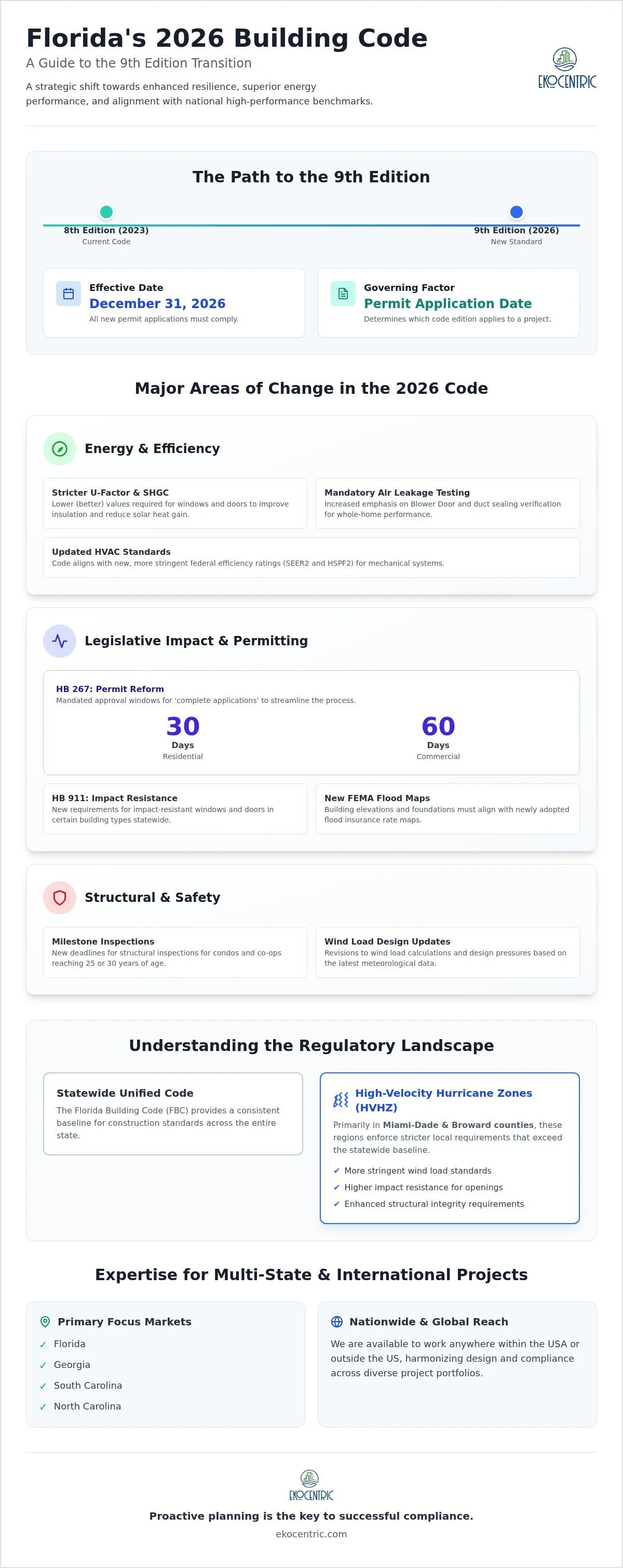
Infographic: Key 2026 Florida Building Code Changes at a Glance
Energy & Efficiency
✔ Stricter U-Factor: Lower (better) U-factor requirements for windows and doors to improve insulation.
✔ Reduced SHGC: Lower Solar Heat Gain Coefficient to minimize heat from sunlight, reducing cooling loads.
✔ Mandatory Testing: Increased emphasis on whole-home air leakage testing (Blower Door) and duct sealing verification.
✔ Updated HVAC Standards: Alignment with new federal SEER2 and HSPF2 efficiency ratings for mechanical systems.
Legislation & Permitting
✔ HB 267 Permit Reform: Mandated permit approval windows—30 days for residential, 60 days for commercial—for 'complete applications'.
✔ HB 911 Impact Resistance: New requirements for impact-resistant windows and doors in specific building classifications statewide.
✔ New FEMA Flood Maps: Building elevations and foundation requirements must align with newly adopted flood insurance rate maps.
Structural & Safety
✔ Milestone Inspections: Deadlines for structural inspections for condo and co-op buildings reaching 25 or 30 years of age.
✔ Wind Load Design: Updates to wind load calculations and design pressures based on the latest meteorological data.
✔ Roofing & Waterproofing: Enhanced standards for roof underlayment and weatherproofing to improve building envelope integrity.
Key 2026 Energy Code Revisions: Efficiency and Metrics
The 2026 Florida Energy Conservation Code sets the mandatory minimum for thermal envelope performance, mechanical system efficiency, and air leakage. The upcoming changes are among the most significant in recent cycles, pushing new construction toward a higher baseline of performance that directly impacts long-term operational costs and occupant comfort. For developers, mastering these metrics is no longer optional—it's central to project success.
Stricter Performance Thresholds: The 2026 code introduces more stringent requirements for U-factor and Solar Heat Gain Coefficient (SHGC), demanding better-performing windows, doors, and insulation.
Mandatory Verification: The role of third-party verification is expanding. Blower door tests to measure air leakage and duct blaster tests to verify duct sealing are becoming standard practice, shifting the focus from design intent to as-built performance.
The Rise of Energy Calculations: Proper HVAC system design, validated by Manual J (load calculation), Manual S (equipment selection), and Manual N (commercial load calculation), is now a non-negotiable part of the permitting process. These calculations ensure that systems are not oversized, which wastes energy and fails to properly dehumidify—a critical issue in Florida's climate.
Thermal Envelope and Window Performance
The building's thermal envelope—its roof, walls, windows, and foundation—is the first line of defense against energy loss. The 2026 code places a heavy emphasis on tightening this envelope, with windows being a primary focus.
Reading the New Window Stickers: NFRC labels on windows will be more important than ever. Builders must ensure the products they install meet the new, lower U-factor and SHGC requirements specified for their climate zone. For a detailed breakdown, explore our Window Ratings Guide: Understanding U-Factor & SHGC.
Impact of SHGC on Cooling Loads: In Florida, minimizing solar heat gain is paramount. The 2026 code's lower SHGC mandates will directly reduce the amount of solar radiation entering a building, decreasing the load on the air conditioning system and lowering cooling costs.
Impact Windows: A Dual Mandate: High-performance impact-resistant windows now serve a dual purpose. They provide critical protection in hurricane zones while also meeting the advanced energy metrics for thermal performance, making them an integrated solution for both safety and efficiency.
Mechanical Systems and HVAC Efficiency
As building envelopes become more airtight, the performance and design of mechanical systems become even more critical. The 2026 code addresses this with updated standards for both equipment and ventilation.
Updated SEER2 and HSPF2 Ratings: The code will fully adopt the new federal standards for HVAC efficiency—SEER2 (Seasonal Energy Efficiency Ratio 2) for cooling and HSPF2 (Heating Seasonal Performance Factor 2) for heating. This requires builders to source and install newer, more efficient equipment.
Mandatory Mechanical Ventilation: An airtight home is an efficient home, but it also requires mechanical ventilation to ensure healthy indoor air quality. The 2026 code strengthens mandates for continuous, balanced ventilation systems that exhaust stale air and introduce fresh, filtered air.
Performance Path Flexibility: While the prescriptive path offers a straightforward checklist, the performance-based compliance path provides greater flexibility. By using energy modeling software, designers can trade-off components (e.g., using higher-efficiency HVAC to compensate for a larger window area) to meet the overall performance target, often measured by a HERS Index score. This approach allows for more innovative and cost-effective design solutions.
Legislative Impact: HB 911, HB 267, and Structural Resilience
Beyond the standard code cycle, recent Florida legislation has introduced transformative changes that directly impact the construction and real estate industries. These laws, born from a need for greater safety and efficiency, are now integrated with the 2026 FBC framework.
HB 911 (2026): This bill expands impact resistance requirements for windows, doors, and other openings to a broader range of building classifications and geographic areas, moving beyond the traditional HVHZ zones.
HB 267 (2024/2025 Implementation): A landmark reform for permit processing, this law aims to eliminate notorious approval backlogs and provide developers with predictable timelines.
Milestone Inspections: Following the tragic Surfside condo collapse, Florida has mandated periodic structural inspections for aging condominium and cooperative buildings, with key deadlines falling in the 2026 cycle.
Flood Zone Requirements: The 2026 FBC will incorporate the latest FEMA flood insurance rate maps (FIRMs), potentially changing base flood elevations and foundation requirements for projects in coastal and low-lying areas. For more on this, see our Florida Green Building: 2026 Coastal Resilience Guide.
Permit Processing Reform (HB 267)
For developers, HB 267 is a game-changer. It replaces ambiguous waiting periods with firm deadlines, empowering builders to accelerate their project schedules and improve their return on investment.
The 30/60-Day Window: Local jurisdictions are now required to approve or deny "complete" permit applications within 30 business days for single-family residential projects and 60 business days for commercial projects.
Defining a 'Complete Application': The key to leveraging this law is understanding the definition of a "complete application." Submitting a thorough, error-free package is critical to starting the clock and avoiding technical restarts that can reset the timeline.
Accelerating Project ROI: Predictable permit timelines allow for more accurate scheduling of trades, financing draws, and material deliveries. Developers who master the submission process can significantly reduce carrying costs and bring projects to market faster.
Structural Integrity and Milestone Inspections
The state's focus on structural safety for existing multi-family buildings has created a new area of compliance and opportunity for licensed professionals.
Upcoming Deadlines: Condominium and cooperative buildings that are three stories or higher face mandatory milestone inspections upon reaching 30 years of age (or 25 years if located within three miles of a coastline). Many of these deadlines converge around 2026.
Phase One vs. Phase Two: A Phase One inspection is a visual examination by a licensed engineer or architect to identify any substantial structural deterioration. If issues are found, a more intensive Phase Two inspection is required.
The Role of Building Contractors: While engineers conduct the inspections, licensed Florida Building Contractors are essential for executing the structural repairs and remediation work identified in the reports. Ekocentric’s contractor license provides our team with the deep, practical understanding needed to consult on these complex remediation projects.
Aligning 2026 Code Compliance with Green Certifications
One of the most exciting outcomes of the 2026 code is its natural alignment with voluntary green building certifications. As the mandatory energy baseline rises, the gap to achieve certifications like LEED (Leadership in Energy and Environmental Design), NGBS (National Green Building Standard), and FGBC (Florida Green Building Coalition) narrows significantly. This presents a powerful opportunity for developers to achieve a higher-value product with less incremental effort.
A Higher Starting Point: A 2026 code-compliant building is already a high-performing asset. The stricter thermal envelope and efficiency requirements automatically satisfy many prerequisites and points within leading green certification programs.
The Role of the Green Rater: Verifying this "code-plus" performance requires a certified professional. A LEED Green Rater or NGBS Green Verifier provides the essential third-party testing and documentation to prove that a project not only meets but exceeds the new standards.
Market Differentiation: In a competitive market, certifications like ENERGY STAR and a low HERS Index score are no longer just plaques on a wall—they are powerful marketing tools that signal quality, durability, and lower utility bills to prospective buyers and tenants.
LEED BD+C and NGBS Strategy
For developers pursuing national certifications, the 2026 FBC simplifies the path forward. The key is to integrate the certification strategy early in the design process.
Adjusting Energy Models: The 2026 Energy Code becomes the new "baseline" in energy models for LEED and NGBS. This means that efficiency measures that once earned many points may now be standard, requiring designers to focus on more advanced strategies for a high score.
Complementary Mandates: New state structural mandates, such as enhanced impact resistance, can directly contribute to resilience credits within programs like NGBS, creating a synergy between compliance and certification.
Innovation Opportunities: Projects that exceed the 2026 code in areas like water conservation, indoor air quality, or innovative storm-resistant design can earn "Innovation" points in LEED, rewarding forward-thinking development.
FGBC: The Florida-Specific Advantage
The Florida Green Building Coalition (FGBC) offers a certification standard designed specifically for Florida’s unique climate and ecology. It provides a practical and regionally relevant framework for sustainable construction.
Tailored to Florida's Climate: FGBC standards prioritize challenges like humidity control, hurricane resistance, and water conservation in a drought-prone state, making it a highly practical choice for local projects.
Navigating Regional Financing: FGBC certification can help projects qualify for specialized green financing or meet sustainability requirements for certain municipal grants and incentives.
Expert Guidance: As a leading FGBC Certifying Agent, Ekocentric provides expert guidance to help projects navigate the certification process efficiently. Explore our FGBC consulting services to learn how we can tailor a strategy for your next development.
Optimizing Building Performance Beyond the 2026 Minimums
The 2026 Florida Building Code establishes the new minimum standard, but visionary developers understand that building to the bare minimum is a short-sighted strategy. True market leadership and long-term asset value come from exceeding the code and delivering a genuinely high-performance building. This approach future-proofs projects against the inevitable tightening of the 2029 and 2032 code cycles and positions them as premium products in the marketplace.
The Risk of "Minimum": A building that only just meets today's code will be functionally obsolete in a few years. This can lead to higher operational costs, lower tenant satisfaction, and reduced resale value over time.
The Value of Third-Party Verification: Certifications from respected programs like LEED, NGBS, ENERGY STAR, and a verified HERS Index score provide tangible proof of quality and performance. This documentation de-risks the asset for lenders and offers a compelling value proposition to buyers.
Comprehensive Support: Ekocentric offers comprehensive certification support not only in our core markets of Florida, Georgia, North Carolina, and South Carolina, but also for national and international projects, ensuring consistent quality and performance across your entire portfolio.
The ROI of High-Performance Building
Investing in performance beyond the code is not an expense; it is a strategic investment with a clear and compelling return.
Lower Operational Costs: Highly efficient buildings use less energy and water, resulting in significantly lower utility bills for owners and tenants—a powerful selling point in any market.
Enhanced Asset Value: Green-certified buildings consistently command higher sale prices and rental rates. They are more attractive to institutional investors, ESG-focused funds, and sophisticated buyers.
The Dual Advantage: Ekocentric's unique combination of technical expertise as a licensed building contractor and market insight as a licensed realtor creates a "Dual Advantage" for our clients. We don't just help you build a better building; we help you leverage that quality to maximize its value in the real estate market.
Partnering for Compliance and Performance
Navigating the complexities of the 2026 FBC while simultaneously pursuing green certifications can overwhelm even the most capable in-house teams. This is where a specialized B2B consulting partnership becomes invaluable.
Overcoming Capacity Gaps: We act as an extension of your team, providing the specialized knowledge and manpower to manage the intricate processes of energy modeling, performance testing, and certification documentation.
Seamless Coordination: Our role is to ensure seamless communication and coordination between architects, engineers, contractors, and raters, keeping the project on track and on budget.
Take the Next Step: The 2026 code changes are coming. Proactive planning is the key to turning this regulatory shift into a competitive advantage. Contact Ekocentric today for a project-specific 2026 code audit and discover how we can help you achieve both compliance and peak performance.