Window Ratings Guide: Understanding U-Factor & SHGC
Your project's certification success often hinges on a small piece of adhesive paper that is frequently overlooked during the design phase. Here is what you need to know about Window Stickers. What is a U factor and a Solar Height Gain Coefficient and why does it matter. What are impact windows? These aren't just technical curiosities; they're the critical data points that determine whether your building meets the 9th Edition Florida Building Code or falls short of LEED certification thresholds.
We know that balancing hurricane resilience with strict energy efficiency standards feels like a moving target. It's difficult to translate complex NFRC ratings into accurate energy modeling data, especially when you're aiming for National Green Building Standard (NGBS) or FGBC verification. You need clarity to ensure your building performs as intended while staying compliant with evolving standards across the Southeast and beyond.
This guide will help you master window technical specifications to optimize building energy ratings and meet rigorous green standards. We'll explore how U-Factor and SHGC impact your project's ROI and explain the latest LEAFF methodology updates. Whether you're developing in Georgia, the Carolinas, or international markets, you'll gain the expertise needed to turn technical acronyms into tangible performance results.
Key Takeaways
Gain a comprehensive understanding of what you need to know about Window Stickers. What is a U factor and a Solar Height Gain Coefficient and why does it matter. What are impact windows? These metrics are the foundation for meeting modern building codes.
Learn how lower U-factors and SHGC values optimize thermal performance and contribute to higher energy efficiency ratings for your building envelope.
Explore why impact-resistant glass is a dual-purpose solution that provides both hurricane resilience and improved insulation through advanced laminated interlayers.
Identify specific pathways to earn LEED BD+C and NGBS certification points by selecting fenestration that exceeds baseline energy standards.
Understand the value of early-stage consultancy to prevent expensive value engineering and ensure project success for developments in the Southeast and international markets.
Table of Contents
Decoding the NFRC Window Sticker: The Basics for Builders
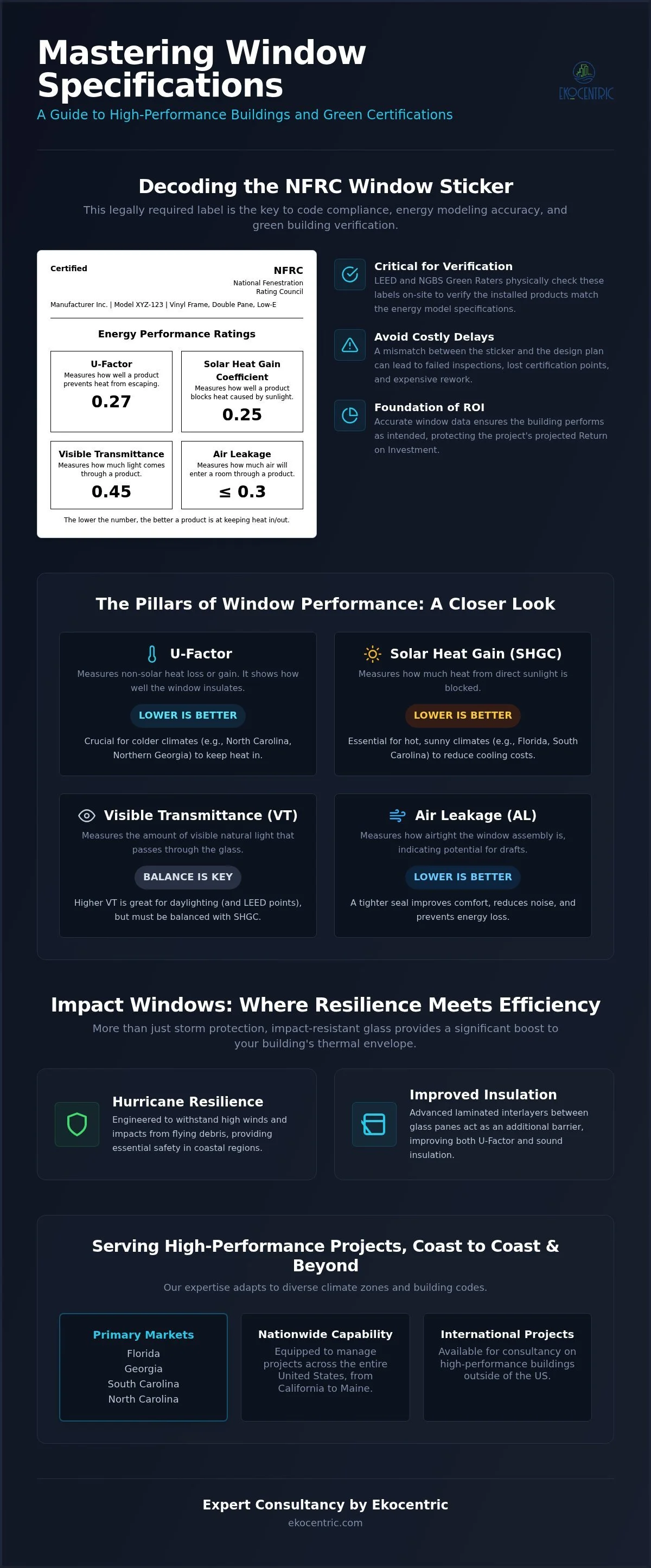
The National Fenestration Rating Council (NFRC) label acts as a standardized tool for objective performance comparison, allowing architects and developers to evaluate glass products on a level playing field. It isn't just a helpful guide; this sticker is a legal requirement for building code compliance in nearly every jurisdiction. When managing projects across the Southeast or internationally, understanding these labels is the first step in high-performance construction. To get the most out of your build, you should start by mastering what you need to know about Window Stickers. What is a U factor and a Solar Height Gain Coefficient and why does it matter. What are impact windows? These components, alongside Visible Transmittance and Air Leakage, form the backbone of modern energy modeling.
Why Window Stickers Matter in New Construction
For professionals seeking LEED Green Rater services or National Green Building Standard (NGBS) Green Verification, the window sticker is a non-negotiable piece of evidence. Verifiers check these labels during site inspections to ensure the installed fenestration matches the energy model specified during the design phase. A mismatch here isn't just a minor error. It can lead to failed inspections, lost certification points, and expensive project delays. Our team at Ekocentric helps developers navigate these requirements across Florida, Georgia, and the Carolinas, ensuring that every consulting service we provide is backed by accurate field verification of these labels. Matching the physical product to the digital model is essential for maintaining the integrity of the building's projected ROI.
Reading the Label: Beyond the Big Numbers
While insulation is often the primary concern, secondary metrics on the label dictate how a building actually feels to its occupants. Visible Transmittance (VT) measures the amount of natural light that passes through the glass, which is vital for achieving LEED daylighting credits and reducing the need for artificial lighting. Air Leakage (AL) provides a measurement of the airtightness of the window assembly. A lower AL rating indicates a tighter seal, which directly impacts occupant comfort by reducing drafts and noise. Utilizing advanced Window insulation technologies allows builders to maximize these ratings, creating spaces that are both energy-efficient and pleasant to inhabit. These metrics work together to determine the overall environmental footprint of the structure.
Deep Dive: Understanding U-Factor and Solar Heat Gain Coefficient (SHGC)
U-Factor measures the rate of non-solar heat loss through a window, whereas the Solar Heat Gain Coefficient (SHGC) represents the fraction of solar radiation admitted through the glass; lower values in both metrics signify better performance, though their importance varies by climate zone. To optimize your building's envelope, you must grasp what you need to know about Window Stickers. What are impact windows? These metrics are not interchangeable. While one focuses on keeping heat from escaping or entering through conduction, the other manages the intense energy from direct sunlight. The "lower is better" rule is a solid starting point, but the ideal balance shifts significantly as you move from the mountains of North Carolina to the coastal heat of Florida.
U-Factor: Keeping the Heat Where It Belongs
U-Factor quantifies how well a window product prevents heat from escaping a home or building. It accounts for the entire assembly, including the glass, frame, and spacers. In regions like North Carolina and northern Georgia, where heating loads are a major concern during winter months, a low U-factor is essential for maintaining occupant comfort. Conduction and radiation through the frame can account for a significant portion of energy loss. Frame materials play a decisive role here. While aluminum provides exceptional strength for large spans, it's highly conductive. Vinyl, wood, or composite frames often yield better U-factor results because they act as natural insulators. Selecting a window with a U-factor tailored to your specific latitude prevents your HVAC system from working overtime to combat thermal transfer.
SHGC: The Critical Metric for Florida and the Southeast
In hot, humid climates, SHGC is the primary driver of cooling costs. It measures how much solar radiation enters through the window and becomes heat inside the building. For developers in Florida and South Carolina, minimizing this value is the most effective way to reduce peak cooling loads. Low-E coatings are the standard solution for lowering SHGC without sacrificing natural light. These microscopic metallic layers reflect long-wave infrared energy while allowing visible light to pass. Orientation is another vital factor in this equation. West-facing windows endure the most punishing solar gain and require the lowest SHGC possible to prevent overheating. Partnering with an ENERGY STAR rater early in the process ensures your glass selections align with your specific climate zone requirements, maximizing your building's long-term efficiency and ROI.
Impact Windows: Where Resilience Meets Energy Efficiency
Building in the Southeast requires a strategy that addresses both extreme heat and extreme weather. While the NFRC label provides the data, the physical construction of the glass determines how that data translates to real-world performance. What are impact windows? These products feature laminated glass composed of two or more panes bonded together by a durable interlayer, typically made of polyvinyl butyral (PVB) or ionoplast polymer. This design allows the window to withstand high-velocity debris during a storm without breaching the building envelope. Understanding this technology is a vital part of what you need to know about Window Stickers. What are impact windows? These questions are linked because the same laminated interlayer that provides safety also enhances the thermal and acoustic properties of the unit.
Hurricane Protection and Building Code Compliance
In High Velocity Hurricane Zones (HVHZ) like South Florida, impact-resistant fenestration is a strict code requirement. The upcoming 9th Edition of the Florida Building Code continues to emphasize these standards, especially as wind zones expand. Unlike shutters, which only provide protection when they're deployed, impact windows offer 24/7 resilience. This constant protection is why developers in coastal Georgia and the Carolinas are increasingly adopting these specifications. For those pursuing FGBC certification consulting, choosing impact glass often simplifies the path to compliance by meeting both structural and energy requirements in a single solution. It's a pragmatic approach that ensures the building remains functional after a major weather event.
Thermal Performance of Laminated Glass
Many industry voices suggest impact glass is only for safety, but its thermal advantages are significant. The plastic interlayer acts as an additional thermal break, which can improve the U-factor compared to standard annealed glass. This interlayer also filters up to 99 percent of UV rays, protecting building interiors and expensive finishes from premature fading. When you pair this with high-performance Low-E coatings, you create a synergy that drastically reduces SHGC. For multi-family residential projects in urban areas, the sound dampening qualities of laminated glass provide an added layer of occupant comfort that standard windows can't match. While the weight and initial cost are higher, the long-term ROI through energy savings and potential insurance premium reductions of 10 to 35 percent makes it an essential choice for serious developers.
How Window Ratings Drive Green Building Certifications
Window ratings aren't just technical benchmarks for code compliance; they're the currency of green building certifications. For projects aiming for LEED BD+C, fenestration performance is a massive contributor to the Energy and Atmosphere (EA) credit category. To maximize these points, developers must move beyond basic compliance and master what you need to know about Window Stickers. What are impact windows? These metrics are the primary inputs for the energy models that dictate your final certification level. When your goal is environmental stewardship and long-term building ROI, every decimal point on that NFRC label counts toward your total score.
National Green Building Standard (NGBS) verification also places a heavy emphasis on high-performance fenestration. Within the Energy Efficiency chapter of ICC 700, points are awarded for windows that significantly exceed baseline standards. Similarly, the Florida Green Building Coalition (FGBC) offers specific credits for low SHGC windows, recognizing their vital role in reducing the state's unique cooling loads. By selecting windows that perform better than the code requires, you're not just building a better structure; you're securing the credentials needed for specialized financing and market differentiation.
The LEED Green Rater Perspective
The LEED Green Rater acts as the final gatekeeper for your project's residential certification. Think of the NFRC sticker as the "birth certificate" of the window. It provides the third-party verification necessary to prove that the products installed on-site match the design intent. If the installed windows have a higher U-factor than what was modeled, it can jeopardize the entire certification level. This is why we advocate for early-stage coordination. Engaging our LEED Green Rater Services ensures that your specifications are accurate from the start, preventing costly compliance gaps during the final inspection phase.
Optimizing for FGBC and ENERGY STAR
Meeting ENERGY STAR Version 7.0 requirements is a high bar for windows in the Southern Zone, requiring a SHGC of 0.23 or lower. These high-performance choices naturally lower the HERS Index, which is a key metric for residential builds across Georgia and the Carolinas. Strategic window selection allows you to meet Florida-specific green building standards while maintaining the aesthetic vision of the project. Whether you're working on a local development or an international project, aligning window performance with these certification thresholds is a pragmatic way to ensure success. If you're ready to optimize your building's performance, contact our expert team to discuss your energy modeling needs.
The Ekocentric Approach: Beyond the Sticker
Understanding technical data is only half the battle. The real challenge lies in applying that data to a complex, multi-million dollar construction project. While the previous sections defined the metrics, our role is to translate those figures into a high-performing building. We provide the clarity you need to know about Window Stickers. What are impact windows? These answers are most valuable when they're integrated into a whole-building performance model. By analyzing the interplay between fenestration, HVAC systems, and lighting, we help developers avoid the pitfalls of fragmented design. This holistic view is essential for projects across Florida, Georgia, and the Carolinas, as well as our international sustainability consulting ventures.
We believe that environmental stewardship and business pragmatism are not mutually exclusive. Our team approaches every project as a partnership, acting as an extension of your staff to manage specialized requirements that often overwhelm internal resources. Whether you're building a high-rise in Charlotte or a coastal development in the Caribbean, we ensure your window selections are optimized for the local climate and specific certification goals. We don't just verify data; we advocate for solutions that enhance the quality of living spaces while protecting our planet's resources.
Maximizing ROI Through Performance Optimization
Value engineering often happens too late, leading to compromises that hurt long-term performance. Consulting with an expert early in the design phase prevents these costly pivots. We help you find the "sweet spot" where window performance is maximized without over-specifying and inflating your budget. For example, selecting a window with a superior SHGC can often allow for a smaller, less expensive HVAC system. This rightsizing provides immediate capital savings and reduces ongoing operational costs. Certified sustainable buildings consistently command higher value in the real estate market, making performance optimization a primary driver of project ROI.
Partnering with Ekocentric for Certification Success
Our credentials provide the authority your project needs to succeed. As Licensed Florida Certified Building Contractors, LEED BD+C consultants, and National Green Building Standard (NGBS) Green Verifiers, we understand the technical and regulatory landscape from every angle. We streamline the certification process for architects and developers, handling the complex documentation and field verification required for success. Our reach extends across the entire United States and into international markets, bringing a world-class perspective to local challenges. We invite you to explore our full range of Sustainability Consulting Services to see how we can support your next high-performance project.
Secure Your Project’s Energy Future
Selecting high-performance fenestration is a decisive step toward environmental stewardship and long-term project viability. Throughout this guide, we've examined what you need to know about Window Stickers. What are impact windows? These metrics are the essential building blocks of a resilient envelope that withstands the Southeast's unique climate challenges while meeting strict LEED or NGBS certification thresholds. By prioritizing data-driven selections, you protect both your building's occupants and your overall ROI.
As a Licensed Florida Certified Building Contractor with LEED BD+C and NGBS Green Verifier expertise, we bridge the gap between technical data and successful project outcomes. We serve developers across Florida, Georgia, South Carolina, and North Carolina; we're also available for international projects. Our team is ready to help you translate window performance into tangible certification points and operational savings. Optimize Your Building Performance with Ekocentric Consulting today. It's time to turn technical specifications into a sustainable legacy for your next development.
Frequently Asked Questions
What is the most important window rating for Florida buildings?
The Solar Heat Gain Coefficient (SHGC) is the most critical metric for Florida buildings because it dictates the amount of solar radiation that enters a structure. High SHGC values lead to excessive cooling loads and increased energy costs in our tropical climate. While U-factor is still important for overall insulation, minimizing solar gain is the primary strategy for meeting Florida Green Building Coalition (FGBC) standards and optimizing HVAC performance in the Sunshine State.
Can I meet LEED requirements with standard windows or do I need impact glass?
You can achieve LEED certification with standard windows, provided they meet the specific performance thresholds for your climate zone. However, impact glass often simplifies the process in coastal regions because its laminated interlayer provides superior thermal insulation and sound dampening. Choosing the right glass is a core part of what you need to know about Window Stickers. What are impact windows? These factors determine your final energy credits.
How does a low U-factor benefit buildings in South Carolina and North Carolina?
A low U-factor is vital for projects in South Carolina and North Carolina because it measures the rate of non-solar heat loss. In these regions, colder winter temperatures make heating a significant portion of the building's energy consumption. High-performance windows with low U-factors act as effective thermal barriers, keeping expensive indoor heat from escaping. This improves occupant comfort and ensures the building meets the stringent energy efficiency requirements of the National Green Building Standard (NGBS).
What is the difference between U-factor and R-value in windows?
U-factor and R-value are mathematical inverses, but the industry uses U-factor for windows to measure the rate of heat flow through the entire assembly. While R-value measures a material's resistance to heat, U-factor accounts for the glass, frame, and spacers together. A lower U-factor indicates better insulation. This standardized metric allows architects and developers to compare products objectively and is the required data point for building code compliance and LEED energy modeling.
Do impact windows always have a lower SHGC?
Impact windows don't automatically have a lower SHGC, but their construction often yields better results than standard glass. The laminated interlayer itself provides some UV filtering, but the real performance gains come when these windows are paired with high-performance Low-E coatings. This combination allows the window to withstand high-velocity debris while maintaining a low SHGC. It's a pragmatic solution for developers who need to balance storm safety with the cooling demands of the Southeast.
Why does the LEED Green Rater need to see my window stickers?
A LEED Green Rater must verify window stickers to ensure the installed products match the energy model used for certification. This third-party verification is a mandatory part of the LEED for Homes and BD+C processes. Without the physical NFRC label as proof, the rater cannot confirm the U-factor or SHGC values. Incorrect or missing documentation can jeopardize your certification level and result in costly delays during the final verification phase of your project.
How do window ratings affect my HERS Index score?
Window ratings have a direct impact on your HERS Index score because they determine the total energy load of the home. High-performance windows with low SHGC and U-factor values reduce the demand on the HVAC system, which lowers the building's overall energy consumption. As a RESNET HERS Rater, we use this data to calculate your score. A lower HERS score indicates a more efficient building, which is often required for ENERGY STAR certification and NGBS green verification points.
Can Ekocentric provide consulting for projects outside of Florida?
Ekocentric provides sustainability consulting for projects across the entire United States and international markets. While we have deep roots in Florida, we're licensed and active in Georgia, South Carolina, and North Carolina. Our team brings specialized expertise in LEED, NGBS, and FGBC certifications to developers and architects worldwide. We manage the complex technical requirements of high-performance building standards, ensuring your project meets its environmental and performance goals regardless of its geographic location.