Green Building Certification: 2026 Developer Guide
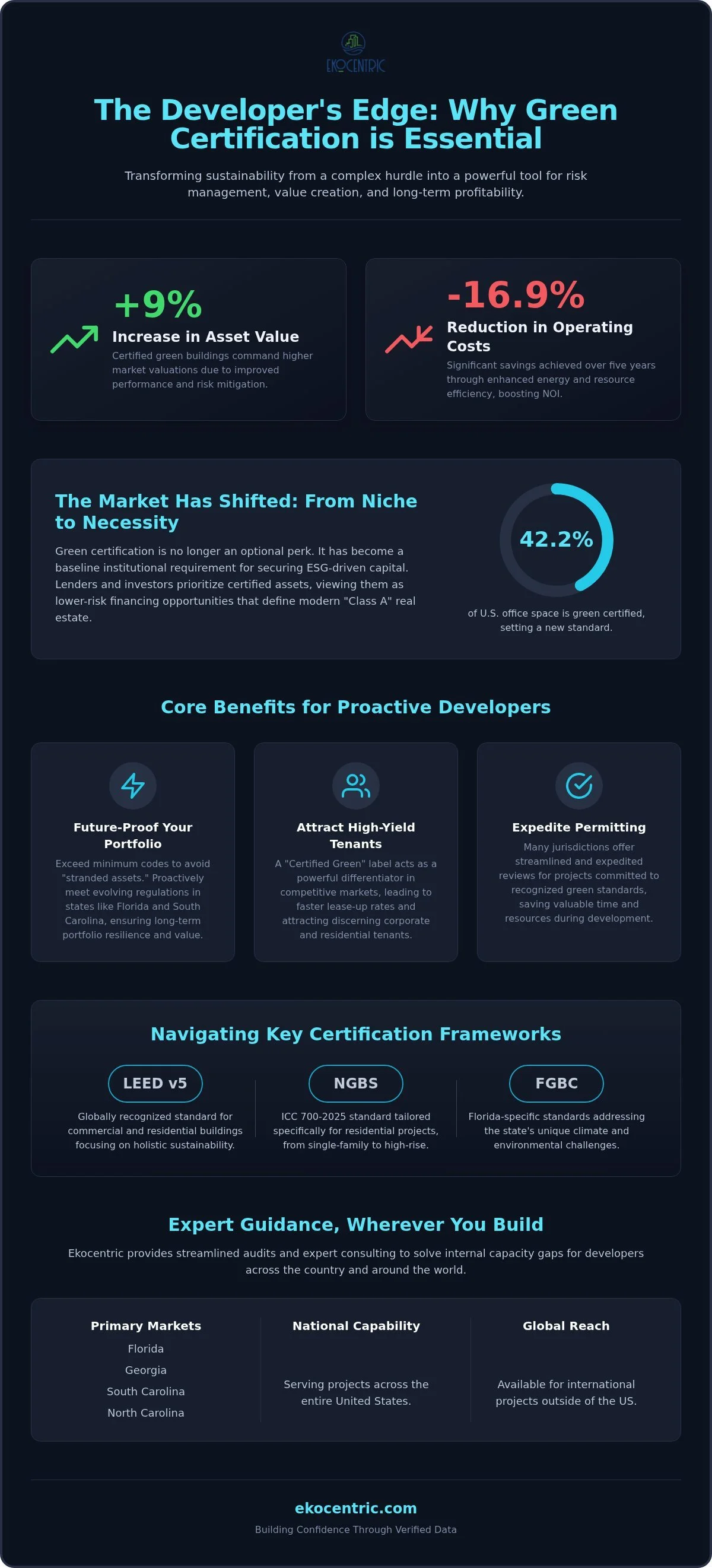
Did you know that green-certified buildings can increase asset value by over 9% while slashing operating costs by nearly 17% over the first five years? Many developers still view high-performance standards as a complex regulatory hurdle or a drain on upfront capital. It's understandable to feel overwhelmed by the shifting requirements of LEED v5 or the rigorous audits required for NGBS certification. However, the benefits of green building certification for developers in 2026 have shifted from optional perks to essential tools for risk management and value creation.
This guide reveals how certifications like LEED, NGBS, and FGBC drive long-term profitability and secure a competitive edge in today's real estate market. You'll learn how to achieve faster lease-up rates and future-proof your compliance with national and international standards. We'll explore the latest ICC 700-2025 updates and show you how to bridge the internal expertise gap. Whether you're building in Florida, Georgia, South Carolina, North Carolina, or across the globe, we'll help you turn sustainability into a pragmatic business advantage that attracts investors and residents alike.
Key Takeaways
Understand why third-party verification has transitioned from a niche marketing tool to an institutional requirement for securing ESG-driven capital in 2026.
Discover how the benefits of green building certification for developers extend beyond energy savings to include higher asset valuations, faster lease-up rates, and lower life-cycle costs.
Learn to distinguish between frameworks like LEED v5, NGBS (ICC 700-2025), and FGBC to select the most efficient path for your specific residential or commercial project.
Identify how to future-proof your portfolio against evolving compliance standards while optimizing building performance in key markets like Florida, Georgia, and the Carolinas.
See how partnering with a LEED Green Rater or NGBS Verifier solves the internal capacity gap and ensures a streamlined audit process for projects across the United States and abroad.
Table of Contents
Why Green Building Certification is a Developer’s Strongest Asset in 2026
Market Differentiation: Attracting High-Yield Tenants and ESG Investment
Comparing Frameworks: LEED, NGBS, and FGBC for Residential and Commercial Projects
Streamlining the Certification Process with Ekocentric’s Expert Consulting
Why Green Building Certification is a Developer’s Strongest Asset in 2026
Green building certification isn't just a plaque on a lobby wall. It represents a third-party verified performance standard that ensures a property meets rigorous benchmarks for energy efficiency, indoor air quality, and resource management. In 2026, the real estate market has reached a tipping point. What was once an optional niche for sustainable enthusiasts has evolved into a baseline institutional requirement. One of the primary benefits of green building certification for developers is the ability to prove performance to a global audience using recognized green building certification systems such as LEED, NGBS, and FGBC. Ultimately, green certification serves as a strategic tool for risk mitigation and long-term value enhancement.
The Institutional Shift Toward Sustainability
The capital markets have fundamentally changed. Lenders and institutional investors now prioritize certified assets because they represent lower-risk financing opportunities. In early 2026, data showed that 42.2% of U.S. office space had achieved green certification, reflecting a massive shift in how "Class A" real estate is defined. Environmental, Social, and Governance (ESG) metrics are no longer abstract goals; they're the criteria used to secure competitive interest rates and insurance premiums. Certification provides a common language for stakeholders, allowing a developer in North Carolina or Georgia to demonstrate asset quality to an international investment fund with total transparency. It's about building confidence through verified data.
Future-Proofing Against Regulatory Changes
Building to the bare minimum code is a recipe for a "stranded asset." As municipal energy codes in states like Florida and South Carolina become increasingly stringent, projects that only meet current baselines risk becoming obsolete within a decade. By pursuing specialized certification services like LEED v5 or the residential-focused NGBS ICC 700-2025, developers pre-empt these regulatory shifts. Choosing to embrace the benefits of green building certification for developers ensures your portfolio remains resilient against shifting climate policies. This proactive approach often streamlines the permitting process, as many jurisdictions offer expedited reviews for projects using recognized green standards. It's a pragmatic way to ensure resource efficiency and maintain high-quality living spaces that won't require costly retrofits as carbon standards tighten.
Maximizing Asset Value and Operational Efficiency
The relationship between a building's environmental performance and its market valuation is no longer theoretical. Data from 2026 confirms that green-certified buildings can increase asset value by over 9%. This appreciation isn't just about prestige; it's a direct result of improved building performance and risk mitigation. For residential developers, utilizing a RESNET HERS Rater provides a standardized energy efficiency score that functions like a fuel economy label. This transparency builds buyer and investor confidence. According to Yale experts on green building, these certifications provide a framework that balances environmental health with financial viability.
Lower utility costs translate directly into a higher Net Operating Income (NOI). New green buildings typically see an average operating cost saving of 10.5% in their first year. Over five years, those savings often climb to 16.9%. These figures represent one of the most compelling benefits of green building certification for developers. When you reduce the "energy drag" on a property, you effectively increase the capital available for other investments or distributions. It's a pragmatic approach to wealth creation that starts with resource efficiency.
Higher Rental Premiums and Faster Lease-up
Tenants today are more discerning about where they live and work. In highly competitive markets like Florida and Georgia, a "Certified Green" label acts as a powerful differentiator that speeds up lease-up rates. Institutional and corporate tenants often have their own internal ESG mandates, meaning they can only sign leases in certified buildings. Occupants also prioritize spaces with superior indoor air quality and thermal comfort. These features lead to lower tenant turnover and higher satisfaction scores. When a building supports the well-being of its residents, it naturally commands a rental premium over non-certified peers.
Reduced Maintenance and Operating Expenses
Building to LEED or NGBS standards requires a focus on high-performance building envelopes and durable materials. This technical rigor pays off through reduced maintenance needs over the property's lifecycle. High-efficiency HVAC systems and AI-powered lighting controls don't just save energy; they often require less frequent repairs than cheaper, lower-performing alternatives. By emphasizing quality at the construction phase, you avoid the "death by a thousand cuts" that comes with frequent minor repairs. Optimized building performance significantly reduces long-term capital expenditure by extending the life of critical infrastructure. If you're looking to maximize your project's ROI, exploring professional verification services is a logical first step toward operational excellence.
Market Differentiation: Attracting High-Yield Tenants and ESG Investment
In a saturated real estate market, green building certification acts as a powerful signal to the most desirable tenants and investors. It provides tangible proof of corporate responsibility, allowing developers to move beyond marketing claims and offer third-party verified excellence. For "Class A" corporate tenants, leasing space in a certified building isn't just a preference; it's often a strict mandate from their own board of directors to meet sustainability goals. By securing a partner for LEED BD+C Consulting, you align your project with the specific requirements these high-yield tenants demand. This alignment is a cornerstone of the benefits of green building certification for developers, as it directly impacts occupancy rates and the quality of your tenant roster in markets like Georgia and Florida.
The ESG Advantage for Developers
Institutional investors and global "green funds" are increasingly selective about where they deploy capital. Certification simplifies the complex process of ESG reporting, providing standardized data that investors can easily plug into their portfolios. This transparency makes your project more attractive for sustainability-linked loans and other favorable financing structures. Beyond the financial mechanics, being a "Certified Green Builder" builds significant brand equity. It positions your firm as a forward-thinking leader capable of delivering high-performance assets that respect both the environment and the bottom line. Whether your project is in the Southeast or an international market, this reputation for quality is an indispensable asset.
Occupant Well-being as a Sales Driver
The "Social" pillar of ESG has gained massive traction, focusing heavily on the health and productivity of a building's occupants. Features like advanced air filtration and maximized natural light aren't just technical specs; they're wellness drivers that conscious consumers prioritize. Yale University experts on green building highlight that these systems significantly improve human comfort and health, which reduces turnover. In multi-family developments across North and South Carolina, developers use certifications to justify premium price points. Residents are willing to pay more for homes that offer lower utility bills and a healthier living environment. Labels like ENERGY STAR and NGBS provide the trust needed to close these sales quickly. By prioritizing occupant well-being, you create a high-quality living space that stands out while fulfilling a mission of environmental stewardship.
Comparing Frameworks: LEED, NGBS, and FGBC for Residential and Commercial Projects
Selecting the correct framework is a pivotal decision that dictates your project's technical path and market perception. It's about aligning your building's goals with the specific benefits of green building certification for developers that matter most to your stakeholders. While some developers seek global prestige, others require pragmatic, residential-focused solutions that optimize every square foot. You can explore Ekocentric services to determine which path best suits your portfolio's needs. We help you choose between broad international standards and specialized regional systems that offer the best return on investment for your specific project type.
LEED vs. NGBS: Choosing the Right Path
LEED remains the global gold standard for high-profile builds. As of 2026, LEED v5 has become the primary framework for new registrations, emphasizing decarbonization and occupant health. For commercial developers, LEED BD+C (Building Design and Construction) provides the comprehensive structure needed for large-scale assets. Conversely, the National Green Building Standard (NGBS) serves as the most pragmatic choice for residential and multi-family construction. The ICC 700-2025 version, approved in early 2026, is the only residential-specific rating system approved by ANSI. While LEED offers unmatched international recognition, NGBS is often preferred for its streamlined verification process tailored specifically to the residential construction cycle. Both frameworks drive asset value, but the choice depends on whether your project is a high-rise commercial tower or a multi-family community.
Regional Excellence with FGBC
Developers focused on the Florida market often prioritize the Florida Green Building Coalition (FGBC) standards. The 13th version of the Florida Green Home Standard, released in 2026, is designed specifically for the state's unique hot-humid environment. It addresses regional challenges that broader national programs might overlook, such as extreme humidity control and resilience against natural disasters. Pursuing FGBC certification demonstrates a commitment to local environmental stewardship and ensures compliance with Florida-specific building codes. This regional expertise is particularly valuable in coastal markets where climate resilience is a top priority for insurers and buyers alike. Whether your project is in Florida, Georgia, or the Carolinas, choosing a framework that balances national prestige with local relevance is essential for long-term success. If you need help navigating these complex requirements, you can consult with our expert team to find your optimal certification strategy.
Streamlining the Certification Process with Ekocentric’s Expert Consulting
Many development teams recognize the benefits of green building certification for developers, yet they often lack the internal capacity to manage the intricate requirements of the audit process. Certification isn't a simple administrative task. It requires meticulous documentation, on-site performance testing, and constant coordination between architects and site leads. Without a dedicated specialist, these technical demands can lead to project delays or missed credits. Ekocentric acts as your pragmatic partner, stepping in as a LEED Green Rater or NGBS Verifier to handle the heavy lifting of certification management. Our goal is to remove the burden from your team so you can focus on the core construction and real estate goals of your project.
Beyond Compliance: Optimizing Building Performance
We don't believe in "checking boxes" just to earn a plaque. Our firm focuses on actual building performance to ensure your asset delivers on its promise of resource efficiency and environmental stewardship. As a licensed Florida Certified Building Contractor, we bring a level of technical construction knowledge that many pure consulting firms lack. We understand how systems interact in the real world, not just on a spreadsheet. By using RESNET HERS ratings and our ENERGY STAR Partner designation, we provide data-backed proof of your building's efficiency. This technical rigor ensures the benefits of green building certification for developers translate into tangible outcomes like lower utility expenses and higher-quality living spaces that stand the test of time.
Your Partner from Design to Verification
A successful project starts with a clear strategy during the pre-design phase. We work alongside your architects to identify the most cost-effective path toward your certification goals, whether you're pursuing LEED BD+C or NGBS verification. Our dual expertise in technical construction and real estate licensing allows us to speak the language of both builders and investors. We reduce friction by acting as a bridge between your design team and the certifying bodies, ensuring that every requirement is met without unnecessary cost overruns. While we have a strong presence in Florida, Georgia, South Carolina, and North Carolina, our firm's reach is truly global. We scale our services for nationwide projects across the United States and are available for international developments. This scalability ensures that no matter where your project is located, you have access to expert consulting that prioritizes performance over simple compliance.
Partner with Ekocentric for expert sustainability consulting and secure a competitive edge for your next development project.
Securing the Future of Real Estate Development
The 2026 market has made one thing clear: high-performance building standards are the new baseline for institutional-grade real estate. By embracing the benefits of green building certification for developers, you secure more than just energy savings; you build long-term asset resilience, attract high-yield institutional capital, and create spaces that residents and corporate tenants truly value. Whether you're navigating the rigorous requirements of LEED v5 or the residential precision of NGBS ICC 700-2025, these frameworks provide the verified data needed to prove your project's worth in a competitive landscape. Building for the future means moving beyond simple compliance and toward a model of optimized performance and environmental stewardship.
Ekocentric is your dedicated partner in this transition. As a Licensed Florida Certified Building Contractor with deep expertise in LEED, NGBS, FGBC, and ENERGY STAR, we provide the technical rater and verification services needed to bridge your team's internal capacity gap. From our roots in Florida, Georgia, and the Carolinas to our projects across the United States and abroad, we help you turn complex certification audits into a streamlined path for value creation. It's time to future-proof your portfolio and lead the industry with buildings that perform as well as they look. Maximize your project’s value with Ekocentric’s certification consulting and start building your legacy of excellence today.
Frequently Asked Questions
What is the most recognized green building certification for developers?
LEED (Leadership in Energy and Environmental Design) is the most globally recognized standard in the industry. As of 2026, LEED v5 is the current version, placing a heavy emphasis on decarbonization and occupant health. Many developers prioritize this framework for its international prestige and the clear benefits of green building certification for developers when attracting institutional investment. It serves as a universal benchmark for high-performance buildings across both commercial and residential sectors.
How does green building certification affect the resale value of a property?
Certified buildings typically command higher resale values because they offer lower risk and verified performance. Data from 2026 indicates that green-certified buildings can increase asset value by over 9%. Investors and buyers view these properties as superior assets due to their lower operating costs and alignment with global ESG mandates. This certification provides a common language that proves a building's longevity and resource efficiency to potential buyers anywhere in the world.
What is the difference between a LEED Green Rater and a LEED AP?
A LEED AP is a consultant who manages the overall documentation and certification process. In contrast, a LEED Green Rater is a required third-party professional who performs essential on-site inspections and performance testing for residential projects. Ekocentric provides specialized LEED Green Rater services to ensure that the actual construction meets the design's high-performance goals. Both roles are necessary to successfully navigate the audit process and secure the full benefits of green building certification for developers.
Are there specific green building certifications for Florida-based projects?
The Florida Green Building Coalition (FGBC) provides standards designed specifically for Florida's unique climate and building codes. The FGBC Florida Green Home Standard addresses regional challenges like high humidity and disaster resilience that national programs might overlook. These standards are updated every three years, with the 13th version released in 2026. This regional focus makes FGBC an excellent choice for developers looking to optimize performance and compliance within the Sunshine State.
How long does the green building certification process typically take?
The timeline for certification generally mirrors the construction schedule of the project. The process should begin during the pre-design phase to identify goals and continues through construction completion and final verification. For most residential or commercial builds, the final certificate is issued shortly after the final site audit is completed. Early involvement is critical, especially since registration for older standards like LEED v4.1 closed on June 30, 2026, requiring teams to adapt quickly.
Is NGBS certification better than LEED for multi-family residential projects?
NGBS (ICC 700-2025) is often the more pragmatic choice for residential and multi-family construction. It is the only residential-specific rating system approved by ANSI and is designed to align closely with the residential building cycle. While LEED offers more international prestige for high-profile commercial towers, NGBS provides a rigorous and cost-effective framework tailored specifically to creating high-quality living spaces. Developers often choose NGBS for its streamlined verification process and focus on residential durability.
Can Ekocentric provide certification services for projects outside of Florida?
Yes, Ekocentric operates on a global scale despite our strong regional presence in Florida, Georgia, South Carolina, and North Carolina. We are licensed contractors and realtors with the technical capacity to manage LEED, NGBS, and ENERGY STAR projects across the entire United States. Our team is also available for international consulting assignments. This allows developers worldwide to access our specialized expertise in building performance optimization and complex certification management regardless of their project's location.
What are the main financial benefits of building to ENERGY STAR standards?
Building to ENERGY STAR standards significantly boosts a property's Net Operating Income (NOI) by reducing utility consumption. New certified buildings typically see an average of 10.5% in first-year savings, which grows to 16.9% over five years. These operational savings directly increase the asset's overall valuation. Additionally, the ENERGY STAR label acts as a powerful differentiator in competitive markets, attracting tenants who prioritize resource efficiency and lower monthly costs for their homes or businesses.