Blower Door Testing: Energy Efficiency & Certification
A failed blower door test isn't just a technical hurdle; it's a missed opportunity to validate the environmental integrity of your project. For developers and project leads across Florida, Georgia, and the Carolinas, Blower Door testing for new homes and energy efficiency has become a critical milestone rather than a simple checklist item. You've likely felt the frustration of unexpected test failures delaying occupancy or the headache of coordinating third-party raters with tight construction schedules. It's difficult to keep up with varying state energy codes while aiming for high-level green certifications.
We understand that you need more than just a pass or fail result. You need a pragmatic partner to help you navigate the complexities of modern building science. This guide will help you master the technical requirements and strategic benefits of these tests to ensure your new construction projects meet 2026 energy codes and green certifications. We'll explore how to pass on your first attempt, optimize building performance for long-term ROI, and seamlessly integrate testing into your LEED or NGBS workflows. Whether your project is local or international, mastering these diagnostics is the key to building high-quality, resource-efficient spaces that stand the test of time.
Key Takeaways
Understand why 2026 building codes prioritize airtightness for moisture control and how these standards protect your project's long-term durability.
Learn the technical process of Blower Door testing for new homes and energy efficiency, including how digital manometers quantify building envelope performance.
Navigate the specific requirements for LEED, NGBS, and FGBC certifications to ensure your project meets the highest standards of environmental stewardship.
Implement a strategic pre-drywall inspection to identify air barrier gaps early, reducing the risk of test failures that delay occupancy.
Shift from simple code compliance to performance optimization, leveraging specialized expertise to enhance asset value across the Southeast and internationally.
Table of Contents
The Role of Blower Door Testing in 2026 New Home Construction
Preparation Checklist: Ensuring a Passing Result for New Builds
The Role of Blower Door Testing in 2026 New Home Construction
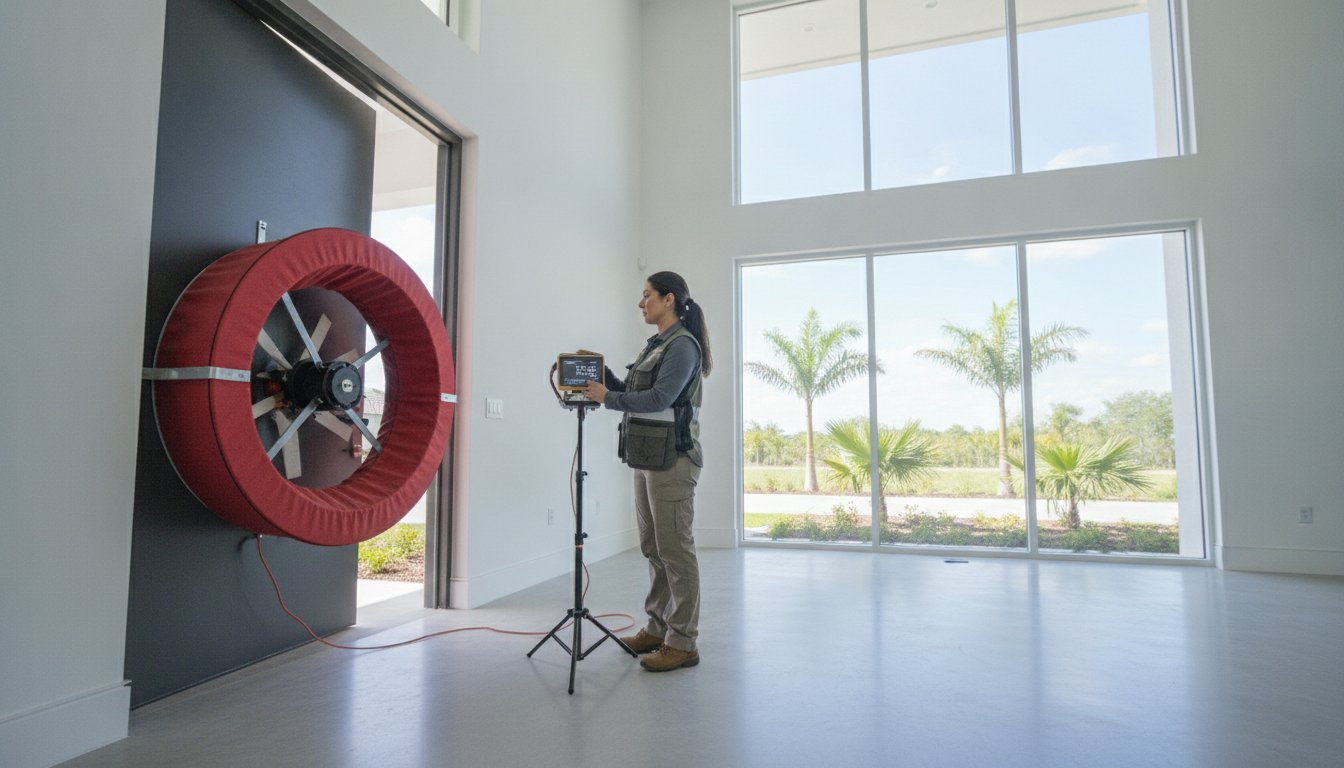
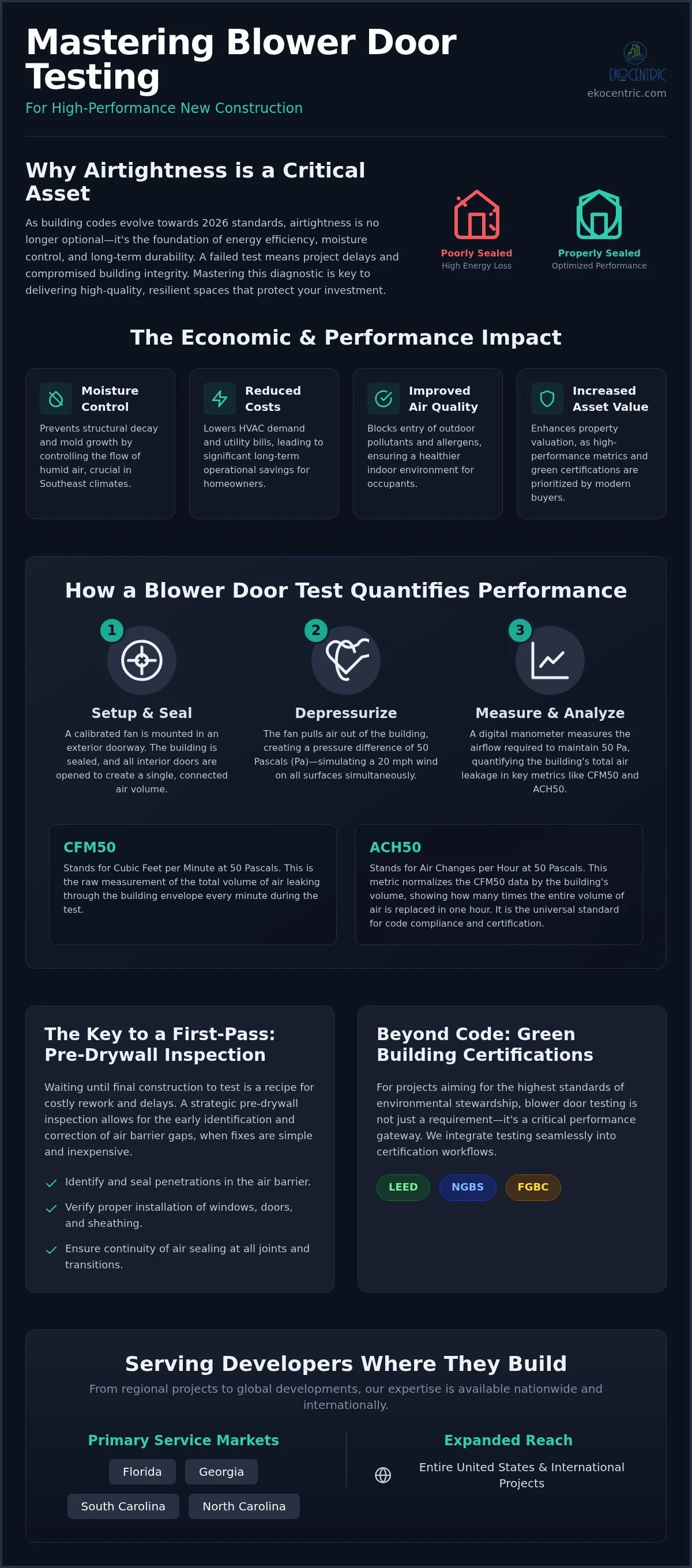
Blower door testing serves as a definitive diagnostic tool to measure the airtightness of a building's envelope. By using a calibrated fan to depressurize a structure, we quantify exactly how much air leaks through gaps, cracks, and unsealed penetrations. As we look toward 2026, building codes have evolved to prioritize these metrics because airtightness is the single most effective way to control moisture and energy loss.
Modern construction has moved beyond the era of optional testing. Today, Blower Door testing for new homes and energy efficiency is a mandatory verification requirement in many jurisdictions across Florida, Georgia, and the Carolinas. This shift ensures that the design intent of an energy-efficient home actually translates into real-world performance. It helps builders distinguish between infiltration, which is uncontrolled air leaking in, and exfiltration, which is conditioned air leaking out. Both force mechanical systems to work harder than necessary and can compromise the building's longevity.
Why Airtightness is the Foundation of Energy Efficiency
In the humid climates of the Southeast, managing the "stack effect" is vital. This phenomenon occurs when warm air rises and escapes through the top of a building, drawing in hot, moist air through the bottom. A tight envelope breaks this cycle. When we achieve high-performance airtightness, we improve indoor air quality by preventing outdoor pollutants and allergens from entering through wall cavities. This precision also allows for the accurate sizing of mechanical ventilation systems. It ensures the home "breathes" through controlled, filtered pathways rather than accidental cracks.
The Economic Impact of a High-Performance Envelope
Airtightness is a tangible asset for developers and homeowners alike. Investing in a superior building envelope provides several concrete benefits:
Reduced operational costs: Lower HVAC demand leads to smaller monthly utility bills.
Increased property valuation: Buyers and investors prioritize high-performance building metrics and green certifications.
Risk mitigation: Proper sealing prevents structural decay and mold growth caused by trapped moisture.
By focusing on performance optimization rather than just meeting the bare minimum of the code, we create resilient, high-quality living spaces. This approach is essential for any project aiming for LEED or NGBS recognition, whether it's located in South Carolina or an international site. You can explore how our specialized services help integrate these standards into your next project.
How Blower Door Tests Measure and Quantify Performance
The accuracy of a performance audit depends on the precision of the equipment used. A standard setup includes a mounting frame that fits into an exterior doorway, a calibrated fan capable of moving large volumes of air, and a digital manometer. This manometer acts as the system's brain. It simultaneously measures the pressure difference between the interior and exterior environments while calculating the air flow through the fan. By using these tools, Blower Door testing for new homes and energy efficiency provides a scientific baseline for a building's integrity.
During the test, we typically depressurize the house to 50 Pascals. This creates a uniform pressure differential that mimics a 20 mph wind blowing against the structure from all directions at once. We then look at two primary numbers to determine performance. CFM50 measures the total cubic feet of air moving through the fan per minute. ACH50, or Air Changes per Hour, normalizes this data by considering the total volume of the home. ACH50 is the essential metric for comparing performance across different project sizes, allowing a small multi-family unit to be measured against a large custom estate on equal terms.
Understanding the Pascal and Pressure Differentials
A Pascal is a unit of pressure equal to one Newton per square meter. In building science, we use it to quantify the "push" or "pull" on the building envelope. Testing at 50 Pascals is the industry standard because it's high enough to overcome natural weather fluctuations but low enough to avoid damaging the structure. This pressure differential is particularly effective at exposing hidden leaks in unconditioned spaces, such as behind knee walls or through recessed lighting in the attic, which might otherwise go unnoticed during a visual inspection.
Interpreting Your Test Results: What the Numbers Mean
Interpreting these results requires looking beyond a simple pass or fail. In the 2026 regulatory environment, a "tight" home generally falls well below 3 ACH50. High-performance certifications like LEED or NGBS often target even more ambitious levels, sometimes reaching below 1.5 ACH50. If the numbers are higher than expected, we use the test as a diagnostic opportunity. By keeping the fan running, we can physically feel for drafts or use thermal imaging cameras to see the "signature" of air entering the envelope. This data-driven approach ensures your project achieves its full potential. Our team of certified raters and verifiers can help you translate these technical metrics into actionable building improvements across the Southeast and beyond.
Blower Door Testing and Green Building Certifications
Achieving a high-performance building requires more than just good intentions; it demands rigorous onsite verification. Blower Door testing for new homes and energy efficiency acts as the bridge between design blueprints and certified reality. For projects pursuing LEED, NGBS, or FGBC status, these diagnostics are non-negotiable. They provide the empirical proof that a building envelope meets the stringent standards required for environmental stewardship and resource efficiency. By quantifying air leakage, we ensure that the HVAC systems aren't fighting against a porous envelope, which is a prerequisite for any elite green certification.
These results also feed directly into the HERS Index. As a RESNET HERS Rater, we use blower door data to calculate the home's overall energy performance score. A lower HERS score indicates a more efficient home, which serves as a powerful validation of quality for developers and a compelling selling point for modern buyers. This data-driven approach transforms a technical requirement into a strategic asset for the project's marketability and long-term ROI.
LEED BD+C and the Green Rater Verification Process
In the world of LEED residential projects, third-party verification is the cornerstone of credibility. A LEED Green Rater performs mandatory onsite inspections and performance testing to ensure every energy-saving measure is correctly installed. The blower door test is a critical part of this process because the results directly influence Energy and Atmosphere (EA) credits. These credits often carry the most weight in the certification scorecard, making precise testing essential for reaching Silver, Gold, or Platinum status. You can learn more about our LEED Green Rater services and how we help streamline this verification for developers and architects.
NGBS and FGBC: Regional Standards for the Southeast
While national codes provide a baseline, regional standards like the Florida Green Building Coalition (FGBC) and the National Green Building Standard (NGBS) offer pathways tailored to the Southeast. In Florida, FGBC standards require specific blower door thresholds that prioritize moisture control and durability in high-humidity environments. Similarly, NGBS (ICC 700) verification incorporates envelope testing to award points for energy efficiency across various climate zones. Navigating these requirements in Georgia, North Carolina, and South Carolina requires a rater who understands local variations in building science. Whether your project is a multi-family development in Charlotte or a coastal build in Charleston, hiring a verifier with regional expertise ensures your project meets both local code and international best practices.
Preparation Checklist: Ensuring a Passing Result for New Builds
Passing a performance audit on the first attempt requires a proactive approach rather than a reactive fix. While many builders view the final fan test as the finish line, the real work happens during the framing stage. The pre-drywall inspection is your most powerful tool. It allows us to identify air barrier gaps while the "guts" of the building are still visible. Correcting a leak at this stage costs pennies compared to the significant expenses and delays required for remediation once the drywall is finished. This foresight is why Blower Door testing for new homes and energy efficiency should be integrated into your project timeline from the start.
Our team focuses on the critical transition points where different materials meet. Sealing top plates, rim joists, and sill plates is a non-negotiable step for any high-performance build. We also verify that window and door installations are airtight, checking for proper sealant application around the rough openings. This level of detail separates a standard build from one that achieves elite certification. When these steps are followed, the final test becomes a stress-free validation of quality rather than a risky gamble.
Critical Sealing Points for Architects and Builders
Architects should clearly define the continuous air barrier on their plans. If the boundary is fuzzy, the execution will be too. Common failure points often hide in plain sight. Recessed lighting, electrical boxes on exterior walls, and HVAC boots are notorious for leaking air into unconditioned spaces. We recommend using airtight gaskets or specialized enclosures for these penetrations. Additionally, don't overlook the importance of high-quality weather-stripping and properly adjusted thresholds on all exterior doors. A continuous seal is the foundation of a durable, energy-efficient envelope.
Final Test Day: On-Site Requirements
On the day of the test, the site must be prepared for precision. All windows must be closed and latched; simply pulling them shut isn't enough to engage the seals. We must also manage mechanical ventilation by temporarily sealing bath fans and range hoods to ensure we are only measuring envelope leakage. Success also requires coordination with other trades to ensure a quiet, accessible site. This allows our raters to work efficiently and provide the most accurate data possible. If you want to ensure your project stays on schedule and meets its performance goals, you can book your pre-drywall inspection and final testing with our expert team today.
Performance Optimization: Beyond Simple Code Compliance
For many in the industry, the goal is simply to clear the code hurdle. However, viewing Blower Door testing for new homes and energy efficiency as a mere compliance task misses the larger picture of asset optimization. A high-performance building isn't just a collection of efficient parts; it's a finely tuned system where every seal and barrier works in harmony to protect the owner's investment. When we shift the focus from "passing the test" to "optimizing the asset," we create structures that are more durable, comfortable, and valuable.
Our team brings a unique perspective as a licensed Florida Certified Building Contractor. We don't just report a failure; we understand the structural assemblies and material interactions that caused it. This contractor expertise allows us to offer practical, cost-effective solutions that solve performance gaps without derailing your construction schedule. By engaging in proactive consulting during the design and framing phases, we help you avoid expensive change orders and late-stage repairs that eat into project margins. We act as a pragmatic partner, ensuring that your commitment to environmental stewardship is matched by sound business logic.
The Advantage of Dual Expertise in Real Estate and Construction
Our background as both building contractors and real estate professionals provides a comprehensive view of a project's lifecycle. We understand how energy performance translates into real-world marketability. In competitive markets across Florida, North Carolina, and South Carolina, a certified green home commands a premium. We help Realtors and developers articulate this value to buyers, proving that a tight envelope leads to lower operational costs and superior indoor air quality. Explore our full suite of sustainability consulting services to see how we bridge the gap between construction quality and market value.
National and International Consulting Capabilities
While we have deep roots in the Southeast, Ekocentric operates with a global perspective. We manage LEED and NGBS projects across the entire United States, ensuring consistency and excellence regardless of the local climate or regulations. Our technical sustainability expertise is also available for international projects, helping global developers meet rigorous environmental standards through expert verification. Whether you are building a boutique residential project or a large-scale commercial development, our mission is to advocate for a more conscious future through better building science. Contact Ekocentric for a project consultation to begin optimizing your next build.
Elevating Building Standards for a Sustainable Future
Mastering the technical nuances of building envelope integrity ensures your projects meet the rigorous 2026 energy codes. By integrating performance diagnostics early, you protect your investment from costly late-stage repairs and occupancy delays. Blower Door testing for new homes and energy efficiency is more than a certification requirement; it's a tangible commitment to creating high-quality, resource-efficient living spaces that stand the test of time.
Our team brings the dual perspective of a Licensed Florida Certified Building Contractor and an expert NGBS Green Verifier and LEED Green Rater. We understand the practical realities of the job site and the business necessity of a seamless workflow. Whether you're building in Florida, Georgia, and the Carolinas, or managing an international development, we provide the pragmatic solutions you need to succeed.
Partner with Ekocentric to optimize your building performance and ensure your next project stands as a model of environmental stewardship. Achieving elite performance is entirely within reach when you have the right technical partner by your side. Let's build something better together.
Frequently Asked Questions
What is a blower door test and why is it required for new homes?
A blower door test uses a calibrated fan to measure the airtightness of a building envelope. It's required because modern energy codes prioritize reducing uncontrolled air leakage to lower HVAC loads and prevent moisture damage. By quantifying how much air moves through the structure, we ensure the home meets performance standards that protect the building's longevity and the owner's investment. This diagnostic verification is essential for compliance in many Southeast jurisdictions.
How much air leakage is allowed in a new construction home in 2026?
While specific thresholds vary by state and climate zone, most new construction projects in 2026 must achieve a result below 3.0 Air Changes per Hour (ACH50). For high-performance projects aiming for elite green certifications, the target is often much lower, sometimes reaching below 1.5 ACH50. Blower Door testing for new homes and energy efficiency provides the precise data needed to prove the building meets these increasingly stringent regulatory and environmental standards.
Can a blower door test help me get LEED certification?
Yes, blower door testing is a mandatory prerequisite for LEED for Homes and other residential LEED BD+C tracks. The test results directly influence the number of points awarded in the Energy and Atmosphere category. A tighter building envelope translates to a higher score, making it easier to reach Silver, Gold, or Platinum levels. Our LEED Green Raters use these results to verify that the home performs according to its design intent.
What happens if my new home fails the blower door test?
If a home fails, the rater keeps the fan running to identify specific leak locations using thermal imaging or smoke pens. Once the gaps are located in areas like top plates, rim joists, or plumbing penetrations, they must be sealed before a re-test occurs. This is why we advocate for pre-drywall inspections. Catching these issues early prevents expensive remediation and ensures you don't face occupancy delays or unexpected change orders at the end of the project.
Is a blower door test required for FGBC certification in Florida?
Yes, the Florida Green Building Coalition (FGBC) requires envelope leakage testing to verify that a residence meets its energy performance criteria. Because Florida's climate is exceptionally humid, managing air infiltration is critical to preventing mold and structural decay. Our team provides FGBC consulting across the state, ensuring that your project not only passes the mandatory test but also optimizes its overall resource efficiency for long-term durability.
How long does a typical blower door test take for a new residence?
A standard test usually takes between one and two hours to complete, depending on the complexity and size of the home. This timeframe includes the setup of the mounting frame and fan, the physical inspection of the building envelope, and the actual depressurization process. For larger multi-family developments or custom estates, the process might take longer. We coordinate closely with your construction schedule to ensure minimal disruption to other trades on site.
Who is qualified to perform blower door testing for green certifications?
Testing for certifications like LEED, NGBS, or FGBC must be performed by a certified third-party professional, such as a RESNET HERS Rater or a LEED Green Rater. Our team holds these specialized credentials and operates as a licensed Florida Certified Building Contractor. This dual expertise allows us to serve projects in North Carolina, South Carolina, Georgia, and Florida, as well as national and international developments requiring high-level technical sustainability consulting.
How does blower door testing improve my homes energy efficiency rating?
Blower Door testing for new homes and energy efficiency provides the empirical data required to calculate a home's HERS Index. By identifying and sealing uncontrolled air leaks, you reduce the workload on the HVAC system, which significantly lowers the HERS score. A lower score indicates a more efficient building, which increases property value and marketability. This diagnostic process transforms a simple code requirement into a strategic tool for performance optimization.