How Builders Achieve Superior RESNET HERS Index Scores

What if the secret to an industry-leading HERS score isn't found in the HVAC system you choose, but in the coordination meetings you hold months before breaking ground? You've likely felt the frustration of a failed inspection or an unexpectedly high score that delays a closing and hurts your marketability. It's a common challenge in an industry where standards like the 2026 ENERGY STAR updates and the mandatory shift to 301-2022 standards are raising the bar. With the national average HERS Index score hitting 53 in 2025, the pressure to outperform the standard is higher than ever.
We understand there are many common things builders can do to ensure that their RESNET HERS rating achieves a good score, but the most successful projects treat efficiency as a core design requirement rather than a final checklist item. This guide provides a repeatable framework for optimizing the building envelope and aligning your trades with your Rater to secure superior ratings. We'll explore the technical strategies and coordination frameworks used to build high-value, resource-efficient homes across Florida, Georgia, the Carolinas, and the rest of the United States.
Key Takeaways
Understand why the 2026 benchmark for a "good" score has shifted to the 50, 60 range and how to aim for net-zero performance on every project.
Master the "Envelope First" strategy to minimize thermal transfer by targeting air sealing at critical attic and crawlspace leakage points before testing begins.
Implement common things builders can do to ensure that their RESNET HERS rating achieves a good score, including right-sizing HVAC units with precise Manual J calculations.
Create a seamless coordination framework by engaging your HERS Rater during the design phase to align trades and prevent unexpected construction delays.
Leverage low HERS scores as a data foundation to qualify for elite certifications like LEED and NGBS for projects in the Southeast, across the US, or internationally.
Table of Contents
Understanding the HERS Index: What Defines a 'Good' Score in 2026?
Optimizing the Building Envelope: Insulation and Air Sealing Strategies
The Coordination Framework: Integrating Your HERS Rater into the Build
Understanding the HERS Index: What Defines a 'Good' Score in 2026?
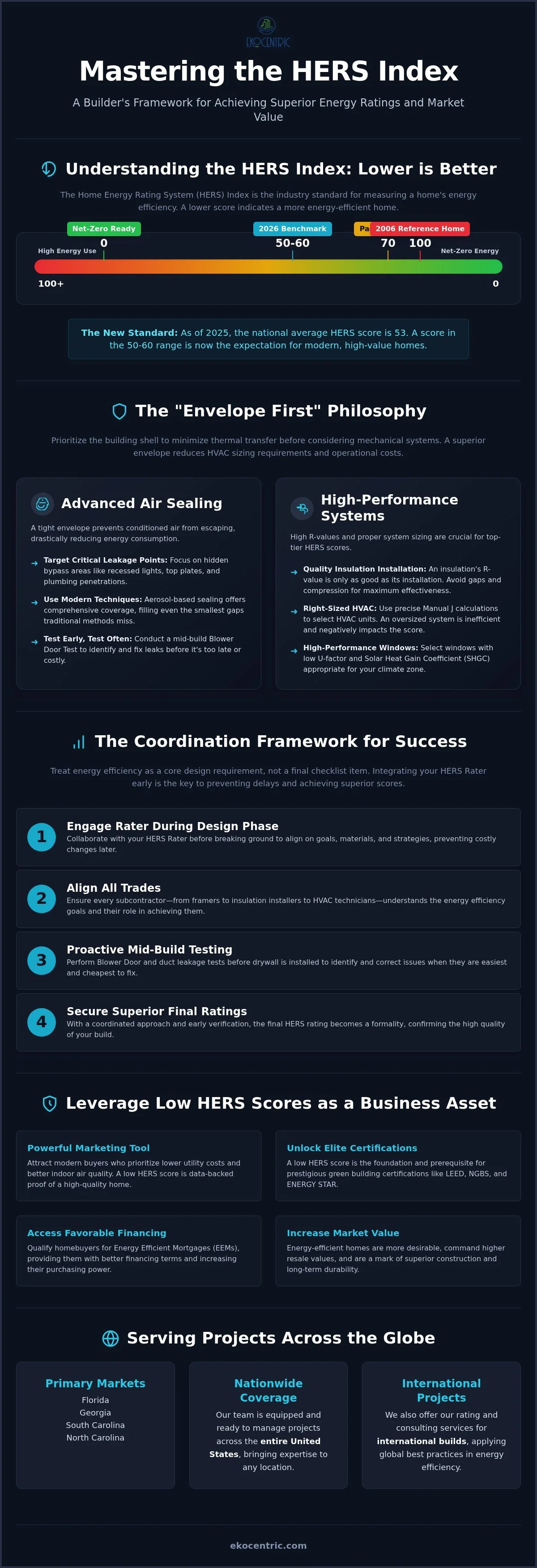
The Home Energy Rating System (HERS) Index is the industry standard for measuring a home's energy performance. It functions as a linear scale where a score of 100 represents a standard new home built in 2006, while a score of 0 represents a net-zero energy home. Achieving a superior rating requires more than just high-end appliances. There are common things builders can do to ensure that their RESNET HERS rating achieves a good score, beginning with a clear understanding of 2026 benchmarks.
To better understand this concept, watch this helpful video:
In 2026, the definition of a "good" score has evolved significantly. While a score of 70 was once acceptable, the national average HERS Index score improved to 53 in 2025. This means a score between 50 and 60 is now the standard expectation for modern developments. For builders in Florida, Georgia, and the Carolinas, these scores aren't just numbers; they're vital indicators of market value and structural integrity.
The HERS Benchmark: From 100 to Net Zero
The rating is calculated by comparing the home's performance against a "Reference Home" of the same size and shape. This ensures the score remains fair regardless of the square footage. A "good" score is always relative to your specific climate zone. In the humid Southeast, managing latent heat loads is just as critical as insulation. As we move toward 2027, when the 301-2022 standards become mandatory for new permits, aiming for a score closer to zero becomes the ultimate mark of environmental stewardship.
Why a Good Score Matters for Developers and Owners
Superior HERS scores serve as a powerful marketing tool. Modern buyers in markets like North Carolina and South Carolina prioritize lower utility costs and better indoor air quality. Implementing common things builders can do to ensure that their RESNET HERS rating achieves a good score also simplifies the path to elite certifications. Low scores are a prerequisite for advanced RESNET HERS Rater services and certifications like LEED for Homes or ENERGY STAR. These ratings also unlock Energy Efficient Mortgages (EEMs), which provide buyers with more favorable financing terms. Whether you're working locally or on international projects, a low HERS score provides the data-backed proof of a high-quality living space.
Optimizing the Building Envelope: Insulation and Air Sealing Strategies
Achieving a superior HERS score starts with the 'Envelope First' philosophy. This approach prioritizes the building shell to minimize thermal transfer before considering mechanical systems. High-performance insulation reduces HVAC sizing requirements by significantly lowering the peak thermal loads the mechanical system must combat. It's one of the most common things builders can do to ensure that their RESNET HERS rating achieves a good score while also lowering long-term operational costs for the homeowner. Understanding the relationship between the HERS Index and energy codes helps project leads stay ahead of local requirements in Florida and the Carolinas.
Advanced Air Sealing Techniques
Identifying bypass areas like recessed lights, top plates, and plumbing penetrations is essential for a tight envelope. These hidden leaks allow conditioned air to escape into unconditioned attics, driving up energy consumption. While traditional foam and caulk are standard, aerosol-based sealing offers a more comprehensive solution by using pressurized application to seal even the smallest gaps. Conducting a mid-build Blower Door Test is a pragmatic step to identify these leaks early. This proactive strategy prevents the stress of a final inspection failure when it's too late to modify the assembly without significant cost.
Selecting High-Performance Insulation and Windows
R-value is only as good as the installation quality. For top-tier scores, Grade I installation is mandatory; this means insulation must be completely free of gaps, voids, or compression. In Southeastern climates like Georgia and Florida, window selection is a primary driver of performance. Builders must prioritize low Solar Heat Gain Coefficient (SHGC) values to block radiant heat from entering the living space. These are common things builders can do to ensure that their RESNET HERS rating achieves a good score on a consistent, repeatable basis. Coastal projects often benefit from impact-rated, low-E windows that provide both storm protection and thermal efficiency. If you're looking to optimize your next project, our RESNET HERS Rater services can help you select the right materials for your specific climate zone, whether you're building in the US or on an international project.
Grade I Installation: Ensuring insulation is installed to the highest industry standards to maximize thermal resistance.
SHGC Optimization: Choosing windows with low solar heat gain to reduce cooling loads in humid climates.
Mid-Build Testing: Using Blower Door results during the framing stage to verify air-sealing success.
High-Efficiency Systems: HVAC, Water Heating, and Lighting
While the building envelope sets the stage, the mechanical systems determine how much energy is required to maintain comfort. In the cooling-dominant climates of Florida, Georgia, and the Carolinas, mechanical efficiency is often the difference between a standard score and a superior one. Optimizing these systems represents some of the most common things builders can do to ensure that their RESNET HERS rating achieves a good score. Without precise system selection, even a perfectly sealed home will struggle to meet the 2026 performance benchmarks.
Right-Sizing HVAC for Cooling-Dominant Climates
Precision is mandatory when selecting HVAC equipment. Many builders still rely on "rule of thumb" sizing, which often leads to oversized units. In humid Southeastern regions, an oversized air conditioner cools the air too quickly without removing enough moisture, resulting in high indoor humidity and poor HERS performance. Utilizing Manual J calculations ensures the system is right-sized for the home's specific thermal load. This accuracy prevents short-cycling and allows variable-speed compressors to operate at their peak seasonal efficiency (SEER2). Additionally, ductwork should be located in conditioned spaces whenever possible. If ducts must remain in vented attics, they must pass a Duct Blaster test with less than 4% total leakage to avoid heavy HERS penalties. Our ENERGY STAR Rater services provide the verification needed to ensure these systems are performing as engineered.
Water Heating and Lighting Loads
Water heating is typically the second-largest energy draw in a modern home. For projects in the Southeast, Heat Pump Water Heaters (HPWH) are exceptionally effective because they capitalize on the ambient heat in garages or mechanical rooms. They provide the dual benefit of high-efficiency water heating and minor dehumidification. While tankless gas units are a viable alternative, the high Energy Factor of a heat pump often yields a better HERS Index result. Lighting and controls offer the most straightforward path to point gains. Implementing 100% LED lighting is now a baseline requirement for any project aiming for a score below 60. Smart thermostats also contribute to better ratings, provided they are programmed to optimize the specific HVAC equipment installed. These are pragmatic, cause-and-effect solutions that directly link specialized practices to positive environmental outcomes and high-quality living spaces.
Manual J Calculations: Eliminating guesswork to prevent humidity issues and equipment short-cycling.
HPWH Integration: Leveraging ambient heat to reduce water heating energy consumption by up to 60% compared to standard electric tanks.
Total LED Adoption: Minimizing the internal heat gain from lighting to further reduce the cooling load.
By focusing on these high-impact systems, builders can create homes that aren't just compliant, but truly optimized for longevity and resource efficiency. Whether you are working on a domestic build or an international project, these technical strategies provide the foundation for a sustainable future.
The Coordination Framework: Integrating Your HERS Rater into the Build
Achieving an elite energy rating is a managed outcome rather than a lucky accident. Integrating a certified Rater into your project workflow is one of the most effective common things builders can do to ensure that their RESNET HERS rating achieves a good score. This partnership ensures that energy goals are technically sound and achievable within your specific budget. Whether you are developing high-volume communities in Georgia or custom coastal estates in South Carolina, a structured coordination framework prevents the costly delays associated with failed final inspections. It's a pragmatic approach that aligns every trade with the project's environmental and performance objectives.
Phase 1: Design Review and Energy Modeling
Successful projects begin with a digital twin of the home. By leveraging advanced modeling software, we can run "What-If" scenarios to select the most cost-effective upgrades before construction begins. This allows you to set a target score before the first shovel hits the ground. We review window and insulation specifications against local 2026 building codes to ensure compliance and optimization. This early engagement is vital for projects in North Carolina and Florida, where regional humidity and temperature swings require specific assembly choices. It allows builders to pivot their strategy early, ensuring that the design supports a low HERS Index result without overspending on unnecessary components.
Phase 2: Mid-Construction and Final Testing
The most critical point in the build is the Pre-Drywall inspection. This is the only time we can verify the air sealing and insulation quality before they are permanently covered. It's an essential part of the coordination matrix that ensures trades have followed the energy design. On testing day, you should expect a comprehensive Blower Door and Duct Leakage test. If a score comes in higher than projected, we provide immediate corrective actions to identify leakage points. This results-oriented process ensures that the final certificate reflects the true performance of the home. Our team provides the expertise needed to manage these complex goals across the United States and on international projects.
Effective documentation management is the final piece of the puzzle. We ensure all data required by the Authority Having Jurisdiction (AHJ) and various green certifications is captured accurately. This meticulous record-keeping supports property value and provides the data-backed proof of quality that modern homeowners demand. To secure your project's success from the design phase to the final walkthrough, partner with our RESNET HERS Rater team today.
Early Engagement: Modeling energy performance during the design phase to eliminate guesswork.
Trade Alignment: Holding pre-construction meetings to clarify air-sealing responsibilities.
Verification: Using mid-build inspections to catch errors before they become expensive repairs.
Scaling Success: Leveraging HERS for LEED, NGBS, and FGBC
A superior HERS Index result is often the first step toward achieving prestigious green building certifications. It provides the empirical data foundation required for programs like LEED for Homes and the National Green Building Standard (NGBS). Identifying the common things builders can do to ensure that their RESNET HERS rating achieves a good score doesn't just lower utility bills; it unlocks the path to higher property values and market differentiation. By treating the HERS rating as a baseline, project leads can seamlessly transition into more comprehensive sustainability frameworks.
For projects in Florida, the Florida Green Building Coalition (FGBC) offers state-specific certifications that rely heavily on verified energy performance. Similarly, NGBS (ICC 700) verification uses HERS data to award points for energy efficiency, simplifying the documentation process for builders. When you explore our comprehensive green building services for LEED and NGBS, you'll see how we integrate these standards to create a cohesive performance strategy for single-family and multi-family developments alike.
Beyond the Score: Holistic Building Performance
True environmental stewardship requires looking beyond energy consumption to include indoor air quality and water conservation. Integrating these elements into the HERS workflow creates a healthier living environment and reduces long-term operational costs. Our role as a LEED Green Rater involves managing the complexities of multi-family certifications, ensuring that every unit meets rigorous standards for resource efficiency and occupant comfort. This holistic approach ensures the building's longevity and protects the owner's investment against future energy code shifts.
Strategic Consulting for the Southeast and Beyond
While we specialize in the specific energy codes and humid climates of Georgia, South Carolina, and North Carolina, our expertise isn't limited by geography. We support sustainable projects across the entire United States, providing the technical guidance needed to meet diverse regional requirements. Our team is also available for international projects, bringing our deep knowledge of HERS and LEED to global developments. This national and international reach allows us to act as a pragmatic partner for developers with diverse portfolios. We bridge the gap between visionary environmental goals and the grounded, technical solutions required to achieve them, ensuring your project stands out in any market.
Data Integration: Using HERS results to streamline LEED and NGBS documentation.
Regional Expertise: Applying climate-specific strategies for the Southeast while maintaining a national and international service scope.
Long-term Value: Focusing on holistic performance to reduce operational costs and improve indoor air quality.
Engineering Performance and Market Leadership for 2026
Achieving a superior HERS Index score requires a shift from simple compliance to intentional engineering. By prioritizing the building envelope and integrating high-efficiency mechanical systems, you create homes that stand the test of time. It's one of the most common things builders can do to ensure that their RESNET HERS rating achieves a good score while simultaneously boosting property value and marketability.
Success is found in the coordination between trades and the early engagement of an expert Rater during the design phase. As a Licensed Florida Certified Building Contractor and expert LEED Green Raters and NGBS Verifiers, we focus on technical performance optimization that delivers a clear ROI for your business. Whether your project is located in Georgia, the Carolinas, or an international site, our mission is to help you create high-quality living spaces that respect our environment. Partner with Ekocentric to optimize your next project's HERS performance and secure your place as an industry leader in resource efficiency. We're ready to help you build a sustainable and prosperous future.
Frequently Asked Questions
What is a good HERS score for a new home in 2026?
In 2026, a good score is generally between 50 and 60. Since the national average in 2025 reached 53, builders should aim for a score below this benchmark to remain competitive. A score of 0 represents a net-zero home, while 100 represents a home built to 2006 standards. Achieving these lower numbers involves common things builders can do to ensure that their RESNET HERS rating achieves a good score, such as optimizing the thermal enclosure.
How much does a HERS rating typically cost for a builder?
Rating costs vary based on the project's size, complexity, and location across the US or internationally. Builders should view this as a pragmatic investment in property value and compliance rather than just a service fee. The process includes design-phase energy modeling, mid-construction inspections, and final performance testing. These specialized services help avoid costly delays and ensure the building meets the 2026 standards required for high-performance certifications like LEED or NGBS while optimizing building performance.
Can an existing home be HERS rated during a remodel?
Existing homes can certainly receive a HERS rating. This is often used during a major remodel to establish a performance baseline and measure the impact of efficiency improvements. It provides a clear metric for energy upgrades, which is particularly useful for developers in Florida or the Carolinas looking to document ROI. A HERS Rater can guide you through the specific steps needed to optimize an older structure's envelope and mechanical systems during the renovation process.
What is the difference between an ENERGY STAR rating and a HERS score?
A HERS score is a numerical index measuring energy performance, while ENERGY STAR is a certification program that uses this score as a foundational prerequisite. To earn an ENERGY STAR label, a home must meet strict technical requirements for thermal enclosures and water management. Most certified homes achieve a HERS score in the mid-50s or low 60s. This provides a verified mark of quality that distinguishes your project in competitive markets like North Carolina and Georgia.
How does a HERS Rater differ from a standard home inspector?
Standard home inspectors focus on general condition and safety during a single walkthrough. A certified RESNET HERS Rater uses diagnostic equipment like blower doors to measure technical energy performance throughout the build. Raters are involved from the design phase through final testing to provide third-party verification. This expertise is required for elite certifications like LEED and NGBS. Our team leverages construction and real estate experience to provide pragmatic solutions that standard inspections simply don't cover.
Will a solar PV system lower my HERS Index score?
Installing a solar PV system will significantly lower a HERS Index score. Since the index measures net energy consumption, renewable production offsets the energy used by the home's HVAC and lighting systems. This represents one of the most common things builders can do to ensure that their RESNET HERS rating achieves a good score. However, we always recommend an "Envelope First" approach. Optimizing insulation and air sealing ensures the home remains efficient even when the sun isn't shining.
What happens if my home fails the blower door test?
If a home fails the blower door test, the air leakage exceeds the limits defined by the energy code. The HERS Rater uses tools like smoke pens to identify specific leakage points in the attic or crawlspace. Builders must then perform corrective sealing before a re-test occurs. To prevent this, we suggest mid-build inspections. Catching leaks before the drywall is installed is a pragmatic way to ensure final testing success and avoid expensive construction delays.
Does the HERS Index account for local climate differences in Florida vs. North Carolina?
The HERS Index accounts for local climate through the "Reference Home" calculation, which is tailored to the specific climate zone of the project. A home in Florida's humid heat faces different thermal loads than one in the varied climate of North Carolina or South Carolina. The software adjusts for these variables to ensure the rating is fair. This allows builders to compare performance accurately across different regions, whether they are working in the Southeast or on international projects.