Blower Door Testing: Boost New Home Energy Efficiency
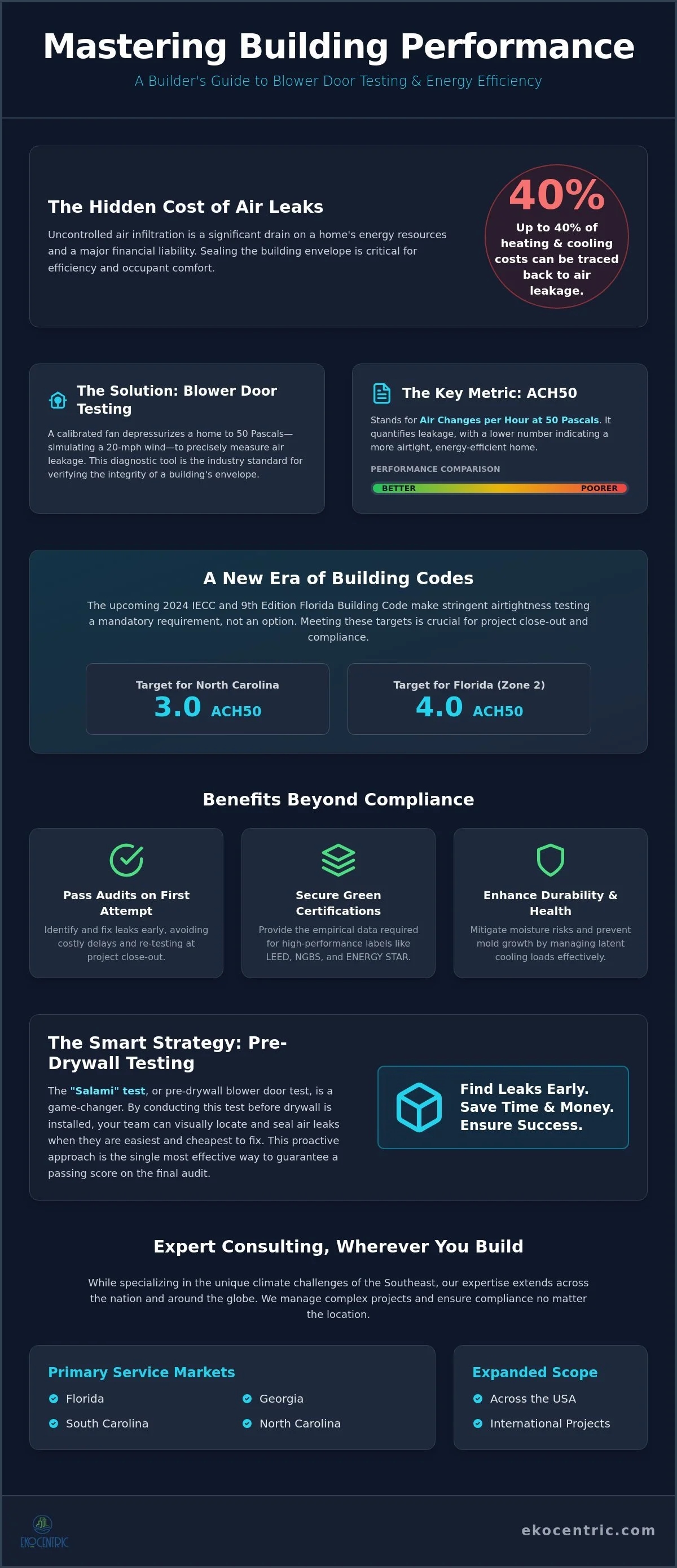
Did you know that air leakage can account for up to 40% of a new home's heating and cooling costs? It's a staggering figure that turns a building envelope into a financial leak for your clients and a potential liability for your reputation. We understand the pressure of facing a project close-out only to have an unexpected energy audit failure delay your timeline. You're currently navigating the transition toward the 2024 IECC and the 9th Edition Florida Building Code, where meeting 3.0 or 4.0 ACH50 targets is no longer optional. Mastering Blower Door testing for new homes and energy efficiency is the most effective way to turn these regulatory hurdles into a clear competitive advantage.
This article provides the technical clarity you need to pass audits on your first attempt and secure prestigious green certifications like LEED v5 or NGBS. We'll break down the 2026 requirements across Florida, Georgia, and the Carolinas while showing you how to optimize envelope performance for maximum ROI. Whether you're building locally or managing international projects, you'll discover how to transform a standard compliance check into a powerful tool for environmental stewardship and structural integrity.
Key Takeaways
Master the 2026 ACH50 requirements to ensure your building envelope meets the increasingly stringent standards of the 9th Edition Florida Building Code.
Leverage Blower Door testing for new homes and energy efficiency to secure premium green certifications and improve long-term building durability.
Implement the pre-drywall "Salami" test to identify air leakage early, avoiding costly delays and ensuring you pass final energy audits on your first attempt.
Mitigate regional moisture risks in the Southeast by using precise airtightness data to manage latent cooling loads and prevent mold growth.
Scale your operations confidently by working with a partner capable of managing complex LEED and NGBS requirements across the United States and international markets.
Table of Contents
Understanding Blower Door Testing: The Pulse of Building Performance
The Critical Role of Testing in Green Building Certifications
How to Prepare Your Project for a Successful Blower Door Test
Regional Challenges: Efficiency in Florida and the Southeast
Partnering with Ekocentric: Expert Consulting for National and International Projects
Understanding Blower Door Testing: The Pulse of Building Performance
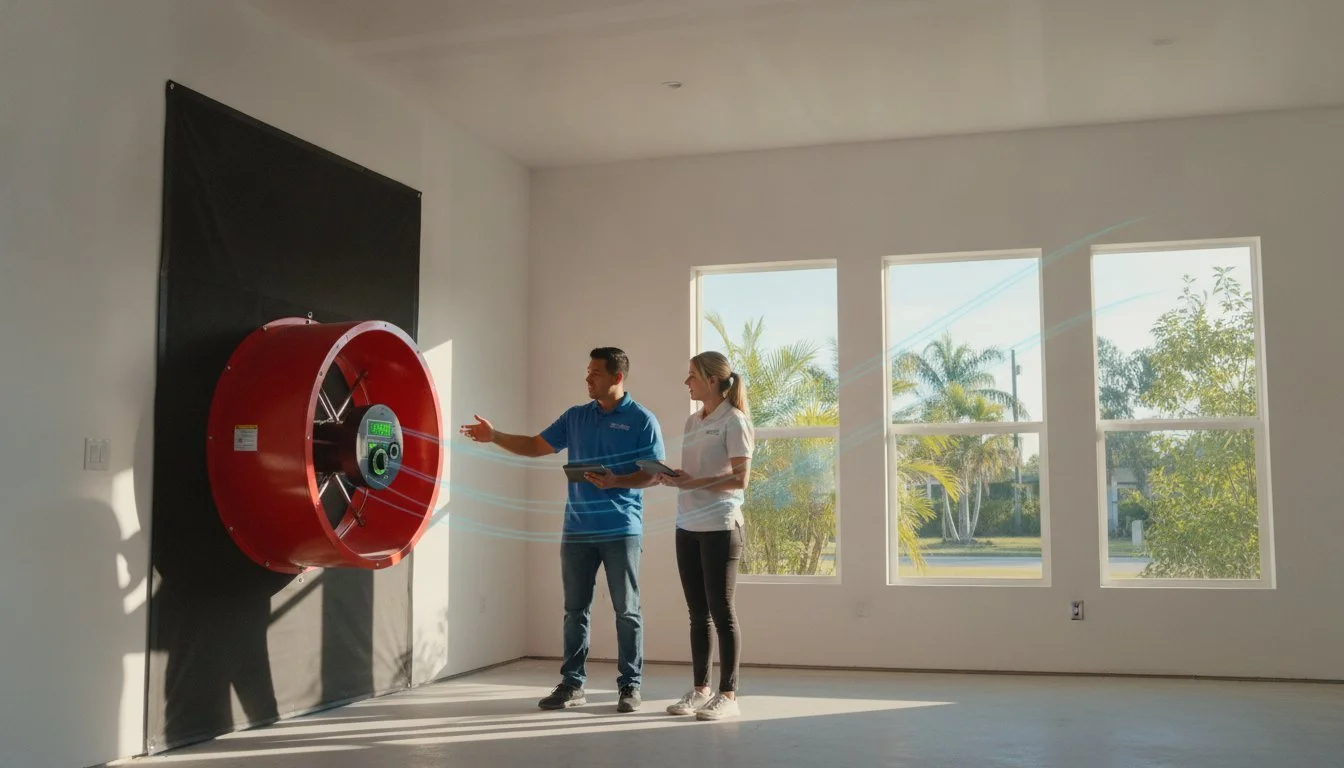
A Blower door is much more than a compliance box to check; it's a vital diagnostic tool that reveals the true integrity of your building's envelope. The mechanism is straightforward but powerful. We use a calibrated fan to depressurize the home to 50 Pascals, which is roughly equivalent to a 20-mph wind hitting the structure from all sides. By measuring the amount of air the fan must move to maintain this pressure, we can identify exactly how much air is leaking through gaps, cracks, and unsealed penetrations. This process is the foundation of Blower Door testing for new homes and energy efficiency, providing the data needed to ensure a home is both durable and cost-effective.
To see this process in action on a job site, watch this helpful video:
The year 2026 marks a major shift for developers across the United States. As states adopt the 2024 IECC and Florida transitions to its 9th Edition Building Code, airtightness testing is no longer a luxury for high-end builds. It's a mandatory requirement. We've seen builders in Georgia and the Carolinas struggle when a home is "too tight" without proper planning. While a sealed envelope drives efficiency, it must be balanced with smart mechanical ventilation. Our team helps you navigate this balance, ensuring your projects achieve maximum efficiency without compromising indoor air quality or occupant health.
The Science of Air Infiltration and ACH50
The ACH50 metric represents Air Changes per Hour at 50 Pascals of pressure. A lower ACH50 number signifies a superior thermal envelope with fewer unintended leaks, directly translating to lower utility bills and better climate control. ACH50 is the globally recognized industry standard for quantifying building leakage and verifying construction quality. Whether you're targeting a 3.0 ACH50 in North Carolina or a 4.0 in Florida's Climate Zone 2, this metric is your primary indicator of success.
Diagnostic Benefits Beyond Compliance
Blower Door testing for new homes and energy efficiency offers insights that go far beyond a "pass/fail" score on an audit. When we pair the test with infrared thermography, we can visually pinpoint hidden leaks behind finished walls or in attic bypasses. This proactive approach identifies moisture risks and potential mold growth in poorly sealed assemblies before they become costly liabilities. It also serves as a final validation of how well your team installed insulation and air barriers. You can explore our full range of consulting services to see how we integrate these diagnostics into your project workflow across the US and international markets.
The Critical Role of Testing in Green Building Certifications
Blower Door testing for new homes and energy efficiency serves as the empirical foundation for nearly every major green building certification. It's the moment of truth where design intent meets field reality. For builders targeting the RESNET HERS Index, infiltration data is a primary variable. A leaky envelope can spike a HERS score, potentially disqualifying a home from high-performance labels. Similarly, the ENERGY STAR Single-Family New Homes program mandates specific infiltration backstops. Under Version 3.2, which became the standard in Florida for homes permitted after January 1, 2025, builders must hit stringent targets to earn the blue label. These benchmarks ensure that every certified home delivers on its promise of lower operating costs and reduced environmental impact.
LEED BD+C and residential performance
In the world of LEED Building Design and Construction (BD+C), whole-building pressurization testing is a non-negotiable requirement for validating the building envelope. The launch of LEED v5 in April 2025 introduced even more rigorous standards, limiting air leakage to 0.40 cfm/ft2 under specific pressure differentials. This level of precision requires a LEED Green Rater who understands the nuances of multi-family assemblies and complex thermal boundaries. At Ekocentric, we provide comprehensive sustainability consulting services to manage these technical hurdles. We help project leads in Georgia and the Carolinas navigate the documentation process while ensuring the physical build meets the high-intensity goals of modern stewardship.
NGBS Verification and the HERS Rater
The National Green Building Standard (NGBS) uses a point-based system where airtightness performance directly dictates your certification tier. Whether you're aiming for Bronze or the elite Emerald level, your Blower Door results carry significant weight. We've found that the most successful projects involve a HERS Rater during the design phase rather than waiting for the final inspection. Early collaboration prevents common pitfalls in multi-family builds, such as unsealed elevator shafts or poorly detailed floor-to-wall junctions. By identifying these issues on paper, you protect your project's ROI and ensure a smooth path to certification. If you're managing a development across the US or abroad, having an expert partner can simplify this complex landscape. You might consider reaching out to a specialized green rater to review your envelope details before breaking ground.
How to Prepare Your Project for a Successful Blower Door Test
Successful Blower Door testing for new homes and energy efficiency isn't a matter of luck; it's a result of a disciplined construction process. Many builders treat the final audit as a nerve-wracking hurdle that could delay project close-out. We advocate for a proactive shift in strategy. By integrating air sealing into your daily site management, you eliminate the frantic scramble to find leaks after the drywall is already up. This approach is especially vital for projects in Florida, Georgia, and the Carolinas, where high humidity makes a tight envelope essential for moisture control and occupant comfort.
Coordinating with your trades is the first step toward a passing score. Your HVAC, plumbing, and electrical teams must understand that every unsealed penetration is a direct threat to the building's performance. We recommend holding a "sealing summit" before rough-ins begin. When trades recognize that their work impacts the final ACH50 result, they're more likely to use fire-rated foam and caulk correctly around wire runs and stacks. If a home fails to meet the required 2026 energy code targets, the "failure protocol" involves an expensive and time-consuming diagnostic search. It's much simpler to build it right the first time.
Top 5 Air Sealing Priorities for Builders
Focusing on the building's "top and bottom" yields the highest return on effort. You must seal attic top plates and sole plates to prevent the stack effect from pulling conditioned air out of the living space. Managing the "big holes" is equally critical. This includes service chases, recessed lighting canisters, and plumbing stacks that often bypass the thermal boundary. Finally, ensure your windows and doors feature high-performance weatherstripping. These components are your last line of defense in maintaining a continuous air barrier across the entire structure.
Conducting the Mid-Construction Audit
The Pre-Drywall "Salami" Test is a game-changer for modern builders. We call it this because it allows you to slice through the complexity of the build and identify leaks while the framing is still exposed. Testing at this stage allows for low-cost corrections that are impossible once the walls are closed. We often use theatrical fog or smoke pens to visualize air pathways, making it easy for site supervisors to see exactly where the envelope is compromised. This empowers your team to take ownership of air barrier continuity. Whether you're working on a single-family home in North Carolina or a large-scale international development, this mid-course correction ensures you hit your efficiency targets with confidence.
Regional Challenges: Efficiency in Florida and the Southeast
The Southeast presents a unique set of challenges that national energy guidelines often overlook. In states like Florida and Georgia, the primary enemy isn't just heat; it's moisture. High humidity levels mean that any air leakage through the building envelope carries a heavy latent cooling load. This forces HVAC systems to work harder to dehumidify the space, increasing energy costs and the risk of mold growth. Blower Door testing for new homes and energy efficiency is the only way to verify that your air barrier is robust enough to keep that humid outdoor air where it belongs. By mastering these regional nuances, you protect the structural integrity of your projects and the health of the occupants.
Building for the Florida Climate
Florida's construction is dominated by slab-on-grade designs, which require specific sealing strategies at the stem wall and sole plate junctions. While national LEED requirements focus on broad sustainability metrics, the Florida Green Building Coalition (FGBC) provides standards tailored specifically to our subtropical environment. FGBC certifications rely heavily on Blower Door data to validate that homes are built for longevity in high-salt, high-moisture areas. We've seen many builders struggle with the transition to the 9th Edition Florida Building Code because they haven't optimized their air sealing for these specific assemblies. Consulting with a partner who understands the Florida Green Building landscape is essential to avoid compliance delays. You can ensure your project meets these local benchmarks by scheduling a consultation with our FGBC experts today.
Energy Performance in Georgia and the Carolinas
Moving north into Georgia and the Carolinas, builders face mixed-humid climates where temperature swings are more extreme. In booming markets like Atlanta and Charlotte, high-performance building requirements are becoming a standard expectation for savvy buyers. Extreme summer heat can turn a minor duct leak or envelope gap into a major performance failure. Utilizing HERS Raters during the construction process allows you to differentiate your properties in a competitive real estate market by providing a certified efficiency score. This data-driven approach proves to buyers that your homes are built to a higher standard of comfort and resource efficiency. Whether you're navigating the specific code amendments in North Carolina or managing a multi-state portfolio, Blower Door testing for new homes and energy efficiency provides the objective proof of quality that today's market demands. Our team brings this specialized expertise to every project, whether it's located in the heart of the Southeast or at an international job site.
Partnering with Ekocentric: Expert Consulting for National and International Projects
Choosing a partner for Blower Door testing for new homes and energy efficiency requires looking beyond a simple equipment operator. At Ekocentric, we bring a rare dual-perspective expertise to every job site. As a licensed Florida Certified Building Contractor with Real Estate licensing, we understand both the physical mechanics of construction and the financial drivers of property value. This unique combination allows us to offer performance optimization and certification management that a standard tester simply cannot provide. While our roots are deep in Florida, Georgia, and the Carolinas, our reach extends across the entire United States. We are also available for international consulting on global sustainable development projects, bringing American efficiency standards to a worldwide stage.
Our mission goes beyond basic compliance. We see ourselves as advocates for a more environmentally conscious future. This passion drives us to provide actionable insights that help you build better, more durable structures. When you work with us, you gain a partner who is genuinely invested in your project's success. We understand the business realities you face, such as the need for specific credentials to qualify for financing or the lack of internal capacity to manage complex green rating systems. We bridge those gaps with pragmatic, results-oriented solutions that protect both the environment and your bottom line.
Why specialized B2B consultancy beats a basic tester
A basic tester might give you a pass or fail result, but we manage the entire certification lifecycle from LEED BD+C to NGBS. This comprehensive approach significantly reduces the administrative burden on architects and developers who are already stretched thin. We don't just "check a box" for code compliance; we focus on the actual building performance that translates to long-term ROI. By acting as your LEED Green Rater or NGBS Green Verifier, we ensure that every technical requirement aligns with your overarching sustainability goals. This level of dedication ensures that your building envelope remains a high-performing asset for decades to come.
Get started on your 2026 sustainability goals
The most successful projects begin long before the first fan is set up in a doorway. Early-stage design consultation is the most effective way to ensure compliance with 2026 energy codes before you ever break ground. We help you integrate Blower Door testing into your project timeline, identifying the optimal moments for mid-construction audits and final verifications. This proactive planning prevents the costly delays and last-minute fixes that can derail a project close-out. You can optimize your next project with Ekocentric services to ensure your vision of environmental stewardship becomes a tangible, certified reality. Whether you're building a single-family community in Charlotte or a multi-family complex abroad, we're ready to serve as your indispensable partner in excellence.
Building a Sustainable Future Through Precise Performance
We've explored how air leakage impacts everything from latent cooling loads in the humid Southeast to your project's ability to secure elite LEED v5 or NGBS Emerald status. By adopting mid-construction audits and coordinating air sealing across all trades, you eliminate the risk of audit failure and protect your building's long-term ROI. Blower Door testing for new homes and energy efficiency is the definitive tool to validate your construction quality and meet the rigorous 2026 standards. It's the bridge between visionary design and tangible environmental stewardship.
As a Licensed Florida Certified Building Contractor, NGBS Green Verifier, and provider of LEED Green Rater Services, Ekocentric is ready to help you navigate these complex requirements. Our team brings deep expertise to projects in Florida, Georgia, and the Carolinas, while maintaining the capacity to serve developers across the United States and international markets. We don't just provide a test; we offer a mission-driven partnership that simplifies certification and optimizes building performance. Partner with Ekocentric for LEED, NGBS, and Energy Performance Consulting to ensure your next build sets a new benchmark for excellence. Let's work together to create high-quality spaces that are resilient, efficient, and ready for the future.
Frequently Asked Questions
Is blower door testing required for new homes in 2026?
Yes, blower door testing is a mandatory requirement for new residential construction under the 2024 International Energy Conservation Code (IECC) and the 9th Edition Florida Building Code. Most jurisdictions have until July 2026 to fully adopt these standards. These updates ensure that every new build meets specific airtightness benchmarks to reduce energy waste and carbon emissions. Blower Door testing for new homes and energy efficiency provides the objective data building officials need to issue a Certificate of Occupancy.
What is a good blower door test score (ACH50) for a new house?
A good score depends on your specific climate zone and target certification. For states like North Carolina and Georgia in Climate Zones 3 through 5, the 2024 IECC sets the maximum leakage at 3.0 ACH50. In Florida's Climate Zones 1 and 2, the limit is 4.0 ACH50. If you're pursuing elite certifications like LEED v5, you'll need to meet even more stringent air leakage rates, often measured in cubic feet per minute per square foot of envelope area.
How long does a professional blower door test typically take?
A standard residential test usually takes between 90 minutes and two hours to complete. This timeframe includes the initial setup of the calibrated fan and frame, the actual depressurization cycles, and the final data collection. If your project requires additional diagnostics like infrared thermography or smoke pen tracing to find specific leaks, the process can take longer. We recommend scheduling these tests during a window when other trades aren't actively entering or exiting the home.
Can a new home fail a blower door test, and what happens next?
Yes, a home can fail if the air changes per hour exceed the maximum limit allowed by local building codes. If this happens, the builder must identify the primary leakage points, apply additional sealants or gaskets, and then schedule a retest. Failing a final audit can delay project close-out and increase costs. This is why we advocate for mid-construction inspections to catch issues while the building envelope is still accessible.
What is the difference between ACH50 and CFM50 in building science?
CFM50 measures the raw volume of air, in cubic feet per minute, that the fan moves to maintain a pressure of 50 Pascals. ACH50, or Air Changes per Hour, is a normalized metric that compares that air volume to the total interior volume of the house. While CFM50 tells us how much air is leaking, ACH50 tells us how significant that leak is relative to the size of the home. Most energy codes use ACH50 because it allows for a fair comparison between small cottages and large estates.
How much does blower door testing cost for a standard residential project?
Industry data shows the average cost for a single-family blower door test is approximately $325. Basic tests can start as low as $200, while comprehensive audits that include thermal imaging typically range between $350 and $450. These prices reflect industry averages for the test itself and don't include consulting or certification management fees. Investing in an accurate test is a small price to pay for the long-term energy savings and structural durability it validates.
Does a blower door test check for duct leakage as well?
No, a blower door test specifically measures the airtightness of the building envelope, not the HVAC ductwork. Duct leakage is measured using a separate tool called a Duct Blaster. However, these two tests are often performed during the same site visit to provide a complete picture of the home's energy performance. Testing both systems is essential for meeting ENERGY STAR requirements and maximizing the efficiency of the mechanical system.
Should I do a blower door test before or after drywall is installed?
You must perform a final test after drywall and finishes are complete for code compliance, but we strongly recommend a preliminary test before drywall. Conducting Blower Door testing for new homes and energy efficiency during the framing stage allows you to find and seal leaks in top plates and chases while they're still visible. This proactive step is the most effective way to ensure you pass your final audit on the first attempt without needing expensive retrofits.